Paper II — Q2
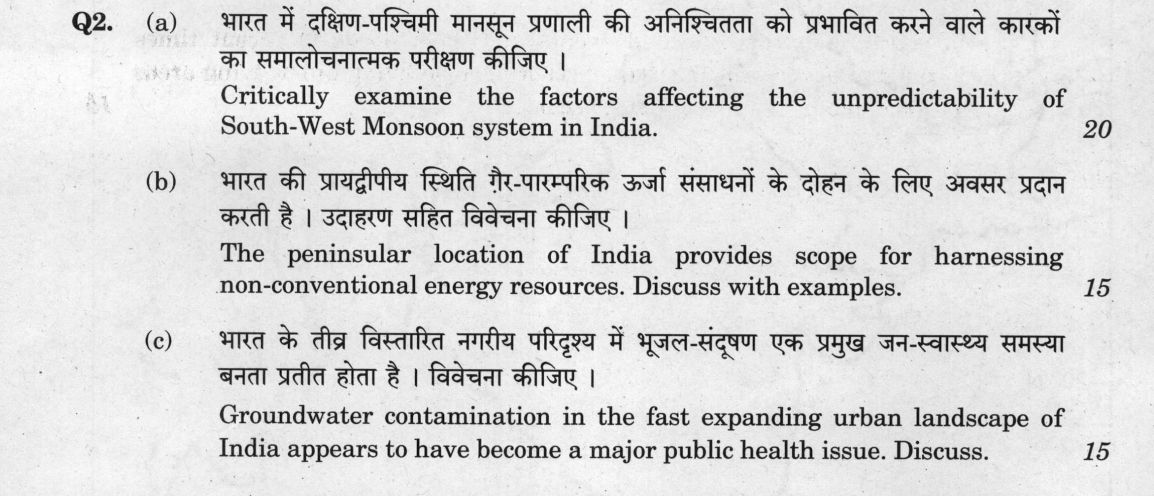
(a) Critically examine the factors affecting the unpredictability of South-West Monsoon system in India. 20 (b) The peninsular…
Critically examine the factors affecting the unpredictability of South-West Monsoon system in India. 20 marks
The peninsular location of India provides scope for harnessing non-conventional energy resources. Discuss with examples. 15 marks
Groundwater contamination in the fast expanding urban landscape of India appears to have become a major public health issue. Discuss. 15 marks
हिंदी में प्रश्न पढ़ें
भारत में दक्षिण-पश्चिमी मानसून प्रणाली की अनिश्चितता को प्रभावित करने वाले कारकों का समालोचनात्मक परीक्षण कीजिए । 20
भारत की प्रायद्वीपीय स्थिति गैर-पारंपरिक ऊर्जा संसाधनों के दोहन के लिए अवसर प्रदान करती है । उदाहरण सहित विवेचना कीजिए । 15
भारत के तीव्र विस्तारित नगरीय परिदृश्य में भूजल-संदूषण एक प्रमुख जन-स्वास्थ्य समस्या बनता प्रतीत होता है । विवेचना कीजिए । 15
Model answer
Written by UPSC Answer Check against this question's marking rubric, to the expected length. UPSC does not publish answers for Mains — this is one way to score well, not an official key.
Unpredictability of the South-West Monsoon System
The South-West Monsoon operates as a complex thermodynamic engine driven by coupled planetary teleconnections and regional land-atmosphere dynamics. Ocean-atmosphere interactions like the El Niño-Southern Oscillation (ENSO) significantly dictate monsoonal behaviour; El Niño generally suppresses precipitation by weakening the Walker circulation, while La Niña enhances it. However, this relationship is non-linear, as a positive Indian Ocean Dipole (IOD) often offsets El Niño-induced deficits. The Madden-Julian Oscillation (MJO) further introduces intra-seasonal unpredictability, triggering active or prolonged break spells depending on its phase over the Indian Ocean. Regionally, the sensible heating of the Tibetan Plateau, the timely northward retreat of the Subtropical Westerly Jet, the development of the Tropical Easterly Jet, and the land-sea thermal contrast govern the onset, spatial progression, and withdrawal.
Critically, anthropogenic forcing has intensified these uncertainties. High atmospheric aerosol loading and black carbon alter cloud microphysics and radiative balances, while rapid land-use changes and Urban Heat Islands (UHIs) induce erratic, high-intensity localized convective storms. Consequently, traditional statistical frameworks and high-resolution dynamical models (like IMD's Coupled Forecast System) face persistent challenges in simulating meso-scale cloud processes and multi-scale ocean interactions. Monsoon unpredictability has thus shifted from being a purely natural oscillation to an anthropogenically amplified, non-linear risk, necessitating sub-seasonal-to-seasonal ensemble forecasting.
Peninsular Location and Non-Conventional Energy Resources
India’s peninsular orientation and tropical location provide an exceptional geographical foundation for renewable energy deployment.
A coastline exceeding 7,500 km facilitates substantial onshore and offshore wind energy generation, concentrated along high-velocity corridors in Tamil Nadu (e.g., Muppandal) and Gujarat. Marine energy resources remain viable in the macro-tidal regimes of the Gulf of Khambhat and Gulf of Kutch, alongside wave energy potential along the south-western littoral.
Solar insolation exceeds 5 to 7 kWh/m²/day across the peninsular plateau and adjacent semi-arid tracts of Gujarat, Rajasthan, and the high-altitude cold desert of Ladakh. Peninsular agriculture supports substantial biomass energy via agro-industrial residues like sugarcane bagasse in Maharashtra and Karnataka. Geothermal prospects exist along structural rifts such as the Damodar-Son valley, the Godavari graben, and the thermal springs of the Western Ghats. These resources collectively drive decentralized energy systems, powering rural micro-grids and advancing industrial decarbonization.
Urban Groundwater Contamination and Public Health
Unregulated urban sprawl has severely degraded groundwater quality through anthropogenic loading and over-abstraction-induced geogenic leaching. Inadequate sewerage networks cause extensive septic tank leakage, while unlined landfills generate toxic leachate that infiltrates unconfined aquifers. Industrial effluents and urban surface runoff significantly elevate nitrate, phosphate, and heavy metal concentrations. Simultaneously, over-extraction alters local hydrogeology, mobilizing geogenic contaminants such as arsenic in the urban belts of the Ganga-Brahmaputra plains and fluoride in peninsular cities like Bengaluru and Hyderabad.
The resulting public health burden is acute. Elevated nitrate levels cause methaemoglobinemia (blue baby syndrome) in infants, while prolonged exposure to geogenic toxins leads to debilitating skeletal fluorosis, arsenicosis, and long-term carcinogenic risks.
Addressing this crisis requires stringent aquifer protection via the Atal Mission for Rejuvenation and Urban Transformation (AMRUT), expanding safe piped drinking water under the Jal Jeevan Mission (Urban), and deploying micro-level hydrogeological interventions using the Central Ground Water Board's National Aquifer Mapping Programme (NAQUIM).
What "Critically examine" is asking you to do
Test the proposition the question puts to you and return a finding on how far it holds. Examine stems carry a claim, or ask whether something has happened, and expect evidence weighed both ways before the extent is stated — often with remedial measures attached. “Critically” is not a section added at the end: name the yardstick you are judging by — the evidence, the stated objective, a constitutional principle, a rival explanation — and let a verdict close each part of the body. Where the question quotes a claim, that verdict must land on the claim itself, accepted, qualified or rejected, and not on the theme in general.
Structure that answers it
Restate the claim as the question frames it → evidence that supports it → evidence that undercuts it → the conditions under which it holds → verdict on how far it stands
Where marks are lost
Merits in one paragraph, demerits in the next, and a conclusion calling for a balanced and holistic approach. That is a survey with the judgement left out and it holds the answer in the middle band. The opposite error is reading “critically” as permission to attack — and with the odd pairings, critically describe or critically explain, the exposition still carries most of the marks, the judgement being a layer on it rather than a substitute for it.
How this answer will be evaluated
Approach
Framework: Concept or mechanism > Diagram > Regional example > Application. (a) examine: intro > how/why with reasoning > evidence > conclusion | (b) discuss: intro > 3-4 dimensions > example > balanced close | (c) discuss: intro > 3-4 dimensions > example > balanced close Full marks: Precise mechanisms, specific Indian examples, clear diagrams, strong causal links.
Key points expected
- Mechanism of ITCZ and pressure gradient
- Role of El Niño/La Niña (ENSO)
- Impact of Indian Ocean Dipole (IOD)
- Influence of Western Disturbances
- Solar energy potential (high insolation)
- Wind energy (coastal/peninsular winds)
- Tidal energy (coastal geography)
- Geothermal potential (plate tectonics)
Evaluation rubric
Each sub-part is marked on its own, against the marks and word limit printed on the paper.
- (a) Critical analysis of factors causing unpredictability of South-West Monsoon. 20 marks
examine— intro → how/why with reasoning → evidence → conclusion
Must cover
- Mechanism of ITCZ and pressure gradient
- Role of El Niño/La Niña (ENSO)
- Impact of Indian Ocean Dipole (IOD)
- Influence of Western Disturbances
Loses marks
- Describing monsoon without explaining unpredictability
- Ignoring oceanic factors (ENSO/IOD)
- No causal link between factors and rainfall
Earns more
- Mention of MJO (Madden-Julian Oscillation)
- Reference to global warming effects
- Explanation of 'breaks' in monsoon
- Sketch of monsoon flow patterns
Extra mark
- Citing IMD data on rainfall variability
- Reference to specific failed monsoon years
- (b) Discussion on how peninsular location aids non-conventional energy. 15 marks
discuss— intro → 3-4 dimensions → example → balanced close
Must cover
- Solar energy potential (high insolation)
- Wind energy (coastal/peninsular winds)
- Tidal energy (coastal geography)
- Geothermal potential (plate tectonics)
Loses marks
- Listing energy types without location link
- Ignoring the 'peninsular' aspect
- No specific Indian examples
Earns more
- Specific examples: Ghatkopar, Muppandal
- Mention of biomass in peninsular states
- Reference to specific wind corridors
- Map showing energy zones
Extra mark
- Citing specific capacity figures (MW)
- Reference to specific government schemes
- (c) Discussion on groundwater contamination as a public health issue. 15 marks
discuss— intro → 3-4 dimensions → example → balanced close
Must cover
- Sources: industrial effluents, sewage
- Sources: agricultural chemicals (nitrates)
- Health impacts: cancer, kidney failure
- Urban expansion role: over-extraction
Loses marks
- General talk on water pollution
- Ignoring the 'urban' context
- No link to public health consequences
Earns more
- Mention of specific pollutants (arsenic, fluoride)
- Reference to specific cities (Delhi, Chennai)
- Discussion of 'mining' of groundwater
- Link to water table decline
Extra mark
- Citing specific health statistics
- Reference to specific court orders
Practice this exact question
Write your answer and it is marked point by point against the model answer above — what you covered, what you missed, what you got wrong.
Evaluate my answer →More from Geography 2022 Paper II
- Q1 On the outline map of India provided to you, mark the location of all of the following. W…
- Q2 (a) Critically examine the factors affecting the unpredictability of South-West Monsoon s…
- Q3 (a) Discuss the recent changes brought about in institutional frameworks of agriculture i…
- Q4 (a) India is bestowed with rich mineral resources due to its geological structure. Correl…
- Q5 Answer the following questions in about 150 words each : 10×5=50 (a) Discuss the impact o…