Paper II — Q6
(a) Why do disparities in development and incomes between regions persist in large countries like India ? How does the recent ADP…
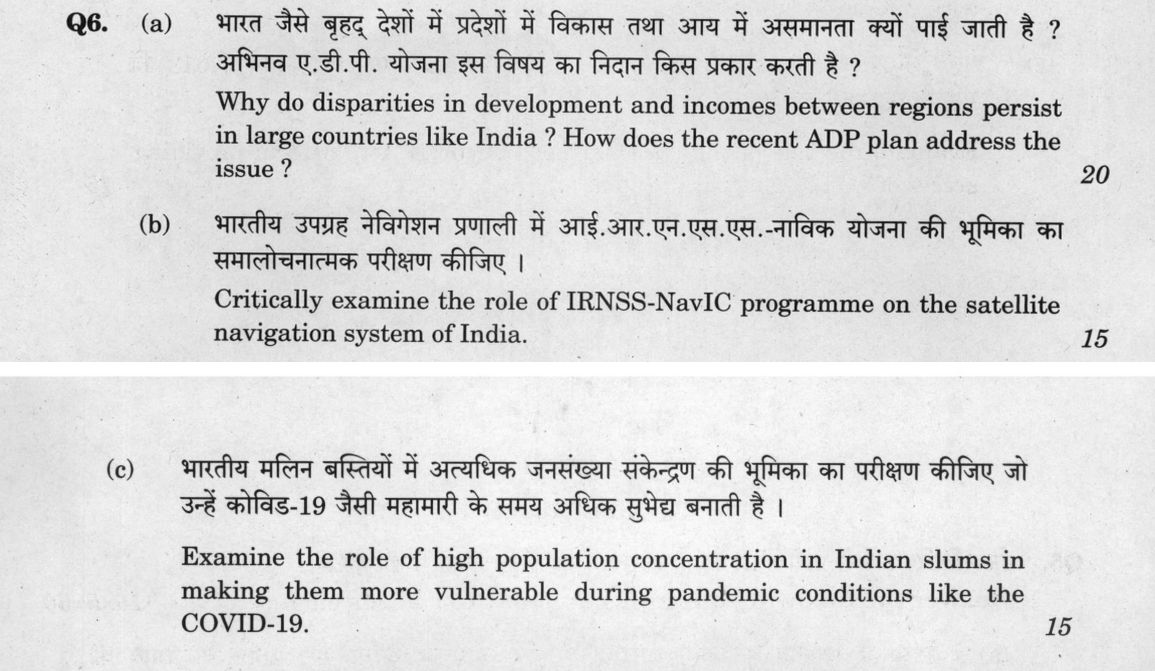
Why do disparities in development and incomes between regions persist in large countries like India ? How does the recent ADP plan address the issue ? 20 marks
Critically examine the role of IRNSS-NavIC programme on the satellite navigation system of India. 15 marks
Examine the role of high population concentration in Indian slums in making them more vulnerable during pandemic conditions like the COVID-19. 15 marks
हिंदी में प्रश्न पढ़ें
भारत जैसे बृहद् देशों में प्रदेशों में विकास तथा आय में असमानता क्यों पाई जाती है ? अभिनव ए.डी.पी. योजना इस विषय का निदान किस प्रकार करती है ? 20 marks
भारतीय उपग्रह नेविगेशन प्रणाली में आई.आर.एन.एस.एस.-नाविक योजना की भूमिका का समालोचनात्मक परीक्षण कीजिए । 15
भारतीय मलिन बस्तियों में अत्यधिक जनसंख्या संकेन्द्रण की भूमिका का परीक्षण कीजिए जो उन्हें कोविड-19 जैसी महामारी के समय अधिक सुभेद्य बनाती है। 15
Model answer
Written by UPSC Answer Check against this question's marking rubric, to the expected length. UPSC does not publish answers for Mains — this is one way to score well, not an official key.
Persistent Regional Disparities and the Aspirational Districts Programme (ADP)
Regional income and development disparities in India stem from colonial path dependency that favored coastal port enclaves over the hinterland, skewed natural resource endowments, and chronic infrastructure deficits. Unfettered market forces have exacerbated these divides through agglomeration economies, where capital and skilled labor polarize in developed clusters—reinforcing Gunnar Myrdal’s backwash effects over spread effects—while structural market failures leave backward regions trapped in low-productivity equilibria.
To overcome these structural imbalances, the ADP was launched in 2018 across 112 underdeveloped districts. Shifting away from input-driven, capital-intensive approaches like the erstwhile Backward Regions Grant Fund (BRGF), the ADP employs a 3Cs framework (Convergence, Collaboration, and Competition). It tracks progress dynamically via monthly delta rankings across 49 Key Performance Indicators spanning five core themes: health and nutrition, education, agriculture and water resources, financial inclusion and skill development, and basic infrastructure.
Critically, while the ADP has fostered administrative agility and targeted local improvements without massive fiscal outlays, its operational model exhibits clear limitations. The reliance on self-reported administrative data introduces data quality and reporting biases. Moreover, the hyper-competitive delta ranking risks incentivizing short-term data optimization over long-term institutional capacity building, undermining inter-district cooperation. Without dedicated structural capital investments comparable to statutory equalization funds, the ADP functions as an effective monitoring mechanism rather than a complete remedy for entrenched regional disparities.
IRNSS-NavIC: Capabilities and Critical Constraints
The Indian Regional Navigation Satellite System (NavIC) provides India with critical spatial autonomy, eliminating vulnerability to denial-of-service risks from foreign constellations like the US GPS, Russian GLONASS, and European Galileo. NavIC operates with a constellation of seven satellites (three geostationary and four geosynchronous) utilizing dual-frequency L5 and S bands to provide two tiers of service: Standard Positioning Service (SPS) for civilians and an encrypted Restricted Service (RS) for strategic defense forces across India and an extended service area of 1,500 km beyond its borders. It underpins key applications in disaster management, marine fisheries navigation (such as potential fishing zone advisories), precision agriculture, and military logistics.
However, NavIC's effectiveness is constrained by its strictly regional coverage, leaving it far behind global multi-constellation systems such as China’s BeiDou. Commercial and civilian adoption has lagged significantly due to delays in mandating compatible multi-band chipsets in entry-level smartphones and commercial telematics. Furthermore, vulnerability of terrestrial ground tracking stations and limited integration with GAGAN (GPS Aided GEO Augmented Navigation) for civil aviation restrict its full potential. NavIC represents a strategic triumph, but its commercial maturity demands aggressive hardware integration and an expanded constellation for global reach.
Slum Morphology and COVID-19 Vulnerability
The spatial morphology and socioeconomic profile of Indian slums acted as an epidemiologic amplifier during the COVID-19 pandemic. Hyper-dense settlements—most notably Dharavi, housing nearly 3,00,000 persons per square kilometer—rendered physical distancing physically impossible. Critical structural deficits, including reliance on shared community water taps and communal public toilets, transformed basic survival activities into high-risk transmission vectors, while narrow, unventilated alleys undermined containment protocols.
Furthermore, lack of land tenure security and formal residential addresses disrupted targeted welfare mapping and ration distribution. High concentration in the informal economy precluded work-from-home possibilities, triggering severe livelihood collapse, acute food insecurity, and massive reverse migration. Compounding this, inadequate localized health infrastructure restricted early diagnostic access. Vulnerabilities were successfully contained only when conventional containment was replaced by targeted decentralized protocols—exemplified by Mumbai’s ‘Chase the Virus’ strategy (aggressive 4T approach: Tracing, Tracking, Testing, and Treating via proactive fever clinics) and Delhi’s decentralized community kitchen model.
Achieving spatial justice and national resilience requires moving beyond ad-hoc crisis containment toward structural slum in-situ upgrading, sovereign technological expansion via NavIC, and institutionalized fiscal equalisation across lagging regions.
What "Critically examine" is asking you to do
Test the proposition the question puts to you and return a finding on how far it holds. Examine stems carry a claim, or ask whether something has happened, and expect evidence weighed both ways before the extent is stated — often with remedial measures attached. “Critically” is not a section added at the end: name the yardstick you are judging by — the evidence, the stated objective, a constitutional principle, a rival explanation — and let a verdict close each part of the body. Where the question quotes a claim, that verdict must land on the claim itself, accepted, qualified or rejected, and not on the theme in general.
Structure that answers it
Restate the claim as the question frames it → evidence that supports it → evidence that undercuts it → the conditions under which it holds → verdict on how far it stands
Where marks are lost
Merits in one paragraph, demerits in the next, and a conclusion calling for a balanced and holistic approach. That is a survey with the judgement left out and it holds the answer in the middle band. The opposite error is reading “critically” as permission to attack — and with the odd pairings, critically describe or critically explain, the exposition still carries most of the marks, the judgement being a layer on it rather than a substitute for it.
How this answer will be evaluated
Approach
Framework: Concept or mechanism > Diagram > Regional example > Application. (a) explain: definition/context > points in order > small example > short close | (b) critically evaluate: positives > negatives/limits > conditions/safeguards > conclusion | (c) examine: intro > how/why with reasoning > evidence > conclusion Full marks: Precise causal chains, specific Indian examples, and clear diagrams.
Key points expected
- Physical/geographic causes of disparity (terrain, climate)
- Economic causes (infrastructure, industrial base)
- ADP's specific mechanism (e.g., 15% allocation, convergence)
- Linkage between ADP and specific regional gap
- Technical role (regional coverage, accuracy)
- Strategic role (sovereignty, defense independence)
- Civilian application (agriculture, disaster management)
- Critical limitation (e.g., regional vs global, cost)
Evaluation rubric
Each sub-part is marked on its own, against the marks and word limit printed on the paper.
- (a) Causal chain for regional disparities and ADP's specific remedial mechanism. 20 marks
explain— definition/context → points in order → small example → short close
Must cover
- Physical/geographic causes of disparity (terrain, climate)
- Economic causes (infrastructure, industrial base)
- ADP's specific mechanism (e.g., 15% allocation, convergence)
- Linkage between ADP and specific regional gap
Loses marks
- Generic description of poverty without regional focus
- ADP described as general welfare, not regional equity
Earns more
- Reference to specific states (e.g., Bihar vs Gujarat)
- Mention of 'convergence' or 'catch-up' growth
- Reference to specific ADP components (e.g., PM Gati Shakti)
Extra mark
- Labelled map showing disparity regions
- Specific statistic on regional income gap
- (b) Assessment of IRNSS-NavIC's role in India's satellite navigation system. 15 marks
critically evaluate— positives → negatives/limits → conditions/safeguards → conclusion
Must cover
- Technical role (regional coverage, accuracy)
- Strategic role (sovereignty, defense independence)
- Civilian application (agriculture, disaster management)
- Critical limitation (e.g., regional vs global, cost)
Loses marks
- Confusing IRNSS with INSAT (weather)
- Vague praise without technical or strategic detail
Earns more
- Comparison with GPS/Galileo
- Mention of specific NavIC satellites (e.g., NVS-01)
- Reference to 'Swayam' (self-reliance)
Extra mark
- Diagram of satellite orbit/coverage
- Specific data on accuracy (e.g., 20m)
- (c) Analysis of how high population density in slums increases pandemic vulnerability. 15 marks
examine— intro → how/why with reasoning → evidence → conclusion
Must cover
- Physical factor: overcrowding/density
- Infrastructure factor: lack of water/sanitation
- Social factor: inability to practice social distancing
- Economic factor: informal work, no leave
Loses marks
- General description of slums without pandemic link
- Ignoring the 'high population concentration' aspect
Earns more
- Reference to specific slum (e.g., Dharavi, Mumbai)
- Mention of 'lockdown' impact on slum dwellers
- Link to 'vulnerability' (health + economic)
Extra mark
- Diagram of slum layout showing density
- Specific statistic on slum population
Practice this exact question
Write your answer and it is marked point by point against the model answer above — what you covered, what you missed, what you got wrong.
Evaluate my answer →More from Geography 2022 Paper II
- Q3 (a) Discuss the recent changes brought about in institutional frameworks of agriculture i…
- Q4 (a) India is bestowed with rich mineral resources due to its geological structure. Correl…
- Q5 Answer the following questions in about 150 words each : 10×5=50 (a) Discuss the impact o…
- Q6 (a) Why do disparities in development and incomes between regions persist in large countr…
- Q7 (a) Discuss the salient characteristics of industrial complexes of Western India. Examine…
- Q8 (a) How do agro-climatic and land capability indicators assist in macro-agricultural regi…