Paper II — Q3
(a) Discuss the recent changes brought about in institutional frameworks of agriculture in India. Evaluate its impact on the…
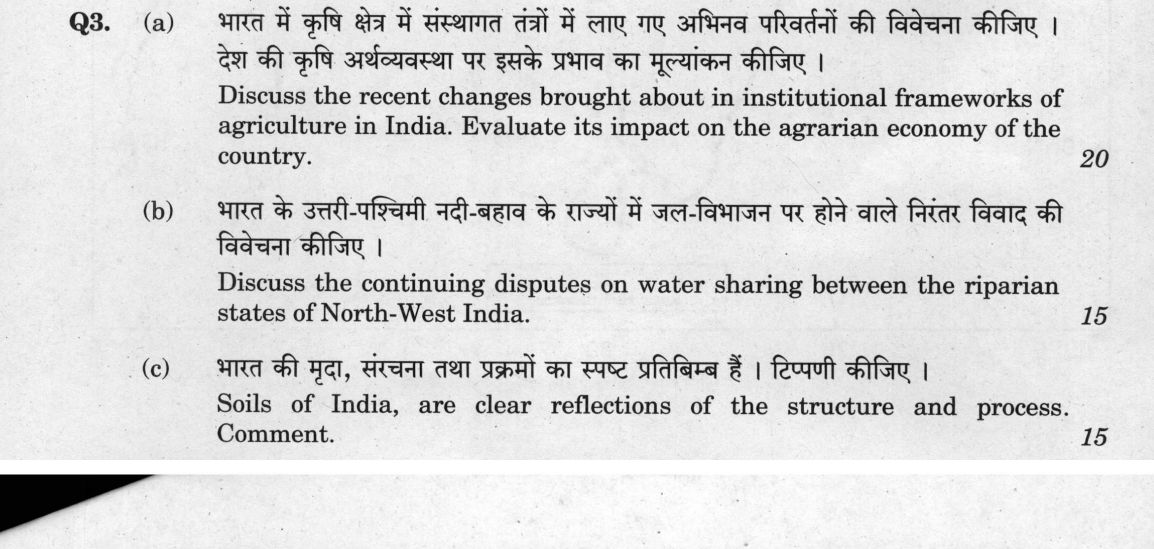
Discuss the recent changes brought about in institutional frameworks of agriculture in India. Evaluate its impact on the agrarian economy of the country. 20 marks
Discuss the continuing disputes on water sharing between the riparian states of North-West India. 15 marks
Soils of India, are clear reflections of the structure and process. Comment. 15 marks
हिंदी में प्रश्न पढ़ें
भारत में कृषि क्षेत्र में संस्थागत तंत्रों में लाए गए अभिनव परिवर्तनों की विवेचना कीजिए । देश की कृषि अर्थव्यवस्था पर इसके प्रभाव का मूल्यांकन कीजिए । 20
भारत के उत्तरी-पश्चिमी नदी-बहाव के राज्यों में जल-विभाजन पर होने वाले निरंतर विवाद की विवेचना कीजिए । 15
भारत की मृदा, संरचना तथा प्रक्रमों का स्पष्ट प्रतिबिंब है । टिप्पणी कीजिए । 15
Model answer
Written by UPSC Answer Check against this question's marking rubric, to the expected length. UPSC does not publish answers for Mains — this is one way to score well, not an official key.
India’s agrarian landscape is shaped by the complex interplay of dynamic policy architectures, competing hydro-federal claims, and underlying geomorphic and pedogenic processes.
Institutional Frameworks in Agriculture and Agrarian Impact
Recent years witnessed decisive institutional shifts aimed at liberalising agricultural markets and modernising supply chains. Key interventions include the promotion of 10,000 Farmer Producer Organisations (FPOs), nationwide integration of mandis through the electronic National Agriculture Market (e-NAM), direct income support via PM-KISAN, and institutional guidelines under the Model Contract Farming Act, 2018. Although the three farm laws of 2020 were repealed following protracted protests, they catalysed state-level marketing reforms and highlighted the demand for a statutory Minimum Support Price (MSP).
Evaluating these changes against the dual standards of economic efficiency and socio-spatial equity reveals mixed outcomes. On efficiency, digital platforms like e-NAM and aggregation via FPOs have marginally reduced intermediary margins and improved price discovery. However, private infrastructure investment remains sluggish, and contract farming arrangements often manifest power asymmetries against smallholders. On equity, market integration has inadvertently driven informalization, as formal APMC protections weaken without robust alternatives. Non-institutional debt cycles persist among small and marginal farmers who comprise 86% of holdings. Furthermore, regional disparities have deepened: while the Green Revolution belt of Punjab and Haryana resisted deregulation to protect public procurement, subsistence-dominated agrarian economies in Eastern and North-Eastern India continue to suffer from underdeveloped marketing infrastructure and negligible institutional procurement. Thus, while policy reforms have modernised transaction architectures, they have yet to deliver comprehensive income security or regional parity.
Riparian Water Disputes in North-West India
Water sharing disputes among the riparian states of Punjab, Haryana, and Rajasthan remain protracted due to conflicting legal claims, electoral politics, and ecological stress. The focal flashpoint is the Sutlej-Yamuna Link (SYL) canal, designed to operationalize the 1981 allocation of surplus Ravi-Beas waters. Punjab asserts the riparian principle, citing dynamic hydrological changes, acute groundwater depletion, and declining river discharges to justify its 2004 Termination of Agreements Act. Conversely, non-riparian Haryana and Rajasthan argue on prior appropriation principles and equitable apportionment, relying on Supreme Court decrees that mandate the completion of the SYL canal.
These frictions are aggravated by limitations of the Interstate River Water Disputes Act, 1956, where tribunal awards like the Eradi Tribunal (1986) remain contested. Geopolitically, internal disputes intersect with the Indus Waters Treaty, as domestic delays hinder optimal utilization of eastern river allocations. The federal dimension exposes a constitutional tension: water is a State subject under Entry 17 (List II), yet subject to Union regulation of inter-state rivers under Entry 56 (List I). Climate-induced scarcity, receding Himalayan glaciers, and erratic monsoons have intensified this zero-sum conflict across the basin.
Soils as Reflections of Structure and Process
Indian soils distinctly manifest the Davisian paradigm of structure (lithology) and process (pedogenesis acting over time).
Structure governs mineral composition and parent material. The peninsular Black Cotton Soils (Regur) directly reflect their Deccan Trap basaltic structure, rich in montmorillonite clay, iron, and calcium. The extensive Alluvial Soils mirror the depositional structural sink of the Indo-Gangetic foreland basin, filled with Himalayan sediments. Laterite soils correlate with elevated, crystalline gneissic surfaces and basaltic capping on the Western Ghats and Chota Nagpur plateau, where stable structural relief allows advanced desilication.
Pedogenic processes determine soil maturity and profiles across climato-vegetational regimes. Zonal soils illustrate climatic dominance: the Aridisols of Rajasthan display calcification and mechanical weathering under hyper-arid conditions, while mountain Podzols reflect mor-humus leaching under humid temperate forests. Azonal soils, such as Khadar (recent riverine alluvium) and glacial scree, demonstrate the dominance of continuous erosional and depositional processes that prevent horizon differentiation. Intrazonal soils, such as the saline-alkali soils (Usar/Kallar) of canal-irrigated tracts in Haryana and Uttar Pradesh, illustrate local process anomalies driven by capillary action and impeded drainage.
India’s agrarian viability hinges on resolving these structural vulnerabilities. Sustainable growth requires balancing market-oriented institutional frameworks with statutory safety nets, transitioning hydro-politics from litigious tribunal mechanisms to basin-wide cooperative management, and aligning cropping patterns with regional pedogenic capabilities.
What "Evaluate" is asking you to do
Judge how well something has performed against the standard it set for itself — its stated aim, mandate or promise — and commit to a verdict. Name the yardstick before you judge; an unanchored judgement reads as opinion.
Structure that answers it
Name the yardstick — stated aim, mandate or benchmark → performance against it → shortfall against it → why the gap exists → verdict
Where marks are lost
Presenting both sides and then declining to decide, or delivering a verdict against a standard you never stated, which makes it look arbitrary.
How this answer will be evaluated
Approach
Framework: Concept or mechanism > Diagram > Regional example > Application. (a) discuss: intro > 3-4 dimensions > example > balanced close | (b) discuss: intro > 3-4 dimensions > example > balanced close | (c) comment: context > arguments both sides > judgment > close Full marks: Precise mechanisms, named examples, balanced evaluation, clear diagrams
Key points expected
- Name specific institutional changes (e.g., e-NAM, PM-KISAN)
- Explain mechanism of changes (e.g., digital market linkage)
- Evaluate impact on agrarian economy (e.g., market access)
- Balanced close on structural vs. operational impact
- Identify specific rivers (Indus, Ravi, Sutlej, Beas)
- Name the riparian states involved (Punjab, Haryana, Rajasthan)
- Explain the nature of disputes (allocation, usage, pollution)
- Mention the role of Inter-State Water Disputes Act
Evaluation rubric
Each sub-part is marked on its own, against the marks and word limit printed on the paper.
- (a) Intro > 3-4 dimensions of institutional change > example > balanced close 20 marks
discuss— intro → 3-4 dimensions → example → balanced close
Must cover
- Name specific institutional changes (e.g., e-NAM, PM-KISAN)
- Explain mechanism of changes (e.g., digital market linkage)
- Evaluate impact on agrarian economy (e.g., market access)
- Balanced close on structural vs. operational impact
Loses marks
- Listing changes without explaining mechanism
- Ignoring the 'evaluate' aspect (impact analysis)
Earns more
- Reference to specific Acts (e.g., 2020 Farm Acts)
- Data on market integration or MSP coverage
- Link to supply chain efficiency
- Mention of FPOs or credit linkages
Extra mark
- Labelled sketch of e-NAM architecture
- Recent data on MSP outlay or FPO count
- (b) Intro > 3-4 dimensions of disputes > example > balanced close 15 marks
discuss— intro → 3-4 dimensions → example → balanced close
Must cover
- Identify specific rivers (Indus, Ravi, Sutlej, Beas)
- Name the riparian states involved (Punjab, Haryana, Rajasthan)
- Explain the nature of disputes (allocation, usage, pollution)
- Mention the role of Inter-State Water Disputes Act
Loses marks
- General discussion without naming specific rivers/states
- Ignoring the 'continuing' aspect (current status)
Earns more
- Reference to specific tribunals (e.g., Ravi-Beas Tribunal)
- Mention of specific projects (e.g., Sutlej-Yamuna Link)
- Link to agricultural water demand
- Mention of environmental flow concerns
Extra mark
- Sketch map of NW river basins
- Specific data on water allocation percentages
- (c) Context > arguments both sides > judgment > close 15 marks
comment— context → arguments both sides → judgment → close
Must cover
- Define 'structure' (parent material, climate, relief)
- Define 'process' (weathering, leaching, accumulation)
- Link specific Indian soils to these factors (e.g., Alluvial)
- Judgment on the validity of the statement
Loses marks
- Listing soil types without linking to structure/process
- Ignoring the 'comment' aspect (judgment)
Earns more
- Example of Red Soils (laterization process)
- Example of Black Soils (basalt structure)
- Mention of soil profile horizons
- Reference to pedogenic processes
Extra mark
- Soil profile diagram with horizons
- Specific data on soil distribution in India
Practice this exact question
Write your answer and it is marked point by point against the model answer above — what you covered, what you missed, what you got wrong.
Evaluate my answer →More from Geography 2022 Paper II
- Q1 On the outline map of India provided to you, mark the location of all of the following. W…
- Q2 (a) Critically examine the factors affecting the unpredictability of South-West Monsoon s…
- Q3 (a) Discuss the recent changes brought about in institutional frameworks of agriculture i…
- Q4 (a) India is bestowed with rich mineral resources due to its geological structure. Correl…
- Q5 Answer the following questions in about 150 words each : 10×5=50 (a) Discuss the impact o…
- Q6 (a) Why do disparities in development and incomes between regions persist in large countr…