Paper II — Q7
(a) Discuss the salient characteristics of industrial complexes of Western India. Examine the impact of SEZ policy on the region…
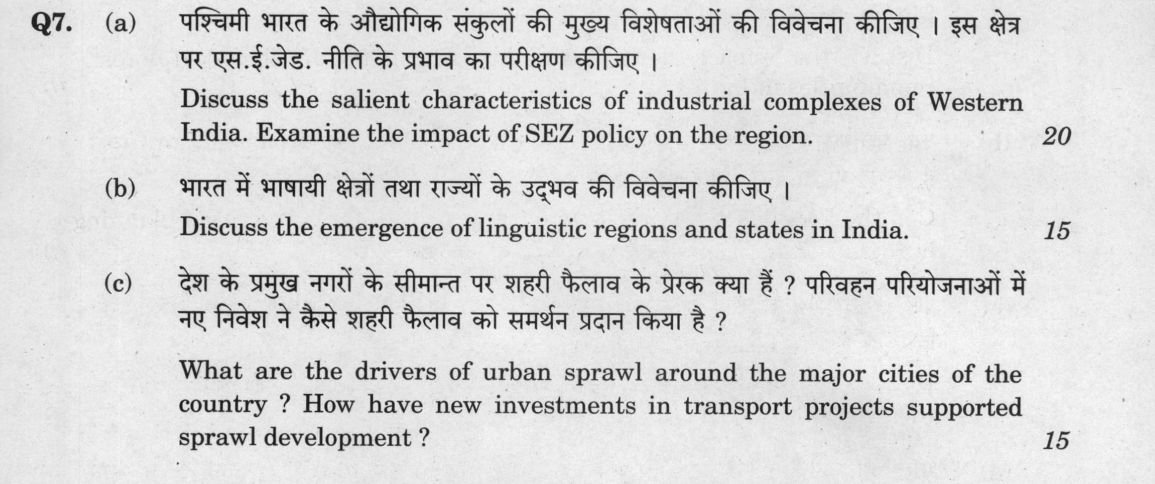
Discuss the salient characteristics of industrial complexes of Western India. Examine the impact of SEZ policy on the region. 20 marks
Discuss the emergence of linguistic regions and states in India. 15 marks
What are the drivers of urban sprawl around the major cities of the country ? How have new investments in transport projects supported sprawl development ? 15 marks
हिंदी में प्रश्न पढ़ें
पश्चिमी भारत के औद्योगिक संकुलों की मुख्य विशेषताओं की विवेचना कीजिए। इस क्षेत्र पर एस.ई.जेड. नीति के प्रभाव का परीक्षण कीजिए। 20
भारत में भाषायी क्षेत्रों तथा राज्यों के उद्भव की विवेचना कीजिए। 15
देश के प्रमुख नगरों के सीमांत पर शहरी फैलाव के प्रेरक क्या हैं ? परिवहन परियोजनाओं में नए निवेश ने कैसे शहरी फैलाव को समर्थन प्रदान किया है ? 15 marks
Model answer
Written by UPSC Answer Check against this question's marking rubric, to the expected length. UPSC does not publish answers for Mains — this is one way to score well, not an official key.
India’s economic geography reflects a continuous interplay between coastal industrial clustering, political-administrative reorganization, and rapid peri-urban spatial transformations.
Industrial Complexes of Western India and the SEZ Impact
Western India (Gujarat and Maharashtra) constitutes the country's pre-eminent industrial corridor. Its primary characteristics include a dominant petrochemical and refining nexus along the Hazira-Dahej-Jamnagar belt, leveraging deep-water port proximity (Kandla, JNPT, Mundra) for imported crude and bulk chemical feedstock. Traditional industrial inertia persists through the historical cotton textile clusters of Ahmedabad and Surat, alongside specialized diamond cutting and polishing in Surat. Over recent decades, the region has transitioned from conventional manufacturing into high-technology segments, including active pharmaceutical ingredients (API), specialty chemicals, precision engineering, and automotive clusters (Sanand, Pune-Chakan).
The enactment of the Special Economic Zones (SEZ) Act of 2005 transformed this landscape. Coastal SEZs, notably Mundra and Kandla, drove large-scale private capital formation, boosted merchandise exports, and integrated local production into global value chains. Unlike pre-SEZ industrial growth, which often relied on inland, state-developed industrial development corporation estates, the post-2005 model created hyper-integrated, privately managed coastal mega-enclaves. However, this generated severe externalities: contentious agricultural and pastoral land acquisition, severe coastal and marine ecological degradation (such as the loss of mangrove ecosystems in the Gulf of Kutch), and acute infrastructure stress on surrounding municipal nodes lacking commensurate civic capacity.
Emergence and Dynamics of Linguistic States
Linguistic regionalism originated as an anti-colonial mobilization strategy, formalized in the 1920 Nagpur Session of the Indian National Congress through Linguistic Provincial Committees. Post-independence administrative anxieties over national unity led the Dhar Commission (1948) and the JVP Committee to caution against linguistic remapping. However, the martyrdom of Potti Sriramulu forced the creation of Andhra State (1953), precipitating the Fazal Ali Commission and the subsequent States Reorganisation Act of 1956. This established language as the primary basis of state boundaries, later leading to the bifurcation of Bombay State (1960) and Punjab (1966).
While linguistic reorganization enhanced administrative efficiency, deepened democratic participation, and stabilized the federal compact by aligning vernacular languages with provincial governance, it did not eliminate intra-state developmental inequalities. Over time, persistent economic neglect within linguistically unified territories spurred second-generation statehood demands rooted in developmental backwardness rather than language. This culminated in the creation of Chhattisgarh, Jharkhand, and Uttarakhand in 2000, and the bifurcation of Andhra Pradesh to form Telangana in 2014, while regional autonomy demands such as Vidarbha and Gorkhaland continue to test the federal framework.
Drivers of Urban Sprawl and Transport-Led Expansion
Urban sprawl across major metropolitan regions (Delhi NCR, Mumbai, Bengaluru, Hyderabad) is driven by steep land price gradients between city cores and peripheries, chronic shortages of affordable urban housing, speculative real estate investment, and unabated rural-to-urban migration. Furthermore, weak master plan enforcement and the outward relocation of land-intensive or polluting industries due to inner-city zoning restrictions have accelerated fragmented, leapfrog development across peri-urban fringes.
Large-scale transport investments have actively enabled this spatial dispersion. Peripheral expressways (Mumbai-Pune Expressway, Hyderabad Outer Ring Road), orbital ring roads, and rapid transit networks (Delhi NCR Metro and RRTS corridors, Bengaluru Namma Metro extensions) drastically compress travel times. While intended to decongest urban cores, these corridors convert distant agrarian hinterlands into viable commuter zones. In the absence of integrated land-use planning, transport investments inadvertently stimulate low-density, automobile-dependent ribbon developments that outpace basic municipal infrastructure like piped water and sewage networks.
Way Forward
Sustaining India’s spatial and economic growth requires institutionalizing polycentric regional planning. Coastal industrialization must be balanced with strict Coastal Regulation Zone (CRZ) compliance; sub-regional economic disparities within states require targeted fiscal devolution; and metropolitan sprawl must be managed through Transit-Oriented Development (TOD) frameworks that synchronize transport corridors with dense, affordable peri-urban housing.
What "Discuss" is asking you to do
Lay the issue out from more than one side — how it arose, what is claimed for it, what is held against it, and where it now stands. UPSC attaches discuss to broad topics with several live dimensions, so coverage of the dimensions earns more than the strength of your opinion.
Structure that answers it
Set the issue up → the case as it is made → the case against → the dimension both sides leave out → where the balance now lies
Where marks are lost
Listing facts with no thread between them, or arguing one side throughout and calling it a discussion.
How this answer will be evaluated
Approach
Framework: Concept or mechanism > Diagram > Regional example > Application. (a) discuss: intro > 3-4 dimensions > example > balanced close | (b) discuss: intro > 3-4 dimensions > example > balanced close | (c) explain: definition/context > points in order > small example > short close Full marks: Comprehensive, specific, well-structured, with diagrams and data.
Key points expected
- Identify specific complexes (e.g., Mumbai, Ahmedabad, Bhavnagar)
- Explain SEZ policy mechanism (tax holidays, infrastructure)
- Link physical geography to industrial location
- Provide balanced assessment of SEZ impact
- Explain the process of linguistic reorganization
- Identify key linguistic regions (e.g., Hindi, Dravidian)
- Link linguistic identity to political demands
- Provide specific examples of state formation
Evaluation rubric
Each sub-part is marked on its own, against the marks and word limit printed on the paper.
- (a) Characteristics of Western India industrial complexes and SEZ impact. 20 marks
discuss— intro → 3-4 dimensions → example → balanced close
Must cover
- Identify specific complexes (e.g., Mumbai, Ahmedabad, Bhavnagar)
- Explain SEZ policy mechanism (tax holidays, infrastructure)
- Link physical geography to industrial location
- Provide balanced assessment of SEZ impact
Loses marks
- Generic description without specific complexes
- No link between SEZ policy and regional impact
- No diagram or map
Earns more
- Mention specific SEZs (e.g., Dholera, Mundra)
- Reference specific industries (textiles, petrochemicals)
- Discuss infrastructure development (ports, highways)
- Mention employment generation or land acquisition issues
Extra mark
- Labelled sketch map of Western India complexes
- Specific data on SEZ investment or employment
- (b) Emergence of linguistic regions and states in India. 15 marks
discuss— intro → 3-4 dimensions → example → balanced close
Must cover
- Explain the process of linguistic reorganization
- Identify key linguistic regions (e.g., Hindi, Dravidian)
- Link linguistic identity to political demands
- Provide specific examples of state formation
Loses marks
- No specific examples of linguistic states
- No link between language and political identity
- No diagram or map
Earns more
- Mention specific states (e.g., Andhra Pradesh, Telangana)
- Reference the States Reorganisation Act, 1956
- Discuss the role of language in national integration
- Mention specific linguistic movements or agitations
Extra mark
- Map showing linguistic regions and state boundaries
- Specific data on linguistic demographics
- (c) Drivers of urban sprawl and role of transport investments. 15 marks
explain— definition/context → points in order → small example → short close
Must cover
- Identify drivers of urban sprawl (e.g., population growth, land prices)
- Explain how transport projects support sprawl
- Link physical infrastructure to urban development
- Provide specific examples of transport projects
Loses marks
- No specific examples of transport projects
- No link between transport and urban sprawl
- No diagram or map
Earns more
- Mention specific cities (e.g., Delhi, Mumbai, Bangalore)
- Reference specific transport projects (e.g., metro, highways)
- Discuss the impact on land use and urban planning
- Mention specific data on urban growth or transport investment
Extra mark
- Diagram showing urban sprawl and transport links
- Specific data on urban population growth or transport investment
Practice this exact question
Write your answer and it is marked point by point against the model answer above — what you covered, what you missed, what you got wrong.
Evaluate my answer →More from Geography 2022 Paper II
- Q4 (a) India is bestowed with rich mineral resources due to its geological structure. Correl…
- Q5 Answer the following questions in about 150 words each : 10×5=50 (a) Discuss the impact o…
- Q6 (a) Why do disparities in development and incomes between regions persist in large countr…
- Q7 (a) Discuss the salient characteristics of industrial complexes of Western India. Examine…
- Q8 (a) How do agro-climatic and land capability indicators assist in macro-agricultural regi…