Paper II — Q8
(a) How do agro-climatic and land capability indicators assist in macro-agricultural regionalisation of India ? Illustrate with…
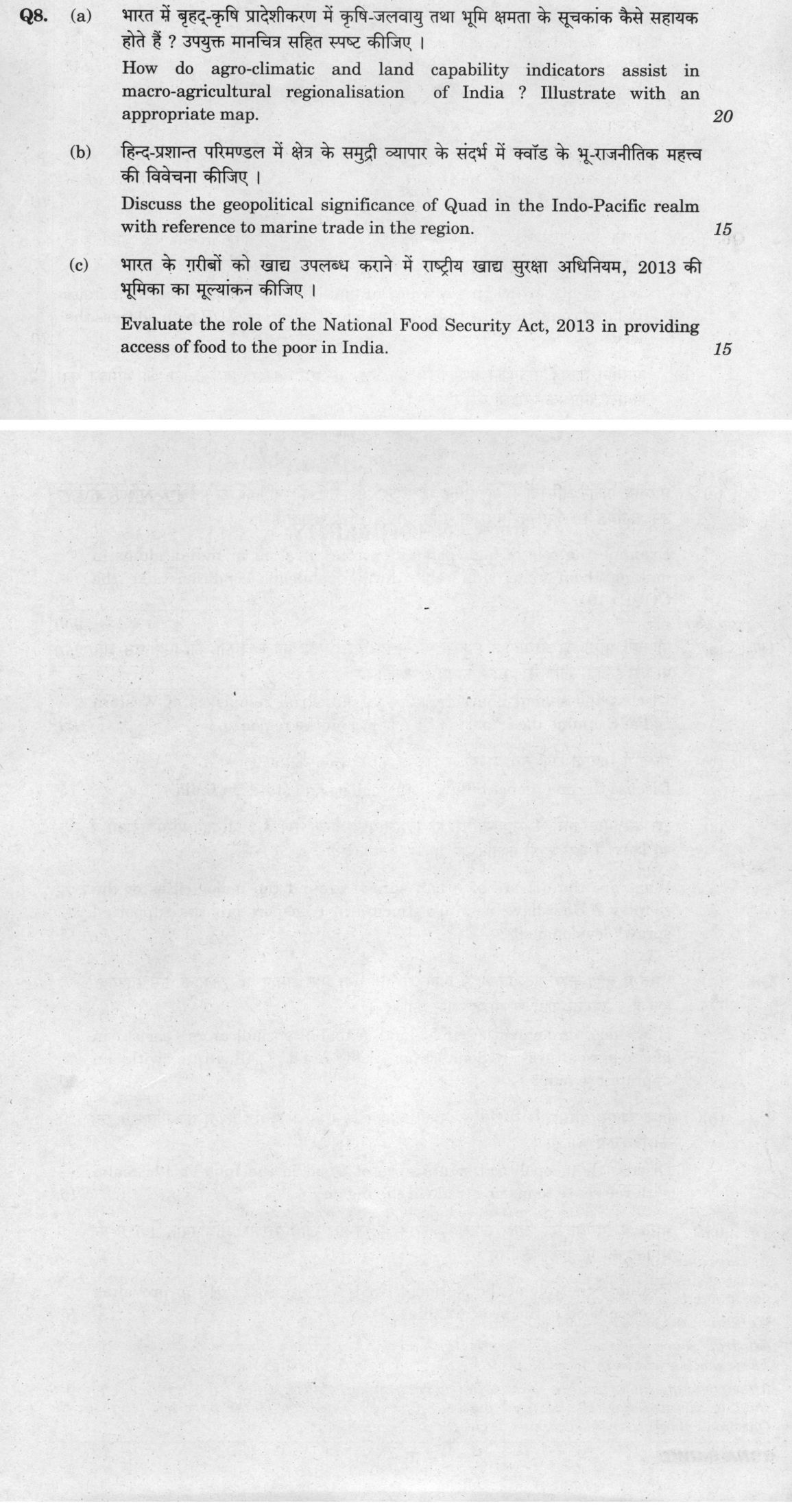
How do agro-climatic and land capability indicators assist in macro-agricultural regionalisation of India ? Illustrate with an appropriate map. 20 marks
Discuss the geopolitical significance of Quad in the Indo-Pacific realm with reference to marine trade in the region. 15 marks
Evaluate the role of the National Food Security Act, 2013 in providing access of food to the poor in India. 15 marks
हिंदी में प्रश्न पढ़ें
भारत में बृहद्-कृषि प्रादेशीकरण में कृषि-जलवायु तथा भूमि क्षमता के सूचकांक कैसे सहायक होते हैं ? उपयुक्त मानचित्र सहित स्पष्ट कीजिए। 20
हिंद-प्रशांत परिमंडल में क्षेत्र के समुद्री व्यापार के संदर्भ में क्वाड के भू-राजनीतिक महत्व की विवेचना कीजिए। 15
भारत के गरीबों को खाद्य उपलब्ध कराने में राष्ट्रीय खाद्य सुरक्षा अधिनियम, 2013 की भूमिका का मूल्यांकन कीजिए। 15
Model answer
Written by UPSC Answer Check against this question's marking rubric, to the expected length. UPSC does not publish answers for Mains — this is one way to score well, not an official key.
(a) Agro-climatic regionalisation India’s macro-agricultural regionalisation is a spatial ordering of climate, soils and production potential. The Planning Commission’s exercise used Thornthwaite and Trewartha climate classifications, rainfall variability, thermal regimes and length of growing period, together with ICAR land capability classes I–VIII based on soil depth, texture, drainage, slope and erosion status. These indicators were integrated into 15 zones and 73 sub-zones, later refined in ICAR’s 127 agro-climatic zones. They assist planning by matching crops, irrigation, soil conservation, credit and extension to biophysical potential: classes I–III suit intensive cereals, IV–VI need conservation, VII–VIII are mainly forestry or pastoral. Map: on an India outline, label Western Himalayan across J&K, Himachal and Uttarakhand; Eastern Himalayan in Sikkim, Darjeeling and NE; Lower Gangetic across UP and Bihar; Middle Gangetic in WB and Jharkhand; Upper Gangetic in Punjab, Haryana, Delhi and western UP; Trans-Gangetic in Assam, Meghalaya and Tripura; Eastern Plateau in Odisha, Jharkhand and WB; Central Plateau in MP, Chhattisgarh and Maharashtra; Western Plateau in Gujarat, Rajasthan and MP; Southern Plateau in AP, Telangana, Karnataka and TN; Eastern Coastal Plains along Odisha and AP; Western Coastal Plains along Kerala, Karnataka, Goa and Maharashtra; Gujarat Plains in Saurashtra-Kathiawar and Kutch; Western Dry in arid Rajasthan, Gujarat, Haryana and Punjab; Island in Andaman-Nicobar and Lakshadweep. The map shows monsoon gradient, soil and slope constraints, and explains cropping patterns: irrigated wheat-rice in Upper Gangetic, paddy in Eastern Coastal, millets in Western Dry, plantation in Western Coastal and Eastern Himalayan, horticulture in Western Himalayan, rice-soybean in Eastern Plateau, groundnut-cotton-pulses in Southern Plateau.
(b) Quad and marine trade Quad’s significance lies in the maritime geography of the Indo-Pacific, where about 60% of global maritime trade moves through Sea Lines of Communication (SLOCs). India, US, Japan and Australia provide a maritime balancing/containment architecture around chokepoints such as the Malacca Strait, through which roughly 80% of China’s oil imports pass, and the Lombok Strait and Makassar Strait as alternative routes. By enhancing maritime domain awareness, interoperability, disaster response and Quad Plus partnerships, including Indo-Pacific Maritime Domain Awareness (IPMDA) initiatives, the Quad helps secure container traffic, rare-earth supply chains and semiconductor logistics. It also counters China’s String of Pearls and BRI maritime corridor. India’s ports, naval presence and partnerships with ASEAN, Japan and Australia strengthen SLOC security, while Quad Plus with France, South Korea and Vietnam widens maritime connectivity. India’s role is distinctive: it does not conduct group Freedom of Navigation Operations (FONOPs), but supports freedom of navigation principles and individual state operations, while offering a non-aligned, rules-based maritime public good.
(c) NFSA evaluation NFSA 2013 converts food access into a legal entitlement: 5 kg per person per month of rice, wheat or coarse cereals at ₹3, ₹2 and ₹1, covering 75% rural and 50% urban populations, with maternity benefit not less than ₹6,000 and mid-day meals for children aged 6–14. It expanded PDS, made women the primary ration card holder, and through One Nation One Ration Card enabled portability. It has helped reduce extreme hunger, reflected in improved Global Hunger Index scores, and stabilised consumption during price shocks, supported by FCI buffer stocks. Yet evaluation must be critical. Exclusion errors persist due to Aadhaar seeding and BPL data gaps; leakages and diversion, reported in some states at around 40%, weaken targeting; the cereal-centric basket limits nutritional diversity; climate shocks to kharif/rabi production threaten supply; and fiscal burden on states constrains implementation. Thus NFSA is a strong entitlement framework but needs better data, nutrition-sensitive food, supply-chain reform and state fiscal support.
Conclusion: Together, agro-climatic regionalisation, Quad-enabled maritime stability and NFSA’s entitlement logic show that India’s food security depends on spatial planning, secure trade routes and inclusive institutional delivery.
What "Illustrate" is asking you to do
Carry the point with concrete cases rather than assert it, so the examples do the work of proving it. In the technical papers illustrate is often literal — a labelled diagram, a map, a graph — and an answer without the figure has not complied with the instruction.
Structure that answers it
The point stated → example 1 with the feature it demonstrates → example 2 → example 3 or the required diagram → what the set of examples establishes
Where marks are lost
Examples named and then abandoned. A case listed without the sentence showing what it demonstrates is marked as recall of information, not as illustration.
How this answer will be evaluated
Approach
Framework: Concept or mechanism > Diagram > Regional example > Application. (a) explain: definition/context > points in order > small example > short close | (b) discuss: intro > 3-4 dimensions > example > balanced close | (c) evaluate: criteria > evidence > balanced judgment Full marks: Comprehensive, well-structured, with clear mechanisms, diagrams, and specific examples.
Key points expected
- Define agro-climatic and land capability indicators
- Explain the mechanism of regionalisation using these indicators
- Illustrate with an appropriate map of India
- Link physical cause to human consequence
- Define the Quad and its members
- Explain the geopolitical significance in the Indo-Pacific
- Reference marine trade in the region
- Provide a balanced close
Evaluation rubric
Each sub-part is marked on its own, against the marks and word limit printed on the paper.
- (a) Explain how agro-climatic and land capability indicators assist in macro-agricultural regionalisation of India. 20 marks
explain— definition/context → points in order → small example → short close
Must cover
- Define agro-climatic and land capability indicators
- Explain the mechanism of regionalisation using these indicators
- Illustrate with an appropriate map of India
- Link physical cause to human consequence
Loses marks
- Description without mechanism
- Answers with no diagram
- Failure to link physical cause to human consequence
Earns more
- Mention specific agro-climatic zones (e.g., Western Himalayan, Indo-Gangetic)
- Reference specific land capability classes (e.g., Class I, Class II)
- Discuss the role of rainfall, temperature, and soil in regionalisation
- Mention specific crops associated with different regions
Extra mark
- Labelled sketch map of India showing agro-climatic zones
- Reference to specific data or reports (e.g., ICAR, FAO)
- (b) Discuss the geopolitical significance of Quad in the Indo-Pacific realm with reference to marine trade. 15 marks
discuss— intro → 3-4 dimensions → example → balanced close
Must cover
- Define the Quad and its members
- Explain the geopolitical significance in the Indo-Pacific
- Reference marine trade in the region
- Provide a balanced close
Loses marks
- Description without mechanism
- Failure to reference marine trade
- Lack of balanced perspective
Earns more
- Mention specific maritime routes (e.g., Strait of Malacca)
- Discuss the role of Quad in ensuring freedom of navigation
- Reference specific incidents or tensions in the region
- Mention the economic implications of Quad's actions
Extra mark
- Labelled sketch map of the Indo-Pacific region
- Reference to recent Quad summits or joint exercises
- (c) Evaluate the role of the National Food Security Act, 2013 in providing access of food to the poor in India. 15 marks
evaluate— criteria → evidence → balanced judgment
Must cover
- Define the National Food Security Act, 2013
- Explain its role in providing food access
- Provide evidence of its impact
- Offer a balanced judgment
Loses marks
- Description without mechanism
- Failure to provide evidence
- Lack of balanced judgment
Earns more
- Mention specific provisions of the Act (e.g., 75% coverage)
- Reference specific data on food distribution
- Discuss the role of PDS (Public Distribution System)
- Mention challenges in implementation
Extra mark
- Reference to specific government reports or audits
- Mention specific states or regions where the Act has been effective
Practice this exact question
Write your answer and it is marked point by point against the model answer above — what you covered, what you missed, what you got wrong.
Evaluate my answer →More from Geography 2022 Paper II
- Q5 Answer the following questions in about 150 words each : 10×5=50 (a) Discuss the impact o…
- Q6 (a) Why do disparities in development and incomes between regions persist in large countr…
- Q7 (a) Discuss the salient characteristics of industrial complexes of Western India. Examine…
- Q8 (a) How do agro-climatic and land capability indicators assist in macro-agricultural regi…