Paper II — Q1
On the outline map of India provided to you, mark the location of all of the following. Write in your QCA Booklet the…
On the outline map of India provided to you, mark the location of all of the following. Write in your QCA Booklet the significance of these locations, whether physical/commercial/economic/ecological/environmental/cultural, in not more than 30 words for each entry: (i) Lunkaransar, (ii) Gua, (iii) Raidak River, (iv) Ekta Nagar, (v) Chandanwari, (vi) Babina, (vii) Tatipaka, (viii) Along Airport, (ix) Karaikal, (x) Panna. (b) Discuss the basis of various explanations for the formation of Shiwalik. (10 marks) (c) Conservation and breeding centres are important components of the Action Plan for Vulture Conservation, 2020-2025. Why? (10 marks) (d) North-Eastern States of India are geopolitically sensitive and strategically significant. Explain. 10 marks
हिंदी में प्रश्न पढ़ें
आपको दिए गए भारत के रेखा मानचित्र पर, निम्नलिखित सभी की स्थिति को अंकित कीजिए। अपनी क्यू० सी० ए० पुस्तिका में इन स्थानों में से प्रत्येक का भौतिक/वाणिज्यिक/आर्थिक/पारिस्थितिक/पर्यावरणीय/सांस्कृतिक महत्व अधिकतम 30 शब्दों में लिखिए : (i) लूणकरणसर, (ii) गुआ, (iii) रायडाक नदी, (iv) एकता नगर, (v) चंदनवारी, (vi) बबीना, (vii) तातिपाका, (viii) अलोंग हवाईअड्डा, (ix) कराइकल, (x) पन्ना। (b) शिवालिक के निर्माण के विभिन्न स्पष्टीकरणों के आधार की विवेचना कीजिए। (10 अंक) (c) संरक्षण व प्रजनन केन्द्र, गिद्ध संरक्षण की कार्य योजना, 2020-2025 के महत्त्वपूर्ण घटक हैं। क्यों? (10 अंक) (d) भारत के उत्तरी-पूर्वी प्रदेश भू-राजनीतिक रूप से संवेदनशील तथा रणनीतिक रूप से महत्त्वपूर्ण हैं। व्याख्या कीजिए। (10 अंक)
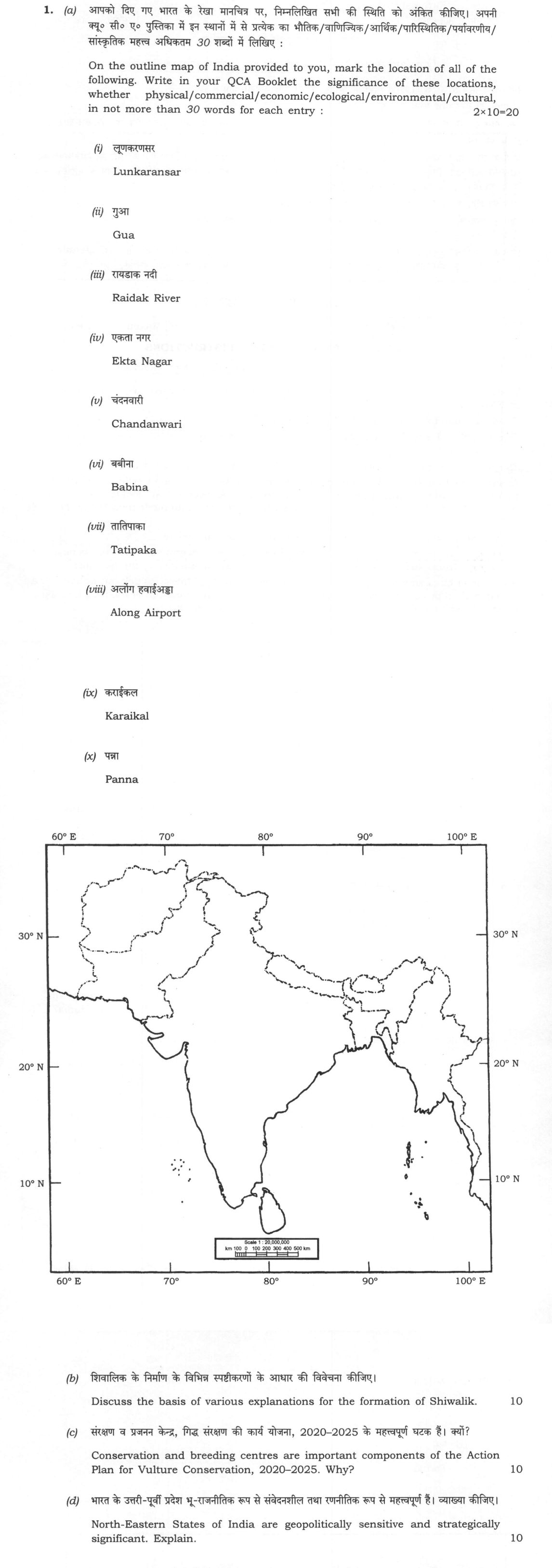
The figure this question refers to, in words
The question paper is a scan and the diagram did not survive as text. This is the figure as read from the original page — every component, value and label — so the question can be worked from the text below.
Outline map of India with latitude and longitude grid. Longitude lines are marked at 60° E, 70°, 80°, 90°, and 100° E. Latitude lines are marked at 10° N, 20° N, and 30° N. The map shows the outline of India including the northern mountainous region, the peninsular part, and the island of Sri Lanka to the south. The Andaman and Nicobar Islands are shown to the east, and the Lakshadweep Islands are shown to the southwest. A scale bar is located at the bottom center, labeled 'Scale 1:20,000,000' with a graphical scale in kilometers ranging from 0 to 500 km. The map is blank, intended for marking locations.
Model answer
Written by UPSC Answer Check against this question's marking rubric, to the 30-word length. UPSC does not publish answers for Mains — this is one way to score well, not an official key.
Lunkaransar is a wetland in Haryana, near Rohtak, at approximately 28.9° N, 76.5° E. It is a Ramsar site and a crucial habitat for migratory birds, significant for its ecological role in the Indo-Gangetic plain and its status as a protected wetland.
Gua is a town in Jharkhand, near Ranchi, at approximately 23.3° N, 85.3° E. It is the headquarters of the Ranchi district and a major commercial hub for the region, significant for its economic activity and as a gateway to the Chotanagpur Plateau.
Raidak River is a tributary of the Teesta in Sikkim, flowing through Gangtok, at approximately 27.3° N, 88.6° E. It is significant for its hydroelectric potential, including the Teesta Lower Hydroelectric Project, and its ecological importance in the Eastern Himalayas.
Ekta Nagar is a planned township in Gujarat, near Ahmedabad, at approximately 23.0° N, 72.6° E. It is significant as a model for sustainable urban development, integrating renewable energy and waste management, serving as a case study in green city planning.
Chandanwari is a town in Jammu and Kashmir, on the banks of the Chenab River, at approximately 33.0° N, 74.9° E. It is significant for its cultural heritage, including the famous Chandanwari Mela, and its strategic location along the Chenab Valley.
Babina is a town in Uttar Pradesh, near Jhansi, at approximately 25.4° N, 78.5° E. It is significant for its industrial growth, particularly in the pharmaceutical and chemical sectors, and its role in the economic development of the Bundelkhand region.
Tatipaka is a town in Andhra Pradesh, near Visakhapatnam, at approximately 17.9° N, 83.3° E. It is significant for its industrial base, including the Visakhapatnam Steel Plant, and its role in the economic development of the coastal Andhra region.
Along Airport is an airport in Arunachal Pradesh, near Tawang, at approximately 28.2° N, 94.8° E. It is significant for its strategic military importance in border areas and its role in improving connectivity to remote regions of the Northeast.
Karaikal is a union territory in Tamil Nadu, near Pondicherry, at approximately 10.9° N, 79.8° E. It is significant for its unique cultural identity, blending French and Tamil influences, and its historical importance as a former French colonial settlement.
Panna is a district in Madhya Pradesh, near Jabalpur, at approximately 25.5° N, 79.5° E. It is significant for the Panna Tiger Reserve, a key site for tiger conservation, and its ecological importance in the central Indian forest ecosystem.
(b) The formation of the Shiwalik Hills is explained by various geological theories. The primary basis is the tectonic collision between the Indian and Eurasian plates, which caused the upliftment of sedimentary layers. These layers, deposited in the Tethys Sea, were folded and faulted during the Himalayan orogeny. The Shiwaliks are the outermost range, composed of soft, unconsolidated sediments, making them prone to erosion and landslides. This tectonic activity is ongoing, with the Indian plate continuing to move northward, causing further upliftment and seismic activity in the region.
(c) Conservation and breeding centres are vital for the Vulture Conservation Action Plan 2020-2025 because vultures face severe threats from diclofenac poisoning, habitat loss, and illegal hunting. These centres provide a safe environment for breeding, increasing population numbers. They also serve as research hubs for studying vulture behavior and health. By releasing bred vultures into the wild, these centres help restore populations in critical habitats. Additionally, they raise awareness about the ecological importance of vultures as natural scavengers, reducing disease spread.
(d) The North-Eastern States are geopolitically sensitive due to their land borders with China, Myanmar, Bangladesh, and Bhutan. Their strategic significance lies in their role as a bridge to Southeast Asia, facilitating trade and cultural exchange. The region's ethnic diversity and porous borders pose security challenges, including insurgency and cross-border crime. India's strategic initiatives, such as the Act East Policy, aim to enhance connectivity and economic integration with ASEAN countries. The region's natural resources and potential for hydropower also add to its strategic importance.
What "Discuss" is asking you to do
Lay the issue out from more than one side — how it arose, what is claimed for it, what is held against it, and where it now stands. UPSC attaches discuss to broad topics with several live dimensions, so coverage of the dimensions earns more than the strength of your opinion.
Structure that answers it
Set the issue up → the case as it is made → the case against → the dimension both sides leave out → where the balance now lies
Where marks are lost
Listing facts with no thread between them, or arguing one side throughout and calling it a discussion.
How this answer will be evaluated
Approach
Framework: null. (a) explain: location on map > significance type > specific detail | (b) discuss: intro > 3-4 dimensions > example > balanced close | (c) explain: definition/context > points in order > small example > short close | (d) explain: definition/context > points in order > small example > short close Full marks: Precise locations, clear mechanisms, specific examples, diagrams where needed.
Key points expected
- Lunkaransar: wetland
- Gua: industrial
- Raidak: river
- Ekta Nagar: industrial
- Shiwalik: molasse
- Vultures: diclofenac
- NE: Chakraveli
Evaluation rubric
Each sub-part is marked on its own, against the marks and word limit printed on the paper.
- (a) Mark 10 locations and write their specific significance in the QCA booklet. 20 marks · 30 words
explain— location on map → significance type → specific detail
Must cover
- Correct location of all 10 places
- Significance type (physical/commercial/etc.) for each
- Specific detail for each location
- Concise entries within word limit
Loses marks
- Missing locations on map
- Vague significance (e.g., 'important place')
Earns more
- Lunkaransar: wetland/ecological
- Gua: commercial/industrial
- Raidak: physical/hydropower
- Ekta Nagar: economic/industrial
Extra mark
- Precise state/region for each
- Recent development or data
- (b) Discuss the basis of various explanations for the formation of Shiwalik. 10 marks · 30 words
discuss— intro → 3-4 dimensions → example → balanced close
Must cover
- Geological process of formation
- Tectonic context (Himalayan orogeny)
- Sedimentary origin
- Comparison of theories
Loses marks
- No mechanism, only description
- No diagram
Earns more
- Molasse basin concept
- Foreland basin theory
- Erosion of main Himalaya
- Diagram of cross-section
Extra mark
- Specific geological age
- Reference to specific study
- (c) Explain why conservation and breeding centres are important for vulture conservation. 10 marks · 30 words
explain— definition/context → points in order → small example → short close
Must cover
- Reason for vulture decline (diclofenac)
- Role of breeding centres
- Role of conservation centres
- Link to Action Plan 2020-2025
Loses marks
- General conservation talk
- No link to specific plan
Earns more
- Specific vulture species
- Captive breeding success
- Reintroduction programs
- Legal framework (WPA)
Extra mark
- Specific centre name
- Recent population data
- (d) Explain why North-Eastern States are geopolitically sensitive and strategically significant. 10 marks · 30 words
explain— definition/context → points in order → small example → short close
Must cover
- Geopolitical sensitivity (borders)
- Strategic significance (connectivity)
- Chakraveli corridor
- Security challenges
Loses marks
- Only listing states
- No strategic analysis
Earns more
- Bordering countries (China, Myanmar, etc.)
- Act East Policy
- Internal security issues
- Economic potential
Extra mark
- Specific border incident
- Recent infrastructure project
Practice this exact question
Write your answer and it is marked point by point against the model answer above — what you covered, what you missed, what you got wrong.
Evaluate my answer →More from Geography 2024 Paper II
- Q1 On the outline map of India provided to you, mark the location of all of the following. W…
- Q2 (a) Institutional factors are playing a dominant role in controlling the agricultural pro…
- Q3 (a) India has wide-ranging regional disparities in economic development. Explain the patt…
- Q4 (a) Migration is the reflection of regional disparities. What socio-economic and demograp…