Paper II — Q2
(a) Institutional factors are playing a dominant role in controlling the agricultural prosperity in India. Justify with…
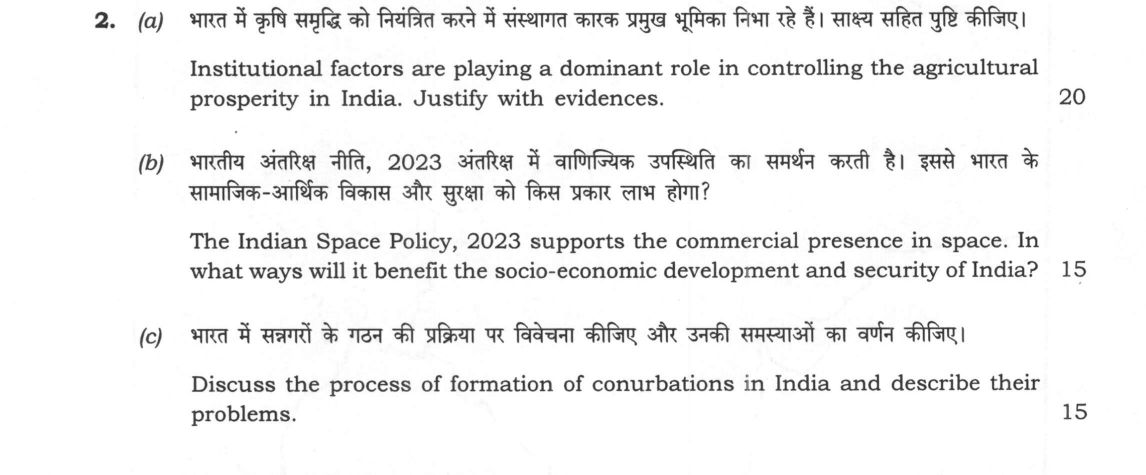
Institutional factors are playing a dominant role in controlling the agricultural prosperity in India. Justify with evidences. 20 marks
The Indian Space Policy, 2023 supports the commercial presence in space. In what ways will it benefit the socio-economic development and security of India? 15 marks
Discuss the process of formation of conurbations in India and describe their problems. 15 marks
हिंदी में प्रश्न पढ़ें
भारत में कृषि समृद्धि को नियंत्रित करने में संस्थागत कारक प्रमुख भूमिका निभा रहे हैं। साक्ष्य सहित पुष्टि कीजिए। (20 अंक)
भारतीय अंतरिक्ष नीति, 2023 अंतरिक्ष में वाणिज्यिक उपस्थिति का समर्थन करती है। इससे भारत के सामाजिक-आर्थिक विकास और सुरक्षा को किस प्रकार लाभ होगा? (15 अंक)
भारत में सनगरों के गठन की प्रक्रिया पर विवेचना कीजिए और उनकी समस्याओं का वर्णन कीजिए। (15 अंक)
Model answer
Written by UPSC Answer Check against this question's marking rubric, to the expected length. UPSC does not publish answers for Mains — this is one way to score well, not an official key.
India’s agricultural prosperity is less a product of soil and rainfall than of institutions that convert resources into marketable surplus. Agricultural institutions The legacy of zamindari and ryotwari tenure shaped fragmented holdings, insecure tenancy and weak market access; post-independence reforms, though incomplete, created a basis for public procurement and credit. The Green Revolution was institutional as much as technological: CACP recommended MSP for 22 notified crops, FCI procured and buffered stocks, and cooperative/RBI-led credit mobilised inputs; NABARD later consolidated rural credit. MSP procurement zones explain regional divergence: Punjab-Haryana, with canal irrigation, FCI mandis and rice-wheat MSP, became surplus but face waterlogging and stubble burning; Bihar-UP, with fragmented land, tenancy and weaker procurement, remain less prosperous. Cooperative models (sugar in Maharashtra, dairy in Gujarat) and contract farming in horticulture show institutions can reduce risk, while the 2020 farm laws debate and tripartite agreements, later repealed, exposed how MSP, market access and tenancy shape farmer welfare. The objection that institutions distort ecology is valid, but the remedy is redesign, not absence: water pricing, crop diversification and procurement reform. Punjab-Haryana’s surplus and Bihar-UP’s lag show that institutions, not climate, are the decisive variable; the same MSP can yield prosperity where procurement, credit and land reform align, and distress where they do not.
Space policy The Indian Space Policy, 2023, by creating IN-SPACe as a regulatory facilitator, invites private constellations for agriculture and insurance: crop mapping, soil moisture, flood and parametric insurance. Space-based asset management strengthens disaster response by locating relief camps, damaged roads and cyclone tracks, reducing NDRF response time. Indigenous PSLV/GSLV capacity gives strategic autonomy, while dual-use remote sensing and communication support border surveillance and situational awareness. Commercial space thus converts orbital assets into socio-economic resilience and security.
Conurbations Conurbations form when core cities, satellite towns and ribbon development along highways and rail merge into continuous urban fabric, as in Delhi NCR (Gurgaon, Noida, Faridabad), Mumbai (Thane, Navi Mumbai, Virar) and Kolkata (Howrah, Salt Lake, Durgapur). Stages include core growth, suburbanisation, satellite towns, corridor development and administrative overlap. Problems are sprawl, groundwater depletion, solid waste crisis and governance fragmentation, where multiple Panchayats, corporations and development authorities compete. These are not separate problems: MSP and credit determine rural surplus, IN-SPACe data improves insurance and disaster management, and Gati Shakti corridors accelerate conurbation. A coherent Amrit Kaal strategy must therefore treat land, orbit and city as one development geography, not three separate sectors.
What "Justify" is asking you to do
Defend a position with reasons that carry evidence, and show why the contrary view does not hold. Where the stem runs as a question and asks you to justify your answer, the position is yours to choose and the marks lie wholly in the defence.
Structure that answers it
Position stated plainly → reason 1 with evidence → reason 2 with evidence → strongest objection, met → position restated as qualified
Where marks are lost
Reasons stated and none of them evidenced. The other standard loss is fence-sitting — an answer that finds merit on both sides and commits to neither has justified nothing.
How this answer will be evaluated
Approach
Framework: Concept or mechanism > Diagram > Regional example > Application. (a) justify: claim > 3-4 reasons > evidence > conclusion | (b) explain: definition/context > points in order > small example > short close | (c) discuss: intro > 3-4 dimensions > example > balanced close Full marks: Precise institutional/policy links, specific Indian examples, clear causal chains, and relevant diagrams/data.
Key points expected
- Define institutional factors (policy, credit, markets, land laws)
- Link specific institutions to agricultural prosperity
- Provide evidence for each institutional factor
- Conclude on the dominant role of these factors
- Contextualize the 2023 Space Policy's commercial focus
- Explain benefits to socio-economic development
- Explain benefits to national security
- Provide specific examples of commercial space applications
Evaluation rubric
Each sub-part is marked on its own, against the marks and word limit printed on the paper.
- (a) Claim that institutional factors dominate agricultural prosperity, supported by 3-4 specific reasons and evidence. 20 marks
justify— claim → 3-4 reasons → evidence → conclusion
Must cover
- Define institutional factors (policy, credit, markets, land laws)
- Link specific institutions to agricultural prosperity
- Provide evidence for each institutional factor
- Conclude on the dominant role of these factors
Loses marks
- Listing factors without explaining their role
- Ignoring the 'dominant' aspect of the claim
- Vague evidence without specific examples
Earns more
- Mention specific schemes (e.g., PM-KISAN, MSP)
- Reference land reform acts or tenancy laws
- Discuss role of cooperatives or FPOs
- Cite data on credit availability or market access
Extra mark
- Reference specific recent policy changes or data
- Include a simple flowchart of institutional impact
- (b) Explain how the 2023 Space Policy's commercial support benefits socio-economic development and security. 15 marks
explain— definition/context → points in order → small example → short close
Must cover
- Contextualize the 2023 Space Policy's commercial focus
- Explain benefits to socio-economic development
- Explain benefits to national security
- Provide specific examples of commercial space applications
Loses marks
- Generalities about space without specific policy links
- Ignoring the 'commercial presence' aspect
- Failing to address both socio-economic and security benefits
Earns more
- Mention specific commercial space ventures or startups
- Discuss satellite data applications in agriculture/disaster
- Reference specific security applications (e.g., surveillance)
- Link to 'Make in India' or 'Atmanirbhar Bharat'
Extra mark
- Cite specific recent commercial space launches or contracts
- Include a diagram showing space-tech applications
- (c) Discuss the process of conurbation formation in India and describe their associated problems. 15 marks
discuss— intro → 3-4 dimensions → example → balanced close
Must cover
- Define conurbation and its formation process
- Explain the stages of conurbation development
- Describe specific problems of Indian conurbations
- Provide regional examples of Indian conurbations
Loses marks
- Describing cities without explaining the conurbation process
- Listing problems without linking them to formation
- Lack of specific Indian examples
Earns more
- Mention specific Indian conurbations (e.g., Delhi-NCR, Mumbai)
- Discuss urban sprawl and land-use changes
- Reference infrastructure challenges (transport, water)
- Link to census data or urban planning reports
Extra mark
- Include a labelled sketch map of a conurbation
- Cite specific recent urban planning initiatives
Practice this exact question
Write your answer and it is marked point by point against the model answer above — what you covered, what you missed, what you got wrong.
Evaluate my answer →More from Geography 2024 Paper II
- Q1 On the outline map of India provided to you, mark the location of all of the following. W…
- Q2 (a) Institutional factors are playing a dominant role in controlling the agricultural pro…
- Q3 (a) India has wide-ranging regional disparities in economic development. Explain the patt…
- Q4 (a) Migration is the reflection of regional disparities. What socio-economic and demograp…
- Q5 Answer the following questions in about 150 words each: (a) How are geographic factors in…