Paper II — Q8
(a) How can morphology of Indian towns be described historically? Discuss the major features of the first planned city in India…
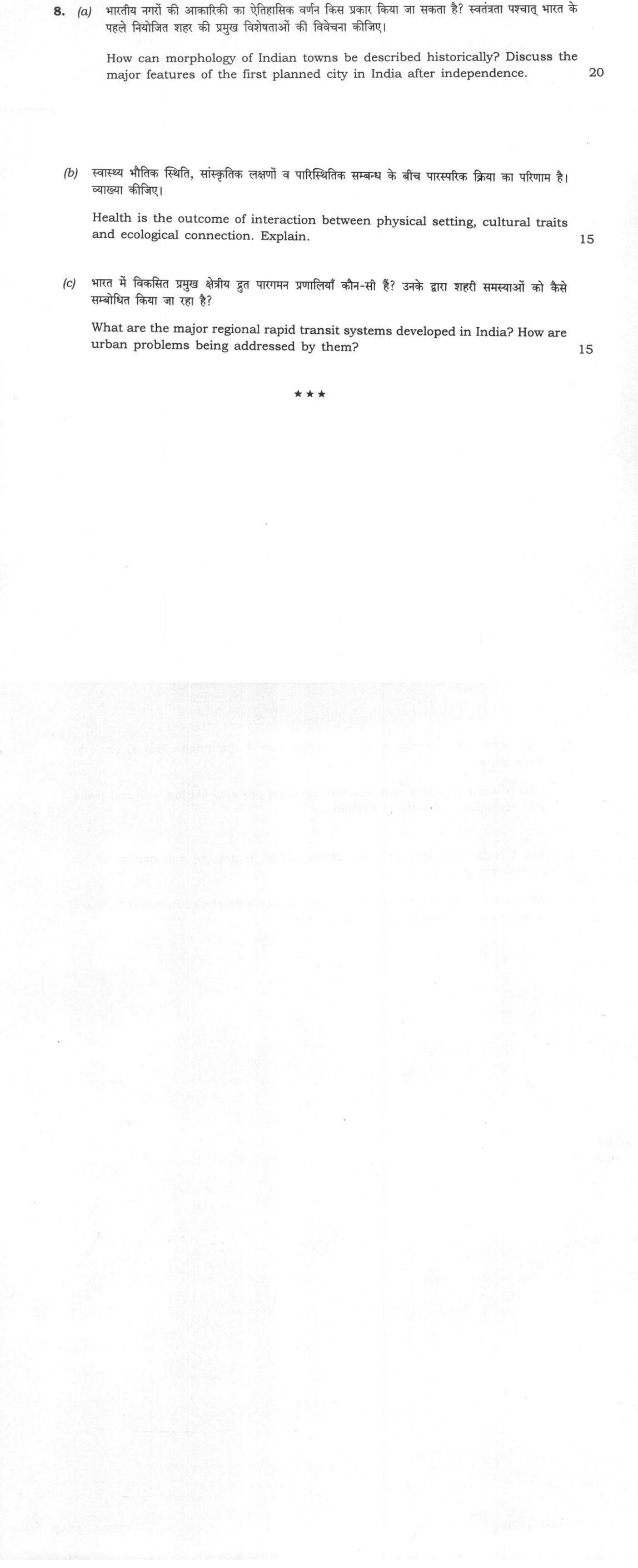
How can morphology of Indian towns be described historically? Discuss the major features of the first planned city in India after independence. 20 marks
Health is the outcome of interaction between physical setting, cultural traits and ecological connection. Explain. 15 marks
What are the major regional rapid transit systems developed in India? How are urban problems being addressed by them? 15 marks
हिंदी में प्रश्न पढ़ें
भारतीय नगरों की आकारिकी का ऐतिहासिक वर्णन किस प्रकार किया जा सकता है? स्वतंत्रता पश्चात् भारत के पहले नियोजित शहर की प्रमुख विशेषताओं की विवेचना कीजिए। (20 अंक)
स्वास्थ्य भौतिक स्थिति, सांस्कृतिक लक्षणों व पारिस्थितिक संबंध के बीच परस्परिक क्रिया का परिणाम है। व्याख्या कीजिए। (15 अंक)
भारत में विकसित प्रमुख क्षेत्रीय द्रुत पारगमन प्रणालियाँ कौन-सी हैं? उनके द्वारा शहरी समस्याओं को कैसे सम्बोधित किया जा रहा है? (15 अंक)
Model answer
Written by UPSC Answer Check against this question's marking rubric, to the expected length. UPSC does not publish answers for Mains — this is one way to score well, not an official key.
The morphology of Indian settlements reflects layered historical epochs. Ancient urbanism began with Harappan gridiron layouts and sophisticated drainage networks. Medieval towns evolved organically as fort-camp nodes, temple-centric agglomerations, and linear bazaar corridors. The colonial era institutionalised structural duality: spacious, low-density Civil Lines, cantonments, and railway colonies segregated from congested native cores. Post-independence planning culminated in Chandigarh, India’s first major planned city designed by Le Corbusier on a biological analogy. Its defining features include self-contained rectangular sectors, the 7V hierarchical road network, the monumental Capitol Complex, and preserved green belts like the Leisure Valley. However, critics note its socio-spatial segregation by occupational hierarchy and an automobile-centric layout that marginalised non-motorised transit and informal workers.
Health as an Ecological, Physical, and Cultural Nexus
Health geography conceptualises well-being as a tripartite interaction: Physical setting governs natural disease ecology: tropical climate, riverine floodplains, and contaminated aquifers determine the endemicity of vector-borne (malaria, dengue) and water-borne pathogens, as observed in the Indo-Gangetic plains. Cultural traits mediate health outcomes through nutritional practices, intra-household gender norms affecting maternal-child health, and medical pluralism bridging traditional AYUSH systems with allopathic medicine. Ecological connections establish human-environment feedback loops, where rapid deforestation, unchecked peri-urban sprawl, and wetland degradation intensify zoonotic spillovers, urban heat-island stress, and antimicrobial resistance.
Regional Rapid Transit Systems and Urban Solutions
To counter metropolitan primacy and vehicular sprawl, India is operationalising Regional Rapid Transit Systems (RRTS) alongside metropolitan rail networks. Key corridors under the National Capital Region Transport Corporation include Delhi-Ghaziabad-Meerut (Namo Bharat), alongside planned Delhi-Gurugram-SNB-Alwar and Delhi-Panipat lines. These work in tandem with extensive metro networks across cities like Delhi (DMRC), Bengaluru (Namma Metro), Chennai, and inter-modal networks like the Kochi Water Metro.
These transit systems resolve critical urban challenges by shifting commuter traffic off highways, directly curbing PM2.5 and greenhouse emissions. They anchor Transit-Oriented Development (TOD) policies, enabling compact, mixed-use densification and the structured absorption of peri-urban informal settlements. However, fully resolving structural urban deficits requires addressing high fare-box burdens for lower-income groups and overcoming last-mile non-motorised transport bottlenecks.
To realise sustainable and healthy settlements, India’s urban paradigm must bridge transit-oriented regional connectivity with inclusive, ecologically sensitive morphological planning that prioritises environmental health and socio-economic equity.
What "Discuss" is asking you to do
Lay the issue out from more than one side — how it arose, what is claimed for it, what is held against it, and where it now stands. UPSC attaches discuss to broad topics with several live dimensions, so coverage of the dimensions earns more than the strength of your opinion.
Structure that answers it
Set the issue up → the case as it is made → the case against → the dimension both sides leave out → where the balance now lies
Where marks are lost
Listing facts with no thread between them, or arguing one side throughout and calling it a discussion.
How this answer will be evaluated
Approach
Framework: UPSC Geography Paper II Rubric. (a) discuss: intro > 3-4 dimensions > example > balanced close | (b) explain: definition/context > points in order > small example > short close | (c) describe: define > structure or process in order > labelled diagram > significance Full marks: Precise examples, clear causal links, and relevant diagrams.
Key points expected
- Historical morphology: organic vs planned growth
- Mughal grid pattern (e.g., Shahjahanabad)
- First planned city: Chandigarh (Le Corbusier)
- Chandigarh features: Sector system, Capitol Complex
- Physical setting: climate, water, sanitation
- Cultural traits: diet, hygiene, social norms
- Ecological connection: disease vectors, environment
- Causal link between these and health outcomes
Evaluation rubric
Each sub-part is marked on its own, against the marks and word limit printed on the paper.
- (a) Historical morphology of Indian towns and features of the first post-independence planned city. 20 marks
discuss— intro → 3-4 dimensions → example → balanced close
Must cover
- Historical morphology: organic vs planned growth
- Mughal grid pattern (e.g., Shahjahanabad)
- First planned city: Chandigarh (Le Corbusier)
- Chandigarh features: Sector system, Capitol Complex
Loses marks
- Confusing Chandigarh with New Delhi
- Ignoring the 'historical' aspect of morphology
- No mention of specific planning features
Earns more
- Mention of Jaipur as planned city
- Reference to Master Plan 1952
- Comparison of old vs new town morphology
- Mention of Green Belt in Chandigarh
Extra mark
- Sketch of Chandigarh sector layout
- Reference to 'City of Tomorrow' concept
- (b) Interaction of physical, cultural, and ecological factors in determining health. 15 marks
explain— definition/context → points in order → small example → short close
Must cover
- Physical setting: climate, water, sanitation
- Cultural traits: diet, hygiene, social norms
- Ecological connection: disease vectors, environment
- Causal link between these and health outcomes
Loses marks
- Treating factors in isolation
- Ignoring the 'interaction' aspect
- Vague generalities without specific examples
Earns more
- Example of waterborne diseases (physical)
- Example of caste-based diet (cultural)
- Mention of vector-borne diseases (ecological)
- Reference to 'Social Determinants of Health'
Extra mark
- Diagram showing the interaction triangle
- Specific example like Malaria in Ganga plains
- (c) Major regional rapid transit systems in India and their role in solving urban problems. 15 marks
describe— define → structure or process in order → labelled diagram → significance
Must cover
- Name major systems: Delhi Metro, Mumbai Metro
- Mention other systems: Bengaluru, Chennai, Kolkata
- Address urban problems: congestion, pollution
- Link transit to TOD (Transit Oriented Development)
Loses marks
- Listing systems without explaining benefits
- Ignoring the 'urban problems' aspect
- Confusing regional with local transit
Earns more
- Mention of Dedicated Corridors
- Reference to 'JNNURM' or 'AMRUT' schemes
- Specific line names (e.g., Airport Express)
- Mention of BRTS in Ahmedabad
Extra mark
- Sketch of a metro network
- Data on ridership or pollution reduction
Practice this exact question
Write your answer and it is marked point by point against the model answer above — what you covered, what you missed, what you got wrong.
Evaluate my answer →More from Geography 2024 Paper II
- Q5 Answer the following questions in about 150 words each: (a) How are geographic factors in…
- Q6 (a) Industrial waste is diversified. Discuss the potentials and challenges associated wit…
- Q7 (a) India is playing a very significant role in world affairs. Examine the stands taken b…
- Q8 (a) How can morphology of Indian towns be described historically? Discuss the major featu…