Paper II — Q7
(a) India is playing a very significant role in world affairs. Examine the stands taken by India in important global and regional…
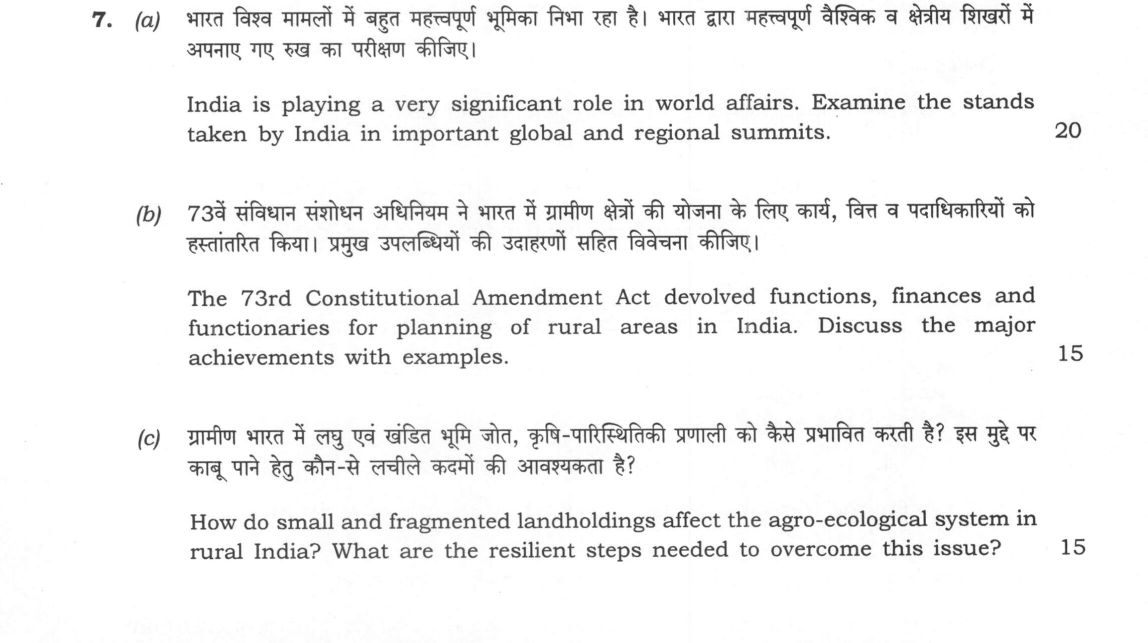
India is playing a very significant role in world affairs. Examine the stands taken by India in important global and regional summits. 20 marks
The 73rd Constitutional Amendment Act devolved functions, finances and functionaries for planning of rural areas in India. Discuss the major achievements with examples. 15 marks
How do small and fragmented landholdings affect the agro-ecological system in rural India? What are the resilient steps needed to overcome this issue? 15 marks
हिंदी में प्रश्न पढ़ें
भारत विश्व मामलों में बहुत महत्वपूर्ण भूमिका निभा रहा है। भारत द्वारा महत्वपूर्ण वैश्विक व क्षेत्रीय शिखरों में अपनाए गए रुख का परीक्षण कीजिए। (20 अंक)
73वें संविधान संशोधन अधिनियम ने भारत में ग्रामीण क्षेत्रों की योजना के लिए कार्य, वित्त व पदाधिकारियों को हस्तांतरित किया। प्रमुख उपलब्धियों की उदाहरणों सहित विवेचना कीजिए। (15 अंक)
ग्रामीण भारत में लघु एवं खंडित भूमि जोत, कृषि-पारिस्थितिकी प्रणाली को कैसे प्रभावित करती है? इस मुद्दे पर काबू पाने हेतु कौन-से लचीले कदमों की आवश्यकता है? (15 अंक)
Model answer
Written by UPSC Answer Check against this question's marking rubric, to the expected length. UPSC does not publish answers for Mains — this is one way to score well, not an official key.
India’s significance in world affairs is visible not in bloc politics but in issue-based leadership. In the G20, it pressed climate finance and debt restructuring, making the New Delhi Summit a platform for Global South priorities. At COP, it advanced the LiFE initiative as a scalable mitigation pathway while insisting on equity under CBDR, so that climate responsibility does not ignore development needs. In the SCO, it has not endorsed the BRI, advocating transparent, rules-based connectivity; its broader connectivity diplomacy—Chabahar and INSTC—offers non-BRI alternatives. In the QUAD, it supports Indo-Pacific maritime security, maritime domain awareness and freedom of navigation without forming a military alliance. In BRICS, it has engaged cautiously with de-dollarization debates, preferring local-currency trade and institutional reform rather than an anti-dollar posture. Its strategic autonomy in the Ukraine conflict, vaccine diplomacy during COVID-19, and leadership in ISA/CDRI show normative power projection. This pattern shows India using summits to shape norms, but its effectiveness depends on follow-through in implementation and coalition-building.
Panchayati Raj devolution The 73rd Amendment did not automatically devolve powers; Article 243G enables State Legislatures to endow Panchayats with functions in the 29 Eleventh Schedule subjects, while related provisions address finances and functionaries. PESA extends similar principles to Fifth Schedule areas. The 14th and 15th Finance Commissions recommended grants-in-aid to PRIs, expanding fiscal space, though untied fund utilization remains below 15%, limiting local discretion. Kerala’s People’s Plan Campaign (1996) transferred planning and funds to gram panchayats; West Bengal’s three-tier resource mapping improved local asset management; Madhya Pradesh’s watershed committees linked rural works with ecological restoration. These achievements show that devolution works where states create institutional capacity, but uneven state action remains the key constraint.
Fragmented landholdings Small, fragmented holdings degrade agro-ecology by reducing biodiversity, depleting soil micronutrients, encouraging inefficient flood irrigation on small plots, and lowering carbon sequestration through monocropping. Resilient steps include voluntary land pooling/consolidation for rural farms—distinct from Andhra Pradesh’s urban LAPS—so that plots can be managed collectively. FPO promotion, with the central target of 10,000 new FPOs by 2027, can improve bargaining and input efficiency. Precision agriculture, crop diversification, and agroforestry under the National Agroforestry Policy 2014 can restore soil, water and carbon functions. Together, these measures can convert fragmentation from an ecological liability into a managed, diversified rural landscape.
India’s evolving role is therefore one of calibrated leadership: principled multilateralism globally, institutional devolution domestically, and ecological resilience at the grassroots.
What "Examine" is asking you to do
Test the proposition the question puts to you and return a finding on how far it holds. Examine stems carry a claim, or ask whether something has happened, and expect evidence weighed both ways before the extent is stated — often with remedial measures attached.
Structure that answers it
Restate the claim as the question frames it → evidence that supports it → evidence that undercuts it → the conditions under which it holds → verdict on how far it stands
Where marks are lost
Stopping at description. An examination has to reach a finding, and “examine with justification” means the extent must be stated, not implied.
How this answer will be evaluated
Approach
Framework: UPSC Mains Geography Paper II. (a) examine: intro > how/why with reasoning > evidence > conclusion | (b) discuss: intro > 3-4 dimensions > example > balanced close | (c) analyse: intro > causes > effects > stakeholders/linkages > way forward Full marks: Comprehensive, well-structured, with specific examples and clear reasoning.
Key points expected
- Identify specific summits (G20, SCO, BRICS, UN)
- Explain the 'how' and 'why' of India's stance
- Provide evidence of outcomes or specific resolutions
- Distinguish between global and regional stands
- Explain the devolution of functions (11th Schedule)
- Explain the devolution of finances (Finance Commission)
- Explain the devolution of functionaries (State Election Commission)
- Provide specific examples of achievements
Evaluation rubric
Each sub-part is marked on its own, against the marks and word limit printed on the paper.
- (a) Analyze India's diplomatic positions in global and regional forums with reasoning and evidence. 20 marks
examine— intro → how/why with reasoning → evidence → conclusion
Must cover
- Identify specific summits (G20, SCO, BRICS, UN)
- Explain the 'how' and 'why' of India's stance
- Provide evidence of outcomes or specific resolutions
- Distinguish between global and regional stands
Loses marks
- Generic description of India's importance without specific stands
- Listing summits without analyzing the positions taken
- Confusing regional and global forums
Earns more
- Mention 'Global South' leadership or 'Vasudhaiva Kutumbakam'
- Reference specific regional initiatives (e.g., BIMSTEC, IORA)
- Link stands to India's strategic interests
Extra mark
- Cite a specific recent summit outcome (e.g., G20 New Delhi Declaration)
- Mention a specific diplomatic mechanism (e.g., QUAD, EAS)
- (b) Discuss the devolution of functions, finances, and functionaries under the 73rd Amendment with examples. 15 marks
discuss— intro → 3-4 dimensions → example → balanced close
Must cover
- Explain the devolution of functions (11th Schedule)
- Explain the devolution of finances (Finance Commission)
- Explain the devolution of functionaries (State Election Commission)
- Provide specific examples of achievements
Loses marks
- Confusing 73rd and 74th Amendments
- Listing functions without explaining the devolution mechanism
- Ignoring the 'functionaries' aspect of the question
Earns more
- Mention the 11th Schedule's 29 items
- Reference the State Finance Commission's role
- Cite specific rural development outcomes (e.g., PDS, roads)
Extra mark
- Mention the 74th Amendment for urban context (if relevant)
- Cite a specific state's Panchayati Raj performance
- (c) Analyze the impact of fragmented landholdings on the agro-ecological system and suggest resilient steps. 15 marks
analyse— intro → causes → effects → stakeholders/linkages → way forward
Must cover
- Explain the impact on the agro-ecological system
- Identify the causes of fragmentation
- Suggest resilient steps to overcome the issue
- Link physical cause to human consequence
Loses marks
- Focusing only on economic impacts, ignoring agro-ecological
- Suggesting solutions without linking them to the problem
- Ignoring the 'resilient steps' part of the question
Earns more
- Mention 'consolidation of landholdings' as a solution
- Reference 'cooperative farming' or 'joint land ownership'
- Cite specific examples of land fragmentation in India
Extra mark
- Mention a specific government scheme for land consolidation
- Cite a specific study or data on land fragmentation
Practice this exact question
Write your answer and it is marked point by point against the model answer above — what you covered, what you missed, what you got wrong.
Evaluate my answer →More from Geography 2024 Paper II
- Q4 (a) Migration is the reflection of regional disparities. What socio-economic and demograp…
- Q5 Answer the following questions in about 150 words each: (a) How are geographic factors in…
- Q6 (a) Industrial waste is diversified. Discuss the potentials and challenges associated wit…
- Q7 (a) India is playing a very significant role in world affairs. Examine the stands taken b…
- Q8 (a) How can morphology of Indian towns be described historically? Discuss the major featu…