Paper II — Q4
(a) Migration is the reflection of regional disparities. What socio-economic and demographic consequences are experienced at the…
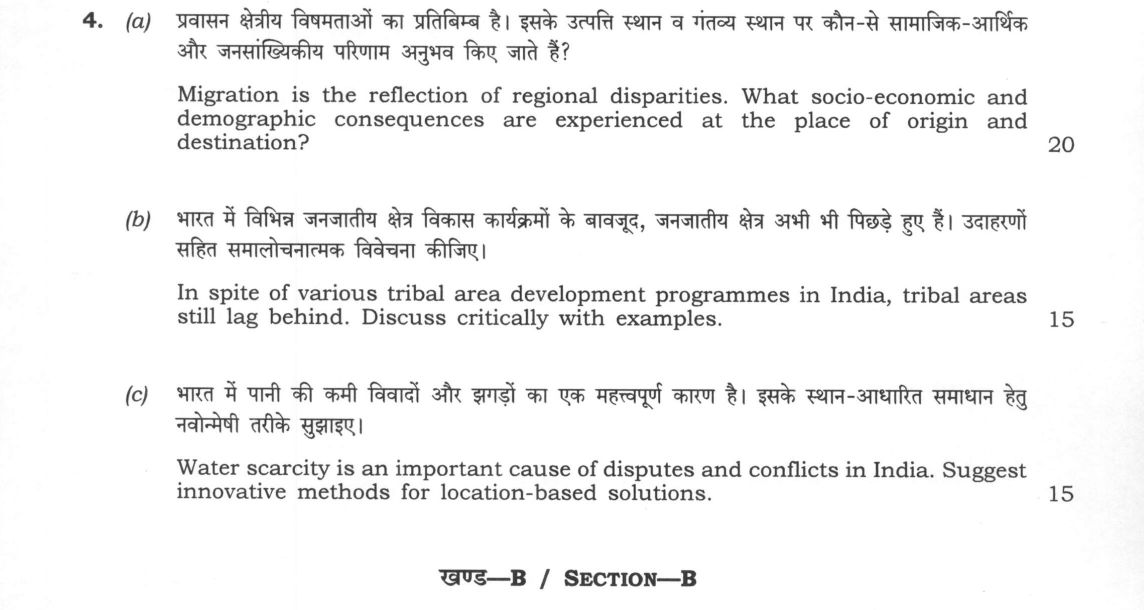
Migration is the reflection of regional disparities. What socio-economic and demographic consequences are experienced at the place of origin and destination? 20 marks
In spite of various tribal area development programmes in India, tribal areas still lag behind. Discuss critically with examples. 15 marks
Water scarcity is an important cause of disputes and conflicts in India. Suggest innovative methods for location-based solutions. 15 marks
हिंदी में प्रश्न पढ़ें
प्रवासन क्षेत्रीय विषमताओं का प्रतिबिंब है। इसके उत्पत्ति स्थान व गंतव्य स्थान पर कौन-से सामाजिक-आर्थिक और जनसांख्यिकीय परिणाम अनुभव किए जाते हैं? (20 अंक)
भारत में विभिन्न जनजातीय क्षेत्र विकास कार्यक्रमों के बावजूद, जनजातीय क्षेत्र अभी भी पिछड़े हुए हैं। उदाहरणों सहित समालोचनात्मक विवेचना कीजिए। (15 अंक)
भारत में पानी की कमी विवादों और झगड़ों का एक महत्वपूर्ण कारण है। इसके स्थान-आधारित समाधान हेतु नवोन्मेषी तरीके सुझाइए। (15 अंक)
Model answer
Written by UPSC Answer Check against this question's marking rubric, to the expected length. UPSC does not publish answers for Mains — this is one way to score well, not an official key.
Regional disparities in India drive migration through push and pull dynamics, validating Lee’s push-pull framework and Ravenstein’s laws, particularly along the corridor from agrarian Bihar-UP to industrial hubs like Delhi-NCR and Mumbai, alongside circular distress migration in central tribal belts.
Consequences at Place of Origin and Destination At the place of origin, out-migration creates a remittance-supported consumer economy but induces local agricultural labour shortages and the feminisation of agriculture. Demographically, age- and sex-selective outflows leave behind an ageing dependent population and skewed sex ratios, accompanied by human capital depletion (brain drain). Conversely, destinations gain productive labour (brain gain) and agglomeration economies, but face acute demographic pressure. This manifests in male-skewed demographic profiles, proliferation of informal settlements and slums (e.g., Dharavi), overburdened civic infrastructure, and occasional sons-of-the-soil cultural friction.
Critique of Tribal Area Development Despite targeted interventions like the Tribal Sub-Plan, tribal regions in central-eastern India lag due to top-down bureaucratic design and inadequate implementation of PESA, 1996 and FRA, 2006. Development-induced displacement without equitable rehabilitation—seen in mining belts of Jharkhand and Odisha, the Dandakaranya project, and Sardar Sarovar Project—has aggravated land alienation and resource dispossession. However, decentralised models offer pathways forward: Kerala’s participatory tribal health and education programmes, livelihood value-addition under Van Dhan Vikas Yojana, and localized asset creation through MGNREGA demonstrate that community ownership yields inclusive human development.
Location-Based Solutions to Water Conflicts Inter-state and inter-basin water disputes—such as Cauvery (Karnataka-Tamil Nadu), the Sutlej-Yamuna Link (Punjab-Haryana), and Damanganga-Pinjal—stem from zero-sum competition over depleting resources. Mitigating these conflicts requires micro-regional, geography-specific interventions: In arid Rajasthan, revival of traditional rainwater harvesting through johads, khadins, and tankas augments local supply. In peninsular basaltic terrains, micro-watershed development and local check dams optimize runoff before large-scale river interlinking. In the Himalayan region, spring-shed management (e.g., Dhara Vikas) ensures perennial base flows. In deltaic and alluvial belts, 3D aquifer mapping, arsenic-safe deep aquifer tapping, and Managed Aquifer Recharge (MAR) prevent over-extraction. Integrating IoT-based real-time telemetry for transboundary discharge monitoring, solar-powered micro-irrigation, and urban wastewater recycling shifts water management from adversarial allocation to decentralized efficiency.
Addressing spatial inequality necessitates moving beyond isolated interventions toward integrated regional planning that harmonizes migration corridors, community-led tribal governance, and hydro-climatically tailored resource management.
What "Discuss" is asking you to do
Lay the issue out from more than one side — how it arose, what is claimed for it, what is held against it, and where it now stands. UPSC attaches discuss to broad topics with several live dimensions, so coverage of the dimensions earns more than the strength of your opinion.
Structure that answers it
Set the issue up → the case as it is made → the case against → the dimension both sides leave out → where the balance now lies
Where marks are lost
Listing facts with no thread between them, or arguing one side throughout and calling it a discussion.
How this answer will be evaluated
Approach
Framework: Concept or mechanism > Diagram > Regional example > Application. (a) explain: definition/context > points in order > small example > short close | (b) critically evaluate: positives > negatives/limits > conditions/safeguards > conclusion | (c) suggest: the problem in one line > implementable measures > who acts > conclusion Full marks: Comprehensive, well-structured, with specific examples, data, and diagrams.
Key points expected
- Origin: Brain drain and labor shortage
- Origin: Demographic aging and dependency ratio
- Destination: Labor surplus and urbanization
- Destination: Remittance inflows and economic growth
- Limitations of specific schemes (e.g., TRIFED, DTP)
- Infrastructure deficits (roads, connectivity)
- Socio-cultural barriers to development
- Examples of lagging regions (e.g., Jharkhand, NE)
Evaluation rubric
Each sub-part is marked on its own, against the marks and word limit printed on the paper.
- (a) Socio-economic and demographic consequences of migration at origin and destination. 20 marks
explain— definition/context → points in order → small example → short close
Must cover
- Origin: Brain drain and labor shortage
- Origin: Demographic aging and dependency ratio
- Destination: Labor surplus and urbanization
- Destination: Remittance inflows and economic growth
Loses marks
- Listing consequences without causal link
- Ignoring the 'origin' or 'destination' side
Earns more
- Push-pull factor mechanism
- Specific Indian examples (e.g., Bihar to Delhi)
- Diagram of migration flow and impact
Extra mark
- Census 2011 migration data
- Labelled map of major migration corridors
- (b) Critical discussion on why tribal areas lag despite development programs. 15 marks
critically evaluate— positives → negatives/limits → conditions/safeguards → conclusion
Must cover
- Limitations of specific schemes (e.g., TRIFED, DTP)
- Infrastructure deficits (roads, connectivity)
- Socio-cultural barriers to development
- Examples of lagging regions (e.g., Jharkhand, NE)
Loses marks
- General praise of government schemes
- Lack of specific examples or data
Earns more
- Comparison of planned vs actual outcomes
- Mention of specific tribal groups (e.g., Santhal, Naga)
Extra mark
- Specific data on tribal poverty indices
- Reference to PESA Act implementation
- (c) Innovative, location-based methods to solve water scarcity and conflicts. 15 marks
suggest— the problem in one line → implementable measures → who acts → conclusion
Must cover
- Innovative technical solutions (e.g., desalination, rainwater harvesting)
- Location-based application (e.g., specific river basins)
- Conflict resolution mechanisms
- Implementation strategy or stakeholder involvement
Loses marks
- Generic suggestions without location context
- Ignoring the 'conflict' aspect of the question
Earns more
- Specific examples (e.g., Cauvery dispute, Rajasthan tanks)
- Use of technology (GIS, remote sensing)
Extra mark
- Reference to specific water treaties or laws
- Diagram of a proposed solution
Practice this exact question
Write your answer and it is marked point by point against the model answer above — what you covered, what you missed, what you got wrong.
Evaluate my answer →More from Geography 2024 Paper II
- Q1 On the outline map of India provided to you, mark the location of all of the following. W…
- Q2 (a) Institutional factors are playing a dominant role in controlling the agricultural pro…
- Q3 (a) India has wide-ranging regional disparities in economic development. Explain the patt…
- Q4 (a) Migration is the reflection of regional disparities. What socio-economic and demograp…
- Q5 Answer the following questions in about 150 words each: (a) How are geographic factors in…
- Q6 (a) Industrial waste is diversified. Discuss the potentials and challenges associated wit…
- Q7 (a) India is playing a very significant role in world affairs. Examine the stands taken b…