Paper II — Q6
(a) Industrial waste is diversified. Discuss the potentials and challenges associated with it. (20 marks) (b) How is cultural…
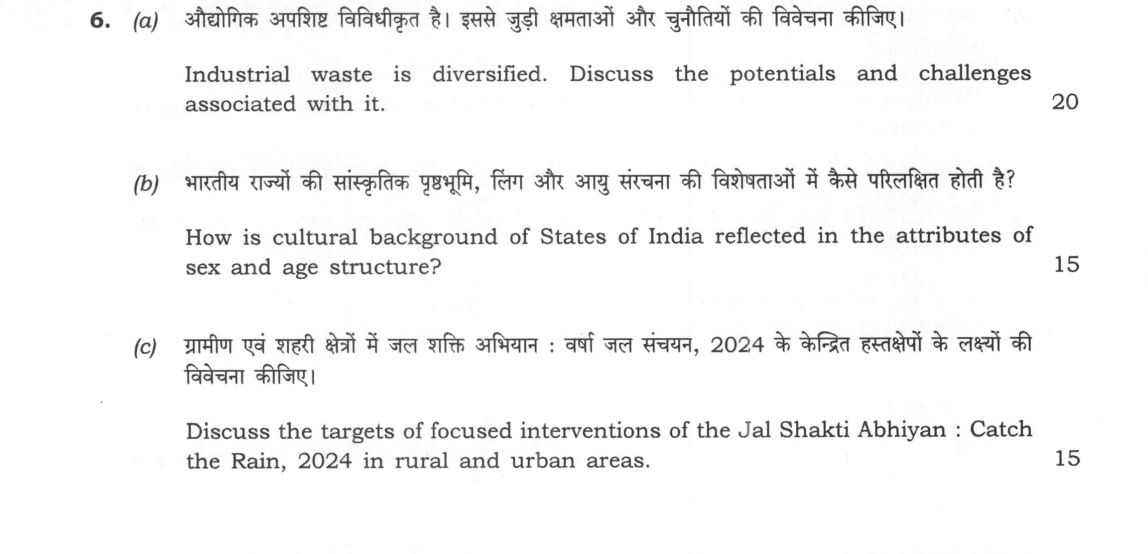
Industrial waste is diversified. Discuss the potentials and challenges associated with it. 20 marks
How is cultural background of States of India reflected in the attributes of sex and age structure? 15 marks
Discuss the targets of focused interventions of the Jal Shakti Abhiyan : Catch the Rain, 2024 in rural and urban areas. 15 marks
हिंदी में प्रश्न पढ़ें
औद्योगिक अपशिष्ट विविधीकृत है। इससे जुड़ी क्षमताओं और चुनौतियों की विवेचना कीजिए। (20 अंक)
भारतीय राज्यों की सांस्कृतिक पृष्ठभूमि, लिंग और आयु संरचना की विशेषताओं में कैसे परिलक्षित होती है? (15 अंक)
ग्रामीण एवं शहरी क्षेत्रों में जल शक्ति अभियान : वर्षा जल संचयन, 2024 के केंद्रित हस्तक्षेपों के लक्ष्यों की विवेचना कीजिए। (15 अंक)
Model answer
Written by UPSC Answer Check against this question's marking rubric, to the expected length. UPSC does not publish answers for Mains — this is one way to score well, not an official key.
India’s accelerating industrialization generates a highly heterogeneous waste stream across sectors, encompassing hazardous chemical effluents, non-hazardous metallurgical slag and fly ash, rapidly accumulating e-waste, biomedical discards, and vast construction and demolition (C&D) debris.
Potentials and Challenges of Diversified Industrial Waste
On the potential front, diversified waste streams provide the feedstock for a circular economy through advanced resource recovery, such as utilizing fly ash in green cement and recovering precious metals from electronic scraps. Waste-to-Energy (WTE) facilities convert industrial organic and non-recyclable refuse into power, while the recycling value chain generates substantial green employment. Conversely, acute challenges persist. Regulatory enforcement under the Environment (Protection) Act and sectoral waste rules remains fragmented. Complex composite materials face technological bottlenecks in segregation and recycling. Furthermore, the pervasive dominance of the unorganized informal sector leads to severe environmental contamination and occupational hazards, compounded by illicit transboundary dumping and weak industrial co-siting infrastructure.
Cultural Determinants of Sex and Age Structure
Spatial patterns in India’s demographic attributes strongly reflect regional socio-cultural matrices. Patriarchal norms, patrilocal residence, and entrenched son preference in north-western states like Punjab and Haryana have historically manifested in deeply male-skewed sex ratios. In contrast, southern states such as Kerala and Tamil Nadu demonstrate balanced or female-advantaged sex ratios, underpinned by historical matrilineal traditions, female autonomy, and universal literacy.
Age structure variations similarly align with socio-cultural transitions. The southern states, having achieved below-replacement fertility through female education and smaller family norms, exhibit a rapidly aging population structure. Conversely, northern and central states (BIMARU belt) retain a pronounced youth bulge and broad-based population pyramids, driven by persistent cultural preferences for larger families, lower mean age of marriage, and higher fertility rates.
Jal Shakti Abhiyan: Catch the Rain (JSA: CTR) 2024 Targets
The JSA: CTR 2024 campaign establishes spatially differentiated targets across rural and urban landscapes to bolster climate resilience.
In rural areas, interventions focus on rejuvenating traditional rainwater harvesting structures, desilting community ponds and tanks under Mission Amrit Sarovar, undertaking scientific spring-shed development in hilly terrains, and managing rural greywater through soak pits and stabilization systems.
In urban areas, the targets mandate the desilting of stormwater drains to curb urban flooding, strict enforcement of municipal bylaws for rooftop rainwater harvesting (RTRWH) in built infrastructure, restoration of urban wetlands and lakes, and convergence with AMRUT 2.0 to institutionalize Water-Sensitive Urban Design (WSUD).
Navigating India's human-environment geography requires aligning industrial circularity, regionalized demographic planning, and decentralized water management. Integrating circular industrial systems with hydro-spatial security and equitable demographic policies will ensure long-term, sustainable spatial development.
What "Discuss" is asking you to do
Lay the issue out from more than one side — how it arose, what is claimed for it, what is held against it, and where it now stands. UPSC attaches discuss to broad topics with several live dimensions, so coverage of the dimensions earns more than the strength of your opinion.
Structure that answers it
Set the issue up → the case as it is made → the case against → the dimension both sides leave out → where the balance now lies
Where marks are lost
Listing facts with no thread between them, or arguing one side throughout and calling it a discussion.
How this answer will be evaluated
Approach
Framework: Concept or mechanism > Diagram > Regional example > Application. (a) discuss: intro > 3-4 dimensions > example > balanced close | (b) explain: definition/context > points in order > small example > short close | (c) discuss: intro > 3-4 dimensions > example > balanced close Full marks: Precise Indian examples, clear mechanisms, balanced discussion, specific data.
Key points expected
- Categorize waste types (hazardous, e-waste, sludge, heat)
- Explain 'waste-to-energy' or recycling mechanisms
- Identify specific environmental/health challenges
- Provide a specific Indian industrial example
- Explain impact of son preference on sex ratio
- Link marriage age to age structure (dependency ratio)
- Contrast North vs South Indian demographic patterns
- Mention specific states (e.g., Haryana vs Kerala)
Evaluation rubric
Each sub-part is marked on its own, against the marks and word limit printed on the paper.
- (a) Balanced analysis of industrial waste as a resource (potential) and a hazard (challenge). 20 marks
discuss— intro → 3-4 dimensions → example → balanced close
Must cover
- Categorize waste types (hazardous, e-waste, sludge, heat)
- Explain 'waste-to-energy' or recycling mechanisms
- Identify specific environmental/health challenges
- Provide a specific Indian industrial example
Loses marks
- Treating waste only as a disposal problem
- Ignoring the 'diversified' nature of the waste
- No mention of specific Indian context
Earns more
- Mention of Circular Economy principles
- Reference to Hazardous Waste Management Rules
- Diagram of waste processing flow
- Mention of specific industrial clusters (e.g., Bhiwandi, Kanpur)
Extra mark
- Specific data on e-waste generation in India
- Mention of specific government schemes (e.g., EPR)
- (b) Linkage between cultural norms (marriage, gender preference) and demographic data (sex ratio, age structure). 15 marks
explain— definition/context → points in order → small example → short close
Must cover
- Explain impact of son preference on sex ratio
- Link marriage age to age structure (dependency ratio)
- Contrast North vs South Indian demographic patterns
- Mention specific states (e.g., Haryana vs Kerala)
Loses marks
- Generic description of demographics without cultural link
- Ignoring the 'age structure' component
- No specific state examples
Earns more
- Reference to 2011 Census data
- Mention of female labor force participation
- Discussion of urban vs rural cultural shifts
- Diagram of population pyramid
Extra mark
- Mention of specific state policies (e.g., Kerala's health)
- Reference to specific cultural practices (e.g., dowry)
- (c) Specific targets of Jal Shakti Abhiyan 2024 for rural and urban water conservation. 15 marks
discuss— intro → 3-4 dimensions → example → balanced close
Must cover
- Define 'Jal Shakti Abhiyan: Catch the Rain' 2024
- List specific rural targets (e.g., water harvesting)
- List specific urban targets (e.g., rainwater harvesting)
- Mention the 'focused intervention' aspect
Loses marks
- Confusing with previous years' Jal Shakti Abhiyan
- No distinction between rural and urban targets
- Generic water conservation advice
Earns more
- Mention of specific districts/regions targeted
- Reference to 'Jal Jeevan Mission' linkage
- Mention of specific infrastructure (e.g., check dams)
- Diagram of rainwater harvesting system
Extra mark
- Specific data on water deficit areas
- Mention of specific state-level initiatives
Practice this exact question
Write your answer and it is marked point by point against the model answer above — what you covered, what you missed, what you got wrong.
Evaluate my answer →More from Geography 2024 Paper II
- Q3 (a) India has wide-ranging regional disparities in economic development. Explain the patt…
- Q4 (a) Migration is the reflection of regional disparities. What socio-economic and demograp…
- Q5 Answer the following questions in about 150 words each: (a) How are geographic factors in…
- Q6 (a) Industrial waste is diversified. Discuss the potentials and challenges associated wit…
- Q7 (a) India is playing a very significant role in world affairs. Examine the stands taken b…
- Q8 (a) How can morphology of Indian towns be described historically? Discuss the major featu…