Paper II — Q5
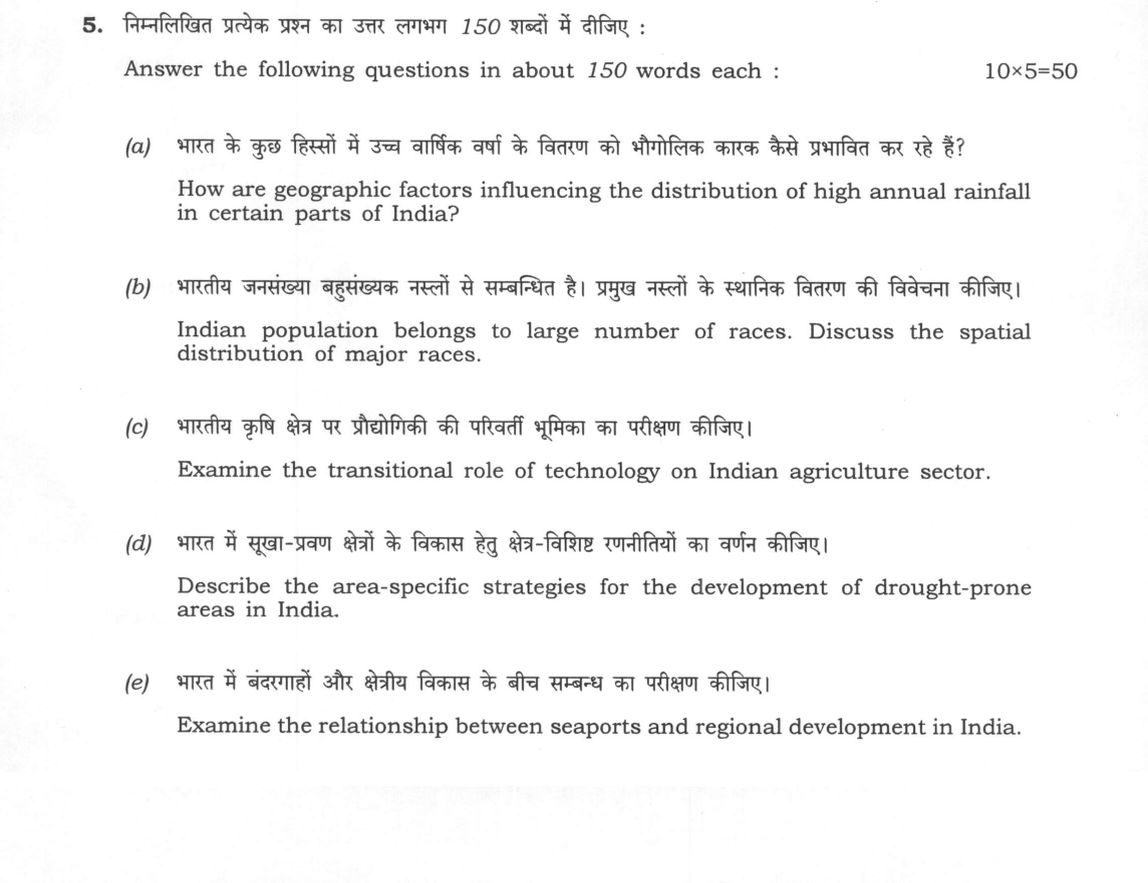
Answer the following questions in about 150 words each: (a) How are geographic factors influencing the distribution of high…
Answer the following questions in about 150 words each: (a) How are geographic factors influencing the distribution of high annual rainfall in certain parts of India? (b) Indian population belongs to large number of races. Discuss the spatial distribution of major races. (c) Examine the transitional role of technology on Indian agriculture sector. (d) Describe the area-specific strategies for the development of drought-prone areas in India. (e) Examine the relationship between seaports and regional development in India.
हिंदी में प्रश्न पढ़ें
निम्नलिखित प्रत्येक प्रश्न का उत्तर लगभग 150 शब्दों में दीजिए : (a) भारत के कुछ हिस्सों में उच्च वार्षिक वर्षा के वितरण को भौगोलिक कारक कैसे प्रभावित कर रहे हैं? (b) भारतीय जनसंख्या बहुसंख्यक नस्लों से संबंधित है। प्रमुख नस्लों के स्थानिक वितरण की विवेचना कीजिए। (c) भारतीय कृषि क्षेत्र पर प्रौद्योगिकी की परिवर्ती भूमिका का परीक्षण कीजिए। (d) भारत में सूखा-प्रवण क्षेत्रों के विकास हेतु क्षेत्र-विशिष्ट रणनीतियों का वर्णन कीजिए। (e) भारत में बंदरगाहों और क्षेत्रीय विकास के बीच संबंध का परीक्षण कीजिए।
Model answer
Written by UPSC Answer Check against this question's marking rubric, to the 150-word length. UPSC does not publish answers for Mains — this is one way to score well, not an official key.
High rainfall clusters where monsoon flow meets orography: Bay of Bengal branch against Khasi-Jaintia hills gives Meghalaya’s record totals; orographic lift on Western Ghats and Himalayan foothills creates wet zones. Racial distribution is patterned: Nordic in Kashmir/Punjab, Western Brachycephalic in northern plains, Mediterranean in north and Palaeo-Mediterranean in south, Proto-Australoid in central/eastern tribal areas, Mongoloid in NE/Himalayas, Negrito in Andaman-Nicobar. HYV seeds and mechanisation transformed agriculture, while drip irrigation’s water-use-efficiency shift improved productivity; Green Revolution gains were uneven (Punjab vs Bihar), while precision agriculture emerges. Yet Punjab’s water-table depletion, digital divide and smallholder exclusion show incomplete transition. Drought-prone development uses contour bunding, check dams, crop diversification, Deccan watershed development, Rajasthan dryland farming, Gujarat livestock integration; DPAP and MGNREGA employment guarantee provide support via fodder banks and tank rehabilitation. Seaports shape regional development: JNPT–Mumbai corridor and Visakhapatnam’s steel linkage show port-led growth, but hinterland constraints and east–west asymmetry persist; Sagarmala and containerization can lift minor ports if connectivity improves.
What "Examine" is asking you to do
Test the proposition the question puts to you and return a finding on how far it holds. Examine stems carry a claim, or ask whether something has happened, and expect evidence weighed both ways before the extent is stated — often with remedial measures attached.
Structure that answers it
Restate the claim as the question frames it → evidence that supports it → evidence that undercuts it → the conditions under which it holds → verdict on how far it stands
Where marks are lost
Stopping at description. An examination has to reach a finding, and “examine with justification” means the extent must be stated, not implied.
How this answer will be evaluated
Approach
Framework: Concept or mechanism > Diagram > Regional example > Application. (a) explain: definition/context > points in order > small example > short close | (b) discuss: intro > 3-4 dimensions > example > balanced close | (c) examine: intro > how/why with reasoning > evidence > conclusion | (d) describe: define > structure or process in order > labelled diagram > significance | (e) examine: intro > how/why with reasoning > evidence > conclusion Full marks: Clear causal chains, precise regional examples, and relevant diagrams.
Key points expected
- Mechanism of orographic uplift (Western Ghats/Himalayas)
- Role of monsoon wind direction (SW/NE)
- Identification of specific high-rainfall regions (e.g., Mawsynram)
- Sketch map showing wind and rain shadow
- Identification of major races (Mongoloid, Negritoid, etc.)
- Geographic location of each group (e.g., NE for Mongoloid)
- Mention of racial admixture or blending
- Sketch map indicating racial distribution zones
Evaluation rubric
Each sub-part is marked on its own, against the marks and word limit printed on the paper.
- (a) Causal chain linking physical geography to high rainfall zones. · 150 words
explain— definition/context → points in order → small example → short close
Must cover
- Mechanism of orographic uplift (Western Ghats/Himalayas)
- Role of monsoon wind direction (SW/NE)
- Identification of specific high-rainfall regions (e.g., Mawsynram)
- Sketch map showing wind and rain shadow
Loses marks
- Listing regions without explaining the physical cause
- Confusing seasonal winds with annual distribution
Earns more
- Mention of Cherrapunji/Mawsynram rainfall figures
- Explanation of rain shadow effect (Leeward side)
Extra mark
- Reference to specific climatic data or records
- (b) Spatial mapping of major racial groups across India. · 150 words
discuss— intro → 3-4 dimensions → example → balanced close
Must cover
- Identification of major races (Mongoloid, Negritoid, etc.)
- Geographic location of each group (e.g., NE for Mongoloid)
- Mention of racial admixture or blending
- Sketch map indicating racial distribution zones
Loses marks
- Treating races as rigid, unchanging categories
- Omitting the spatial/geographic component of the answer
Earns more
- Reference to specific tribes (e.g., Naga, Santhal)
- Mention of physical characteristics defining the groups
Extra mark
- Reference to specific anthropological studies or scholars
- (c) Analysis of how technology shifted agricultural practices. · 150 words
examine— intro → how/why with reasoning → evidence → conclusion
Must cover
- Explanation of the 'transitional' nature (e.g., Green Revolution)
- Specific technologies (HYV seeds, irrigation, mechanization)
- Impact on productivity and cropping patterns
- Link between technology and regional changes
Loses marks
- Generalizing without specific examples of technology
- Ignoring the 'transitional' aspect of the question
Earns more
- Mention of specific crops (wheat, rice) and regions (Punjab)
- Discussion of negative impacts (water table, soil health)
Extra mark
- Reference to specific government schemes or policies
- (d) Specific strategies for developing drought-prone areas. · 150 words
describe— define → structure or process in order → labelled diagram → significance
Must cover
- Identification of drought-prone regions (e.g., Rajasthan, Maharashtra)
- Specific strategies (water harvesting, drought-resistant crops)
- Institutional or policy measures (e.g., Drought Prone Areas Programme)
- Sketch map or diagram of a specific strategy
Loses marks
- Generic advice not specific to drought-prone areas
- Focusing only on relief measures, not development
Earns more
- Mention of specific schemes (e.g., PM-KISAN, MGNREGA)
- Discussion of community-based approaches
Extra mark
- Reference to specific success stories or case studies
- (e) Relationship between seaports and regional economic development. · 150 words
examine— intro → how/why with reasoning → evidence → conclusion
Must cover
- Explanation of how seaports drive regional growth
- Specific examples of ports and their hinterlands (e.g., Mumbai, Chennai)
- Link between port infrastructure and industrial development
- Sketch map showing port-hinterland relationship
Loses marks
- Describing ports without linking to regional development
- Ignoring the spatial/economic relationship
Earns more
- Mention of specific industries linked to ports
- Discussion of port-led development models
Extra mark
- Reference to specific port authorities or development plans
Practice this exact question
Write your answer and it is marked point by point against the model answer above — what you covered, what you missed, what you got wrong.
Evaluate my answer →More from Geography 2024 Paper II
- Q2 (a) Institutional factors are playing a dominant role in controlling the agricultural pro…
- Q3 (a) India has wide-ranging regional disparities in economic development. Explain the patt…
- Q4 (a) Migration is the reflection of regional disparities. What socio-economic and demograp…
- Q5 Answer the following questions in about 150 words each: (a) How are geographic factors in…
- Q6 (a) Industrial waste is diversified. Discuss the potentials and challenges associated wit…
- Q7 (a) India is playing a very significant role in world affairs. Examine the stands taken b…
- Q8 (a) How can morphology of Indian towns be described historically? Discuss the major featu…