Paper I — Q2
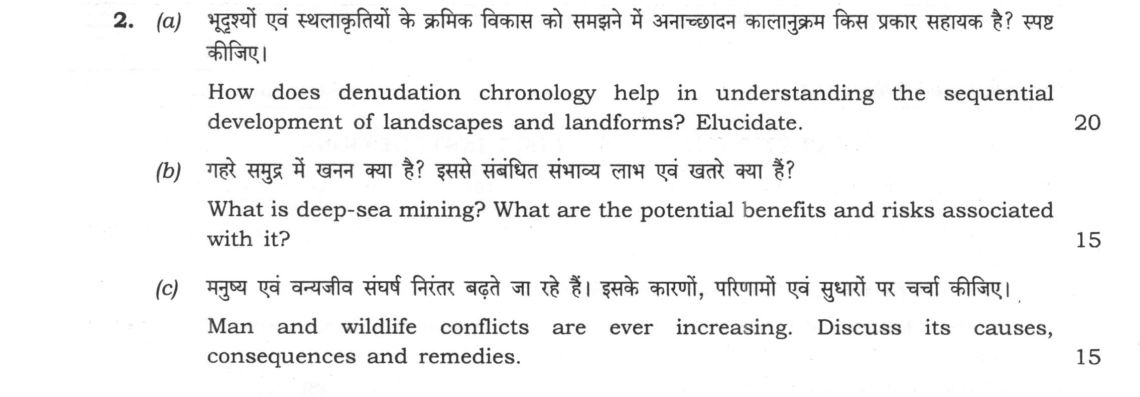
(a) How does denudation chronology help in understanding the sequential development of landscapes and landforms? Elucidate. (20…
How does denudation chronology help in understanding the sequential development of landscapes and landforms? Elucidate. 20 marks
What is deep-sea mining? What are the potential benefits and risks associated with it? 15 marks
Man and wildlife conflicts are ever increasing. Discuss its causes, consequences and remedies. 15 marks
हिंदी में प्रश्न पढ़ें
भूदृश्यों एवं स्थलाकृतियों के क्रमिक विकास को समझने में अनाच्छादन कालानुक्रम किस प्रकार सहायक है? स्पष्ट कीजिए। (20 अंक)
गहरे समुद्र में खनन क्या है? इससे संबंधित संभाव्य लाभ एवं खतरे क्या हैं? (15 अंक)
मनुष्य एवं वन्यजीव संघर्ष निरंतर बढ़ते जा रहे हैं। इसके कारणों, परिणामों एवं सुधारों पर चर्चा कीजिए। (15 अंक)
Model answer
Written by UPSC Answer Check against this question's marking rubric, to the expected length. UPSC does not publish answers for Mains — this is one way to score well, not an official key.
Denudation chronology Denudation chronology is the ordering of erosion surfaces and landform generations to read a landscape as a sequence of past denudation events. It makes plain how present relief is not a single-age surface but a palimpsest. In Davisian cycle, a dissected upland passes through youth, maturity and old age, with rejuvenation by base-level fall producing younger valleys on older surfaces. Penck’s slope-replacement model emphasises that mature landscapes are shaped by successive slope surfaces replacing older ones, rather than by a single peneplain. King’s pediplanation explains parallel retreat of escarpments and formation of pediplains, while etchplanation, associated with Wayland and Büdel, describes deep tropical chemical weathering and stripping of saprolite to form etchplains. These models help distinguish relict surfaces: Western Ghats escarpments show stepped relief and scarp retreat; Nilgiri and Mysore plateaus preserve older, gently undulating surfaces cut by younger rivers. Polycyclic relief is recognised where erosion surfaces, peneplains, relict ridges and incised valleys overlap. Morphometric analysis, relative dating of terraces, and absolute methods such as cosmogenic nuclide or OSL dating allow sequences to be correlated with base-level changes and tectonic episodes. Thus denudation chronology converts scattered landforms into a time-series, showing which surfaces are old, which were rejuvenated, and how uplift, climate and base level produced the present landscape.
Deep-sea mining Deep-sea mining is the extraction of mineral resources from the ocean floor, mainly polymetallic nodules on abyssal plains, polymetallic sulphides at hydrothermal vents, and cobalt-rich ferromanganese crusts on seamounts. It is regulated through the International Seabed Authority under UNCLOS, which controls exploration and future exploitation in the Area. The potential benefits are strategic: nodules and crusts contain manganese, nickel, cobalt, copper and rare-earth elements needed for batteries, electric vehicles, renewable-energy infrastructure and defence electronics, reducing dependence on land-based mining and conflict minerals. India’s exploration contract in the Central Indian Ocean Basin is relevant to this green-transition mineral security. The risks are equally serious. Mining can destroy benthic habitats, generate sediment plumes that smother organisms, create noise and light pollution, and disperse toxic metals. Many abyssal and chemosynthetic communities are slow-growing, poorly known and may have no recovery. There are also risks to fisheries, carbon and nutrient cycles, and to the legal and environmental governance of the high seas. Thus deep-sea mining is not simply a resource option but an environmental trade-off: benefits must be weighed against precautionary regulation, environmental management plans, and alternatives such as recycling and land-based supply.
Human–wildlife conflict Human–wildlife conflict is increasing because wildlife ranges and human settlements are expanding into each other. Habitat fragmentation, linear infrastructure such as roads, railways and transmission lines, crop raiding, livestock predation and rising population pressure force animals into villages and farms. In India, elephant corridors are blocked by settlements and infrastructure, Asiatic lion dispersal from Gir creates pressure in Gujarat and Rajasthan, and leopard conflicts in Himachal Pradesh and other forest-fringe areas show how connectivity loss drives encounters. Consequences are economic and ecological: crop and livestock losses, injury or death, retaliatory killing, poisoning, and displacement of both people and animals, which further destabilises populations. Remedies must be multi-stakeholder. E-Surveillance, early-warning systems and rapid-response teams can reduce attacks. Compensation schemes and insurance reduce the cost of coexistence. Community reserves, protected-area expansion and landscape connectivity, such as the Kanha–Pench corridor, restore movement space. Crop-protection measures, including PM-KISHA support, fencing, solar lighting, bee-keeping and buffer-zone agriculture, lower raiding. Legal enforcement under the Wildlife (Protection) Act, habitat restoration, and community participation are essential. The way forward is to manage shared landscapes through connectivity, compensation, technology and local ownership, recognising that landforms, ocean resources and wildlife are dynamic systems requiring sustainable use.
What "Elucidate" is asking you to do
Make a stated proposition plain and then prove it with instances. Elucidate stems almost always carry a claim or a named concept, and very often the words “with examples” or “with suitable diagrams” — the illustration is part of the directive, not decoration.
Structure that answers it
Plain-language statement of what the proposition means → the part that is obscure, resolved → first illustration → second illustration → why the proposition holds
Where marks are lost
Adding terminology; elucidate rewards removing it. The commoner loss is a clean explanation with no example, when the stem asked for examples.
How this answer will be evaluated
Approach
Framework: Concept or mechanism > Diagram > Regional example > Application. (a) explain: definition/context > points in order > small example > short close | (b) explain: definition/context > points in order > small example > short close | (c) discuss: intro > 3-4 dimensions > example > balanced close Full marks: Comprehensive mechanism, precise examples, balanced assessment, and clear diagrams.
Key points expected
- Define denudation chronology (e.g., Davisian cycle or Penck's model)
- Explain the sequential stages of landscape development (youth, maturity, old age)
- Link specific landforms to specific stages of denudation
- Provide a regional example of a landscape in a specific stage
- Define deep-sea mining (extraction of polymetallic nodules, etc.)
- Identify specific potential benefits (e.g., rare earth elements, energy transition)
- Identify specific risks (e.g., benthic ecosystem damage, sediment plumes)
- Mention the regulatory body (ISA) or legal framework
Evaluation rubric
Each sub-part is marked on its own, against the marks and word limit printed on the paper.
- (a) Mechanism of denudation chronology and its role in sequencing landscape development. 20 marks
explain— definition/context → points in order → small example → short close
Must cover
- Define denudation chronology (e.g., Davisian cycle or Penck's model)
- Explain the sequential stages of landscape development (youth, maturity, old age)
- Link specific landforms to specific stages of denudation
- Provide a regional example of a landscape in a specific stage
Loses marks
- Description of landforms without linking to chronological stages
- Confusing denudation with erosion or weathering
- No diagram or visual aid
Earns more
- Mention of specific indices (e.g., relief ratio, hypsometric curve)
- Comparison of Davisian and Penck's models
- Reference to specific Indian physiographic regions (e.g., Deccan, Himalayas)
Extra mark
- Labelled diagram of the cycle of erosion
- Reference to specific recent research or data on denudation rates
- (b) Definition of deep-sea mining and a balanced assessment of its benefits and risks. 15 marks
explain— definition/context → points in order → small example → short close
Must cover
- Define deep-sea mining (extraction of polymetallic nodules, etc.)
- Identify specific potential benefits (e.g., rare earth elements, energy transition)
- Identify specific risks (e.g., benthic ecosystem damage, sediment plumes)
- Mention the regulatory body (ISA) or legal framework
Loses marks
- Vague description of 'mining' without specific deep-sea context
- Listing benefits without corresponding risks (or vice versa)
- Ignoring the environmental impact entirely
Earns more
- Specific examples of minerals (e.g., cobalt, nickel, manganese)
- Reference to specific mining sites (e.g., Clarion-Clipperton Zone)
- Discussion of the 'precautionary principle' in this context
Extra mark
- Diagram showing the mining process and environmental impact
- Reference to specific recent ISA decisions or moratoriums
- (c) Analysis of causes, consequences, and remedies for man-wildlife conflicts. 15 marks
discuss— intro → 3-4 dimensions → example → balanced close
Must cover
- Identify specific causes (e.g., habitat loss, fragmentation, encroachment)
- Detail consequences for both humans (crop damage, injury) and wildlife (death, displacement)
- Propose specific remedies (e.g., wildlife corridors, compensation, community involvement)
- Provide a specific Indian example (e.g., elephant corridors in Kerala, tiger reserves)
Loses marks
- General statements without specific examples or mechanisms
- Focusing only on one side (human or wildlife) of the conflict
- Lack of specific remedies or solutions
Earns more
- Mention of specific legislation (e.g., Wildlife Protection Act)
- Reference to specific technologies (e.g., early warning systems, drones)
- Discussion of the socio-economic dimensions of the conflict
Extra mark
- Map showing specific conflict hotspots in India
- Reference to specific recent incidents or data on conflict frequency
Practice this exact question
Write your answer and it is marked point by point against the model answer above — what you covered, what you missed, what you got wrong.
Evaluate my answer →More from Geography 2025 Paper I
- Q1 Answer the following in about 150 words each: (a) Explain the causes of glacial lake outb…
- Q2 (a) How does denudation chronology help in understanding the sequential development of la…
- Q3 (a) Examine the formation of atmospheric tricellular circulation system. Describe with ex…
- Q4 (a) What are the ecological consequences of agricultural deforestation in the Amazon and…
- Q5 Answer the following in about 150 words each: (a) Why did the Welfare Approach in Human G…