Paper I — Q3
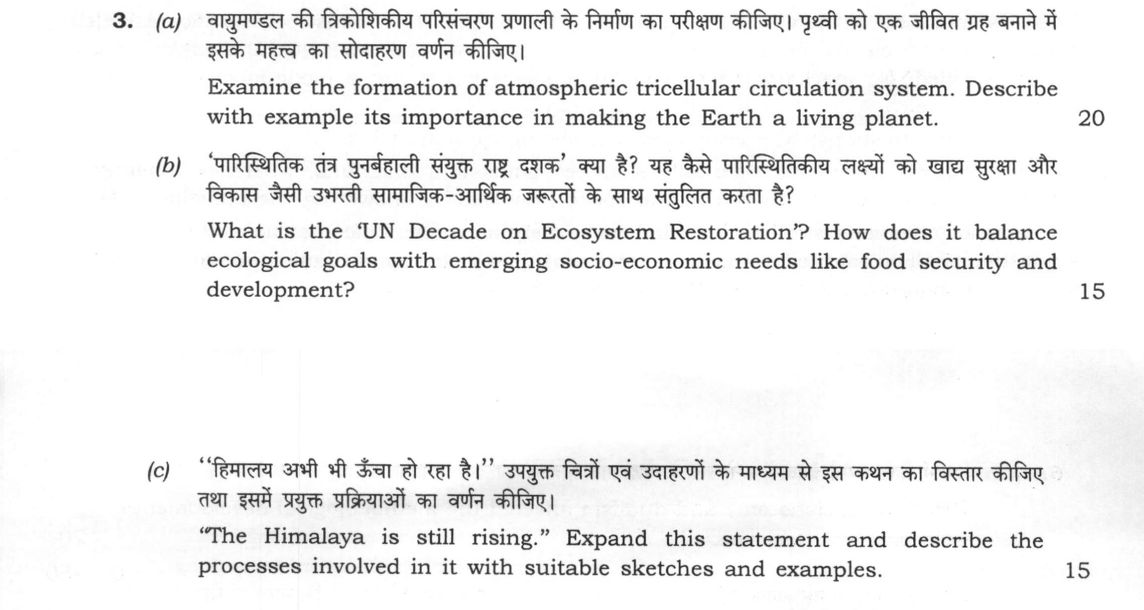
(a) Examine the formation of atmospheric tricellular circulation system. Describe with example its importance in making the Earth…
Examine the formation of atmospheric tricellular circulation system. Describe with example its importance in making the Earth a living planet. 20 marks
What is the 'UN Decade on Ecosystem Restoration'? How does it balance ecological goals with emerging socio-economic needs like food security and development? 15 marks
"The Himalaya is still rising." Expand this statement and describe the processes involved in it with suitable sketches and examples. 15 marks
हिंदी में प्रश्न पढ़ें
वायुमण्डल की त्रिकोशिकीय परिसंचरण प्रणाली के निर्माण का परीक्षण कीजिए। पृथ्वी को एक जीवित ग्रह बनाने में इसके महत्व का सौदाहरण वर्णन कीजिए। (20 अंक)
'पारिस्थितिक तंत्र पुनर्स्थापनी संयुक्त राष्ट्र दशक' क्या है? यह कैसे पारिस्थितिकीय लक्ष्यों को खाद्य सुरक्षा और विकास जैसी उभरती सामाजिक-आर्थिक जरूरतों के साथ संतुलित करता है? (15 अंक)
"हिमालय अभी भी ऊँचा हो रहा है।" उपयुक्त चित्रों एवं उदाहरणों के माध्यम से इस कथन का विस्तार कीजिए तथा इसमें प्रयुक्त प्रक्रियाओं का वर्णन कीजिए। (15 अंक)
Model answer
Written by UPSC Answer Check against this question's marking rubric, to the expected length. UPSC does not publish answers for Mains — this is one way to score well, not an official key.
Atmospheric tricellular circulation. The claim that Earth’s atmosphere operates as a tricellular system is well supported because differential solar heating, the Coriolis force and pressure-belt formation together produce three meridional cells in each hemisphere. Intense equatorial heating creates low pressure and rising air at the ITCZ; air diverges aloft, descends near 30° latitude to form subtropical highs, and returns as trade winds, constituting the Hadley cell. The Ferrel cell is an indirect cell between 30° and 60°, where surface westerlies carry warm, moist air poleward toward the subpolar low, while upper-level easterlies return air equatorward. The polar cell completes the system, with cold air descending at the pole and blowing as polar easterlies toward the subpolar low. The finding is that this circulation is not merely a schematic; it redistributes heat, organises precipitation and maintains biodiversity. The ITCZ’s seasonal migration sustains tropical rainforests and monsoonal rainfall; in India, the south-west monsoon, modulated by the Hadley cell and pressure contrasts, supports rice cultivation and groundwater recharge. Westerlies transport moisture to temperate zones and drive the Antarctic Circumpolar Current; polar easterlies help maintain cold, dry polar air masses and influence sea-ice dynamics that regulate Antarctic marine food webs. Thus the tricellular system makes Earth habitable by moderating temperature extremes and stabilising water cycles.
UN Decade on Ecosystem Restoration. The UN Decade on Ecosystem Restoration (2021–2030) is a global initiative to restore degraded ecosystems, enhance biodiversity, and improve livelihoods. It aligns with UNCCD’s land-degradation-neutrality goals and the CBD Kunming-Montreal Global Biodiversity Framework, which calls for restoring at least 30 per cent of degraded ecosystems by 2030 and the 30x30 conservation target; the Decade has also mobilised commitments toward restoring 1 billion hectares. Mechanisms include the Bonn Challenge, national commitments, and landscape restoration that combines forests, wetlands, soils and agricultural systems. The Decade balances ecological goals with socio-economic needs by making restoration productive. Agroforestry using nitrogen-fixing Sesbania with fast-growing Moringa for fodder and food can restore degraded lands while improving nutrition and soil fertility. Payment for ecosystem services rewards communities for watershed protection, carbon storage and pollination. In India, Joint Forest Management under forest governance frameworks mobilises local communities to restore forests, protect biodiversity and secure non-timber forest produce. Nature-based solutions such as wetland restoration and soil conservation enhance food security by improving water availability, crop resilience and livelihoods.
Himalayan uplift. The statement “The Himalaya is still rising” is tectonically accurate. Ongoing convergence between the Indian and Eurasian plates causes crustal shortening, underthrusting along the Main Himalayan Thrust, and active faulting along the Main Boundary Thrust. Neo-tectonic processes include MHT activity, duplex formation and continued crustal shortening. GPS measurements show continued northward movement of India and uplift in parts of the range; river incision rates and frequent seismicity, including major Himalayan earthquakes, confirm active deformation. A cross-section sketch would show the Indian plate underthrusting Eurasia, the MHT as a major ramp, duplex formation in the mid-Himalaya, and a foreland fold-thrust belt; a drainage sketch would show terraced river valleys, knickpoints and anomalous captures. Examples are the Nanga Parbat-Haramosh massif, where steep topography and active faulting indicate rapid uplift, and the Arun-Kosi river captures, where river reorganisation reflects differential uplift and tectonic control. The MBT remains an active structure, recording ongoing crustal shortening.
The tricellular atmosphere, ecosystem-restoration governance and Himalayan tectonics together show that planetary habitability depends on dynamic, interacting systems. The atmosphere regulates climate and water; restoration policies can align ecological recovery with food security and development; and the Himalaya’s continued rise demonstrates that Earth’s solid surface is still shaping its climate, drainage and biodiversity.
What "Examine" is asking you to do
Test the proposition the question puts to you and return a finding on how far it holds. Examine stems carry a claim, or ask whether something has happened, and expect evidence weighed both ways before the extent is stated — often with remedial measures attached.
Structure that answers it
Restate the claim as the question frames it → evidence that supports it → evidence that undercuts it → the conditions under which it holds → verdict on how far it stands
Where marks are lost
Stopping at description. An examination has to reach a finding, and “examine with justification” means the extent must be stated, not implied.
How this answer will be evaluated
Approach
Framework: Concept > Diagram > Regional Example > Application. (a) examine: intro > how/why with reasoning > evidence > conclusion | (b) explain: definition/context > points in order > small example > short close | (c) describe: define > structure or process in order > labelled diagram > significance Full marks: Precise mechanisms, labelled diagrams, and specific regional examples for all parts.
Key points expected
- Mechanism of Hadley, Ferrel, and Polar cells
- Role of Coriolis force in cell formation
- Link to ITCZ and subtropical high pressure belts
- Example of climate impact (e.g., monsoons or deserts)
- Definition of 'UN Decade on Ecosystem Restoration' (2021-2030)
- Explanation of ecological goals (biodiversity, carbon)
- Explanation of socio-economic goals (food security, livelihoods)
- Mechanism of balancing these two (e.g., agroforestry)
Evaluation rubric
Each sub-part is marked on its own, against the marks and word limit printed on the paper.
- (a) Mechanism of tricellular circulation and its role in planetary habitability. 20 marks
examine— intro → how/why with reasoning → evidence → conclusion
Must cover
- Mechanism of Hadley, Ferrel, and Polar cells
- Role of Coriolis force in cell formation
- Link to ITCZ and subtropical high pressure belts
- Example of climate impact (e.g., monsoons or deserts)
Loses marks
- Describing cells without explaining the driving force (heat/Coriolis)
- Omitting the 'tricellular' aspect (only mentioning Hadley)
Earns more
- Labelled sketch of global circulation cells
- Mention of pressure belts (Equatorial, Subtropical, Subpolar)
- Connection to oceanic gyres
Extra mark
- Reference to specific climate zones (e.g., Sahara, Amazon)
- (b) Definition of the UN Decade and its balance of ecology vs. socio-economics. 15 marks
explain— definition/context → points in order → small example → short close
Must cover
- Definition of 'UN Decade on Ecosystem Restoration' (2021-2030)
- Explanation of ecological goals (biodiversity, carbon)
- Explanation of socio-economic goals (food security, livelihoods)
- Mechanism of balancing these two (e.g., agroforestry)
Loses marks
- Treating it as a general environmental policy without specific dates
- Ignoring the 'socio-economic' half of the question
Earns more
- Mention of 'restoring degraded ecosystems' as a core aim
- Link to Sustainable Development Goals (SDGs)
Extra mark
- Specific example of a restoration project (e.g., Great Green Wall)
- (c) Geological processes behind the ongoing uplift of the Himalayas. 15 marks
describe— define → structure or process in order → labelled diagram → significance
Must cover
- Process of India-Asia plate convergence
- Mechanism of crustal shortening and thickening
- Role of isostatic rebound or gravitational collapse
- Suitable sketch of the collision zone
Loses marks
- Describing the mountain range without the tectonic mechanism
- Failing to provide the requested sketch
Earns more
- Mention of specific rates (e.g., 5mm/year)
- Reference to the Main Central Thrust (MCT)
Extra mark
- Mention of GPS data or recent seismic activity
Practice this exact question
Write your answer and it is marked point by point against the model answer above — what you covered, what you missed, what you got wrong.
Evaluate my answer →More from Geography 2025 Paper I
- Q1 Answer the following in about 150 words each: (a) Explain the causes of glacial lake outb…
- Q2 (a) How does denudation chronology help in understanding the sequential development of la…
- Q3 (a) Examine the formation of atmospheric tricellular circulation system. Describe with ex…
- Q4 (a) What are the ecological consequences of agricultural deforestation in the Amazon and…
- Q5 Answer the following in about 150 words each: (a) Why did the Welfare Approach in Human G…
- Q6 (a) How have dichotomy and dualism affected the methodological development of Geography?…