Paper I — Q8
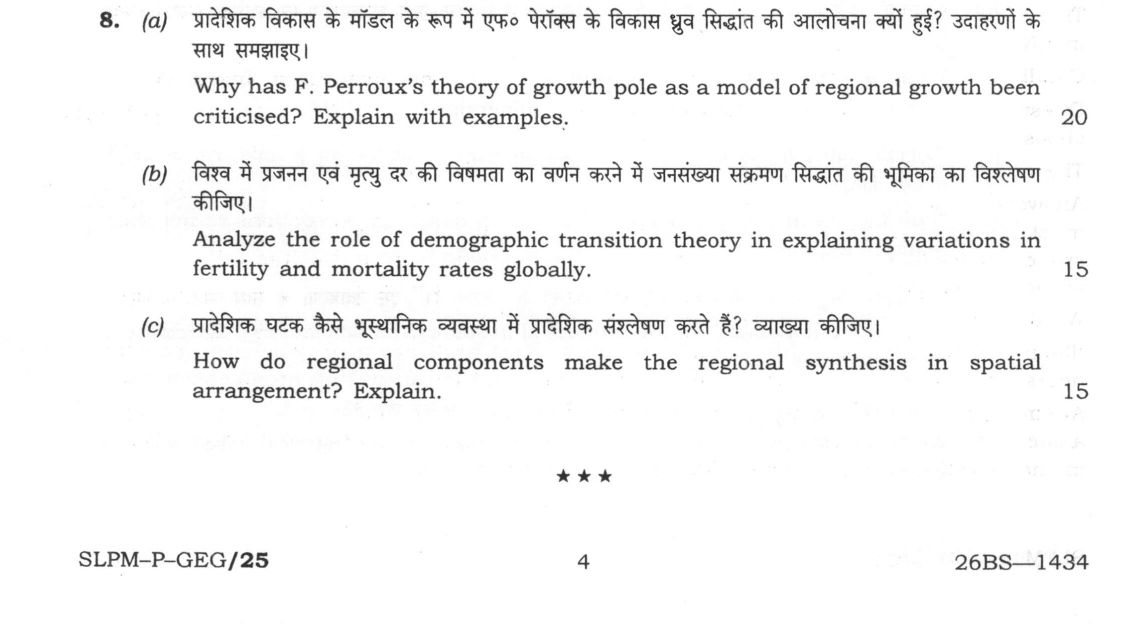
(a) Why has F. Perroux's theory of growth pole as a model of regional growth been criticised? Explain with examples. (20…
Why has F. Perroux's theory of growth pole as a model of regional growth been criticised? Explain with examples. 20 marks
Analyze the role of demographic transition theory in explaining variations in fertility and mortality rates globally. 15 marks
How do regional components make the regional synthesis in spatial arrangement? Explain. 15 marks
हिंदी में प्रश्न पढ़ें
प्रादेशिक विकास के मॉडल के रूप में एफ० पेरॉक्स के विकास ध्रुव सिद्धांत की आलोचना क्यों हुई? उदाहरणों के साथ समझाइए। (20 अंक)
विश्व में प्रजनन एवं मृत्यु दर की विषमता का वर्णन करने में जनसंख्या संक्रमण सिद्धांत की भूमिका का विस्लेषण कीजिए। (15 अंक)
प्रादेशिक घटक कैसे भूस्थानिक व्यवस्था में प्रादेशिक संश्लेषण करते हैं? व्याख्या कीजिए। (15 अंक)
Model answer
Written by UPSC Answer Check against this question's marking rubric, to the expected length. UPSC does not publish answers for Mains — this is one way to score well, not an official key.
Criticism of Perroux’s Growth Pole Theory
François Perroux conceptualised growth poles (pôles de croissance) within abstract economic space, asserting that economic growth does not appear everywhere at once, but originates at dynamic, innovative "propulsive industries" (industries motrices) possessing strong inter-industry linkages. Jacques Boudeville subsequently translated this concept into geographical space as urban growth centres. The model posits that agglomeration economies and multiplier mechanisms within the pole will eventually diffuse prosperity to peripheral hinterlands through "trickle-down" or spread effects.
However, the model has been widely criticised for several structural flaws:
Dominance of Polarization and Backwash Effects: Instead of diffusing growth, growth poles generate centripetal forces. As Gunnar Myrdal explained, backwash effects—the selective drainage of capital, raw materials, and skilled manpower from the hinterland to the core—overwhelm weak spread effects, exacerbating core-periphery disparities.
Spatial Process: [Propulsive Core] <--- (Backwash: Drains Labour & Capital) --- [Periphery/Hinterland] [Propulsive Core] --x (Weak Spread / Limited Trickle-Down) --x> [Periphery/Hinterland] Outcome: Enclave development and regional inequality.
Capital-Intensive Bias and Limited Employment: Propulsive units are typically high-technology, capital-intensive industries (e.g., heavy engineering, metallurgy) that create minimal direct employment for local populations and lack organic forward-backward linkages with traditional agrarian economies.
Neglect of Institutional and Social Infrastructure: Perroux assumed seamless market mechanisms, ignoring structural barriers such as land tenure, illiteracy, lack of healthcare, and poor transport infrastructure that prevent hinterlands from absorbing growth impulses.
Empirical Failures in Developing Nations: When applied as top-down regional planning tools, growth centres produced isolated enclaves. In India, public sector investments in steel cities like Bhilai, Rourkela, and Bokaro created industrial islands within underdeveloped tribal hinterlands without triggering broad regional development. Similarly, the Mumbai-Pune industrial belt polarised Maharashtra's economy, leaving Marathwada and Vidarbha marginalized. A parallel outcome occurred in Brazil, where the Manaus Free Trade Zone failed to integrate with the broader Amazonian interior.
Role of Demographic Transition Theory (DTT) in Global Demographic Variations
Demographic Transition Theory (Thompson, Notestein) explains variations in fertility and mortality rates as systemic adjustments driven by socio-economic modernisation (urbanisation, industrialisation, and healthcare expansion) across evolutionary stages:
Stage 2 and 3 (Developing Nations): Modern medical interventions sharply lower crude death rates (CDR), while crude birth rates (CBR) remain high due to agrarian dependency, religious norms, and low female literacy. This widening demographic gap causes population explosion across Sub-Saharan Africa and parts of South Asia. As urbanisation and female education advance (Stage 3), fertility declines (e.g., India's TFR reaching 2.0).
Stage 4 and 5 (Developed Nations): High urbanisation, female workforce participation, and high costs of child-rearing depress CBR below CDR, resulting in sub-replacement fertility, population aging, and natural decrease across Western Europe, Japan, and South Korea.
Criticisms and Exceptions: DTT is criticised for Eurocentric determinism, assuming all nations follow linear industrial-demographic trajectories. It overlooks state policy interventions, notably China’s One-Child Policy, which artificially compressed the transition timeline regardless of economic stage. It also ignores cultural diversity: within India, Kerala attained Stage 4 replacement levels through social development and female literacy decades before industrialising, whereas Bihar remains in Stage 2/3 despite identical national macroeconomic policies.
Regional Synthesis in Spatial Arrangement
Regional synthesis is geography's central integrative method, articulated by Richard Hartshorne through "areal differentiation." It explains how distinct physical, economic, social, cultural, and political components interact dynamically within a bounded space to produce an integrated spatial structure.
Spatial Interaction Model: [Physical Base: Relief, Drainage, Climate] ↕ (Resource Base & Constraints) [Economic Layer: Agriculture, Industry, Transport Networks] ↕ (Livelihoods & Spatial Organization) [Socio-Cultural & Political Fabric: Demography, Institutions, Administrative Frameworks] = Integrated Regional Synthesis
The mechanism operates through layered causation: the physical environment provides resources and constraints; human agency exploits these opportunities via technology and economic organisation; and socio-cultural institutions stabilise this arrangement spatially.
For instance, the Indo-Gangetic Plain synthesises perennial Himalayan drainage and fertile alluvium (physical base) with intensive agriculture, dense canal and rail networks (economic), giving rise to high population densities, compact settlement structures, and historical urban agglomerations (social-cultural).
Conversely, in India's Northeast, rugged terrain and biodiversity (physical) necessitate terrace and shifting cultivation (economic), fostering isolated ethnic communities and tailored administrative mechanisms like Sixth Schedule autonomous district councils (socio-political).
Uncoordinated, top-down growth poles trigger distress migration and regional imbalances precisely because they disregard demographic realities and local socio-ecological systems. Sustainable regional development requires regional synthesis as a spatial planning methodology, integrating economic interventions with demographic dynamics and ecological capacities.
What "Explain" is asking you to do
Make the working of something clear — what sets it off, what follows from what, and what it produces. Explain is the Commission's mechanism word: it dominates the technical papers and the “explain why” stems, where the marks sit in the causal chain and not in the label.
Structure that answers it
State what it is → the initiating condition → the chain of cause, step by step → an instance where it plays out → what the chain produces
Where marks are lost
Describing what something looks like instead of why it works that way. Naming the stages without linking them reads as description too.
How this answer will be evaluated
Approach
Framework: Concept or mechanism > Diagram > Regional example > Application. (a) critique: the claim > its strengths > its weaknesses > your judgment | (b) analyse: intro > causes > effects > stakeholders/linkages > way forward | (c) explain: definition/context > points in order > small example > short close Full marks: Clear mechanism, specific examples, balanced judgment, and relevant diagrams.
Key points expected
- Define growth pole and its core mechanism
- Identify at least three specific criticisms of the model
- Provide specific regional examples (e.g., Silicon Valley)
- Conclude with a balanced judgment on the theory
- Outline the stages of the demographic transition
- Explain the link between stages and fertility/mortality
- Provide global examples of regions in different stages
- Discuss limitations of the theory in modern contexts
Evaluation rubric
Each sub-part is marked on its own, against the marks and word limit printed on the paper.
- (a) Critique Perroux's growth pole theory with specific regional examples. 20 marks
critique— the claim → its strengths → its weaknesses → your judgment
Must cover
- Define growth pole and its core mechanism
- Identify at least three specific criticisms of the model
- Provide specific regional examples (e.g., Silicon Valley)
- Conclude with a balanced judgment on the theory
Loses marks
- Description of the theory without critique
- Vague examples without specific regional names
- No mention of the mechanism of growth
Earns more
- Mention 'trickle-down' vs 'backwash' effects
- Reference specific critics (e.g., Myrdal, Hirschman)
- Include a diagram of growth pole dynamics
- Link to modern regional planning policies
Extra mark
- Cite specific data on regional inequality
- Mention a specific government policy based on this
- (b) Analyze the role of demographic transition theory in global fertility/mortality variations. 15 marks
analyse— intro → causes → effects → stakeholders/linkages → way forward
Must cover
- Outline the stages of the demographic transition
- Explain the link between stages and fertility/mortality
- Provide global examples of regions in different stages
- Discuss limitations of the theory in modern contexts
Loses marks
- Listing stages without explaining the mechanism
- Ignoring the global variation aspect
- No mention of the theory's limitations
Earns more
- Include a demographic transition curve diagram
- Mention specific countries (e.g., India, Nigeria, Japan)
- Discuss the role of healthcare and education
- Reference recent census data or UN projections
Extra mark
- Mention the 'demographic dividend' concept
- Reference a specific UN World Population Report
- (c) Explain how regional components create regional synthesis in spatial arrangement. 15 marks
explain— definition/context → points in order → small example → short close
Must cover
- Define regional components and regional synthesis
- Explain the interaction between physical and human components
- Describe how these interactions create spatial patterns
- Provide a specific regional example of synthesis
Loses marks
- Defining terms without explaining the process
- No specific regional example
- Ignoring the spatial arrangement aspect
Earns more
- Include a diagram of regional synthesis
- Mention specific spatial patterns (e.g., urban-rural)
- Reference specific regional planning concepts
- Link to sustainable regional development
Extra mark
- Cite a specific regional planning document
- Mention a specific spatial analysis technique
Practice this exact question
Write your answer and it is marked point by point against the model answer above — what you covered, what you missed, what you got wrong.
Evaluate my answer →More from Geography 2025 Paper I
- Q5 Answer the following in about 150 words each: (a) Why did the Welfare Approach in Human G…
- Q6 (a) How have dichotomy and dualism affected the methodological development of Geography?…
- Q7 (a) Why is oil important for energy security? What is the role of oil in clean energy tra…
- Q8 (a) Why has F. Perroux's theory of growth pole as a model of regional growth been critici…