Paper I — Q4
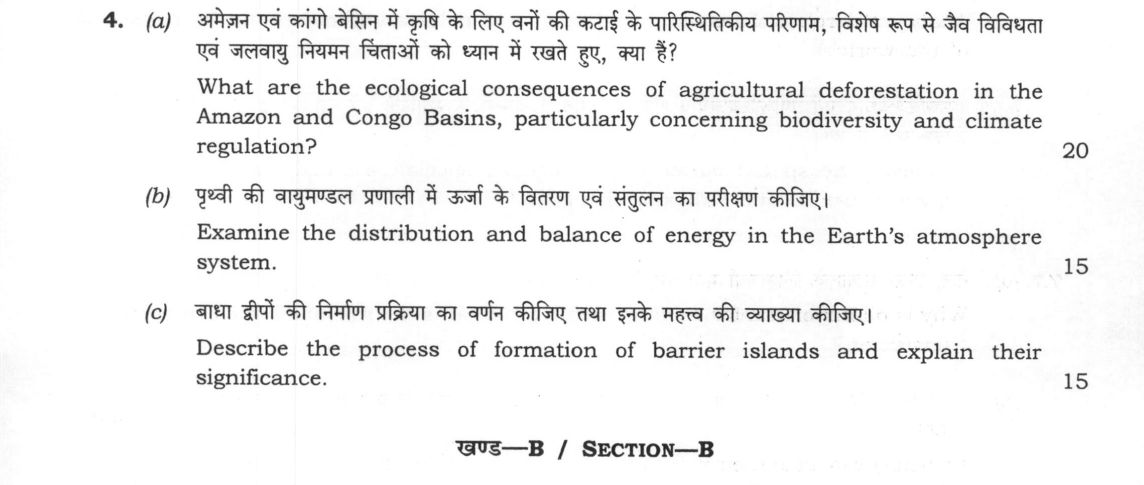
(a) What are the ecological consequences of agricultural deforestation in the Amazon and Congo Basins, particularly concerning…
What are the ecological consequences of agricultural deforestation in the Amazon and Congo Basins, particularly concerning biodiversity and climate regulation? 20 marks
Examine the distribution and balance of energy in the Earth's atmosphere system. 15 marks
Describe the process of formation of barrier islands and explain their significance. 15 marks
हिंदी में प्रश्न पढ़ें
अमेज़न एवं कांगो बेसिन में कृषि के लिए वनों की कटाई के पारिस्थितिकीय परिणाम, विशेष रूप से जैव विविधता एवं जलवायु नियमन चिंताओं को ध्यान में रखते हुए, क्या हैं? (20 अंक)
पृथ्वी की वायुमंडल प्रणाली में ऊर्जा के वितरण एवं संतुलन का परीक्षण कीजिए। (15 अंक)
बाधा द्वीपों की निर्माण प्रक्रिया का वर्णन कीजिए तथा इनके महत्व की व्याख्या कीजिए। (15 अंक)
Model answer
Written by UPSC Answer Check against this question's marking rubric, to the expected length. UPSC does not publish answers for Mains — this is one way to score well, not an official key.
Ecological Consequences of Deforestation in the Amazon and Congo Basins
Agricultural clearance across the Amazon and Congo basins disrupts primary terrestrial carbon sinks and biophysical regulators of the global climate system. In the Amazon, commercial cattle ranching and intensive soybean cultivation drive extensive habitat fragmentation, creating severe edge effects, disrupting wildlife corridors, and triggering local extinctions of keystone species. Deforestation impairs forest-driven evapotranspiration and biogenic aerosol emissions, weakening the tropospheric transport of moisture ("flying rivers") and causing regional rainfall decline. Critical research (Carlos Nobre, 2018) demonstrates that crossing a 20–25% cumulative deforestation threshold risks an irreversible tipping point toward tropical savannization.
Conversely, in the Congo Basin, shifting smallholder agriculture and logging concession roads threaten the equatorial rainforest and the world's most extensive tropical peatland complex in the Cuvette Centrale. The drainage and degradation of these peatlands threaten to release up to 30 gigatons of sub-surface carbon into the atmosphere, shifting the basin from an active sink to a net carbon source. While the Amazon's vulnerability manifests through basin-scale atmospheric-vegetation feedbacks, the Congo faces severe loss of subterranean carbon storage alongside poaching-induced defaunation. Addressing both requires aggressive enforcement of REDD+ mechanisms and landscape restoration commitments under the Bonn Challenge.
Distribution and Balance of the Earth-Atmosphere Energy System
The Earth-atmosphere system functions as an open thermodynamic engine driven by incoming shortwave solar radiation and balanced by outgoing longwave terrestrial radiation. Insolation is distributed heterogeneously across latitudes due to Earth's sphericity and axial tilt, producing a permanent radiative surplus between the equator and ~38° N/S, and a net radiative deficit poleward of 38°. Radiative equilibrium is maintained by meridional heat transport: atmospheric circulation (Hadley, Ferrel, and Polar cells) and ocean currents redistribute sensible and latent heat toward the poles.
Within the atmosphere, incoming solar radiation undergoes scattering (Rayleigh and Mie), reflection by clouds, and direct absorption by ozone and water vapor, yielding a planetary albedo of approximately 0.30. The remaining energy warms Earth's surface, which re-emits longwave infrared radiation. This terrestrial flux is largely absorbed and counter-radiated by atmospheric greenhouse gases, maintaining a mean surface temperature of ~15°C. However, contemporary observations by NASA’s CERES (Clouds and the Earth's Radiant Energy System) confirm a persistent positive Earth Energy Imbalance, indicating that anthropogenic greenhouse gas forcing traps excess thermal energy predominantly within the upper oceans.
Formation and Geomorphological Significance of Barrier Islands
Barrier islands are elongated, shore-parallel sedimentary bodies separated from the mainland by shallow lagoons or marsh estuaries. Their formation occurs through three primary mechanisms: the drowning and detachment of mainland beach ridges during Holocene sea-level transgression; the emergence and upward aggradation of offshore submarine sandbars driven by wave shoaling; and the growth and breach of longshore sand spits fed by riverine sediment loads and longshore drift. Overwash events during major storms and hydrodynamic adjustments through tidal inlets continuously transport sand landward via barrier rollover processes. Prominent examples include Padre Island, the Outer Banks of North Carolina, and the barrier islands flanking the Mississippi River delta.
These systems provide indispensable ecological and socioeconomic functions. They act as natural dissipative shock absorbers that attenuate high-energy storm surges and tsunamis, shielding mainland infrastructure. The sheltered lagoons behind them nurture hypersaline and estuarine habitats essential for fisheries and avian biodiversity. While barrier islands support substantial economic activity and tourism, their dynamic migration patterns present persistent navigation hazards and coastal erosion challenges, demanding integrated Coastal Zone Management (CZM) and Nature-based Solutions (NbS) over rigid structural armoring.
Conclusion
An examination of these surface systems reveals critical Earth-system interconnectedness: tropical deforestation disrupts the hydrological cycle and alters planetary latent heat fluxes, exacerbating global energy imbalances that drive climatic extremes and amplify marine hydrodynamic pressures on fragile barrier coasts. Holistic biosphere and coastal stewardship remain imperative.
What "Examine" is asking you to do
Test the proposition the question puts to you and return a finding on how far it holds. Examine stems carry a claim, or ask whether something has happened, and expect evidence weighed both ways before the extent is stated — often with remedial measures attached.
Structure that answers it
Restate the claim as the question frames it → evidence that supports it → evidence that undercuts it → the conditions under which it holds → verdict on how far it stands
Where marks are lost
Stopping at description. An examination has to reach a finding, and “examine with justification” means the extent must be stated, not implied.
How this answer will be evaluated
Approach
Framework: Concept or mechanism > Diagram > Regional example > Application. (a) discuss: intro > 3-4 dimensions > example > balanced close | (b) examine: intro > how/why with reasoning > evidence > conclusion | (c) describe: define > structure or process in order > labelled diagram > significance Full marks: Mechanism-first approach with diagrams and specific regional examples.
Key points expected
- Mechanism of biodiversity loss (habitat fragmentation)
- Carbon cycle disruption (source vs sink)
- Regional hydrological feedback (rainfall reduction)
- Comparison of Amazon vs Congo basin impacts
- Insolation distribution (equator vs poles)
- Mechanism of energy transfer (sensible/latent heat)
- Role of atmospheric circulation (Hadley/Ferrel cells)
- Concept of radiative equilibrium
Evaluation rubric
Each sub-part is marked on its own, against the marks and word limit printed on the paper.
- (a) Ecological consequences of deforestation in Amazon/Congo on biodiversity and climate. 20 marks
discuss— intro → 3-4 dimensions → example → balanced close
Must cover
- Mechanism of biodiversity loss (habitat fragmentation)
- Carbon cycle disruption (source vs sink)
- Regional hydrological feedback (rainfall reduction)
- Comparison of Amazon vs Congo basin impacts
Loses marks
- General description without causal mechanism
- Ignoring the specific 'Congo' basin context
Earns more
- Mention of 'flying rivers' or atmospheric moisture transport
- Specific species examples (e.g., jaguar, gorilla)
- Reference to tipping points in climate systems
Extra mark
- Labelled map of deforestation hotspots
- Recent data on forest cover loss (e.g., INPE)
- (b) Distribution and balance of energy in Earth's atmospheric system. 15 marks
examine— intro → how/why with reasoning → evidence → conclusion
Must cover
- Insolation distribution (equator vs poles)
- Mechanism of energy transfer (sensible/latent heat)
- Role of atmospheric circulation (Hadley/Ferrel cells)
- Concept of radiative equilibrium
Loses marks
- Describing weather without energy mechanism
- Omitting the 'balance' aspect (equilibrium)
Earns more
- Diagram of energy budget (incoming vs outgoing)
- Mention of albedo effect
- Link to global temperature gradients
Extra mark
- Sketch of atmospheric circulation cells
- Reference to specific energy flux values (W/m²)
- (c) Process of formation of barrier islands and their significance. 15 marks
describe— define → structure or process in order → labelled diagram → significance
Must cover
- Sediment transport mechanism (longshore drift)
- Role of wave action and storm surges
- Formation of lagoon/back-barrier environment
- Significance: coastal protection and habitat
Loses marks
- Confusing barrier islands with coral reefs
- Describing formation without 'significance'
Earns more
- Mention of 'spit' or 'bar' evolution
- Reference to specific examples (e.g., Andaman, Florida)
- Explanation of 'submergence' theory
Extra mark
- Labelled cross-section of barrier island
- Mention of specific Indian barrier islands
Practice this exact question
Write your answer and it is marked point by point against the model answer above — what you covered, what you missed, what you got wrong.
Evaluate my answer →More from Geography 2025 Paper I
- Q1 Answer the following in about 150 words each: (a) Explain the causes of glacial lake outb…
- Q2 (a) How does denudation chronology help in understanding the sequential development of la…
- Q3 (a) Examine the formation of atmospheric tricellular circulation system. Describe with ex…
- Q4 (a) What are the ecological consequences of agricultural deforestation in the Amazon and…
- Q5 Answer the following in about 150 words each: (a) Why did the Welfare Approach in Human G…
- Q6 (a) How have dichotomy and dualism affected the methodological development of Geography?…
- Q7 (a) Why is oil important for energy security? What is the role of oil in clean energy tra…