Paper I — Q7
(a) Why is oil important for energy security? What is the role of oil in clean energy transition? (20 marks) (b) Critically…
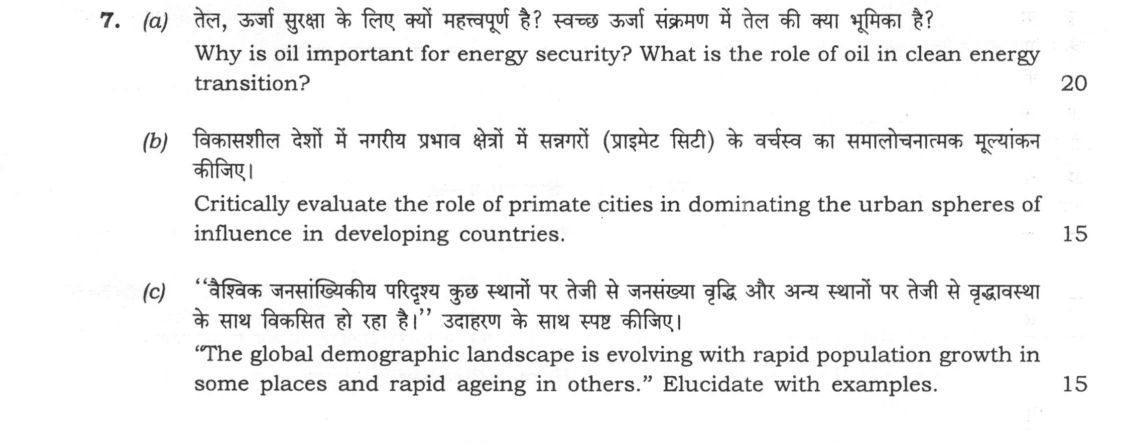
Why is oil important for energy security? What is the role of oil in clean energy transition? 20 marks
Critically evaluate the role of primate cities in dominating the urban spheres of influence in developing countries. 15 marks
"The global demographic landscape is evolving with rapid population growth in some places and rapid ageing in others." Elucidate with examples. 15 marks
हिंदी में प्रश्न पढ़ें
तेल, ऊर्जा सुरक्षा के लिए क्यों महत्वपूर्ण है? स्वच्छ ऊर्जा संक्रमण में तेल की क्या भूमिका है? (20 अंक)
विकासशील देशों में नगरीय प्रभाव क्षेत्रों में सत्ताग्रों (प्राइमेट सिटी) के वर्चस्व का समालोचनात्मक मूल्यांकन कीजिए। (15 अंक)
"वैश्विक जनसांख्यिकीय परिदृश्य कुछ स्थानों पर तेजी से जनसंख्या वृद्धि और अन्य स्थानों पर तेजी से वृद्धावस्था के साथ विकसित हो रहा है।" उदाहरण के साथ स्पष्ट कीजिए। (15 अंक)
Model answer
Written by UPSC Answer Check against this question's marking rubric, to the expected length. UPSC does not publish answers for Mains — this is one way to score well, not an official key.
Oil and energy security Oil remains central to energy security because it is the dominant fuel for transport, with a global share above 90%, and because heavy freight, aviation and marine shipping still lack immediate low-carbon substitutes. Its energy density and established supply chains make it difficult to replace quickly. For import-dependent economies such as India, crude imports create exposure to price volatility, exchange-rate shocks and geopolitical supply risk; the import bill affects inflation, the current account and fiscal transfers, so strategic petroleum reserves, diversified sourcing and fiscal buffers are treated as security instruments rather than mere commercial policy. Oil’s role as a bridge fuel is narrow: oil-fired generation may have served as a stop-gap in some power transitions, but it does not balance renewable variability; gas, hydro and storage do that. Oil can still act as a stop-gap in hard-to-electrify transport and industrial uses, and it supplies petrochemical feedstocks for wind turbine blades, solar panel components and EV plastics. Yet under IEA Net Zero 2050 scenarios, oil demand must fall sharply; continued dependence risks stranded assets and locks in emissions, so its transition role is limited and time-bound.
Primate cities A primate city is disproportionately larger than the second city, as in Mark Jefferson’s law, and examples include Mexico City, Buenos Aires, Bangkok and Lagos. Their dominance over national urban spheres of influence is produced by cumulative causation, agglomeration economies, political centralization and concentrated infrastructure—ministries, ports, universities and financial institutions—which draw firms, skilled labour and public investment into one urban core. In India, Mumbai’s financial, port and service-sector concentration illustrates how a primate city can dominate economic and cultural life. Critically, however, this dominance is not absolute. Secondary cities such as Pune, Hyderabad and Surabaya are growing and benefiting from decentralized industrial policies, better connectivity and digital economy opportunities that reduce some spatial concentration. Polycentric urban regions are emerging, but these counter-trends do not yet offset the primacy of Mumbai or Jakarta; they mainly soften it. The verdict is that primate dominance remains structurally strong in developing countries, but it is being moderated by policy and technology.
Demographic divergence The demographic landscape is splitting between rapid growth and rapid ageing. In Sub-Saharan Africa and parts of South Asia, populations are expanding quickly: Nigeria is projected to reach about 375 million by 2050, while the DRC, Ethiopia, Pakistan, Afghanistan and Yemen still have high fertility, with Yemen around 3.7; Bangladesh adds large absolute numbers. Declining but still high mortality and a large youth cohort create a youth bulge, implying future labour supply but also pressure on education, jobs and migration. In East Asia and Europe, ageing is rapid: Japan’s median age is about 48.6, South Korea’s about 44.5, China’s demographic dividend is ending, and Germany and Italy face similar low-fertility, high-longevity pressures. Low fertility and increased longevity raise old-age dependency ratios; in Japan the ratio is around or above 50%, while in Italy it is about 37%, Germany about 33%, South Korea about 25% and China about 20%. Where ratios approach or exceed 50%, pension and health-care burdens become acute. These divergences are interconnected: ageing economies face labour shortages and pension pressure, while youthful regions face job creation and migration pressure, shaping global labour flows, consumption patterns and resource demand.
Overall, oil’s security importance is high, but its clean-transition role is paradoxical and shrinking. Primate city dominance is real and still dominant, though secondary-city growth is moderating it. Demographic divergence will increasingly determine migration, labour markets and consumption, and energy transitions will shape urbanization patterns, which in turn influence demographic outcomes.
What "Critically evaluate" is asking you to do
Judge how well something has performed against the standard it set for itself — its stated aim, mandate or promise — and commit to a verdict. Name the yardstick before you judge; an unanchored judgement reads as opinion. “Critically” is not a section added at the end: name the yardstick you are judging by — the evidence, the stated objective, a constitutional principle, a rival explanation — and let a verdict close each part of the body. Where the question quotes a claim, that verdict must land on the claim itself, accepted, qualified or rejected, and not on the theme in general.
Structure that answers it
Name the yardstick — stated aim, mandate or benchmark → performance against it → shortfall against it → why the gap exists → verdict
Where marks are lost
Merits in one paragraph, demerits in the next, and a conclusion calling for a balanced and holistic approach. That is a survey with the judgement left out and it holds the answer in the middle band. The opposite error is reading “critically” as permission to attack — and with the odd pairings, critically describe or critically explain, the exposition still carries most of the marks, the judgement being a layer on it rather than a substitute for it.
How this answer will be evaluated
Approach
Framework: Concept > Diagram > Regional Example > Application. (a) explain: definition/context > points in order > small example > short close | (b) critically evaluate: positives > negatives/limits > conditions/safeguards > conclusion | (c) explain: definition/context > points in order > small example > short close Full marks: Precise definitions, clear mechanisms, specific regional examples, and relevant diagrams.
Key points expected
- Define energy security in the context of oil dependence
- Explain the mechanism of oil as a strategic reserve
- Describe the role of oil in petrochemicals and aviation
- Link oil's transition role to hydrogen and biofuels
- Define 'primate city' (Mark's concept)
- Explain the mechanism of 'primate' dominance (economic/political)
- Provide a specific developing country example (e.g., Bangkok, Lagos)
- Critique the negative impacts on regional balance
Evaluation rubric
Each sub-part is marked on its own, against the marks and word limit printed on the paper.
- (a) Explain oil's role in energy security and its function in the clean energy transition. 20 marks
explain— definition/context → points in order → small example → short close
Must cover
- Define energy security in the context of oil dependence
- Explain the mechanism of oil as a strategic reserve
- Describe the role of oil in petrochemicals and aviation
- Link oil's transition role to hydrogen and biofuels
Loses marks
- Treating oil and gas as identical commodities
- Ignoring the non-energy uses of oil (plastics)
Earns more
- Mention specific OPEC+ production quotas
- Reference the 'peak oil' debate
- Cite specific biofuel mandates (e.g., India's E20)
Extra mark
- Labelled diagram of the oil supply chain
- Recent data on global oil reserves
- (b) Critically evaluate the dominance of primate cities in developing countries' urban spheres. 15 marks
critically evaluate— positives → negatives/limits → conditions/safeguards → conclusion
Must cover
- Define 'primate city' (Mark's concept)
- Explain the mechanism of 'primate' dominance (economic/political)
- Provide a specific developing country example (e.g., Bangkok, Lagos)
- Critique the negative impacts on regional balance
Loses marks
- Confusing 'primate' with 'metropolitan' or 'megacity'
- Failing to provide a developing country context
Earns more
- Reference the 'primate city' index
- Mention specific regional disparities (e.g., Lagos vs. Kano)
- Discuss the 'primate' effect on migration
Extra mark
- Sketch map showing the 'primate' city's sphere of influence
- Citation of a specific urban planning policy
- (c) Elucidate the global demographic landscape's evolution with examples of growth and ageing. 15 marks
explain— definition/context → points in order → small example → short close
Must cover
- Define the 'demographic transition' model
- Identify regions of rapid growth (e.g., Sub-Saharan Africa)
- Identify regions of rapid ageing (e.g., Japan, Europe)
- Explain the causes (fertility rates, life expectancy)
Loses marks
- Failing to provide specific regional examples
- Ignoring the 'ageing' aspect of the question
Earns more
- Mention the 'demographic dividend' concept
- Reference specific census data (e.g., UN World Population Prospects)
- Discuss the 'ageing' impact on pension systems
Extra mark
- Pyramid diagram contrasting a young vs. old population
- Specific statistic on the 'old-age dependency ratio'
Practice this exact question
Write your answer and it is marked point by point against the model answer above — what you covered, what you missed, what you got wrong.
Evaluate my answer →More from Geography 2025 Paper I
- Q4 (a) What are the ecological consequences of agricultural deforestation in the Amazon and…
- Q5 Answer the following in about 150 words each: (a) Why did the Welfare Approach in Human G…
- Q6 (a) How have dichotomy and dualism affected the methodological development of Geography?…
- Q7 (a) Why is oil important for energy security? What is the role of oil in clean energy tra…
- Q8 (a) Why has F. Perroux's theory of growth pole as a model of regional growth been critici…