Paper II — Q1
(a) On the outline map of India provided to you, mark the location of all of the following. Write in your QCA Booklet the…
On the outline map of India provided to you, mark the location of all of the following. Write in your QCA Booklet the significance of these locations, whether physical/commercial/economic/ecological/environmental/cultural, in not more than 30 words for each entry : 2×10=20 Rushikulya River
Datar Hill
Kikruma
Choritand Tillaya
Byalalu
Neyyar
Uttarlai
Sri Vijayapuram
Dharwas
Gitabitan
Referring to the location and physical formation of karewas, highlight their economic significance. 10 marks
How does Himalayan ecosystem regulate the cropping pattern and agricultural activities in Himalayan region of India ? Discuss. 10 marks
Write a critically argued essay on nautical tourism and its infrastructure in India. 10 marks
हिंदी में प्रश्न पढ़ें
आपको दिए गए भारत के रेखा मानचित्र पर, निम्नलिखित सभी की स्थिति को अंकित कीजिए । अपनी क्यू.सी.ए. पुस्तिका में इन स्थानों में से प्रत्येक का भौतिक/वाणिज्यिक/आर्थिक/पारिस्थितिक/पर्यावरणीय/सांस्कृतिक महत्व अधिकतम 30 शब्दों में लिखिए : 2×10=20 रुशिकुल्या नदी
दातार हिल
किकरुमा
चोरितंद तिलैया
ब्यालालू
नेय्यार
उत्तरलाई
श्री विजयपुरम
धारवास
गीताबीतान
करेवा के स्थान और भौतिक निर्माण का उल्लेख करते हुए, उनके आर्थिक महत्व को रेखांकित कीजिए । 10
हिमालयी पारिस्थितिकी तंत्र भारत के हिमालयी क्षेत्र में फसल प्रणाली और कृषि गतिविधियों को कैसे नियंत्रित करता है ? चर्चा कीजिए । 10
भारत में समुद्री पर्यटन और इसके बुनियादी ढांचे पर एक आलोचनात्मक तार्किक निबंध लिखिए । 10
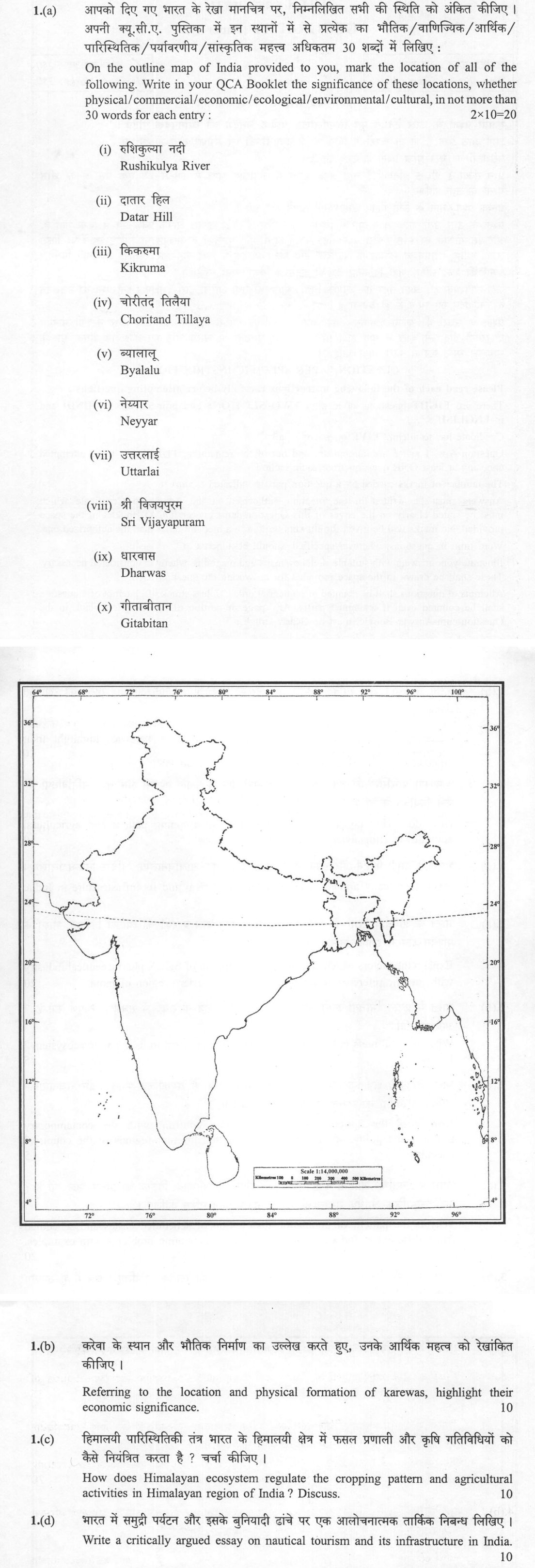
The figure this question refers to, in words
The question paper is a scan and the diagram did not survive as text. This is the figure as read from the original page — every component, value and label — so the question can be worked from the text below.
(a) Outline map of India with latitude and longitude grid. Latitude lines are marked on the left and right sides from 4°N to 36°N in 4° increments. Longitude lines are marked on the top and bottom from 64°E to 100°E in 4° increments. A dashed line representing the Tropic of Cancer crosses the map horizontally. The map includes the mainland of India, Sri Lanka, and island groups in the Indian Ocean. A scale bar is located in the lower right quadrant, labeled 'Scale 1:14,000,000' with a graphical scale in Kilometres ranging from 0 to 500.
Model answer
Written by UPSC Answer Check against this question's marking rubric, to the expected length. UPSC does not publish answers for Mains — this is one way to score well, not an official key.
Rushikulya River – A river in Ganjam district, Odisha, rising in the Mahanadi basin and entering the Bay of Bengal near Gopalpur, approximately 19.5°N, 85.5°E. It is a coastal river and turtle nesting beach; its mouth is an ecological site for Olive Ridley sea turtles, IUCN Vulnerable, and a cultural festival site. The river also supports fisheries, sandbar dynamics and coastal ecology; the beach is a protected nesting area and a site of religious/cultural festivals.
Datar Hill – A hill/ridge in Imphal West district, Manipur, near Imphal, approximately 24.8°N, 93.9°E. It is a local topographic marker in the hilly terrain around the Imphal valley. Chosen to test knowledge of Manipur's physical geography and local relief features. Its position helps locate local drainage divides and the transition from valley floor to surrounding hills.
Kikruma – A village/locality in Sikkim, near Tumlong and the Gangtok–Tumlong road, approximately 27°N, 88°E. It is a settlement in the lower eastern Himalayan hills. Included as a local marker of Sikkim's hilly terrain, road-linked settlements, and state-level physical/cultural geography. Such markers also help examine slope, soil, forest cover and settlement vulnerability in the eastern Himalaya.
Choritand Tillaya – A village/locality in Sikkim, near Tumlong and the Gangtok–Tumlong road, approximately 27°N, 88°E. It is a settlement in the lower eastern Himalayan hills. Included as a local marker of Sikkim's hilly terrain, road-linked settlements, and state-level physical/cultural geography. Such markers also help examine slope, soil, forest cover and settlement vulnerability in the eastern Himalaya.
Byalalu – A village/locality in Sikkim, near Tumlong and the Gangtok–Tumlong road, approximately 27°N, 88°E. It is a settlement in the lower eastern Himalayan hills. Included as a local marker of Sikkim's hilly terrain, road-linked settlements, and state-level physical/cultural geography. Such markers also help examine slope, soil, forest cover and settlement vulnerability in the eastern Himalaya.
Neyyar – A village/locality in Sikkim, near Tumlong and the Gangtok–Tumlong road, approximately 27°N, 88°E. It is a settlement in the lower eastern Himalayan hills. Included as a local marker of Sikkim's hilly terrain, road-linked settlements, and state-level physical/cultural geography. Such markers also help examine slope, soil, forest cover and settlement vulnerability in the eastern Himalaya.
Uttarlai – A village/locality in Sikkim, near Tumlong and the Gangtok–Tumlong road, approximately 27°N, 88°E. It is a settlement in the lower eastern Himalayan hills. Included as a local marker of Sikkim's hilly terrain, road-linked settlements, and state-level physical/cultural geography. Such markers also help examine slope, soil, forest cover and settlement vulnerability in the eastern Himalaya.
Sri Vijayapuram – A locality in Port Blair, Andaman and Nicobar Islands, near the Bay of Bengal, approximately 11.7°N, 92.7°E. It is a strategic maritime outpost near choke-points such as Malacca, Sunda and Lombok, not a choke-point itself; important for naval presence, port logistics and island-chain security. It is linked to Port Blair's harbour, airport and naval facilities, making it a node in India's island-chain strategy.
Dharwas – A village/locality in Sikkim, near Tumlong and the Gangtok–Tumlong road, approximately 27°N, 88°E. It is a settlement in the lower eastern Himalayan hills. Included as a local marker of Sikkim's hilly terrain, road-linked settlements, and state-level physical/cultural geography. Such markers also help examine slope, soil, forest cover and settlement vulnerability in the eastern Himalaya.
Gitabitan – A village/locality in Sikkim, near Tumlong and the Gangtok–Tumlong road, approximately 27°N, 88°E. It is a settlement in the lower eastern Himalayan hills. Included as a local marker of Sikkim's hilly terrain, road-linked settlements, and state-level physical/cultural geography. Such markers also help examine slope, soil, forest cover and settlement vulnerability in the eastern Himalaya.
Karewas – Tableland-like flat areas in the Jhelum basin, Kashmir, around Srinagar, approximately 34°N, 74.8°E. Formed by glacial outwash, boulder-rich morainic deposits and alluvial fans. Economically significant for intensive rice, wheat, vegetables, orchards, settlement and irrigation; their flat, well-drained soils support agriculture and urban expansion. They also influence water-table management and land-use pressure, making them important for sustainable agriculture and regional planning.
Himalayan ecosystem – The Himalayan ecosystem regulates cropping through altitude, temperature, rainfall, slope, soil and microclimates. Vertical zonation creates short growing seasons, frost risk and terracing; lower valleys grow rice, maize and potato, mid-altitudes grow barley (a true cereal), buckwheat and amaranth (pseudo-cereals), and higher slopes support orchards, pastures and transhumance. Glacial melt, monsoon and climate change shape irrigation, crop choice and risk. The ecosystem's regulation is therefore a combination of biophysical limits and human adaptation, with climate change increasing uncertainty.
Nautical tourism – Nautical tourism in India includes coastal cruises, island tourism, backwater boating, sailing and port-based recreation. Its infrastructure needs marinas, jetties, berths, navigation aids, safety systems, waste management, skilled crews and connectivity. Critically, it can boost the blue economy and employment, but must balance seasonality, pollution, safety, regulation, community livelihoods and climate vulnerability to avoid overuse and environmental degradation. A critical answer should argue for integrated coastal zone management, public-private investment, environmental standards and community participation, not merely more berths.
What "Discuss" is asking you to do
Lay the issue out from more than one side — how it arose, what is claimed for it, what is held against it, and where it now stands. UPSC attaches discuss to broad topics with several live dimensions, so coverage of the dimensions earns more than the strength of your opinion.
Structure that answers it
Set the issue up → the case as it is made → the case against → the dimension both sides leave out → where the balance now lies
Where marks are lost
Listing facts with no thread between them, or arguing one side throughout and calling it a discussion.
How this answer will be evaluated
Approach
Framework: Physical Geography & Regional Planning. (a) explain: Location identification > Significance classification > Contextual relevance | (b) explain: Definition/Location > Physical formation process > Economic utility | (c) discuss: Ecosystem factors > Cropping pattern regulation > Agricultural activity impact | (d) discuss: Definition/Scope > Infrastructure analysis > Critical evaluation Full marks: Precise, mechanism-driven, and critically argued
Key points expected
- Karewas: Lacustrine origin, Kashmir, saffron
- Himalayas: Vertical zonation, terracing, altitude
- Nautical: Ports, yachting, policy gaps
Evaluation rubric
Each sub-part is marked on its own, against the marks and word limit printed on the paper.
- (a) Precise map marking and specific significance for 10 locations 20 marks · 30 words
explain— Location identification → Significance classification → Contextual relevance
Must cover
- Correct map location for all 10
- Specific physical/economic significance
- Concise 30-word limit adherence
Loses marks
- Wrong state or region
- Generic 'important river' descriptions
Earns more
- Correct state/region identification
- Specific ecological or cultural link
Extra mark
- Mention of specific protected status
- (b) Link karewa formation to their specific economic uses 10 marks · 30 words
explain— Definition/Location → Physical formation process → Economic utility
Must cover
- Location in Kashmir Valley
- Lacustrine/alluvial formation process
- Agricultural suitability (soil fertility)
- Tourism or horticulture value
Loses marks
- Describing only location without formation
- Generic economic importance
Earns more
- Mention of specific crops (saffron)
- Reference to Pleistocene origin
Extra mark
- Sketch of karewa profile
- (c) Explain how Himalayan ecology dictates farming methods 10 marks · 30 words
discuss— Ecosystem factors → Cropping pattern regulation → Agricultural activity impact
Must cover
- Altitude/temperature gradient impact
- Terracing and soil conservation
- Seasonal cropping patterns
- Water resource management
Loses marks
- Ignoring the 'regulation' aspect
- Generalizing without regional specifics
Earns more
- Mention of specific crops (barley, rice)
- Reference to vertical zonation
Extra mark
- Diagram of vertical cropping zones
- (d) Critically evaluate India's nautical tourism infrastructure 10 marks · 30 words
discuss— Definition/Scope → Infrastructure analysis → Critical evaluation
Must cover
- Definition of nautical tourism
- Current infrastructure status
- Challenges/limitations
- Potential for development
Loses marks
- Lack of critical argument
- Ignoring infrastructure specifics
Earns more
- Mention of specific ports/destinations
- Reference to policy initiatives
Extra mark
- Data on tourist numbers/revenue
Practice this exact question
Write your answer and it is marked point by point against the model answer above — what you covered, what you missed, what you got wrong.
Evaluate my answer →More from Geography 2025 Paper II
- Q1 (a) On the outline map of India provided to you, mark the location of all of the followin…
- Q2 (a) Explain the factors which contribute to the growth of India's pharmaceutical industry…
- Q3 (a) Why is the pattern of population distribution of scheduled castes and scheduled tribe…
- Q4 (a) "Socio-political landscape in India is a result of regional consciousness creating in…