Paper II — Q4
(a) "Socio-political landscape in India is a result of regional consciousness creating inter-state disputes." Discuss with region…
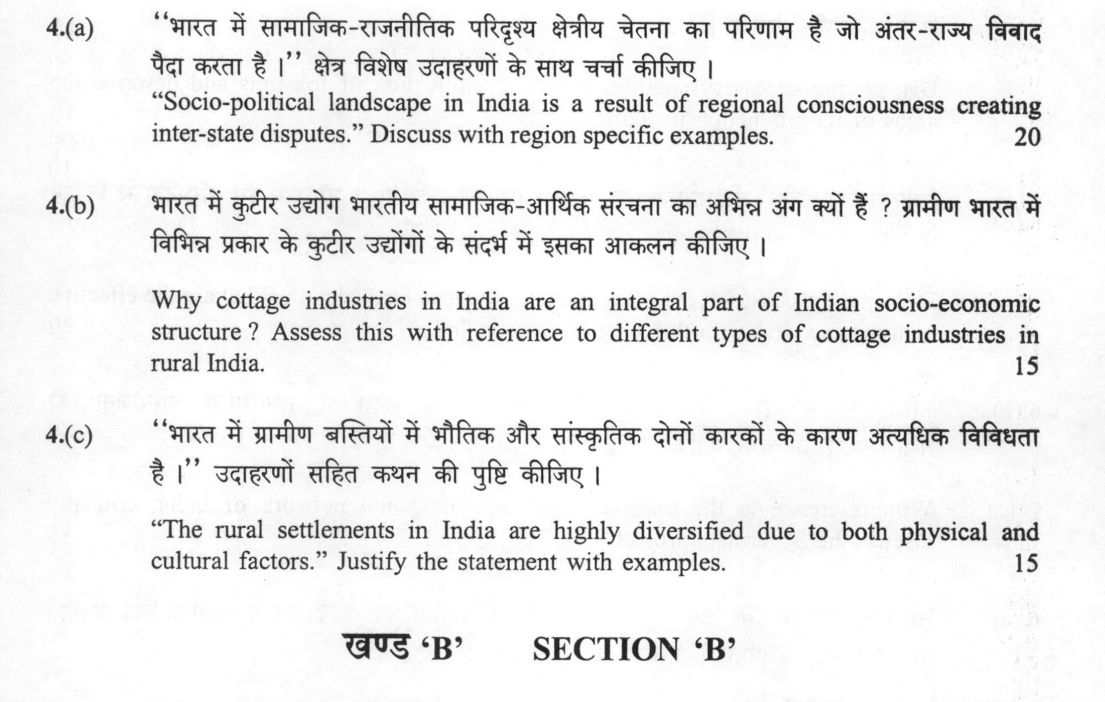
"Socio-political landscape in India is a result of regional consciousness creating inter-state disputes." Discuss with region specific examples. 20 marks
Why cottage industries in India are an integral part of Indian socio-economic structure ? Assess this with reference to different types of cottage industries in rural India. 15 marks
"The rural settlements in India are highly diversified due to both physical and cultural factors." Justify the statement with examples. 15 marks
हिंदी में प्रश्न पढ़ें
"भारत में सामाजिक-राजनीतिक परिदृश्य क्षेत्रीय चेतना का परिणाम है जो अंतर-राज्य विवाद पैदा करता है ।" क्षेत्र विशेष उदाहरणों के साथ चर्चा कीजिए । 20
भारत में कुटीर उद्योग भारतीय सामाजिक-आर्थिक संरचना का अभिन्न अंग क्यों हैं ? ग्रामीण भारत में विभिन्न प्रकार के कुटीर उद्योगों के संदर्भ में इसका आकलन कीजिए । 15
"भारत में ग्रामीण बस्तियों में भौतिक और सांस्कृतिक दोनों कारकों के कारण अत्यधिक विविधता है ।" उदाहरणों सहित कथन की पुष्टि कीजिए । 15
Model answer
Written by UPSC Answer Check against this question's marking rubric, to the expected length. UPSC does not publish answers for Mains — this is one way to score well, not an official key.
India’s socio-political landscape is shaped by regional consciousness, which can generate legitimate demands for identity and resources, but in some cases hardens into zero-sum inter-state disputes.
Inter-state disputes Regional consciousness forms through language, ethnicity, culture and perceived historical entitlement. When tied to scarce resources or boundaries, it can become inter-state conflict. The Cauvery dispute between Karnataka and Tamil Nadu illustrates water scarcity, agricultural dependence and linguistic-regional identity; tribunals and Supreme Court orders have managed but not fully resolved it. The Belagavi border dispute between Maharashtra and Karnataka shows how historical claims, local identity and administrative control can persist after reorganisation. Similar tensions appear in Krishna and Godavari water sharing, Ganga allocation, and Saindhya and Sutlej disputes. The States Reorganisation Act, 1956, and Article 3 gave the Union a constitutional tool to rationalise boundaries, but linguistic reorganisation also strengthened regional identities and subsequent demands. Some regional movements, such as Bodo autonomy in Assam and Jharkhand statehood, were intra-state identity/statehood struggles rather than inter-state disputes; they show the same consciousness at a different political level. A balanced view distinguishes legitimate regional aspirations—equitable resource sharing, cultural recognition, better governance—from secessionist or majoritarian tendencies. The way forward lies in cooperative federalism, credible water tribunals, transparent border demarcation, and development that reduces scarcity-driven politics.
Cottage industries Cottage industries are integral to India’s socio-economic structure because they are capital-light, household-based, and linked to local resources, skills and agriculture. They provide decentralized employment, especially in rural areas, and absorb surplus labour in agricultural slack seasons. Khadi and village industries, handloom weaving such as Varanasi silk and Kanchipuram sarees, handicrafts such as Moradabad brass and Kashmir walnut-wood work, and agro-based units such as Kerala coir and Bengal jute handicrafts/product-making show this diversity. Their integration is also cultural: many are caste- and community-based, preserving traditional occupational continuity and artisan knowledge. They support women’s empowerment through home-based work, flexible participation, and income without complete separation from domestic responsibilities. They create rural-urban linkages: raw materials and finished goods move between villages and markets, while some products earn export income. They complement agriculture by adding value to local produce and reducing distress migration. Yet they face mechanisation, factory competition, global market pressures, irregular raw material supply, and weak credit and marketing. KVIC support and MUDRA credit help, but integration requires skill upgradation, design innovation, and better market access.
Rural settlements Rural settlement diversity in India is produced by physical and cultural factors. Physically, terrain matters: plains often support nucleated or compact villages, while hilly and forested regions favour dispersed hamlets. Water availability is decisive: in Rajasthan’s arid tracts, settlements cluster around scarce water sources such as wells, stepwells, springs and seasonal tanks; in fertile river plains, linear patterns may follow rivers or levees; in the Deccan, villages often group around seasonal tanks and water bodies. Climate also shapes form—compact, defensive or closely built settlements in harsh or exposed areas, and more dispersed settlements where land and climate are favourable. Cultural factors are equally important. Caste and religion can produce segregated mohallas or hamlets, while joint-family systems may encourage larger, extended settlements. Security needs have historically produced fortified villages in Rajasthan and other vulnerable zones, whereas tribal belts often show dispersed settlements linked to forest resources and mobility. Land tenure systems also matter: zamindari areas often had larger landlord estates and clustered villages, while ryotwari regions tended to smaller, scattered holdings and settlements.
In conclusion, regional consciousness, cottage industries and rural settlements show how India’s diversity is political, economic and spatial. The challenge is to manage regional identities through cooperative institutions, strengthen cottage industries through market and skill support, and recognise settlement diversity in rural planning.
What "Discuss" is asking you to do
Lay the issue out from more than one side — how it arose, what is claimed for it, what is held against it, and where it now stands. UPSC attaches discuss to broad topics with several live dimensions, so coverage of the dimensions earns more than the strength of your opinion.
Structure that answers it
Set the issue up → the case as it is made → the case against → the dimension both sides leave out → where the balance now lies
Where marks are lost
Listing facts with no thread between them, or arguing one side throughout and calling it a discussion.
How this answer will be evaluated
Approach
Framework: Concept or mechanism > Diagram > Regional example > Application. (a) discuss: intro > 3-4 dimensions > example > balanced close | (b) examine: intro > how/why with reasoning > evidence > conclusion | (c) justify: claim > 3-4 reasons > evidence > conclusion Full marks: Comprehensive mechanism, precise regional examples, and clear diagrams.
Key points expected
- Define regional consciousness and its socio-political roots
- Explain the mechanism of consciousness leading to conflict
- Provide specific inter-state dispute examples (e.g., Cauvery, Ganga)
- Balanced conclusion on the nature of these disputes
- Define cottage industries and their socio-economic role
- Explain why they are integral (employment, income, culture)
- Provide specific examples of rural cottage industries
- Assess their contribution to the overall structure
Evaluation rubric
Each sub-part is marked on its own, against the marks and word limit printed on the paper.
- (a) Explain how regional consciousness drives inter-state disputes with specific examples. 20 marks
discuss— intro → 3-4 dimensions → example → balanced close
Must cover
- Define regional consciousness and its socio-political roots
- Explain the mechanism of consciousness leading to conflict
- Provide specific inter-state dispute examples (e.g., Cauvery, Ganga)
- Balanced conclusion on the nature of these disputes
Loses marks
- Listing disputes without explaining the 'consciousness' mechanism
- Focusing only on one region without comparative analysis
- Ignoring the 'inter-state' aspect of the dispute
Earns more
- Mention specific river basin disputes (Cauvery, Krishna)
- Reference linguistic or cultural identity factors
- Include a map showing the disputed regions
- Mention the role of central government in mediation
Extra mark
- Cite specific Supreme Court judgments on water sharing
- Reference specific census data on regional demographics
- (b) Assess the role of cottage industries in the socio-economic structure with rural examples. 15 marks
examine— intro → how/why with reasoning → evidence → conclusion
Must cover
- Define cottage industries and their socio-economic role
- Explain why they are integral (employment, income, culture)
- Provide specific examples of rural cottage industries
- Assess their contribution to the overall structure
Loses marks
- Confusing cottage industries with small-scale industries
- Failing to link to the 'socio-economic structure'
- Lack of specific rural examples
Earns more
- Mention specific industries (handloom, pottery, khadi)
- Link to rural employment and poverty alleviation
- Include a diagram showing the cottage industry value chain
- Reference government schemes supporting these industries
Extra mark
- Cite specific production statistics for a cottage industry
- Mention specific rural clusters known for cottage industries
- (c) Justify the diversification of rural settlements due to physical and cultural factors. 15 marks
justify— claim → 3-4 reasons → evidence → conclusion
Must cover
- Define rural settlement diversification
- Explain the role of physical factors (terrain, climate)
- Explain the role of cultural factors (religion, caste)
- Provide specific examples of diversified settlements
Loses marks
- Failing to distinguish between physical and cultural factors
- Lack of specific examples of settlement types
- Ignoring the 'diversification' aspect of the statement
Earns more
- Mention specific physical factors (e.g., Himalayan vs. Plains)
- Reference cultural factors (e.g., caste-based segregation)
- Include a map showing different settlement patterns
- Mention specific examples of clustered vs. dispersed settlements
Extra mark
- Cite specific census data on settlement density
- Mention specific cultural practices influencing settlement layout
Practice this exact question
Write your answer and it is marked point by point against the model answer above — what you covered, what you missed, what you got wrong.
Evaluate my answer →More from Geography 2025 Paper II
- Q1 (a) On the outline map of India provided to you, mark the location of all of the followin…
- Q2 (a) Explain the factors which contribute to the growth of India's pharmaceutical industry…
- Q3 (a) Why is the pattern of population distribution of scheduled castes and scheduled tribe…
- Q4 (a) "Socio-political landscape in India is a result of regional consciousness creating in…
- Q5 (a) How can rural-urban fringe be delineated ? Explain with suitable examples from India.…
- Q6 (a) Describe the causes of the phenomenon of 'urban heat island'. What are the effective…
- Q7 (a) Explain the factors that contribute to droughts in India with specific reference to f…