Paper II — Q2
(a) Explain the factors which contribute to the growth of India's pharmaceutical industry with specific reference to its…
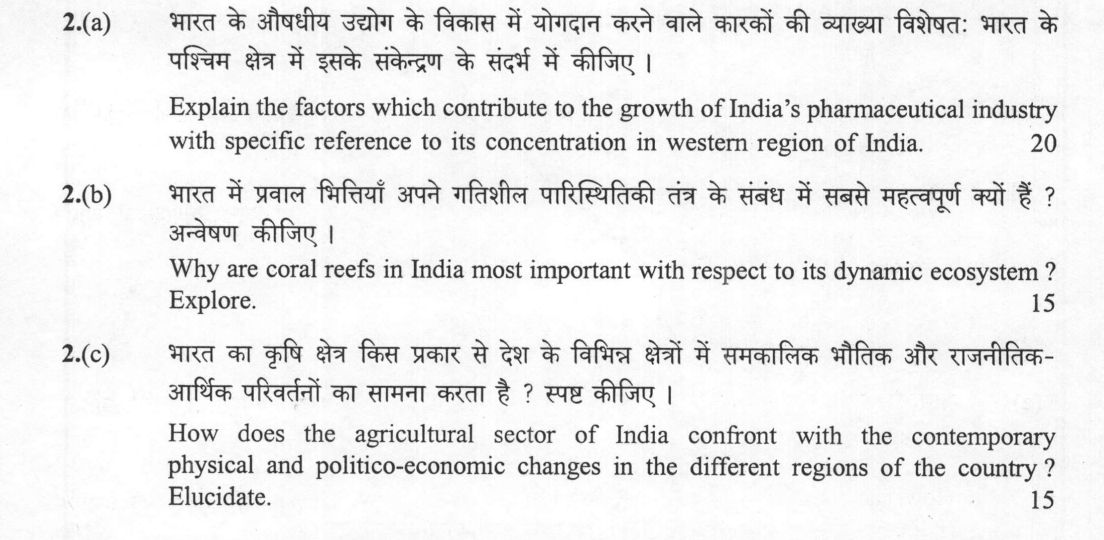
Explain the factors which contribute to the growth of India's pharmaceutical industry with specific reference to its concentration in western region of India. 20 marks
Why are coral reefs in India most important with respect to its dynamic ecosystem ? Explore. 15 marks
How does the agricultural sector of India confront with the contemporary physical and politico-economic changes in the different regions of the country ? Elucidate. 15 marks
हिंदी में प्रश्न पढ़ें
भारत के औषधीय उद्योग के विकास में योगदान करने वाले कारकों की व्याख्या विशेषतः भारत के पश्चिम क्षेत्र में इसके संकेन्द्रण के संदर्भ में कीजिए । 20
भारत में प्रवाल भित्तियाँ अपने गतिशील पारिस्थितिकी तंत्र के संबंध में सबसे महत्वपूर्ण क्यों हैं ? अन्वेषण कीजिए । 15
भारत का कृषि क्षेत्र किस प्रकार से देश के विभिन्न क्षेत्रों में समकालीन भौतिक और राजनीतिक-आर्थिक परिवर्तनों का सामना करता है ? स्पष्ट कीजिए । 15
Model answer
Written by UPSC Answer Check against this question's marking rubric, to the expected length. UPSC does not publish answers for Mains — this is one way to score well, not an official key.
India’s regional economic and ecological patterns show how location, policy and environment interact. The pharmaceutical industry, coral reefs and agriculture all illustrate how western, coastal and agrarian regions respond to different but connected drivers.
Pharmaceutical concentration in western India The western concentration of India’s pharmaceutical industry is rooted in the historical chemical industry base of Gujarat and Maharashtra, where early organic and inorganic chemical units created supply chains, technical know-how and industrial culture. This historical base made Gujarat and Maharashtra early exporters of bulk drugs and formulations, and the presence of chemical parks, ports and regulatory expertise created path dependence. The Mumbai-Pune knowledge corridor reinforces this by providing IITs, ICTs, universities and research institutions that supply chemists, biotechnologists and regulatory professionals. Proximity to ports such as JNPT and Kandla lowers transaction costs for importing APIs and exporting formulations, while Gujarat’s industrial policy and state incentives have encouraged pharma parks, bulk drug units and special economic zones. Skilled workforce availability from ICT/IIT institutions and clustering economies in the Hyderabad-Ahmedabad-Mumbai triangle reduce costs through shared suppliers, testing agencies, logistics and skilled labour. Production-linked incentives further strengthen scale and export competitiveness. This growth also affects agricultural input markets, as pharma and agrochemical firms influence the availability and pricing of fertilizers and pesticides, linking industrial western India to agrarian regions.
Coral reefs as dynamic ecosystems India’s coral reefs in the Gulf of Mannar, Gulf of Kachchh, Lakshadweep and Andaman are important because they sustain high biodiversity, including endemic fish, invertebrates and algae, and function as nursery grounds for commercially important species. Their dynamic nature comes from constant biological turnover, zonation and symbiotic relationships, which make them both productive and sensitive. Their ecosystem role is not only biological; reefs and associated coastal habitats buffer shorelines against cyclones, storm surges and sea-level rise, protecting communities and infrastructure. They support fisheries and coastal livelihoods by maintaining breeding and feeding grounds. Their value also includes carbon sequestration through associated blue-carbon habitats such as seagrass beds and mangroves, although coral calcification itself is not a major carbon sink and reefs are vulnerable to ocean acidification. The need for exploration is urgent because warming, bleaching, cyclones, sedimentation, overfishing and coastal development are degrading these systems. Conservation under CRZ notifications, marine protected areas and community-based management are essential to preserve their ecological and economic functions.
Agriculture confronting physical and politico-economic change Agriculture confronts physical changes through climate variability: erratic monsoons alter sowing and harvest cycles, groundwater depletion in Punjab-Haryana threatens water-intensive rice-wheat systems, and desertification in Rajasthan reduces arable land. These impacts are regionally uneven, with eastern and northeastern states facing flood-prone, low-mechanized agriculture, while the northwest faces water stress. Politico-economic changes add further pressure: debates over farm laws and MSP politics shape farmers’ expectations and market access, while contract farming and agri-processing create new linkages but also raise concerns about land and bargaining power. Regional disparities persist between Green Revolution areas, which are more commercialized and input-intensive, and eastern/northeastern states, where subsistence and rain-fed farming remain common. Policy responses include climate-resilient crops, PM-KISAN income support, and National Innovations in Climate Resilient Agriculture, but adaptation must be region-specific. Coastal ecosystem health is also linked to agriculture, as runoff of fertilizers and pesticides can degrade reefs and estuaries, showing that agricultural modernization must be ecologically regulated.
In sum, western India’s pharma strength, India’s coral reef ecosystems and regional agricultural transformation are connected through geography, policy and environment. Sustainable development requires integrating industrial location advantages, coastal conservation and climate-adaptive agriculture so that growth does not undermine the ecological and livelihood systems on which it depends.
What "Explain" is asking you to do
Make the working of something clear — what sets it off, what follows from what, and what it produces. Explain is the Commission's mechanism word: it dominates the technical papers and the “explain why” stems, where the marks sit in the causal chain and not in the label.
Structure that answers it
State what it is → the initiating condition → the chain of cause, step by step → an instance where it plays out → what the chain produces
Where marks are lost
Describing what something looks like instead of why it works that way. Naming the stages without linking them reads as description too.
How this answer will be evaluated
Approach
(a) explain: definition/context > points in order > small example > short close | (b) examine: intro > how/why with reasoning > evidence > conclusion | (c) explain: definition/context > points in order > small example > short close Full marks: Precise causal chains, specific Indian examples, and clear regional differentiation.
Key points expected
- Raw material availability (Gujarat/Maharashtra)
- Port infrastructure and export logistics
- Presence of major pharma hubs (Ahmedabad/Pune)
- Skilled workforce and R&D institutions
- Biodiversity hotspot (coral triangle)
- Coastal protection mechanism (wave attenuation)
- Fisheries support and livelihoods
- Carbon sequestration or nutrient cycling
Evaluation rubric
Each sub-part is marked on its own, against the marks and word limit printed on the paper.
- (a) Causal chain of growth factors linked to western India's specific concentration. 20 marks
explain— definition/context → points in order → small example → short close
Must cover
- Raw material availability (Gujarat/Maharashtra)
- Port infrastructure and export logistics
- Presence of major pharma hubs (Ahmedabad/Pune)
- Skilled workforce and R&D institutions
Loses marks
- Generic factors without western India link
- No mention of raw material or ports
- Description without causal mechanism
Earns more
- Government policy incentives (PLI scheme)
- IT/Pharma synergy in western states
- Raw material supply chains (APIs)
Extra mark
- Labelled map of western pharma clusters
- Recent export data for western India
- (b) Reasoning on the ecological importance of Indian coral reefs. 15 marks
examine— intro → how/why with reasoning → evidence → conclusion
Must cover
- Biodiversity hotspot (coral triangle)
- Coastal protection mechanism (wave attenuation)
- Fisheries support and livelihoods
- Carbon sequestration or nutrient cycling
Loses marks
- General description without ecosystem link
- Ignoring the 'dynamic' aspect of the question
- No specific Indian context
Earns more
- Specific locations (Lakshadweep/Andaman)
- Threats (bleaching, acidification)
- Economic value (tourism)
Extra mark
- Diagram of reef ecosystem structure
- Specific species names (e.g., Acropora)
- (c) Analysis of how agriculture faces physical and politico-economic changes regionally. 15 marks
explain— definition/context → points in order → small example → short close
Must cover
- Physical changes (climate, water stress)
- Politico-economic changes (policy, market access)
- Regional variation (e.g., Punjab vs. NE)
- Link between physical and economic factors
Loses marks
- Ignoring the 'regional' aspect
- No link between physical and economic
- Generic description without specific changes
Earns more
- Specific regional examples (e.g., groundwater in Punjab)
- Policy impacts (MSP, land reforms)
- Market integration challenges
Extra mark
- Map showing regional agricultural stress
- Recent policy reference (e.g., farm laws)
Practice this exact question
Write your answer and it is marked point by point against the model answer above — what you covered, what you missed, what you got wrong.
Evaluate my answer →More from Geography 2025 Paper II
- Q1 (a) On the outline map of India provided to you, mark the location of all of the followin…
- Q2 (a) Explain the factors which contribute to the growth of India's pharmaceutical industry…
- Q3 (a) Why is the pattern of population distribution of scheduled castes and scheduled tribe…
- Q4 (a) "Socio-political landscape in India is a result of regional consciousness creating in…
- Q5 (a) How can rural-urban fringe be delineated ? Explain with suitable examples from India.…