Paper II — Q6
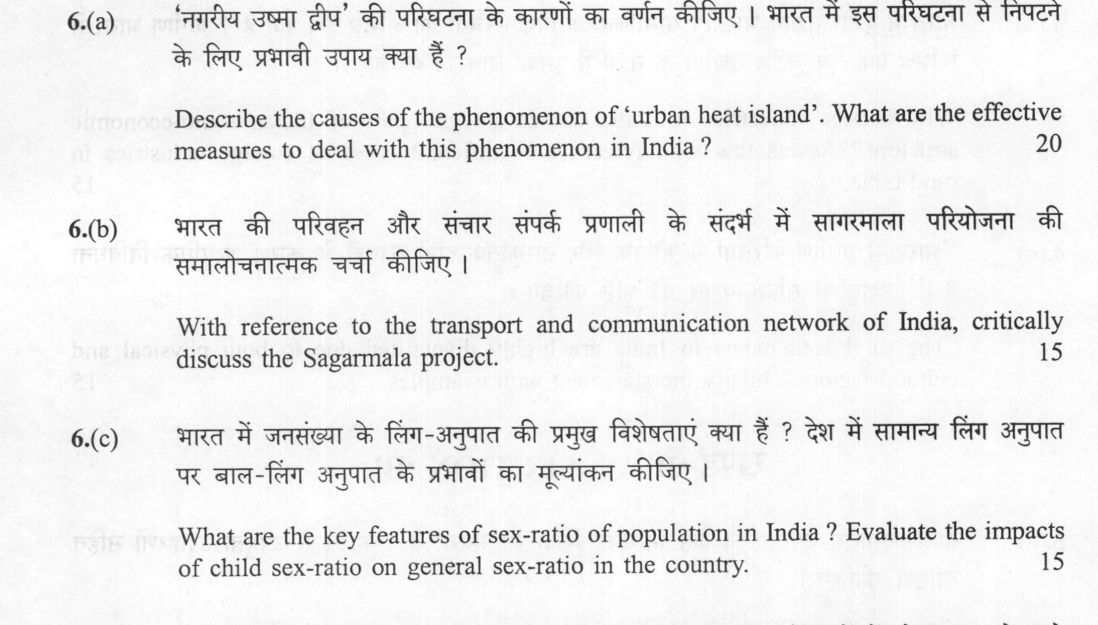
(a) Describe the causes of the phenomenon of 'urban heat island'. What are the effective measures to deal with this phenomenon in…
Describe the causes of the phenomenon of 'urban heat island'. What are the effective measures to deal with this phenomenon in India ? 20 marks
With reference to the transport and communication network of India, critically discuss the Sagarmala project. 15 marks
What are the key features of sex-ratio of population in India ? Evaluate the impacts of child sex-ratio on general sex-ratio in the country. 15 marks
हिंदी में प्रश्न पढ़ें
'नगरीय उष्मा द्वीप' की परिघटना के कारणों का वर्णन कीजिए । भारत में इस परिघटना से निपटने के लिए प्रभावी उपाय क्या हैं ? 20 marks
भारत की परिवहन और संचार संपर्क प्रणाली के संदर्भ में सागरमाला परियोजना की समालोचनात्मक चर्चा कीजिए । 15
भारत में जनसंख्या के लिंग-अनुपात की प्रमुख विशेषताएं क्या हैं ? देश में सामान्य लिंग अनुपात पर बाल-लिंग अनुपात के प्रभावों का मूल्यांकन कीजिए । 15
Model answer
Written by UPSC Answer Check against this question's marking rubric, to the expected length. UPSC does not publish answers for Mains — this is one way to score well, not an official key.
Urban heat island. Urban heat island (UHI) arises because cities replace natural surfaces with built ones. Dark roofs, asphalt and concrete have low albedo, absorbing more solar radiation than vegetation or soil. Their high heat capacity and thermal conductivity store daytime heat and release it at night, delaying cooling. Anthropogenic heat from vehicles, industries, air-conditioning and appliances adds directly to the urban energy balance. Paved surfaces reduce soil moisture and vegetation, lowering evapotranspiration, which otherwise cools air through latent heat. Tall buildings and narrow streets form urban canyons that trap long-wave radiation, reduce sky view, and weaken wind mixing, so heat accumulates. The effect is most visible in dense Indian cities where open space is limited and night-time temperatures remain high. In India, mitigation must be low-cost and climate-sensitive. Ahmedabad’s Heat Action Plan promotes cool roofs and reflective surfaces to lower roof temperatures. Urban greening, including Miyawaki forests, street trees and parks, increases shade and evapotranspiration. Permeable pavements and rainwater harvesting reduce sealed surfaces and recharge groundwater. Building codes should require cross-ventilation, thermal insulation, and orientation that reduces cooling loads. Metro corridors can create cool islands by displacing private vehicles, reducing congestion heat, and encouraging compact, walkable development.
Sagarmala and transport-communication network. Sagarmala is a port-led development strategy that links India’s transport and communication networks. It modernises ports through dredging, berths, cargo handling and multi-modal terminals; enhances connectivity through roads, railways, inland waterways and intermodal corridors; promotes port-linked industrialization in coastal zones; and supports coastal community development. Its communication-network dimension is equally important: port community systems, single-window customs clearance, e-port cargo platforms, real-time logistics data and telecom/IT links connect customs, ports, railways, shipping and industry, reducing clearance time and improving supply-chain visibility. This makes ports nodes in a national logistics and information network, not isolated terminals. Critically, implementation remains uneven. Some projects face delays, land acquisition, financing and institutional coordination problems. Environmental concerns are visible at Mundra and Vizag, where port expansion, dredging and industrial activity raise issues of coastal ecology, siltation and community displacement. Hinterland connectivity deficits persist in many ports, limiting cargo movement and reducing the multiplier effect. Digital integration also needs stronger inter-agency data sharing, cybersecurity and last-mile connectivity.
Sex-ratio and child sex-ratio. India’s sex-ratio shows strong regional variation: southern states generally have higher female representation, while northern and north-western states such as Punjab, Haryana, Rajasthan and Uttar Pradesh have lower ratios. Rural and urban ratios differ: in 2011 rural areas had a slightly higher sex-ratio than urban areas, though state patterns vary. The general sex-ratio in 2011 was 943 females per 1000 males, but the child sex-ratio for 0–6 years was only 918, down from 945 in 1991. The adult sex-ratio, 976 in 2011, has improved since then, reflecting better female survival and ageing, yet the persistent decline in child sex-ratio remains the main drag on the overall ratio. Prenatal sex selection, son preference and weak enforcement of the PC-PNDT Act have created a daughter deficit in the 0–6 group, depressing the general sex-ratio because children form a large share of the population. This demographic distortion also affects future marriage markets, household structure and the quality of the demographic dividend. Policies such as Beti Bachao Beti Padhao, stronger PC-PNDT enforcement, girl-child education, and social campaigns are essential to arrest the decline.
Thus, UHI mitigation, Sagarmala and sex-ratio correction are not separate issues but parts of sustainable development. Cooler, greener, ventilated cities reduce health risks and energy demand. A port-led, digitally connected coastal economy can raise productivity if environmental safeguards and hinterland links are strengthened. A balanced child sex-ratio is the demographic foundation for a just and productive society. India’s way forward lies in combining urban climate action, integrated transport-communication infrastructure, and gender-just demographic policies.
What "Describe" is asking you to do
Give a full, ordered account of the thing named — its parts, stages or mechanism — in the sequence in which it actually exists or occurs. Most describe questions come from the science optionals, where the marks sit in correct technical detail and, where the stem says so, a labelled diagram.
Structure that answers it
One-line identification of the subject → the parts or stages in their real order, each with its defining detail → labelled diagram where the subject is structural → closing line on function or significance
Where marks are lost
Loose general prose where the examiner is ticking named parts, correct terminology and their sequence; and in the General Studies papers, turning to evaluation before the description is finished.
How this answer will be evaluated
Approach
Framework: Concept or mechanism > Diagram > Regional example > Application. (a) describe: define > structure or process in order > labelled diagram > significance | (b) critically evaluate: positives > negatives/limits > conditions/safeguards > conclusion | (c) evaluate: criteria > evidence > balanced judgment Full marks: Comprehensive, well-structured, with diagrams and specific examples.
Key points expected
- Define urban heat island phenomenon
- Explain causes: albedo, waste heat, lack of vegetation
- List effective measures: green cover, cool roofs
- Include a labelled diagram of the UHI mechanism
- Define the Sagarmala project and its objectives
- Discuss its role in port-led development
- Critically evaluate its impact on transport network
- Mention challenges or limitations of the project
Evaluation rubric
Each sub-part is marked on its own, against the marks and word limit printed on the paper.
- (a) Explain the mechanism of UHI and list effective mitigation measures for India. 20 marks
describe— define → structure or process in order → labelled diagram → significance
Must cover
- Define urban heat island phenomenon
- Explain causes: albedo, waste heat, lack of vegetation
- List effective measures: green cover, cool roofs
- Include a labelled diagram of the UHI mechanism
Loses marks
- Description without explaining the physical mechanism
- Answer with no diagram or sketch
- Generic measures not specific to India
Earns more
- Mention specific Indian cities like Delhi or Mumbai
- Reference specific policies like Smart City Mission
- Discuss the role of urban planning in mitigation
- Mention the impact on energy consumption
Extra mark
- Cite specific temperature differential data for Indian cities
- Mention specific government schemes for urban greening
- (b) Critically discuss the Sagarmala project's role in India's transport and communication network. 15 marks
critically evaluate— positives → negatives/limits → conditions/safeguards → conclusion
Must cover
- Define the Sagarmala project and its objectives
- Discuss its role in port-led development
- Critically evaluate its impact on transport network
- Mention challenges or limitations of the project
Loses marks
- Description without critical evaluation
- Ignoring the communication network aspect
- No mention of specific ports or regions
Earns more
- Reference specific ports like Mundra or Paradip
- Discuss the role of inland waterways
- Mention the economic impact on coastal regions
- Reference the National Waterway policy
Extra mark
- Cite specific investment figures for port development
- Mention specific challenges like environmental concerns
- (c) Describe key features of sex-ratio in India and evaluate child sex-ratio's impact on general sex-ratio. 15 marks
evaluate— criteria → evidence → balanced judgment
Must cover
- Define sex-ratio and its key features in India
- Explain the trend of child sex-ratio
- Evaluate the impact of child sex-ratio on general sex-ratio
- Mention regional variations in sex-ratio
Loses marks
- Description without evaluating the impact
- Ignoring the child sex-ratio aspect
- No mention of regional variations
Earns more
- Reference specific census data on sex-ratio
- Discuss the role of son preference
- Mention the impact of female infanticide
- Reference specific states with low sex-ratio
Extra mark
- Cite specific census year data for sex-ratio
- Mention specific government initiatives to address the issue
Practice this exact question
Write your answer and it is marked point by point against the model answer above — what you covered, what you missed, what you got wrong.
Evaluate my answer →More from Geography 2025 Paper II
- Q3 (a) Why is the pattern of population distribution of scheduled castes and scheduled tribe…
- Q4 (a) "Socio-political landscape in India is a result of regional consciousness creating in…
- Q5 (a) How can rural-urban fringe be delineated ? Explain with suitable examples from India.…
- Q6 (a) Describe the causes of the phenomenon of 'urban heat island'. What are the effective…
- Q7 (a) Explain the factors that contribute to droughts in India with specific reference to f…
- Q8 (a) While defining the green architecture, discuss its principles and challenges in respo…