Paper II — Q3
(a) Why is the pattern of population distribution of scheduled castes and scheduled tribes different in India ? Compare their…
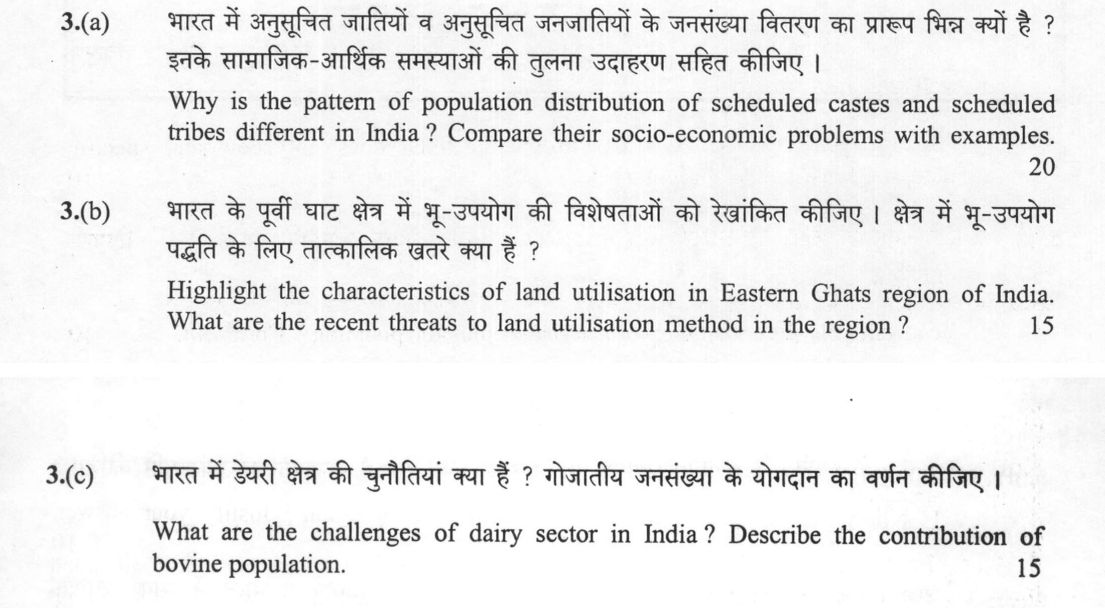
Why is the pattern of population distribution of scheduled castes and scheduled tribes different in India ? Compare their socio-economic problems with examples. 20 marks
Highlight the characteristics of land utilisation in Eastern Ghats region of India. What are the recent threats to land utilisation method in the region ? 15 marks
What are the challenges of dairy sector in India ? Describe the contribution of bovine population. 15 marks
हिंदी में प्रश्न पढ़ें
भारत में अनुसूचित जातियों व अनुसूचित जनजातियों के जनसंख्या वितरण का प्रारूप भिन्न क्यों है ? इनके सामाजिक-आर्थिक समस्याओं की तुलना उदाहरण सहित कीजिए । 20
भारत के पूर्वी घाट क्षेत्र में भू-उपयोग की विशेषताओं को रेखांकित कीजिए । क्षेत्र में भू-उपयोग पद्धति के लिए तात्कालिक खतरे क्या हैं ? 15 marks
भारत में डेयरी क्षेत्र की चुनौतियाँ क्या हैं ? गोजातीय जनसंख्या के योगदान का वर्णन कीजिए । 15
Model answer
Written by UPSC Answer Check against this question's marking rubric, to the expected length. UPSC does not publish answers for Mains — this is one way to score well, not an official key.
India’s demographic and ecological diversity is reflected in distinct regional socio-economic adaptations, land-use patterns, and agrarian practices.
Distribution and Socio-Economic Disparities: Scheduled Castes vs Scheduled Tribes
The spatial distribution of Scheduled Castes (SCs) and Scheduled Tribes (STs) differs fundamentally due to historical, environmental, and socio-cultural factors. SCs are predominantly concentrated in the fertile alluvial tracts of the Indo-Gangetic plains (such as Uttar Pradesh, Bihar, and West Bengal) and coastal deltas. Historically, their distribution followed the caste-based agrarian hierarchy of settled valley agriculture, where they formed the core agricultural labour force. Conversely, STs are concentrated in the forested, rugged uplands of the Central Tribal Belt (Madhya Pradesh, Chhattisgarh, Jharkhand, and Odisha) and the North-Eastern hill states. This pattern stems from geographical isolation, historical retreat from expanding agrarian states, and colonial forest policies that demarcated reserve forests, confining tribal communities to marginal uplands.
In socio-economic terms, both groups share similarities in high poverty incidence, educational deprivation, and political under-representation. However, their challenges differ in structural dimensions:
Spatial Exclusion versus Physical Isolation: SCs reside in mainstream, multi-caste villages but endure social exclusion, untouchability, residential segregation on village peripheries, and the historical indignity of manual scavenging. STs, by contrast, face physical and infrastructural isolation in remote, hilly settlements with poor road connectivity, inadequate healthcare access, and weak institutional reach.
Resource and Livelihood Insecurity: Rural SCs suffer predominantly from acute landlessness, functioning primarily as landless agricultural or unorganised wage labourers. In contrast, STs, who traditionally depended on customary rights over common property resources, face large-scale developmental displacement, alienation of ancestral lands for industrial or mining projects, and legal curbs on shifting cultivation (podu or jhum) due to rigid forest conservation regimes.
Land Utilisation and Recent Threats in the Eastern Ghats
The Eastern Ghats, a discontinuous chain of relict highlands running across Odisha, Andhra Pradesh, and Tamil Nadu, exhibit specific land utilisation characteristics: traditional shifting cultivation (podu) on upper slopes, degraded dry deciduous and scrub forest patches, monoculture commercial plantations (coffee and rubber in areas like Araku and Shevaroy hills), resource-extractive mining corridors, and sparse, rainfed settled agriculture in narrow valley bottoms.
Recent threats undermining sustainable land utilisation in this region include: First, intense open-cast bauxite and iron-ore mining across the Odisha–Andhra Pradesh belt causes large-scale topsoil removal, habitat fragmentation, and aquifer depletion. Second, the unscientific expansion of wind energy projects along high-ridge summits in the Tamil Nadu Ghats disrupts ridge ecology and alters local microclimates. Third, rapid urban sprawl and industrial corridor expansion along the Chennai–Bengaluru axis induce heavy land conversion, consuming foothill commons and fertile agricultural fringes. Fourth, climate-induced rainfall variability, marked by intense dry spells and irregular monsoon bursts, accelerates soil erosion on degraded slopes, rendering rainfed valley farming increasingly precarious.
Challenges and Bovine Contribution in the Dairy Sector
India’s dairy sector faces multiple structural challenges: low average milk productivity among non-descript indigenous breeds; chronic deficits in both green and dry fodder; inadequate coverage of artificial insemination (AI) and cold-chain infrastructure in rural hinterlands; seasonal farm-gate price volatility; and stark regional imbalances, with well-developed cooperative networks in western and southern India contrasting sharply with weak, unorganised markets in eastern and central states.
Despite these constraints, the bovine population provides critical multi-dimensional contributions: It underpins rural livelihood security by serving as a year-round buffer against crop failure; supplies organic manure and bio-fertiliser vital for soil health and sustainable agriculture; provides draught animal power essential for ploughing and rural haulage in the fragmented, smallholder landscapes of eastern and peninsular India; and earns valuable foreign exchange through the commercial export of dairy commodities, including skimmed milk powder, butter, and indigenous milk preparations.
Sustainable regional development in India requires addressing the historical marginalisation of SC and ST communities, arresting ecological and land degradation in sensitive zones like the Eastern Ghats, and strengthening the livestock economy to foster inclusive and climate-resilient rural growth.
What "Compare" is asking you to do
Set the items against each other on named dimensions. In UPSC practice compare already carries both halves — likeness and difference — and where the stem names the dimensions, as in region, nature and climatic impact, those are the headings the examiner expects to see.
Structure that answers it
Dimensions named → both items on dimension 1 → dimension 2 → dimension 3 → where they converge and where they part
Where marks are lost
Two self-contained descriptive blocks with the comparison left for the reader to make. Marks here sit on the dimensions, so an answer that names none of them gives the examiner nothing to award.
How this answer will be evaluated
Approach
Framework: Concept or mechanism > Diagram > Regional example > Application. (a) compare: paired headings or table > key differences > significance > conclusion | (b) highlight: name the salient points > one line of substance each > close | (c) challenges: 3-4 challenges > solutions mapped to them > conclusion Full marks: Precise spatial analysis for (a), specific land use details for (b), and clear link between bovine contribution and dairy challenges for (c).
Key points expected
- SCs concentrated in plains/urban; STs in forested/hilly regions
- SC issues: caste discrimination, landlessness, urban slums
- ST issues: forest rights, displacement, loss of habitat
- Specific examples: SCs in UP/Bihar; STs in Jharkhand/Northeast
- Characteristics: Shifting cultivation (Podu), fragmented landholdings, dry farming
- Characteristics: Extensive grazing, low irrigation potential
- Threats: Deforestation for mining (iron/bauxite) and industry
- Threats: Encroachment by plantations (cashew/coconut) and urbanization
Evaluation rubric
Each sub-part is marked on its own, against the marks and word limit printed on the paper.
- (a) Explain the distinct spatial distribution patterns of SCs and STs and contrast their socio-economic issues. 20 marks
compare— paired headings or table → key differences → significance → conclusion
Must cover
- SCs concentrated in plains/urban; STs in forested/hilly regions
- SC issues: caste discrimination, landlessness, urban slums
- ST issues: forest rights, displacement, loss of habitat
- Specific examples: SCs in UP/Bihar; STs in Jharkhand/Northeast
Loses marks
- Treating SCs and STs as a single homogeneous group
- Focusing only on population numbers without spatial pattern
- Ignoring the 'why' of the distribution difference
Earns more
- Reference to 2011 Census data on population share
- Mention of specific tribal groups (e.g., Santhal, Gond)
- Reference to specific SC castes (e.g., Dalits, Mahars)
Extra mark
- Labelled map showing SC/ST concentration zones
- Reference to Forest Rights Act (FRA) 2006
- (b) Identify key land use features of the Eastern Ghats and list current threats to these methods. 15 marks
highlight— name the salient points → one line of substance each → close
Must cover
- Characteristics: Shifting cultivation (Podu), fragmented landholdings, dry farming
- Characteristics: Extensive grazing, low irrigation potential
- Threats: Deforestation for mining (iron/bauxite) and industry
- Threats: Encroachment by plantations (cashew/coconut) and urbanization
Loses marks
- Confusing Eastern Ghats with Western Ghats characteristics
- Listing threats without linking them to land use methods
- Ignoring the specific geography of the Eastern Ghats
Earns more
- Mention of specific states (Odisha, Andhra Pradesh, Tamil Nadu)
- Reference to specific crops (e.g., cashew, coconut, groundnut)
- Mention of specific mining activities (e.g., bauxite in Odisha)
Extra mark
- Sketch map of Eastern Ghats with land use zones
- Reference to specific environmental issues (e.g., soil erosion)
- (c) List the major problems facing the Indian dairy sector and explain the role of bovine animals. 15 marks
challenges— 3-4 challenges → solutions mapped to them → conclusion
Must cover
- Challenges: Low milk yield per animal, lack of fodder/feed
- Challenges: Poor veterinary services, lack of cold chain infrastructure
- Contribution: Cows/Buffaloes provide milk, manure, and draft power
- Contribution: Bovines are the primary source of milk in India
Loses marks
- Focusing only on challenges without addressing the 'contribution' part
- Ignoring the specific role of bovine animals (cows/buffaloes)
- Listing generic agricultural problems not specific to dairy
Earns more
- Mention of specific breeds (e.g., Sahiwal, Murrah, Gir)
- Reference to Operation Flood or National Dairy Development Board (NDDB)
- Mention of specific challenges like 'milk adulteration'
Extra mark
- Data on milk production (e.g., India's rank in milk production)
- Reference to specific dairy cooperatives (e.g., Amul, Mother Dairy)
Practice this exact question
Write your answer and it is marked point by point against the model answer above — what you covered, what you missed, what you got wrong.
Evaluate my answer →More from Geography 2025 Paper II
- Q1 (a) On the outline map of India provided to you, mark the location of all of the followin…
- Q2 (a) Explain the factors which contribute to the growth of India's pharmaceutical industry…
- Q3 (a) Why is the pattern of population distribution of scheduled castes and scheduled tribe…
- Q4 (a) "Socio-political landscape in India is a result of regional consciousness creating in…
- Q5 (a) How can rural-urban fringe be delineated ? Explain with suitable examples from India.…
- Q6 (a) Describe the causes of the phenomenon of 'urban heat island'. What are the effective…