Paper II — Q5
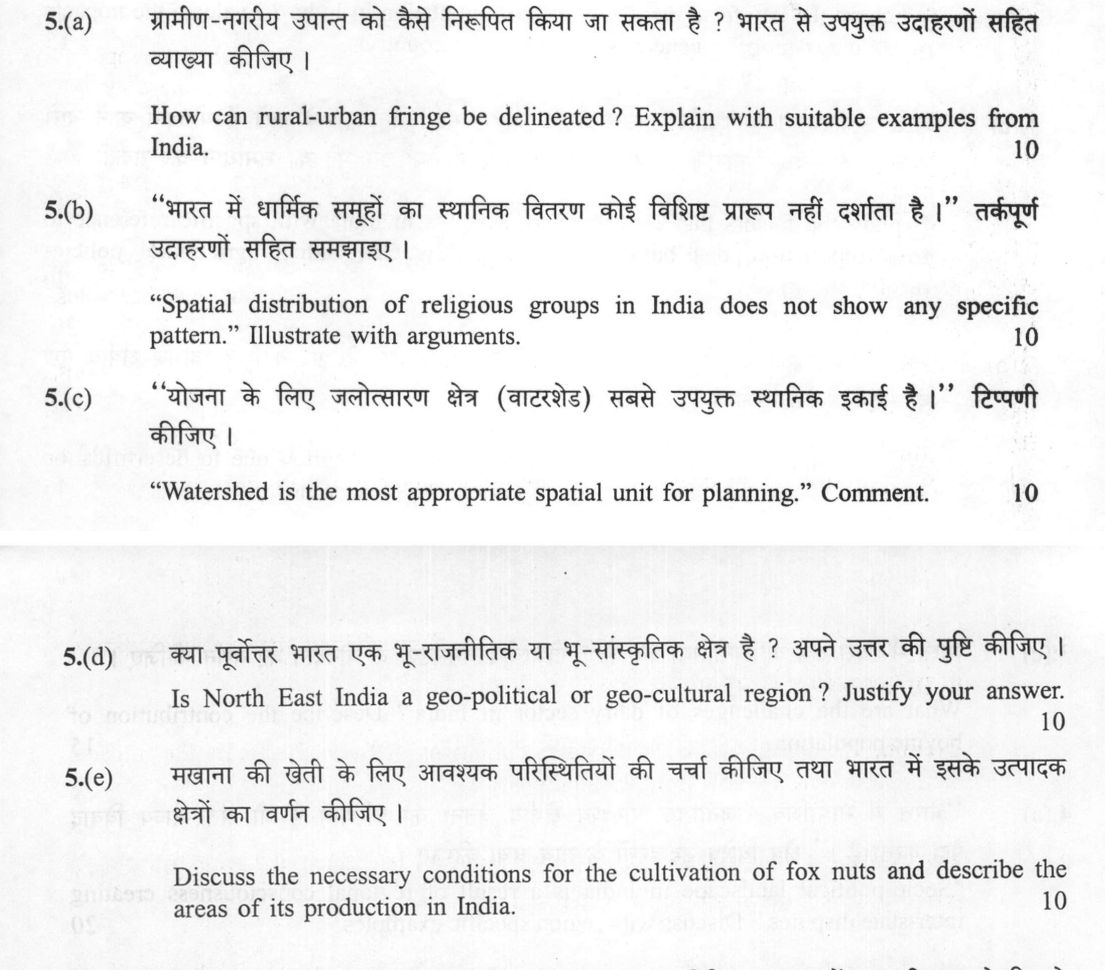
(a) How can rural-urban fringe be delineated ? Explain with suitable examples from India. 10 (b) "Spatial distribution of…
How can rural-urban fringe be delineated ? Explain with suitable examples from India. 10 marks
"Spatial distribution of religious groups in India does not show any specific pattern." Illustrate with arguments. 10 marks
"Watershed is the most appropriate spatial unit for planning." Comment. 10 marks
Is North East India a geo-political or geo-cultural region ? Justify your answer. 10 marks
Discuss the necessary conditions for the cultivation of fox nuts and describe the areas of its production in India. 10 marks
हिंदी में प्रश्न पढ़ें
ग्रामीण-नगरीय उपांत को कैसे निर्धारित किया जा सकता है ? भारत से उपयुक्त उदाहरणों सहित व्याख्या कीजिए । 10
"भारत में धार्मिक समूहों का स्थानिक वितरण कोई विशिष्ट प्रारूप नहीं दर्शाता है ।" तर्कपूर्ण उदाहरणों सहित समझाइए । 10
"योजना के लिए जलोत्सरण क्षेत्र (वाटरशेड) सबसे उपयुक्त स्थानिक इकाई है ।" टिप्पणी कीजिए । 10
क्या पूर्वोत्तर भारत एक भू-राजनीतिक या भू-सांस्कृतिक क्षेत्र है ? अपने उत्तर की पुष्टि कीजिए । 10
मखाना की खेती के लिए आवश्यक परिस्थितियों की चर्चा कीजिए तथा भारत में इसके उत्पादक क्षेत्रों का वर्णन कीजिए । 10
Model answer
Written by UPSC Answer Check against this question's marking rubric, to the expected length. UPSC does not publish answers for Mains — this is one way to score well, not an official key.
(a) Delineation of the Rural-Urban Fringe
The rural-urban fringe is a dynamic transition zone lying between the continuously built-up urban core and the purely agricultural hinterland, exhibiting a structural mix of rural and urban land uses, occupations, and demographic profiles. Delineating this boundary is essential for regional planning, infrastructure extension, and master-plan formulation.
Land-Use Gradient and Dynamism: The causal sequence begins with city expansion, driving up speculative land values. This causes agricultural land to be converted into residential colonies, warehouses, and industrial layouts. The fringe is identified where primary agricultural land use drops below 50% but built-up density has not yet reached contiguous urban thresholds.
Demographic and Density Thresholds: Fringe areas typically record population growth rates far exceeding those of the core city, accompanied by intermediate population densities (between 400 and 1,500 persons per sq. km) and a progressive decline in the primary workforce alongside an increase in secondary and tertiary employment.
Commuting and Mobility Patterns: A high volume of daily outward and inward commuting of labor, milk, and perishable vegetables indicates functional integration with the metropolis, serving as a functional marker of fringe boundaries.
Remote Sensing and Satellite Imagery: Multi-temporal satellite data (NDVI for vegetation decline, NDBI for built-up growth) maps the spatial edge where continuous urban fabric fragments into isolated non-agricultural patches.
In India, this delineation is visible along the peripheral corridors of Delhi NCR (e.g., peri-urban zones along the Kundli-Manesar-Palwal Expressway, Najafgarh, and Greater Noida West), Bengaluru's outer periphery (the Sarjapur-Varthur and Devanahalli belts), and Hyderabad's Outer Ring Road RURBAN growth nodes. Thus, the rural-urban fringe is best delineated through a multi-criteria approach that integrates land-use dynamism, workforce transformation, and spatial mobility.
(b) Spatial Distribution of Religious Groups in India
The assertion that the spatial distribution of religious groups in India lacks a specific pattern is geographically untenable. While local-level syncretism and minority dispersion exist throughout the country, religious distribution at the macro and meso scales exhibits well-defined spatial clustering shaped by historical migrations, physiographic barriers, and socio-political processes.
Macro-Regional Dominance: Hindus, constituting nearly 80% of the population, form the spatial continuum across the Indo-Gangetic Plains, the Deccan Plateau, and peninsular coastal regions, acting as the demographic baseline of the mainland.
Clustered Distribution of Minorities: Sikhs are concentrated in the agro-climatic core of Punjab and adjoining districts of Haryana and Rajasthan, a pattern anchored in the historical origin and institutional consolidation of Sikhism in the fertile plains of the Indus-Ganga divide. Muslims, though dispersed across India, show distinct spatial nodes: high-density majorities in the Kashmir Valley, significant concentrations in the upper and middle Gangetic plains of Uttar Pradesh and Bihar, the border districts of West Bengal and the Barak/Brahmaputra valleys of Assam, and along the Malabar Coast of Kerala, reflecting maritime trade links and medieval administrative centers. Christians exhibit a bifurcated spatial pattern: a dominant presence across the North-Eastern hill states of Nagaland, Mizoram, and Meghalaya due to 19th-century missionary activities, and historic coastal enclaves in Kerala, Goa, and coastal Tamil Nadu tracing back to ancient Syrian Christian and Portuguese colonial interactions. Buddhists are concentrated in the high-altitude Himalayan borderlands (Ladakh, Sikkim, Arunachal Pradesh) and in parts of Maharashtra following the Neo-Buddhist movement under Dr. B.R. Ambedkar.
Syncretic Corridors: While historical syncretism—such as the Ganga-Jamuni tehzeeb in the plains and composite cultures in coastal trade ports—creates shared micro-spaces, the overarching national map reveals distinct spatial clustering rather than a random or uniform dispersion.
(c) Watershed as the Spatial Unit for Planning
A watershed is a geohydrological unit draining runoff through a single common outlet. It is widely regarded as an ecologically sound unit for area-based planning because natural processes of water, soil, and biomass operate within its boundaries.
Hydrological and Ecological Congruence: Unlike arbitrary administrative units (such as districts or tehsils), a watershed aligns development interventions with natural resource flows. Adopting a "ridge-to-valley" approach ensures that soil conservation works at the ridge prevent siltation of downstream water-harvesting structures, thereby stabilizing the hydrological cycle and recharging aquifers.
Integrated Resource Management and Community Participation: Watershed planning facilitates the simultaneous management of land, surface water, groundwater, and vegetation. This integrated framework promotes community mobilization, as seen under the Drought Prone Areas Programme (DPAP) and the Watershed Development Component of the Pradhan Mantri Krishi Sinchayee Yojana (WDC-PMKSY), where Village Watershed Committees manage micro-catchments.
Operational Limitations: Administrative Mismatch: Watershed boundaries do not coincide with village, block, or district boundaries. This creates jurisdictional conflicts in budget allocation, revenue administration, and scheme implementation through Panchayati Raj Institutions (PRIs). Scale Disconnect: Micro-watersheds (500–1,000 ha) are effective for local soil-water conservation, but they cannot address macro-basin issues such as inter-state river sharing, large-scale flood control, or industrial pollution.
Watershed delineation remains the most appropriate spatial unit for ecological and natural resource planning, provided administrative convergence bridges the gap between hydrological boundaries and institutional jurisdictions.
(d) North East India: Geo-political vs Geo-cultural Region
North East India—comprising the Eight Sister states—cannot be categorized exclusively as either a geo-political or a geo-cultural unit; it is a synthesis of both dimensions.
Geo-Political Character: The region's geopolitical identity is defined by its strategic vulnerability and international borders. Over 98% of its perimeter forms international boundaries with China, Myanmar, Bangladesh, and Bhutan, connected to mainland India solely through the narrow, 22-km-wide Siliguri Corridor ("Chicken's Neck"). This border ecology has historically necessitated distinctive governance arrangements, including the Sixth Schedule of the Constitution, the Inner Line Permit (ILP) regime, and special security frameworks like AFSPA to manage cross-border insurgencies. Furthermore, under India's Act East Policy, the region serves as the geopolitical gateway to Southeast Asia through initiatives like the Kaladan Multi-Modal Transit Project and the India-Myanmar-Thailand Trilateral Highway.
Geo-Cultural Character: Culturally, the North East is distinct from the caste-stratified, agrarian systems of the Indo-Gangetic plains. The region is home to over 200 distinct tribal communities belonging predominantly to the Tibeto-Burman, Mon-Khmer, and Austro-Asiatic ethno-linguistic families. Its social structures feature community-based land tenure, customary tribal laws, indigenous animist traditions, and matrilineal kinship systems (e.g., Khasis and Garos), alongside widespread Christian and Vaishnavite practices.
North East India is an integrated geo-cultural and geo-political region where cultural heterogeneity and strategic borderland geography continuously shape its identity and administrative arrangements.
(e) Conditions and Areas of Fox Nut Cultivation in India
Fox nut (Euryale ferox Salisb.), locally known as Makhana, is a high-value aquatic non-cereal crop cultivated for its edible starchy seeds.
Necessary Conditions for Cultivation:
- Hydrological Regime: Requires stagnant, shallow perennial water bodies such as ponds, ditches, swamps, oxbow lakes (chaurs and mauns), and low-lying waterlogged fields with a stable water depth of 1 to 1.5 meters.
- Climatic Parameters: Thrives in tropical to sub-tropical humid climates with annual temperatures ranging between 20°C and 35°C, high relative humidity (above 70%), and annual rainfall between 1,000 and 2,500 mm.
- Edaphic Factors: Prefers a thick, organic-matter-rich aquatic sediment layer resting on heavy clay or sandy-loam soils capable of retaining standing water throughout its 8-to-9-month growth cycle (December to August).
Areas of Production in India:
- Bihar: Dominates national and global production, accounting for over 85–90% of the total output. The core production cluster is the Mithilanchal floodplain, covering the districts of Darbhanga, Madhubani, Purnia, Katihar, Saharsa, Supaul, and Sitamarhi. Darbhanga serves as the primary processing and trade hub, and "Mithila Makhana" holds a Geographical Indication (GI) tag.
- Other Regions: Secondary production occurs in the floodplains and beels of Lower and Central Assam, the wetland depressions (bils) of West Bengal (Malda, North and South Dinajpur districts), and around the margins of Loktak Lake in Manipur.
Given its climate resilience and low dependence on synthetic inputs, makhana provides strong economic returns for small, marginal, and wetland-dependent farming communities, particularly when supported by improved seed varieties and mechanized harvesting and popping systems.
What "Explain" is asking you to do
Make the working of something clear — what sets it off, what follows from what, and what it produces. Explain is the Commission's mechanism word: it dominates the technical papers and the “explain why” stems, where the marks sit in the causal chain and not in the label.
Structure that answers it
State what it is → the initiating condition → the chain of cause, step by step → an instance where it plays out → what the chain produces
Where marks are lost
Describing what something looks like instead of why it works that way. Naming the stages without linking them reads as description too.
How this answer will be evaluated
Approach
Framework: Concept or mechanism > Diagram > Regional example > Application. (a) explain: definition/context > points in order > small example > short close | (b) examine: intro > how/why with reasoning > evidence > conclusion | (c) comment: context > arguments both sides > judgment > close | (d) justify: claim > 3-4 reasons > evidence > conclusion | (e) discuss: intro > 3-4 dimensions > example > balanced close Full marks: Precise definitions, clear mechanisms, specific Indian examples, and balanced arguments.
Key points expected
- Definition of rural-urban fringe (RUF)
- Morphological/physical criteria for delineation
- Socio-economic criteria for delineation
- Specific Indian examples (e.g., Delhi, Mumbai)
- Argument for lack of specific pattern
- Evidence of religious mixing/intermingling
- Historical reasons for distribution (migration)
- Counter-argument or nuance (e.g., pockets of concentration)
Evaluation rubric
Each sub-part is marked on its own, against the marks and word limit printed on the paper.
- (a) Definition of rural-urban fringe and methods of its delineation with Indian examples. 10 marks
explain— definition/context → points in order → small example → short close
Must cover
- Definition of rural-urban fringe (RUF)
- Morphological/physical criteria for delineation
- Socio-economic criteria for delineation
- Specific Indian examples (e.g., Delhi, Mumbai)
Loses marks
- Confusing RUF with general urbanization
- No specific Indian examples provided
Earns more
- Mention of administrative vs physical boundaries
- Reference to specific studies (e.g., Delhi RUF study)
Extra mark
- Labelled sketch map of RUF transition
- Recent census data on urban sprawl
- (b) Arguments illustrating the lack of specific spatial pattern in religious distribution. 10 marks
examine— intro → how/why with reasoning → evidence → conclusion
Must cover
- Argument for lack of specific pattern
- Evidence of religious mixing/intermingling
- Historical reasons for distribution (migration)
- Counter-argument or nuance (e.g., pockets of concentration)
Loses marks
- Describing only the distribution without arguing the pattern
- Ignoring the 'no specific pattern' claim
Earns more
- Reference to specific states with mixed populations
- Mention of historical invasions/migrations
Extra mark
- Census data on religious composition
- Map showing religious distribution
- (c) Commentary on the watershed as the most appropriate spatial unit for planning. 10 marks
comment— context → arguments both sides → judgment → close
Must cover
- Definition of watershed as a spatial unit
- Arguments for its appropriateness (natural boundaries)
- Arguments against or limitations (administrative boundaries)
- Balanced judgment on its utility
Loses marks
- One-sided argument without considering limitations
- No definition of watershed
Earns more
- Mention of specific planning examples (e.g., Narmada basin)
- Reference to integrated resource management
Extra mark
- Diagram of watershed boundaries vs administrative
- Specific policy reference (e.g., NITI Aayog)
- (d) Justification of whether North East India is a geo-political or geo-cultural region. 10 marks
justify— claim → 3-4 reasons → evidence → conclusion
Must cover
- Claim: Geo-political or geo-cultural
- Reasons supporting the chosen classification
- Evidence from political/cultural features
- Conclusion justifying the answer
Loses marks
- No clear claim made
- Confusing geo-political with geo-cultural
Earns more
- Mention of specific states (e.g., Assam, Nagaland)
- Reference to cultural diversity vs political unity
Extra mark
- Map of North East India
- Reference to specific cultural practices
- (e) Necessary conditions for fox nut cultivation and its production areas in India. 10 marks
discuss— intro → 3-4 dimensions → example → balanced close
Must cover
- Necessary conditions for cultivation (soil, climate)
- Description of production areas in India
- Link between conditions and specific regions
- Balanced close on significance
Loses marks
- No specific production areas named
- Confusing fox nuts with other crops
Earns more
- Mention of specific states (e.g., Maharashtra, Gujarat)
- Reference to specific soil types (e.g., alluvial)
Extra mark
- Map of fox nut production areas
- Recent production statistics
Practice this exact question
Write your answer and it is marked point by point against the model answer above — what you covered, what you missed, what you got wrong.
Evaluate my answer →More from Geography 2025 Paper II
- Q2 (a) Explain the factors which contribute to the growth of India's pharmaceutical industry…
- Q3 (a) Why is the pattern of population distribution of scheduled castes and scheduled tribe…
- Q4 (a) "Socio-political landscape in India is a result of regional consciousness creating in…
- Q5 (a) How can rural-urban fringe be delineated ? Explain with suitable examples from India.…
- Q6 (a) Describe the causes of the phenomenon of 'urban heat island'. What are the effective…
- Q7 (a) Explain the factors that contribute to droughts in India with specific reference to f…
- Q8 (a) While defining the green architecture, discuss its principles and challenges in respo…