Paper II — Q2
(a) The relationship between El Niño and the Indian monsoon is becoming complex under the conditions of global warming…
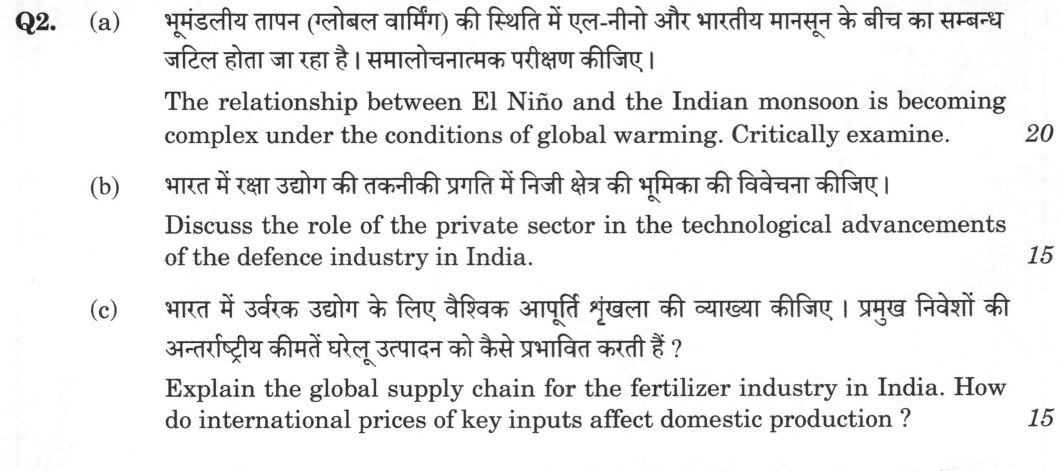
The relationship between El Niño and the Indian monsoon is becoming complex under the conditions of global warming. Critically examine. 20 marks
Discuss the role of the private sector in the technological advancements of the defence industry in India. 15 marks
Explain the global supply chain for the fertilizer industry in India. How do international prices of key inputs affect domestic production? 15 marks
हिंदी में प्रश्न पढ़ें
भूमंडलीय तापन (ग्लोबल वार्मिंग) की स्थिति में एल-नीनो और भारतीय मानसून के बीच का सम्बन्ध जटिल होता जा रहा है। समालोचनात्मक परीक्षण कीजिए। (20 अंक)
भारत में रक्षा उद्योग की तकनीकी प्रगति में निजी क्षेत्र की भूमिका की विवेचना कीजिए। (15 अंक)
भारत में उर्वरक उद्योग के लिए वैश्विक आपूर्ति शृंखला की व्याख्या कीजिए। प्रमुख निवेशों की अन्तर्राष्ट्रीय कीमतें घरेलू उत्पादन को कैसे प्रभावित करती हैं? (15 अंक)
Model answer
Drafted with AI by UPSC Answer Check against this question's marking rubric, to the expected length. UPSC does not publish answers for Mains — this is one way to score well, not an official key. How we build rubrics and answers.
(a) El Niño and the Indian monsoon under global warming
The classical teleconnection between El Niño and the Indian monsoon operates through the Walker circulation and the Southern Oscillation. During El Niño, the warming of the eastern Pacific shifts the Walker circulation, weakening the monsoon circulation over the Indian subcontinent. However, under global warming, this relationship has become non-stationary and complex. Kumar, Rajagopalan and Cane (1999) demonstrated a significant weakening of the ENSO-monsoon correlation in recent decades.
The complexity is evident in "offset" years: in 1997, a strong El Niño coincided with a normal monsoon because a positive Indian Ocean Dipole (IOD; Saji et al., 1999) offset the Pacific warming, and in 2019 a strong positive IOD helped deliver an above-normal season. Conversely, 2002 saw a severe deficit under a weak El Niño. Furthermore, the "flavour" of the event matters; Ashok et al. (2007) showed that central-Pacific El Niño Modoki events have a different impact on the Indian monsoon than canonical eastern-Pacific events.
Global warming adds further layers. Rapid Indian Ocean warming of about 1 °C since 1950 has weakened the land–sea thermal contrast (Roxy et al., 2015), while a warmer atmosphere holds about 7 per cent more moisture per degree, and widespread extreme-rain events over central India rose about threefold between 1950 and 2015 (Roxy et al., 2017). Seasonal totals and El Niño signals therefore no longer map simply onto droughts and floods, and climate models disagree on whether the teleconnection will strengthen or weaken. While El Niño remains the strongest single predictor, it explains only part of the interannual variance. Consequently, forecasting has shifted from simple labels to dynamical multi-predictor models like the Monsoon Mission. Policy must now account for distributional risks—such as delayed onset and extreme events—rather than relying solely on the El Niño label.
(b) The private sector and defence technology
The private sector has become a primary driver of technological advancement in India’s defence industry, supported by a robust policy framework. The Defence Acquisition Procedure (DAP) 2020 and the 74% FDI automatic route (2020) have opened the sector to global capital and technology. The Strategic Partnership model, positive indigenisation lists, and the Defence Industrial Corridors in Uttar Pradesh (Lucknow, Kanpur, Agra, Aligarh, Jhansi, Chitrakoot) and Tamil Nadu (Chennai, Coimbatore, Hosur, Salem, Tiruchirappalli) have created geographical clusters for high-tech manufacturing, alongside the Bengaluru and Hyderabad aerospace hubs.
Innovation is further catalysed by the iDEX (Innovations for Defence Excellence, run by the Defence Innovation Organisation) and the Technology Development Fund, which provide start-up challenges and funding. The corporatisation of the Ordnance Factory Board into seven DPSUs in 2021 has also streamlined the ecosystem. Concrete technological contributions include L&T’s K9 Vajra-T self-propelled gun (with Hanwha), the Tata–Airbus C-295 transport aircraft line at Vadodara, and the DRDO-designed ATAGS howitzer built by Bharat Forge and Tata Advanced Systems.
The private sector supplied about 23 per cent of a record ₹1.51 lakh crore of defence production in 2024-25, but accounts for a majority of defence exports, which reached ₹23,622 crore that year. However, limitations remain, including a monopsony buyer (the government), lumpy orders, and weak private R&D spending. To sustain this growth, India must address MSME payment bottlenecks and ensure a level playing field between private firms and DPSUs.
(c) Fertilizer supply chain and international input prices
India’s fertilizer industry is heavily dependent on a global supply chain for its three primary nutrients. For Nitrogen (N), the feedstock is natural gas/LNG, which is largely imported and processed at gas-based urea plants, while a declining volume of finished urea is also imported. For Phosphorus (P), rock phosphate and phosphoric acid are sourced from Morocco, Jordan, and Saudi Arabia, processed at port-based plants like Kandla and Paradip. For Potassium (K), India has 100% import dependence on MOP from Russia, Belarus, Canada, Israel and Jordan. These cargoes move through the Strait of Hormuz, the Suez–Red Sea route or around the Cape, so shipping disruptions add to price risk.
International prices affect domestic production through a specific transmission mechanism. Because the urea MRP is statutorily fixed and P/K are supported by the Nutrient Based Subsidy (NBS), international price spikes (such as those following the 2022 Russia-Ukraine war) do not reach the farm gate but instead inflate the government's subsidy bill, which peaked at about ₹2.5 lakh crore in 2022-23; where NBS rates lag import costs, P and K manufacturers cut output and capacity utilisation falls. This leads to an NPK use imbalance, drifting away from the desirable 4:2:1 ratio.
India’s responses include overseas equity investments in OMIFCO (Oman), JIFCO (Jordan), and ICS (Senegal), as well as the revival of closed urea units at Ramagundam, Gorakhpur, Sindri and Barauni, the Talcher coal-gasification project, and new capacity under the New Investment Policy 2012. Additionally, initiatives like PM-PRANAM, nano-urea, and soil health cards aim to improve nutrient use efficiency and reduce the overall dependency on volatile global markets.
How this answer will be evaluated
Evaluation rubric
Each sub-part is marked on its own, against the marks and word limit printed on the paper.
- (a) 'Critically examine' - first establish the classical El Nino-Indian summer monsoon teleconnection and its mechanism, then show with evidence that the relationship has become complex/non-stationary (weakening correlation, exceptions, ENSO flavours, competing drivers), and finally judge how global warming is reshaping it and what this means for forecasting. 20 marks
Must cover
- Walker circulation and Southern Oscillation
- Kumar, Rajagopalan and Cane (1999) weakening ENSO-monsoon correlation
- Indian Ocean Dipole (Saji and others, 1999); 1997 and 2019 as offset years
- El Nino Modoki / central-Pacific El Nino (Ashok and others, 2007)
- 1997 normal monsoon under a strong El Nino versus the 2002 deficit under a weak El Nino
- Fast tropical Indian Ocean warming and rising extreme rainfall over central India
- Monsoon Mission dynamical forecasting
Loses marks
- Writing a general essay on ENSO physics with no Indian monsoon evidence, or listing drought years with no mechanism.
- Asserting that every El Nino year brings drought - the counter-examples of 1997 and 2002 are exactly what 'complex' refers to.
- Ignoring the global-warming half of the question, which is the pivot of the statement.
- Confusing the Indian Ocean Dipole with ENSO, or claiming a negative IOD strengthens the monsoon (a POSITIVE IOD is the monsoon-favourable phase).
- Uncritical acceptance - a 'critically examine' answer must weigh what still holds (El Nino remains the single strongest predictor) against what has changed.
Earns more
- Role of competing drivers, above all the Indian Ocean Dipole offsetting El Nino (1997, 2019), plus EQUINOO, the Atlantic Nino/AMO, Eurasian-Tibetan snow cover and the Madden-Julian Oscillation.
- ENSO flavours - central-Pacific El Nino Modoki versus canonical eastern-Pacific El Nino - and the point that the location of the Pacific warming determines the Indian impact.
- Critical judgement and implications: ENSO explains only part of the interannual variance, so forecasting has moved to dynamical multi-predictor models (Monsoon Mission), and policy must plan for distributional risk - dry spells, extreme events, delayed onset - not merely an El Nino label.
- (b) 'Discuss' the private sector's contribution specifically to TECHNOLOGICAL advancement in India's defence industry - the enabling policy framework, concrete company-and-product examples, the geography of private defence clusters, and a balanced assessment of limitations. 15 marks
Must cover
- 74 per cent FDI automatic route (2020) and Strategic Partnership model
- Defence Acquisition Procedure 2020; positive indigenisation lists
- iDEX and the Technology Development Fund
- Defence Industrial Corridors - Uttar Pradesh and Tamil Nadu, with nodes
- Named private firms with named products (L&T K9 Vajra-T, Tata-Airbus C-295, Bharat Forge ATAGS)
- Ordnance Factory Board corporatisation into seven DPSUs (2021)
Loses marks
- Writing about defence policy in general and never naming a private firm or a product - the question is about the private sector's technological role.
- Claiming the private sector has replaced DRDO or the DPSUs; its share of production is still under a quarter (about 23 per cent in 2024-25).
- Omitting the geographical dimension (clusters and corridors) in a geography paper.
- Quoting FDI as 100 per cent under the automatic route - 100 per cent is only through the government route.
- Giving no critical side at all, or conversely only listing problems with no evidence of technological gain.
Earns more
- Innovation-funding architecture: iDEX/Defence Innovation Organisation start-up challenges, the Technology Development Fund, DRDO transfer of technology to industry, the SRIJAN portal and the defence testing infrastructure scheme.
- Evidence of outcome with approximate magnitudes - record defence production of about 1.5 lakh crore rupees in 2024-25 and exports of about 23,600 crore rupees, with the private sector supplying roughly a fifth to a quarter of production but a majority of exports.
- Balanced critique: monopsony buyer and lumpy orders, offset under-delivery, weak private R&D spending, foreign intellectual-property restrictions, MSME payment and certification bottlenecks, and an unlevel field versus DPSUs, with a short way-forward.
- (c) Two parts. First EXPLAIN the global supply chain on which India's fertilizer industry depends - nutrient by nutrient (N, P, K), the source countries, the port-based plant geography and the shipping routes. Second explain the TRANSMISSION MECHANISM by which international input prices affect domestic production, subsidy, prices and nutrient use, with India's responses. 15 marks
Must cover
- Natural gas/LNG as the urea feedstock and the gas-price pass-through
- Morocco, Jordan, Saudi Arabia for rock phosphate/phosphoric acid/DAP
- 100 per cent potash import dependence - Russia, Belarus, Canada, Israel, Jordan
- Nutrient Based Subsidy for P and K versus statutorily fixed urea MRP
- The subsidy spike after 2021-22 and the Russia-Ukraine war/Belarus sanctions/China export curbs
- NPK use imbalance against the desirable 4:2:1 ratio
- OMIFCO (Oman), JIFCO (Jordan), ICS (Senegal); revived plants - Ramagundam, Gorakhpur, Sindri, Barauni, Talcher
Loses marks
- Describing the supply chain nutrient-blind - the exposures for N (gas), P (rock and acid) and K (finished MOP) are quite different and must be separated.
- Claiming India imports most of its urea; India is largely self-sufficient in urea manufacture and it is the GAS that is imported, along with a shrinking volume of finished urea.
- Saying India has large potash reserves - there is no commercial production; Rajasthan's deposits are only under exploration.
- Missing the policy transmission channel (fixed urea MRP plus NBS) and therefore failing to explain why price shocks show up as a subsidy bill rather than as farm-gate urea prices.
- Writing only about problems and omitting India's diversification responses, which the second half of the question invites.
Earns more
- Domestic geography of the chain: port-based P and K plants at Kandla, Paradip, Visakhapatnam, Kakinada, Tuticorin and Mangaluru against pipeline/gas-based urea plants inland, and the Hormuz, Suez-Red Sea and Cape shipping routes.
- Consequences and responses: worsening NPK imbalance away from the desirable 4:2:1 ratio because subsidised urea is relatively cheap; and India's responses - overseas equity and long-term contracts (OMIFCO, JIFCO, ICS Senegal, Saudi and Moroccan DAP agreements), revival of urea plants under the New Investment Policy (NIP)-2012 (amended 2014) at Ramagundam, Gorakhpur, Sindri, Barauni and Talcher coal gasification, nano urea, neem coating, soil health cards and PM-PRANAM.
What "Critically examine" is asking you to do
Test the proposition the question puts to you and return a finding on how far it holds. Examine stems carry a claim, or ask whether something has happened, and expect evidence weighed both ways before the extent is stated — often with remedial measures attached. “Critically” is not a section added at the end: name the yardstick you are judging by — the evidence, the stated objective, a constitutional principle, a rival explanation — and let a verdict close each part of the body. Where the question quotes a claim, that verdict must land on the claim itself, accepted, qualified or rejected, and not on the theme in general.
Structure that answers it
Restate the claim as the question frames it → evidence that supports it → evidence that undercuts it → the conditions under which it holds → verdict on how far it stands
Where marks are lost
Merits in one paragraph, demerits in the next, and a conclusion calling for a balanced and holistic approach. That is a survey with the judgement left out and it holds the answer in the middle band. The opposite error is reading “critically” as permission to attack — and with the odd pairings, critically describe or critically explain, the exposition still carries most of the marks, the judgement being a layer on it rather than a substitute for it.
Practice this exact question
Write your answer and it is marked point by point against the model answer above — what you covered, what you missed, what you got wrong.
Evaluate my answer →More from Geography 2026 Paper II
- Q1 (a) On the outline map of India provided to you, mark the location of all of the followin…
- Q2 (a) The relationship between El Niño and the Indian monsoon is becoming complex under the…
- Q3 (a) Examine the causes and consequences of crop diversification in India. How can crop di…
- Q4 (a) Analyse the spatial distribution of India's automobile industry. How have the cluster…
- Q5 (a) Analyse the consequences of circular migration in India. How does it influence both r…