Paper II — Q5
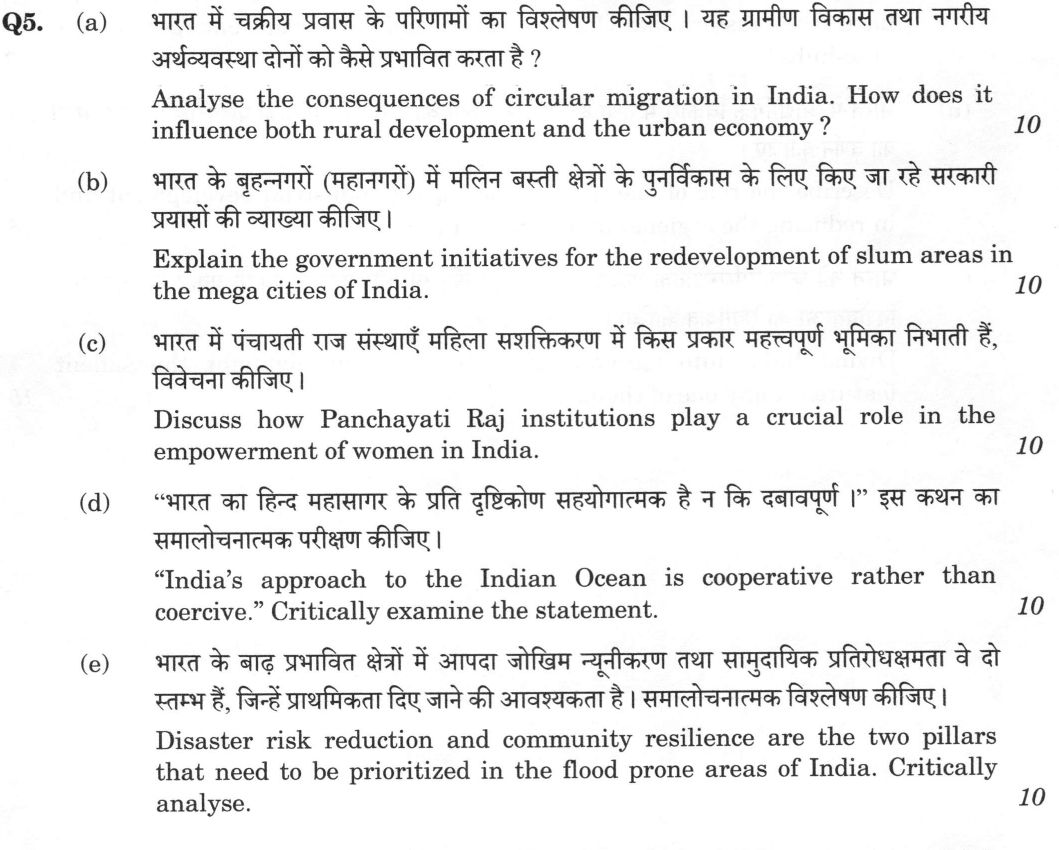
(a) Analyse the consequences of circular migration in India. How does it influence both rural development and the urban economy ?…
Analyse the consequences of circular migration in India. How does it influence both rural development and the urban economy ? 10 marks
Explain the government initiatives for the redevelopment of slum areas in the mega cities of India. 10 marks
Discuss how Panchayati Raj institutions play a crucial role in the empowerment of women in India. 10 marks
“India’s approach to the Indian Ocean is cooperative rather than coercive.” Critically examine the statement. 10 marks
Disaster risk reduction and community resilience are the two pillars that need to be prioritized in the flood prone areas of India. Critically analyse. 10 marks
हिंदी में प्रश्न पढ़ें
भारत में चक्रीय प्रवास के परिणामों का विश्लेषण कीजिए । यह ग्रामीण विकास तथा नगरीय अर्थव्यवस्था दोनों को कैसे प्रभावित करता है ? (10 अंक)
भारत के बृहन्नगरों (महानगरों) में मलिन बस्ती क्षेत्रों के पुनर्विकास के लिए किए जा रहे सरकारी प्रयासों की व्याख्या कीजिए । (10 अंक)
भारत में पंचायती राज संस्थाएँ महिला सशक्तिकरण में किस प्रकार महत्त्वपूर्ण भूमिका निभाती हैं, विवेचना कीजिए । (10 अंक)
“भारत का हिन्द महासागर के प्रति दृष्टिकोण सहयोगात्मक है न कि दबावपूर्ण ।” इस कथन का समालोचनात्मक परीक्षण कीजिए । (10 अंक)
भारत के बाढ़ प्रभावित क्षेत्रों में आपदा जोखिम न्यूनीकरण तथा सामुदायिक प्रतिरोधक्षमता वे दो स्तंभ हैं, जिन्हें प्राथमिकता दिए जाने की आवश्यकता है । समालोचनात्मक विश्लेषण कीजिए । (10 अंक)
Model answer
Drafted with AI by UPSC Answer Check against this question's marking rubric, to the expected length. UPSC does not publish answers for Mains — this is one way to score well, not an official key. How we build rubrics and answers.
(a) Circular migration: rural and urban consequences
Circular migration refers to the repeated, seasonal, or short-duration movement of workers between their origin and destination without a change of usual residence, a phenomenon Jan Breman terms 'footloose labour'. This is statistically invisible; while the Census 2011 counted about 45 crore internal migrants, the NSS 64th round (2007-08) recorded only about 13.6 million short-term migrants, an acknowledged undercount against independent estimates running into several tens of millions.
Key streams include workers from Bihar, eastern Uttar Pradesh, Odisha, Jharkhand, Chhattisgarh, Madhya Pradesh, West Bengal, and southern Rajasthan moving to Delhi-NCR, Mumbai, Surat, Punjab-Haryana (for paddy transplanting and wheat harvest), Kerala, Tamil Nadu, and Gujarat. Specific examples include sugarcane cutters moving from Beed and Marathwada to western Maharashtra, and workers in brick-kiln, construction, textile, fishery, and hospitality sectors. This movement is predominantly male, short-duration, and contractor-mediated.
Rural Consequences:
- Income: Remittances sustain rural household incomes and finance housing, schooling, debt repayment and farm inputs, though they are seldom invested in productive rural enterprise.
- Demographics: Leads to the feminisation of agriculture and leaves behind children and the elderly.
- Exploitation: Contractor-mediated recruitment (mukadam / jamadar) often leads to debt bondage.
- Labour market: Peak-season absence can create local labour shortages, while returning migrants bring skills and new aspirations.
Urban Consequences:
- Economy: Provides cheap, flexible informal labour essential for urban production — construction in Delhi-NCR and Mumbai, Surat's textile and diamond units — but keeps wages low and workers in slums, work-site camps or rented rooms without tenure.
- Policy Gap: The 2020 COVID-19 lockdown return of over one crore workers demonstrated the absence of portable entitlements.
- Policy Handles: The Inter-State Migrant Workmen Act, 1979 (now subsumed in the Occupational Safety, Health and Working Conditions Code, 2020, in force since 21 November 2025), the e-Shram database (2021), One Nation One Ration Card, and Affordable Rental Housing Complexes (2020) aim to address these gaps.
(b) Slum redevelopment in India's mega cities
India’s mega cities face a massive slum challenge; the Census 2011 recorded a slum population of about 6.55 crore, roughly 17 percent of the urban population of slum-reporting towns. Slums are classified as notified, recognised, and identified. Improvement and clearance rest with states under the Slum Areas (Improvement and Clearance) Act, 1956, and with urban local bodies after the 74th Constitutional Amendment.
Government Initiatives:
- Central Schemes: The evolution began with the Environmental Improvement of Urban Slums (1972) and Valmiki Ambedkar Awas Yojana (2001). The Jawaharlal Nehru National Urban Renewal Mission (2005) introduced Basic Services to the Urban Poor (BSUP) and Integrated Housing and Slum Development (IHSDP). Rajiv Awas Yojana (2011) aimed for a 'slum-free India' with a focus on property rights. Currently, PMAY-Urban (2015) included In-Situ Slum Redevelopment (ISSR), while PMAY-U 2.0 (2024) works through BLC, AHP, ARH and ISS.
- State/City Models: Maharashtra Slum Rehabilitation Authority (1995) uses TDR/FSI incentives (e.g., Dharavi Redevelopment Project). Delhi’s DDA handled in-situ rehabilitation (e.g., Kathputli Colony). Ahmedabad implemented the Slum Networking Programme (Parivartan), and Odisha passed the Land Rights to Slum Dwellers Act, 2017 (Jaga Mission).
- Convergence: Swachh Bharat Mission-Urban (toilets), AMRUT (water/sewerage), and DAY-NULM (livelihoods) support these efforts.
Critical Note: Redevelopment often under-delivers due to relocation to the urban periphery (destroying livelihoods), cut-off-date eligibility (excluding recent migrants), and developer-driven models that create 'vertical slums' with weak maintenance and persisting tenure insecurity.
(c) Panchayati Raj institutions and women's empowerment
Panchayati Raj Institutions (PRIs) play a crucial role in women's empowerment through constitutional mandates and large-scale political participation.
Constitutional Mechanism: The 73rd Constitutional Amendment Act, 1992 (effective 24 April 1993) mandated the reservation of one-third of seats and chairperson posts for women under Article 243D. Currently, about 21 states have increased this to 50 percent. Article 243G and the Eleventh Schedule (29 subjects) provide the functional framework.
Scale of Participation: PRIs have created the largest body of elected women in the world. There are roughly 14.5 lakh elected women representatives, constituting about 46 percent of the approximately 31.8 lakh elected panchayat representatives. This scale of political participation is unmatched by any other institution in India, contrasting with the still-unimplemented 106th Constitutional Amendment for the legislature.
Demonstrated Effects: Studies, such as the work of Chattopadhyay and Duflo, indicate that women pradhans prioritize different public goods (like water and sanitation) compared to their male counterparts. Institutions like the Gram Sabha and Mahila Sabha facilitate grassroots mobilization. Convergence with livelihood programs like SHG-panchayat under DAY-NRLM and state models like Kudumbashree further strengthens economic empowerment, while the Rashtriya Gram Swaraj Abhiyan funds training and capacity building for elected women.
Limits:
- Proxy Rule: The phenomenon of 'sarpanch pati' (husbands acting as proxies) dilutes the impact.
- Eligibility: The Rajbala v. State of Haryana (2015) judgment on eligibility conditions has created legal ambiguities.
- Devolution: Weak devolution of the 'three Fs' (funds, functions, and functionaries) limits the actual decision-making power of these representatives.
(d) India's approach to the Indian Ocean: cooperative or coercive?
India’s approach to the Indian Ocean is fundamentally cooperative, focusing on public goods and connectivity, though it retains a coercive capacity to ensure regional stability.
Cooperative Approach:
- Doctrine: The SAGAR doctrine (Security and Growth for All in the Region, 2015), broadened as MAHASAGAR in 2025, and the Indo-Pacific Oceans Initiative (2019) emphasise a positive-sum game, with India as 'net security provider' and 'first responder'.
- Institutions: India is a founding member of the Indian Ocean Rim Association (IORA, 1997), launched the Indian Ocean Naval Symposium (IONS, 2008) and is part of the Colombo Security Conclave; the Navy has kept an anti-piracy presence in the Gulf of Aden since 2008. The Information Fusion Centre-Indian Ocean Region (IFC-IOR) and the 2014 PCA with Bangladesh reflect institutional cooperation.
- Public Goods: India provides humanitarian assistance and disaster relief (HADR), from the 2004 tsunami to operations like Rahat (Yemen, 2015) and Samudra Setu (2020), and 'Vaccine Maitri' during the pandemic.
Coercive Residue:
- Perceptions: Some nations perceive India as a 'Big Brother'.
- Interventions: Past interventions like the IPKF (Sri Lanka) and Operation Cactus (Maldives) demonstrate a willingness to use force.
- Friction Points: The 'India Out' campaign in the Maldives, the Palk Bay fishermen and Katchatheevu disputes with Sri Lanka, local opposition that stalled the Assumption Island project in Seychelles, and strategic readings of the Agalega facilities in Mauritius show that partners see India's presence as a mix of help and leverage.
Verdict: While India possesses the military capability for coercion and is steadily building naval and island infrastructure, its policy is predominantly cooperative — but strategically motivated rather than altruistic: 'cooperative, but not disinterested'.
(e) Disaster risk reduction and community resilience in flood-prone India
Disaster risk reduction (DRR) and community resilience are indeed the two pillars that must be prioritized in India's flood-prone areas, which cover about 40 million hectares (RBA 1980).
Disaster Risk Reduction (DRR):
- Institutional Framework: The Disaster Management Act, 2005 (amended 2025), with the NDMA, state and district authorities and the NDRF, provides the legal and administrative backbone, and the Fifteenth Finance Commission created dedicated mitigation funds (NDMF/SDMF).
- International Alignment: India aligns with the Sendai Framework for Disaster Risk Reduction (2015-2030) through its National Disaster Management Plan (2016) and promotes the Coalition for Disaster Resilient Infrastructure (2019).
- Early Warning: Institutions like the Central Water Commission (CWC) and the India Meteorological Department (IMD) provide critical data. CWC flood forecasting stations and IMD impact-based forecasts support preparedness.
Community Resilience:
- Local Capacity: Programs like Aapda Mitra build local capacity for disaster response.
- Infrastructure: Odisha’s community-managed multipurpose flood and cyclone shelters, built after the 1999 super cyclone, are a prime example of resilience infrastructure that has sharply reduced mortality.
Critical Analysis: While these two pillars are essential, they are insufficient without structural interventions.
- Zoning: The 1975 Model Bill for Flood Plain Zoning remains largely unadopted, leading to encroachment of floodplains.
- Ecological Space: The concept of 'room for the river' is often ignored in favor of rigid engineering.
- Levee Effect: The Kosi experience shows that embankments raise the riverbed between them and create catastrophic breach risk, as at Kusaha in 2008.
- Urban Floods: Mumbai (2005), Chennai (2015), Bengaluru (2022) and Delhi (2023) show that drainage and encroachment, not only rivers, now drive flood losses.
Therefore, DRR and resilience must be integrated with land-use planning and ecological restoration to be truly effective.
How this answer will be evaluated
Evaluation rubric
Each sub-part is marked on its own, against the marks and word limit printed on the paper.
- (a) Analyse the consequences of circular migration and answer the explicit second question on its twin effect - on rural development at the origin AND on the urban economy at the destination. A compact note, not an essay, with named source-destination streams. 10 marks
Must cover
- definition of circular / seasonal / short-duration migration; Jan Breman's 'footloose labour'
- Census 2011 internal migrants (about 45 crore) versus NSS short-term migrant estimates - the undercount
- named streams: Bihar/eastern UP/Odisha/Jharkhand to Delhi-NCR, Mumbai, Surat, Punjab-Haryana, Kerala
- Beed-Marathwada sugarcane cutters; brick kilns and construction
- remittances; feminisation of agriculture; left-behind children and elderly
- contractor-mediated recruitment (mukadam / jamadar) and debt bondage
- Inter-State Migrant Workmen Act 1979 and the OSH Code 2020
- e-Shram, One Nation One Ration Card, Affordable Rental Housing Complexes
- COVID-19 2020 return migration
Loses marks
- Treating the question as being about migration in general, with push-pull factors and Lee's theory, instead of the specific consequences of circular migration.
- Answering only the rural side (remittances) and neglecting the urban economy, or vice versa - both are explicitly asked.
- Giving no named source or destination region and no sector, so the note is unverifiable.
- Listing only negatives (slums, exploitation) with no recognition that circulation sustains both rural incomes and urban informal production.
- A long introduction on migration typologies that leaves no room for consequences.
Earns more
- Defines circular migration - repeated seasonal or short-duration movement between origin and destination without a change of usual residence, Jan Breman's 'footloose labour' - and notes that it is statistically invisible: Census 2011 counted about 45 crore internal migrants but only by change of residence, while the NSS 64th round (2007-08) recorded only about 13.6 million short-term migrants, an acknowledged undercount against independent estimates running into several tens of millions.
- Names real streams rather than generalities: Bihar, eastern Uttar Pradesh, Odisha, Jharkhand, Chhattisgarh, Madhya Pradesh, West Bengal and southern Rajasthan as sources; Delhi-NCR, Mumbai, Surat, Punjab-Haryana (paddy transplanting and wheat harvest), Kerala, Tamil Nadu and Gujarat as destinations; sugarcane cutters moving from Beed and Marathwada to western Maharashtra; brick-kiln, construction, textile, fishery and hospitality work as the typical sectors; and predominantly male, short-duration, contractor-mediated movement.
- Policy handles and the reality check: the Inter-State Migrant Workmen Act, 1979 (now subsumed in the Occupational Safety, Health and Working Conditions Code, 2020), the e-Shram database (2021), One Nation One Ration Card for portable food entitlements, Affordable Rental Housing Complexes (2020), PM SVANidhi for street vendors, and the recommendations of the Ministry of Housing and Urban Affairs Working Group on Migration (2017); the 2020 COVID-19 lockdown return of over one crore workers demonstrated both the scale of circulation and the absence of portable entitlements.
- (b) Explain - i.e. describe with reasons and named examples - the initiatives taken by government for redeveloping slums specifically in India's mega cities. Central schemes AND state/city-level models are expected; a short critical note on why redevelopment under-delivers lifts the answer. 10 marks
Must cover
- Census 2011 slum population of about 6.55 crore
- Slum Areas (Improvement and Clearance) Act, 1956
- JNNURM (2005) - BSUP and IHSDP; Rajiv Awas Yojana (2011)
- PMAY-Urban (2015) and its In-Situ Slum Redevelopment vertical; PMAY-U 2.0
- Affordable Rental Housing Complexes (2020)
- Maharashtra Slum Rehabilitation Authority (1995), TDR/FSI incentive, Dharavi Redevelopment Project
- Kathputli Colony in-situ rehabilitation, Delhi (DUSIB)
- Ahmedabad Slum Networking Programme / Parivartan
- Odisha Jaga Mission and the Odisha Land Rights to Slum Dwellers Act, 2017
- Swachh Bharat Mission-Urban, AMRUT, DAY-NULM convergence
Loses marks
- Listing housing schemes generally (PMAY-Gramin, Indira Awas Yojana) without distinguishing the slum-redevelopment instrument, which is ISSR under PMAY-U.
- Giving no city-specific example, so the 'mega cities' framing of the question is never addressed.
- Describing slum clearance and eviction as redevelopment; the policy shift since Rajiv Awas Yojana is towards in-situ redevelopment with tenure security.
- Confusing the Slum Rehabilitation Authority (Maharashtra, a state body using FSI/TDR) with a central scheme.
- Spending the answer on causes of slum formation instead of on government initiatives.
Earns more
- Establishes scale and legal base: Census 2011 recorded a slum population of about 6.55 crore, roughly 17 percent of the urban population of slum-reporting towns, concentrated in the mega cities (Dharavi in Mumbai being the best-known case); slums are classified as notified, recognised and identified; improvement and clearance rest with states under the Slum Areas (Improvement and Clearance) Act, 1956 and with urban local bodies after the 74th Constitutional Amendment.
- Traces the evolution of central programmes: Environmental Improvement of Urban Slums (1972) providing basic services rather than housing; Valmiki Ambedkar Awas Yojana (2001); the Jawaharlal Nehru National Urban Renewal Mission (2005) with its Basic Services to the Urban Poor and Integrated Housing and Slum Development sub-missions; Rajiv Awas Yojana (2011) with its explicit 'slum-free India' goal and its emphasis on property rights and slum mapping.
- Notes convergence and gives a critical edge: household toilets under Swachh Bharat Mission-Urban, water and sewerage under AMRUT, livelihoods, SHGs and shelters for the urban homeless under DAY-NULM, and area-based development under the Smart Cities Mission; but outcomes are limited by relocation to the urban periphery that destroys livelihoods and adds commuting cost, cut-off-date eligibility that excludes recent migrants and tenants, developer-driven models that are viable only on high-value land, weak maintenance and the creation of 'vertical slums', and persisting tenure insecurity.
- (c) Discuss how Panchayati Raj institutions empower women in India - the constitutional mechanism, the scale of participation, the demonstrated effects, and (for a 'discuss') the limits such as proxy rule and weak devolution. 10 marks
Must cover
- 73rd Constitutional Amendment Act, 1992 (effective 24 April 1993)
- Article 243D - one-third reservation of seats and chairperson posts for women; 50 percent in about 21 states
- Article 243G and the Eleventh Schedule (29 subjects); Gram Sabha / Mahila Sabha
- about 14.5 lakh elected women representatives, roughly 46 percent of PRI members
- Chattopadhyay and Duflo study on women pradhans and public-good priorities
- 'sarpanch pati' / proxy participation
- Rajbala v. State of Haryana (2015) on eligibility conditions
- devolution of funds, functions and functionaries (the three Fs)
- SHG-panchayat convergence under DAY-NRLM; Kudumbashree
- Rashtriya Gram Swaraj Abhiyan
Loses marks
- Attributing women's reservation in panchayats to the 74th Amendment (which is for urban local bodies) instead of the 73rd.
- Claiming the Constitution itself mandates 50 percent reservation - Article 243D mandates not less than one-third; 50 percent comes from state laws.
- Writing a general essay on women's empowerment in India with no panchayat-specific mechanism or evidence.
- Presenting only the positives and ignoring proxy rule and weak devolution, which a 'discuss' requires.
- Confusing the 106th Amendment (Parliament and assemblies, not yet operative) with panchayat reservation already in force since 1993.
Earns more
- Quantifies the scale: roughly 14.5 lakh elected women representatives, about 46 percent of the approximately 31.8 lakh elected panchayat representatives on Ministry of Panchayati Raj figures - the largest body of elected women in the world, and a scale of political participation no other institution in India has produced; contrast with the still-unimplemented 106th Constitutional Amendment (2023) for Parliament and state assemblies.
- States the limits honestly: 'sarpanch pati' or 'pradhan pati' proxy rule where husbands and male relatives exercise the office; elite, caste and party capture; rotation of reserved seats preventing continuity; disqualification conditions in some states such as minimum educational qualification and the two-child norm, which disproportionately exclude poor and rural women (the Haryana law was upheld in Rajbala v. State of Haryana, 2015); frequent no-confidence motions and harassment; and above all the weak devolution of funds, functions and functionaries, which leaves elected women presiding over bodies with little real power.
- (d) Critically examine a claim - test whether India's Indian Ocean policy is genuinely cooperative rather than coercive. Evidence must be marshalled on both sides (doctrine and public goods versus 'Big Brother' perceptions and past interventions) and a reasoned verdict given. 10 marks
Must cover
- SAGAR (Security and Growth for All in the Region), 2015
- Indo-Pacific Oceans Initiative (2019)
- IORA (1997) and IONS (2008); Colombo Security Conclave
- Information Fusion Centre-Indian Ocean Region, Gurugram (2018)
- Gulf of Aden anti-piracy deployment since 2008
- HADR record - 2004 tsunami, Operation Rahat (2015), Operation Samudra Setu (2020), Vaccine Maitri
- acceptance of the 2014 Permanent Court of Arbitration maritime award with Bangladesh
- IPKF in Sri Lanka (1987-90) and Operation Cactus in the Maldives (1988)
- 'India Out' campaign in the Maldives; Palk Bay fishermen / Katchatheevu
- 'net security provider' and 'first responder'
Loses marks
- Writing a one-sided endorsement of SAGAR with no counter-evidence - 'critically examine' requires both sides and a verdict.
- Turning the answer into an India-China rivalry essay about the String of Pearls without addressing India's own conduct.
- Failing to cite a single concrete instance of cooperation (no HADR operation, no capacity-building transfer, no institution).
- Asserting that India has never used force in the region, which ignores the IPKF and Operation Cactus.
- Stating no verdict at the end, leaving the examiner with a list rather than a judgement.
Earns more
- Frames the doctrine: SAGAR - Security and Growth for All in the Region - articulated in Mauritius in 2015, the Indo-Pacific Oceans Initiative announced in 2019, the self-description as 'net security provider' and 'first responder' in the Indian maritime security strategy 'Ensuring Secure Seas' (2015), and the more recent broadening of SAGAR into a wider global-South maritime outreach.
- States the counter-case fairly: persistent 'Big Brother' perceptions arising from India's sheer asymmetry of size; precedents of force - the Indian Peace Keeping Force in Sri Lanka (1987-90) and Operation Cactus in the Maldives (1988), both invited but read regionally as intervention; the Palk Bay fishermen dispute and the Katchatheevu question with Sri Lanka; the 'India Out' campaign in the Maldives; local opposition that ended the Assumption Island project in Seychelles; strategic readings of the Agalega facilities in Mauritius; India's discomfort with extra-regional naval presence and with Chinese connectivity projects in its neighbourhood; and chronic delays in delivering promised Indian projects, which erode goodwill.
- Delivers a reasoned verdict: the cooperative characterisation is broadly accurate because India lacks both the resources and the incentive to coerce against Chinese economic weight, and because public goods buy influence more cheaply; but cooperation is strategically motivated rather than altruistic, coexists with a determined build-up of hard naval power and island infrastructure in the Andaman and Nicobar Command, and is constrained by domestic politics in partner states - hence 'cooperative, but not disinterested'.
- (e) Critically analyse a prescription - that disaster risk reduction and community resilience should be the two prioritised pillars in India's flood-prone areas. Both pillars must be examined separately with India-specific institutions and examples, and the answer must test whether the two alone are sufficient. 10 marks
Must cover
- about 40 million hectares flood-prone (Rashtriya Barh Ayog, 1980)
- Disaster Management Act 2005; NDMA, SDMA, DDMA, NDRF
- Sendai Framework for Disaster Risk Reduction 2015-2030; National Disaster Management Plan 2016
- Fifteenth Finance Commission mitigation funds (NDMF/SDMF)
- Central Water Commission flood forecasting; IMD impact-based forecasting
- Aapda Mitra community volunteers; village disaster management plans
- Odisha's community shelter model after the 1999 super cyclone
- Kosi embankments and the levee effect in Bihar
- model Flood Plain Zoning Bill, 1975 - largely unlegislated
- urban flooding cases: Mumbai 2005, Chennai 2015, Bengaluru 2022, Delhi 2023
- Coalition for Disaster Resilient Infrastructure (2019)
Loses marks
- Describing the causes of floods in India rather than analysing the two prescribed pillars.
- Treating disaster risk reduction and community resilience as the same thing and writing a single undifferentiated list.
- Accepting the prescription uncritically - 'critically analyse' requires testing whether these two pillars are sufficient.
- No named institution, statute or scheme (no DM Act 2005, no Sendai, no Aapda Mitra), leaving the answer unverifiable.
- Advocating more embankments as the solution without acknowledging the levee effect and the Bihar experience.
Earns more
- Establishes the geography and scale: about 40 million hectares - roughly one-eighth of India's area - is flood-prone on the Rashtriya Barh Ayog (1980) assessment; the worst-affected tracts are the Ganga plain tributaries in Bihar (Kosi, the 'Sorrow of Bihar', Gandak, Bagmati, Burhi Gandak), the Brahmaputra-Barak valley in Assam, the Damodar, Mahanadi and Godavari basins, and increasingly the mega cities through urban flooding (Mumbai 2005, Chennai 2015 and 2023, Hyderabad 2020, Bengaluru 2022, Delhi 2023).
- Balanced conclusion: the two pillars are correctly prioritised but insufficient on their own - they must be joined to basin-level planning and catchment treatment, ecosystem-based measures (wetland and floodplain restoration, 'room for the river', sponge-city drainage), enforceable land-use and floodplain zoning, risk transfer through insurance, and resilient infrastructure standards.
What "Analyse" is asking you to do
Break the subject into its working parts and show how they act on each other. The marks are in the interconnections — which factor drives which, and what the resulting structure explains — not in the inventory of factors.
Structure that answers it
Define the whole → separate it into its parts → show which part drives which → what that interaction produces → what the structure implies
Where marks are lost
A flat list of causes with no account of which drives which. An answer of neatly separated headings, each self-contained, scores as description.
Practice this exact question
Write your answer and it is marked point by point against the model answer above — what you covered, what you missed, what you got wrong.
Evaluate my answer →More from Geography 2026 Paper II
- Q2 (a) The relationship between El Niño and the Indian monsoon is becoming complex under the…
- Q3 (a) Examine the causes and consequences of crop diversification in India. How can crop di…
- Q4 (a) Analyse the spatial distribution of India's automobile industry. How have the cluster…
- Q5 (a) Analyse the consequences of circular migration in India. How does it influence both r…
- Q6 (a) Examine the trends in fertility rates across Indian states over time. How are they pr…
- Q7 (a) Why is it difficult to improve the quality of air during the winter season in the Gan…
- Q8 (a) Critically examine the strategic, economic and ecological impacts of the proposed ‘Gr…