Paper II — Q3
(a) Examine the causes and consequences of crop diversification in India. How can crop diversification contribute to sustainable…
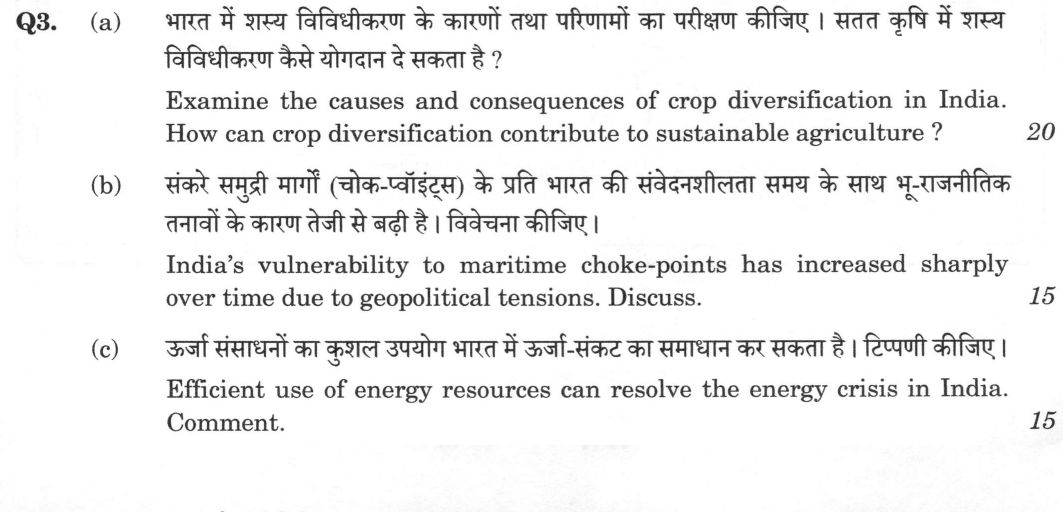
Examine the causes and consequences of crop diversification in India. How can crop diversification contribute to sustainable agriculture? 20 marks
India's vulnerability to maritime choke-points has increased sharply over time due to geopolitical tensions. Discuss. 15 marks
Efficient use of energy resources can resolve the energy crisis in India. Comment. 15 marks
हिंदी में प्रश्न पढ़ें
भारत में शस्य विविधीकरण के कारणों तथा परिणामों का परीक्षण कीजिए। सतत कृषि में शस्य विविधीकरण कैसे योगदान दे सकता है? (20 अंक)
संकरे समुद्री मार्गों (चोक-प्वॉइंट्स) के प्रति भारत की संवेदनशीलता समय के साथ भू-राजनीतिक तनावों के कारण तेजी से बढ़ी है। विवेचना कीजिए। (15 अंक)
ऊर्जा संसाधनों का कुशल उपयोग भारत में ऊर्जा-संकट का समाधान कर सकता है। टिप्पणी कीजिए। (15 अंक)
Model answer
Drafted with AI by UPSC Answer Check against this question's marking rubric, to the expected length. UPSC does not publish answers for Mains — this is one way to score well, not an official key. How we build rubrics and answers.
(a) Crop diversification in India and sustainable agriculture
Crop diversification, measured by indices such as the Simpson's Index of Diversification or the Herfindahl Index, refers to the shift from a narrow crop mix to a wider variety of crops (horizontal diversification), and also to value addition through processing and allied activities (vertical diversification). In India, this transition is primarily a response to the environmental and economic unsustainability of the post-Green Revolution rice-wheat monoculture in the north-west.
The causes of this shift are multifaceted. First, the Central Ground Water Board classifies most of Punjab's assessment blocks as over-exploited, necessitating a move away from water-intensive paddy. Second, the average operational holding of 1.08 ha (Agriculture Census 2015-16) limits the scale of surplus, pushing farmers toward high-value horticulture. Policy interventions have also been critical, including the Crop Diversification Programme (2013-14) under RKVY, the Mission for Integrated Development of Horticulture (MIDH), the National Mission on Edible Oils-Oil Palm (2021) and its Oilseeds mission (2024), and price-deficiency payments such as Madhya Pradesh's Bhavantar Bhugtan Yojana. Furthermore, the International Year of Millets 2023 (Shree Anna) has promoted climate-resilient crops.
The consequences are mixed. On the positive side, horticulture output has exceeded foodgrain output since 2012-13, and regional successes include Nashik grapes, Jalgaon bananas and maize and aquaculture in Andhra Pradesh. However, diversification faces adverse constraints: price volatility in the tomato-onion-potato cycle, the absence of assured procurement outside rice and wheat, and high post-harvest losses due to inadequate cold chains. In some regions, "negative diversification" has occurred, where farmers shift to water-guzzling sugarcane.
To contribute to sustainable agriculture, diversification must be integrated with Integrated Farming Systems (IFS) and agroforestry. By shifting to millets and pulses, farmers can improve soil health through nitrogen fixation, reduce the water footprint and cut paddy-straw burning, while a wider crop portfolio spreads climatic and price risk. However, for this to be truly sustainable, the government must broaden the Minimum Support Price (MSP) and procurement mechanisms to include these diversified crops, ensuring that farmers are not penalized for moving away from the rice-wheat cycle.
(b) India and maritime choke-points
India’s vulnerability to maritime choke-points has intensified as its seaborne trade has expanded; approximately 95% of India's trade by volume is seaborne, and its crude oil import dependence stands at roughly 85-88%. This heavy reliance makes India acutely sensitive to disruptions in critical maritime corridors.
The primary choke-points include the Strait of Hormuz, through which a majority of India's Gulf crude passes; the Bab-el-Mandeb and Suez Canal, which are vital for trade with Europe; and the Strait of Malacca, essential for commerce with East Asia; closer home, the Ten-Degree and Nine-Degree Channels carry the main east–west shipping lanes past India's island territories. Geopolitical tensions have recently exacerbated these risks. The 2023-24 Red Sea crisis, involving Houthi attacks and the Chem Pluto incident, forced a significant rerouting of vessels round the Cape of Good Hope, increasing transit times and costs, and the June 2025 Israel–Iran conflict revived threats to close the Strait of Hormuz. Similarly, the "String of Pearls" strategy—exemplified by China's presence in Gwadar, Hambantota, and Djibouti—poses a strategic challenge to India's maritime security.
The consequences for India are severe: higher landed costs for crude, LNG, and fertilizers; loss of export competitiveness for textiles and engineering goods; and a stretched operational commitment for the Indian Navy across two oceans.
In response, India has adopted a multi-pronged strategy. Operation Sankalp (2019) demonstrated the Navy's capability to protect merchant shipping in the Gulf. The establishment of the Information Fusion Centre-Indian Ocean Region (IFC-IOR) in Gurugram (2018) has enhanced maritime domain awareness. India is also diversifying its energy suppliers and developing alternative corridors such as Chabahar, the International North-South Transport Corridor (INSTC), and the India-Middle East-Europe Economic Corridor (IMEC, 2023). Additionally, the SAGAR doctrine (broadened as MAHASAGAR in 2025) and strategic petroleum reserves of about 5.3 million tonnes at Visakhapatnam, Mangaluru and Padur are key components of India's resilience framework.
(c) Energy efficiency and India's energy crisis
The claim that efficient use of energy resources can resolve India's energy crisis is partly true. Energy efficiency is often called the "first fuel" because it is the most cost-effective way to meet growing demand. India has made significant strides through the Energy Conservation Act (2001, amended 2022) and the Bureau of Energy Efficiency (BEE). Schemes like Perform, Achieve and Trade (PAT) under the National Mission for Enhanced Energy Efficiency (NMEEE), the UJALA LED programme, Standards and Labelling star ratings, the Energy Conservation Building Code (2017) and Eco Niwas Samhita, PM-KUSUM solar pumps and the India Cooling Action Plan (2019) have contributed, with other measures, to a substantial fall in the energy and emission intensity of GDP; aggregate technical and commercial (AT&C) losses of distribution utilities have also fallen to about 16 per cent. PAT is now being folded into the Carbon Credit Trading Scheme (2023).
However, efficiency alone is not sufficient to resolve the crisis. India faces a "decoupling-without-decline" problem: while energy intensity has fallen, absolute demand continues to rise due to economic growth and industrialization. Furthermore, the "rebound effect" (Jevons paradox) suggests that efficiency gains can sometimes lead to increased consumption as energy becomes cheaper. India's heavy dependence on fuel imports and the sheer scale of its projected demand growth mean that conservation cannot be the sole solution.
Therefore, a balanced approach is required. Efficiency must be complemented by a robust supply-side strategy, including the achievement of India's NDC targets: a 50% non-fossil share of installed power capacity (reached in June 2025) and a 45% cut in emission intensity from 2005 levels by 2030, with net zero by 2070. This requires a focus on the National Green Hydrogen Mission, nuclear expansion, and grid strengthening. In conclusion, while energy efficiency is a necessary foundation, it must be integrated with a diversified, non-fossil-centric supply mix to truly resolve India's energy crisis.
How this answer will be evaluated
Evaluation rubric
Each sub-part is marked on its own, against the marks and word limit printed on the paper.
- (a) Three linked tasks: 'examine' the causes of crop diversification in India, 'examine' its consequences (both favourable and adverse), and then answer the explicit second question - how diversification can contribute to sustainable agriculture. An answer that treats only causes and consequences, or only sustainability, is incomplete. 20 marks
Must cover
- Simpson's Index of Diversification / Herfindahl index
- Crop Diversification Programme (2013-14, under RKVY, for Punjab, Haryana, western Uttar Pradesh)
- Mission for Integrated Development of Horticulture (MIDH)
- National Mission on Edible Oils-Oil Palm (2021)
- Central Ground Water Board over-exploited blocks in Punjab
- average operational holding 1.08 ha (Agriculture Census 2015-16)
- horticulture output exceeding foodgrain output since about 2012-13
- International Year of Millets 2023 / Shree Anna
- MSP and procurement skew towards rice and wheat
- Bhavantar Bhugtan Yojana (price deficiency payment, Madhya Pradesh)
- integrated farming systems and agroforestry
Loses marks
- Answering only 'causes and consequences' and ignoring the explicit second question on sustainable agriculture (this alone caps the score).
- Writing a generic Indian-agriculture essay with no named scheme, index or region - no Crop Diversification Programme, no MIDH, no Punjab groundwater data.
- Treating diversification as unambiguously good; not mentioning price volatility, absent procurement outside rice-wheat, or cold-chain and holding-size constraints.
- Confusing crop diversification with crop rotation or with diversification of the rural economy into non-farm activity.
- Padding the answer with description and leaving no space for the sustainability mechanisms.
Earns more
- Defines crop diversification and states how it is measured (Simpson's Index of Diversification, Herfindahl Index or entropy index); distinguishes horizontal diversification (a wider crop mix in the rotation) from vertical diversification (value addition), and identifies the post-Green-Revolution rice-wheat monoculture of the north-west as the baseline problem.
- Consequences - adverse and constraining: price volatility and absence of assured procurement outside rice and wheat (the tomato-onion-potato cycle); inadequate cold chain, grading and processing so post-harvest losses stay high; small and fragmented holdings (average operational holding 1.08 ha, Agriculture Census 2015-16) limiting scale and marketable surplus; credit and crop-insurance gaps; 'negative diversification' into water-guzzling sugarcane or paddy in unsuitable tracts; contraction of coarse-cereal and pulse area in some belts.
- Regional illustration - at least two named cases: Punjab-Haryana's paddy-wheat lock-in and maize/pulse/agro-forestry pilots; Madhya Pradesh's soybean-gram-wheat belt; Maharashtra's sugarcane versus Nashik grapes and Jalgaon banana; Andhra Pradesh-Telangana's chilli, maize and aquaculture; West Bengal's potato and vegetables; the North-East's organic horticulture.
- (b) Discuss, i.e. establish with evidence, that India's exposure to maritime choke-points has risen sharply over time, and that geopolitical tension is the driver. The answer must name the specific choke-points, quantify India's seaborne dependence, cite recent geopolitical episodes, and indicate India's responses. 15 marks
Must cover
- Strait of Hormuz
- Bab-el-Mandeb / Suez Canal / Red Sea crisis 2023-24
- Strait of Malacca (and Sunda, Lombok alternatives)
- Ten-Degree Channel, Nine-Degree Channel, Palk Strait
- about 95 percent of India's trade by volume is seaborne
- crude import dependence of roughly 85-88 percent
- Operation Sankalp
- Information Fusion Centre-Indian Ocean Region, Gurugram (2018)
- String of Pearls - Gwadar, Hambantota, Djibouti
- Chabahar / INSTC and IMEC (2023)
- strategic petroleum reserves at Visakhapatnam, Mangaluru, Padur
- SAGAR doctrine
Loses marks
- Listing world choke-points without connecting each to a specific Indian trade or energy flow.
- Describing the 'Malacca dilemma' as India's when the term is China's - India's Malacca stake is trade with East Asia and naval access, and this should be stated correctly.
- Giving no dated evidence of the recent worsening (Red Sea 2023-24, Chem Pluto, Panama drought), so the 'sharply over time' part of the statement is never demonstrated.
- Omitting India's responses entirely, which makes the answer a list of problems rather than a discussion.
- Confusing the Ten-Degree Channel (Andaman-Nicobar) with the Nine-Degree Channel (Lakshadweep) or misplacing them.
Earns more
- Spells out consequences for India: higher landed cost of crude, LNG, fertilizer (urea, DAP, potash), edible oil and coking coal; loss of export competitiveness for textiles, engineering goods and agri-exports to Europe; container shortages and blank sailings at Nhava Sheva, Mundra and Chennai; wider fiscal and subsidy pressure; and an operational stretch on the Navy across a two-ocean commitment.
- India's responses: Indian Navy escort and anti-piracy deployment (Operation Sankalp in the Gulf from 2019 and mission-based deployments during the 2023-24 Red Sea crisis); Information Fusion Centre-Indian Ocean Region at Gurugram (2018) and white-shipping agreements for maritime domain awareness; the SAGAR framework and IONS/IORA engagement; strategic petroleum reserves (Visakhapatnam, Mangaluru, Padur); supplier diversification towards Russia, the USA, West Africa and Latin America; alternative corridors - Chabahar and the International North-South Transport Corridor, and the India-Middle East-Europe Economic Corridor announced in September 2023; coastal shipping and inland waterways under Sagarmala.
- (c) 'Comment' on a strong claim - that efficiency alone can resolve India's energy crisis. The answer must agree in part (showing the real gains available from efficiency, with named institutions and schemes) and disagree in part (showing why demand growth, the rebound effect, fuel-import dependence and the supply mix mean efficiency is necessary but not sufficient), and then take a position. 15 marks
Must cover
- Energy Conservation Act 2001 and 2022 amendment
- Bureau of Energy Efficiency (2002)
- Perform, Achieve and Trade (PAT) under NMEEE
- Standards and Labelling / star rating
- UJALA LED programme
- Energy Conservation Building Code 2017 / Eco Niwas Samhita
- PM-KUSUM solar pumps
- aggregate technical and commercial (AT&C) losses
- rebound (Jevons) effect
- India's NDC - 50 percent non-fossil installed capacity and 45 percent emission-intensity cut by 2030, net zero by 2070
- India Cooling Action Plan 2019
- National Green Hydrogen Mission
Loses marks
- Accepting the statement wholesale and writing only about conservation tips, with no counter-argument - 'comment' requires a two-sided treatment.
- Not naming a single statute, institution or scheme (no EC Act, BEE, PAT or ECBC), leaving the answer unverifiable.
- Confusing energy efficiency with renewable energy expansion and devoting the answer to solar and wind capacity.
- Ignoring the rebound effect and the sheer scale of projected demand growth, which is the strongest argument against the statement.
- Quoting outdated or invented numbers (for example claiming AT&C losses are still above 25 percent nationally, or that India has eliminated coal from generation).
Earns more
- Frames the issue: distinguishes energy conservation from energy efficiency and notes that India's energy and emission intensity of GDP has fallen substantially (emission intensity of GDP down of the order of a third between 2005 and 2019 as reported in India's national communications), while absolute demand keeps rising - the classic decoupling-without-decline problem.
- Balanced verdict with the supply-side complement: efficiency is the cheapest 'first fuel' and defers capacity, but must run with India's non-fossil targets (500 GW non-fossil capacity and 50 percent non-fossil installed share by 2030, emission intensity cut of 45 percent from 2005 levels, net zero by 2070), storage and grid strengthening, nuclear expansion, and the National Green Hydrogen Mission. Hence the statement is partly true - necessary but not sufficient.
What "Examine" is asking you to do
Test the proposition the question puts to you and return a finding on how far it holds. Examine stems carry a claim, or ask whether something has happened, and expect evidence weighed both ways before the extent is stated — often with remedial measures attached.
Structure that answers it
Restate the claim as the question frames it → evidence that supports it → evidence that undercuts it → the conditions under which it holds → verdict on how far it stands
Where marks are lost
Stopping at description. An examination has to reach a finding, and “examine with justification” means the extent must be stated, not implied.
Practice this exact question
Write your answer and it is marked point by point against the model answer above — what you covered, what you missed, what you got wrong.
Evaluate my answer →More from Geography 2026 Paper II
- Q1 (a) On the outline map of India provided to you, mark the location of all of the followin…
- Q2 (a) The relationship between El Niño and the Indian monsoon is becoming complex under the…
- Q3 (a) Examine the causes and consequences of crop diversification in India. How can crop di…
- Q4 (a) Analyse the spatial distribution of India's automobile industry. How have the cluster…
- Q5 (a) Analyse the consequences of circular migration in India. How does it influence both r…
- Q6 (a) Examine the trends in fertility rates across Indian states over time. How are they pr…