Paper I — Q1
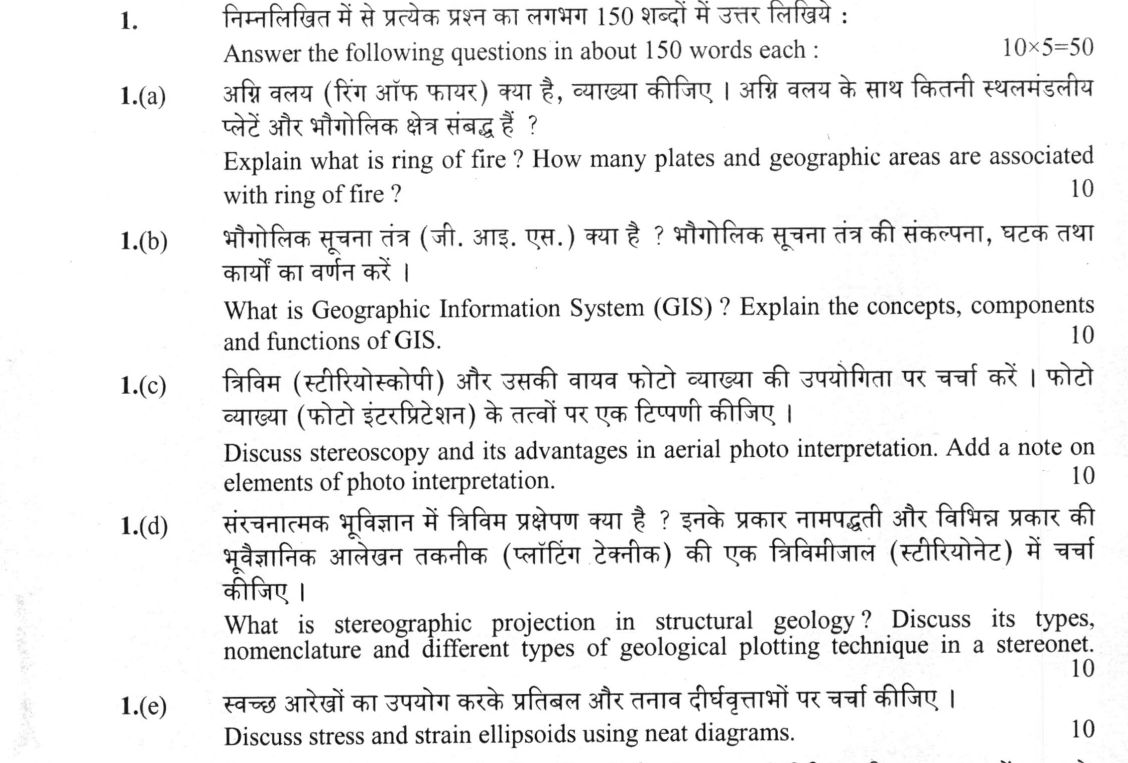
Answer the following questions in about 150 words each: (a) Explain what is ring of fire? How many plates and geographic areas…
Answer the following questions in about 150 words each: Explain what is ring of fire? How many plates and geographic areas are associated with ring of fire? 10 marks
What is Geographic Information System (GIS)? Explain the concepts, components and functions of GIS. 10 marks
Discuss stereoscopy and its advantages in aerial photo interpretation. Add a note on elements of photo interpretation. 10 marks
What is stereographic projection in structural geology? Discuss its types, nomenclature and different types of geological plotting technique in a stereonet. 10 marks
Discuss stress and strain ellipsoids using neat diagrams. 10 marks
हिंदी में प्रश्न पढ़ें
निम्नलिखित में से प्रत्येक प्रश्न का लगभग 150 शब्दों में उत्तर लिखिए : अग्नि वलय (रिंग ऑफ फायर) क्या है, व्याख्या कीजिए । अग्नि वलय के साथ कितनी स्थलमंडलीय प्लेटें और भौगोलिक क्षेत्र संबद्ध हैं ? (10 अंक)
भौगोलिक सूचना तंत्र (जी. आई. एस.) क्या है ? भौगोलिक सूचना तंत्र की संकल्पना, घटक तथा कार्यों का वर्णन करें । (10 अंक)
त्रिविम (स्टीरियोस्कोपी) और उसकी वायव फोटो व्याख्या की उपयोगिता पर चर्चा करें । फोटो व्याख्या (फोटो इंटरप्रिटेशन) के तत्वों पर एक टिप्पणी कीजिए । (10 अंक)
संरचनात्मक भूविज्ञान में त्रिविम प्रक्षेपण क्या है ? इनके प्रकार नामपद्धति और विभिन्न प्रकार की भूवैज्ञानिक आलेखन तकनीक (प्लॉटिंग टैक्निक) की एक त्रिविमजाल (स्टीरियोनेट) में चर्चा कीजिए । (10 अंक)
स्वच्छ आरेखों का उपयोग करके प्रतिबल और तनाव दीर्घवृत्ताभों पर चर्चा कीजिए । (10 अंक)
Model answer
Written by UPSC Answer Check against this question's marking rubric, to the 150-word length. UPSC does not publish answers for Mains — this is one way to score well, not an official key.
(a) Ring of Fire
The Ring of Fire is a roughly 40,000-kilometre horseshoe-shaped circum-Pacific belt characterized by intense seismic activity and active volcanism, hosting over 75% of the world's active volcanoes and 90% of global earthquakes. It is formed by the continuous subduction of denser oceanic lithosphere beneath lighter oceanic or continental plates, creating deep oceanic trenches, partial melting of the asthenosphere, and resultant volcanic arc systems.
The belt involves the interaction of at least seven major and minor tectonic plates: the Pacific, Nazca, Cocos, Juan de Fuca, North American, Eurasian, and Indo-Australian plates, alongside the Philippine Sea Plate. Geographically, it extends along the western margin of South America (the Andes of Chile and Peru), through Central America and Mexico, past the western United States (Cascades) and Canada to Alaska, looping across the Aleutian Arc, Kamchatka, Japan, Taiwan, the Philippines, eastern Indonesia, and terminating through Papua New Guinea, Tonga, and New Zealand.
(b) Geographic Information System (GIS)
A Geographic Information System is a computer-based framework designed for capturing, storing, managing, analyzing, and visualizing spatially referenced (geospatial) data to solve complex geological, environmental, and planning problems.
GIS integrates five essential components: hardware (servers, processing units, digitizers), software (geoprocessing engines like ArcGIS, QGIS), data (spatial data comprising vector points, lines, polygons, and raster grids, integrated with tabular attribute data), people (GIS professionals and analysts), and methods (standard operational procedures, spatial algorithms, and topological rules).
Its core functions operate in a defined sequence: data acquisition and input (scanning, digitizing remote sensing imagery, GPS surveys), data storage and database management (geodatabases with spatial indexing), spatial query and analytical modeling (overlay operations, proximity buffering, Digital Elevation Model interpolation, network analysis), and output visualization (thematic cartography, 3D surface modeling, and reporting). In India, platforms such as ISRO’s Bhuvan utilize these functions for resource mapping.
(c) Stereoscopy and Photo Interpretation
Stereoscopy is the technique of obtaining a three-dimensional visual perception of terrain by viewing a stereopair—two aerial photographs of the same area taken from different camera positions with roughly 60% forward overlap. It relies on the principle of binocular parallax, where the optical disparity between the two viewing angles is fused by the human brain (using mirror or pocket stereoscopes) to recreate depth and vertical relief. Its primary advantages include accurate calculation of relative heights and slopes, precise delineation of structural attitudes (dip and strike), geomorphic mapping, and structural feature discrimination obscured in 2D views.
Photo interpretation relies on eight fundamental diagnostic elements:
- Tone: Relative brightness or colour reflectance of features.
- Texture: Frequency of tonal change (e.g., smooth water vs. coarse forest).
- Shape: Distinctive geometric configuration of landforms.
- Size: Absolute and relative spatial dimensions at photo scale.
- Pattern: Orderly spatial arrangement (e.g., trellis drainage indicating folded strata).
- Shadow: Profile revealing relative relief and structural height.
- Site: Geographic and topographic position.
- Association: Spatial correlation with adjacent natural or cultural features.
(d) Stereographic Projection in Structural Geology
Stereographic projection is a 3D-to-2D geometric technique where spatial orientations of geological planes (bedding, cleavage, faults) and lines (fold axes, lineations) are projected from the centre of a lower reference hemisphere onto its horizontal equatorial plane.
Its two primary types are the Equal-angle projection (Wulff net), which preserves true angular relationships and is used in crystallography, and the Equal-area projection (Schmidt net), which preserves surface area proportions and is mandatory for structural statistical analyses. Key nomenclature includes the Primitive Circle (outer boundary representing the horizontal plane), Great Circles (curved projections representing inclined planes), Small Circles (cones of constant angular divergence), and the Pole (π-point, representing the normal to a plane).
Geological plotting techniques on a stereonet include:
- Great Circle (Cyclographic) Plotting: Tracing planar orientations.
- Pole (π) Plotting: Plotting perpendiculars to planes for structural density analysis.
- β-Diagram: Plotting intersections of multiple planar surfaces to determine fold hinges.
- π-Diagram: Fitting a great circle girdle to a cluster of poles to find the fold axis (β-pole).
- Density Contouring: Using Kalsbeek or Schmidt counting nets to map structural fabric concentrations.
(e) Stress and Strain Ellipsoids
The stress ellipsoid is an imaginary geometric surface representing the state of stress acting at a specific point in a rock body. Derived from an initial unit sphere, it is defined by three mutually orthogonal principal stress axes: σ₁ (maximum compressive stress), σ₂ (intermediate stress), and σ₃ (minimum compressive stress). The differential stress (σ₁ - σ₃) dictates brittle failure regimes: normal faulting (σ₁ vertical), strike-slip faulting (σ₂ vertical), and reverse/thrust faulting (σ₃ vertical).
`` STRESS ELLIPSOID STRAIN ELLIPSOID σ1 (Max) X (Max extension) ▲ ▲ │ │ │ σ2 (Int) │ Y (Intermediate) │ / │ / ──────┼──────► σ3 (Min) ──────┼──────► Z (Max shortening) /│ /│ / │ / │ │ │ ``
The strain ellipsoid geometrically illustrates finite ductile deformation, transforming an undeformed unit sphere into a triaxial ellipsoid with principal finite strain axes X ≥ Y ≥ Z (where X is maximum extension, Y intermediate strain, and Z maximum shortening). Based on Flinn’s parameter (k), strain ellipsoids are classified into:
- Prolate Ellipsoids (k > 1; X > Y = Z): Cigar-shaped forms developed under constrictional strain, resulting in prominent linear fabrics (L-tectonites).
- Oblate Ellipsoids (k < 1; X = Y > Z): Pancake-shaped forms developed under flattening strain, producing pervasive foliation (S-tectonites).
- Plane Strain (k = 1): Deformed without change along the intermediate Y-axis.
What "Explain" is asking you to do
Make the working of something clear — what sets it off, what follows from what, and what it produces. Explain is the Commission's mechanism word: it dominates the technical papers and the “explain why” stems, where the marks sit in the causal chain and not in the label.
Structure that answers it
State what it is → the initiating condition → the chain of cause, step by step → an instance where it plays out → what the chain produces
Where marks are lost
Describing what something looks like instead of why it works that way. Naming the stages without linking them reads as description too.
How this answer will be evaluated
Approach
Framework: Geology Paper 1: Define > Process > Field/Petrographic Evidence > Indian Example. (a) explain: definition/context > points in order > small example > short close | (b) explain: definition/context > points in order > small example > short close | (c) discuss: intro > 3-4 dimensions > example > balanced close | (d) discuss: intro > 3-4 dimensions > example > balanced close | (e) discuss: intro > 3-4 dimensions > example > balanced close Full marks: Precise definitions, complete lists, neat diagrams, specific Indian examples.
Key points expected
- Define Ring of Fire as tectonic boundary
- State number of plates (approx 16-18)
- Identify specific plates (e.g., Pacific, Nazca)
- Mention geographic areas (Pacific, Andes, Japan)
- Define GIS as data management system
- List components (Hardware, Software, Data)
- List functions (Storage, Analysis, Display)
- Mention spatial data types (Vector, Raster)
Evaluation rubric
Each sub-part is marked on its own, against the marks and word limit printed on the paper.
- (a) Definition of Ring of Fire, count of plates, and geographic extent. 10 marks · 150 words
explain— definition/context → points in order → small example → short close
Must cover
- Define Ring of Fire as tectonic boundary
- State number of plates (approx 16-18)
- Identify specific plates (e.g., Pacific, Nazca)
- Mention geographic areas (Pacific, Andes, Japan)
Loses marks
- Vague geographic description
- Missing plate count
- No specific plate names
Earns more
- Mention subduction zones
- Reference specific volcanoes (e.g., Fuji, Cotopaxi)
- Link to seismicity
Extra mark
- Mention specific Indian Ocean plate interactions
- Reference specific Indian seismic zones
- (b) Definition of GIS, its core components, and primary functions. 10 marks · 150 words
explain— definition/context → points in order → small example → short close
Must cover
- Define GIS as data management system
- List components (Hardware, Software, Data)
- List functions (Storage, Analysis, Display)
- Mention spatial data types (Vector, Raster)
Loses marks
- Confusing GIS with GPS
- Missing component list
- No mention of spatial analysis
Earns more
- Mention specific software (ArcGIS, QGIS)
- Reference remote sensing integration
- Mention database management
Extra mark
- Mention specific Indian GIS applications (e.g., NNRMS)
- Reference specific Indian geological survey data
- (c) Stereoscopy definition, advantages in aerial photos, and interpretation elements. 10 marks · 150 words
discuss— intro → 3-4 dimensions → example → balanced close
Must cover
- Define stereoscopy (3D perception)
- List advantages (Depth, Relief, Structure)
- List elements (Tone, Texture, Shape, Size)
- Mention aerial photo context
Loses marks
- Missing element list
- No mention of 3D perception
- Vague advantages
Earns more
- Mention stereoscope instrument
- Reference specific geological features (e.g., folds)
- Mention scale and resolution
Extra mark
- Mention specific Indian aerial photo projects
- Reference specific Indian geological formations
- (d) Stereographic projection definition, types, nomenclature, and plotting techniques. 10 marks · 150 words
discuss— intro → 3-4 dimensions → example → balanced close
Must cover
- Define stereographic projection
- List types (Upper/Lower hemisphere)
- Mention nomenclature (Wulff, Schmidt)
- Describe plotting technique (Great circles)
Loses marks
- Missing type list
- No mention of plotting technique
- Vague definition
Earns more
- Mention specific geological applications (e.g., foliation)
- Reference specific structural features (e.g., bedding)
- Mention stereonet instrument
Extra mark
- Mention specific Indian structural geology studies
- Reference specific Indian geological formations
- (e) Stress and strain ellipsoids with neat diagrams. 10 marks · 150 words
discuss— intro → 3-4 dimensions → example → balanced close
Must cover
- Define stress ellipsoid
- Define strain ellipsoid
- Draw neat diagrams
- Mention principal axes
Loses marks
- Missing diagrams
- No mention of principal axes
- Vague definitions
Earns more
- Mention specific stress types (e.g., compressive)
- Reference specific strain types (e.g., ductile)
- Mention specific geological contexts (e.g., faulting)
Extra mark
- Mention specific Indian stress studies
- Reference specific Indian geological formations
Practice this exact question
Write your answer and it is marked point by point against the model answer above — what you covered, what you missed, what you got wrong.
Evaluate my answer →More from Geology 2021 Paper I
- Q1 Answer the following questions in about 150 words each: (a) Explain what is ring of fire?…
- Q2 (a) What are lithospheric plates? Discuss the theory of plate tectonics. Which plates wer…
- Q3 (a) What are the fundamental concepts used in Geomorphological studies? Explain the conce…
- Q4 (a) What are hanging wall and footwall of a fault? Describe the different classes of faul…