Paper I — Q6
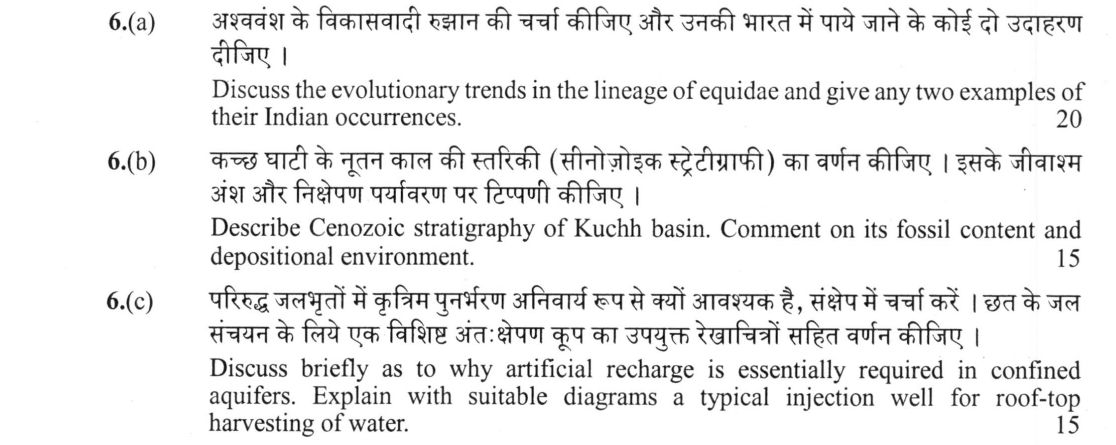
(a) Discuss the evolutionary trends in the lineage of equidae and give any two examples of their Indian occurrences. (20…
Discuss the evolutionary trends in the lineage of equidae and give any two examples of their Indian occurrences. 20 marks
Describe Cenozoic stratigraphy of Kuchh basin. Comment on its fossil content and depositional environment. 15 marks
Discuss briefly as to why artificial recharge is essentially required in confined aquifers. Explain with suitable diagrams a typical injection well for roof-top harvesting of water. 15 marks
हिंदी में प्रश्न पढ़ें
अश्ववंश के विकासवादी रूझान की चर्चा कीजिए और उनकी भारत में पाये जाने के कोई दो उदाहरण दीजिए । (20 अंक)
कच्छ घाटी के नूतन काल की स्तरिकी (सीनोजोइक स्ट्रैटिग्राफी) का वर्णन कीजिए । इसके जीवाश्म अंश और निक्षेपण पर्यावरण पर टिप्पणी कीजिए । (15 अंक)
परिरुद्ध जलभृतों में कृत्रिम पुनर्भरण अनिवार्य रूप से क्यों आवश्यक है, संक्षेप में चर्चा करें । छत के जल संचयन के लिये एक विशिष्ट अंतःक्षेपण कूप का उपयुक्त रेखाचित्रों सहित वर्णन कीजिए । (15 अंक)
Model answer
Written by UPSC Answer Check against this question's marking rubric, to the expected length. UPSC does not publish answers for Mains — this is one way to score well, not an official key.
Equidae: The evolutionary history of Equidae is a classic record of adaptive radiation in response to changing vegetation and climate. From the small, multi-toed, low-crowned Eohippus of the Eocene to the single-toed, high-crowned Equus of the Pleistocene, the lineage shows consistent trends. The sequence from Eohippus through Mesohippus, Merychippus, Parahippopus and Pliohippus to Equus records increasing specialization for open-country life. These trends reflect the transition from browsing in forested environments to grazing on open grasslands. A simple diagram would show Eohippus with multiple toes and low crowns, Hipparion with three toes, and Equus with one toe. In dentition, the cheek teeth changed from brachydont to hypsodont, with longer enamel ridges or lophs and increased cementum, enabling grazing on abrasive grasses. In the limbs, lateral digits were progressively reduced, the third digit became dominant, and the metapodials were elongated, giving faster locomotion. Body size also increased, with shoulder height rising from about 0.4 m to about 1.5 m and mass from a few kilograms to several hundred kilograms. Pliohippus, a Pliocene single-toed form, shows advanced hypsodonty and is a key link to Equus. Indian occurrences are well known from the Siwalik Hills: Hipparion, a three-toed Late Miocene equid, is recorded from the Dhok Pathan Formation, while Equus occurs in later Siwalik/Quaternary deposits; Sivalhippus nagriensis from the Nagri Formation further illustrates the Indian equid record.
Kutch basin: The Cenozoic stratigraphy of the Kutch basin, a Cenozoic intracontinental basin, records a shift from marine to non-marine conditions. The Eocene is represented by Nummulitic limestone and the Kharinadi Formation, rich in Nummulites and Assilina, indicating shallow warm marine deposition. These units are important markers of the early Cenozoic marine incursion into the basin. The Oligocene-Miocene succession includes the Khari Nadi and Chhasra formations, comprising limestone, sandstone and shale with foraminifera, gastropods and bivalves, reflecting continued shallow marine to restricted marine environments through transgressive-regressive cycles. The Pliocene-Pleistocene Gaj and Babia Hill formations show sandstone, conglomerate, sand, gravel and clay with brackish-water fossils, fish, reptiles and mammals, marking a transition to fluvial-lacustrine and coastal plain deposition. The basin’s fossil content thus tracks a broad environmental change from open marine to fluvial-lacustrine settings, with vertebrate fossils adding evidence of changing ecosystems.
Confined aquifers: Artificial recharge is essentially required in confined aquifers because natural recharge is limited by the overlying impermeable confining layer or aquitard. In a confined aquifer the water table is not the upper surface; the potentiometric surface controls flow, and pumping lowers piezometric levels. Recovery depends on storativity or storage coefficient, not on specific yield. Artificial recharge raises the potentiometric head and increases the stored volume, while also reducing the risk of saline-water intrusion in coastal areas and land subsidence. Such recharge is particularly important where overexploitation has drawn the potentiometric surface below natural equilibrium and where the aquifer is vulnerable to saltwater ingress. A typical injection well for roof-top harvesting would be drawn as a roof gutter feeding a first-flush diverter, then a small storage tank or filter, and a pipe to a recharge pit or sump. The well has a casing, a screen placed in the confined aquifer, a gravel pack around the screen to transmit water, and a seal above the screen to prevent bypass. Pumped or gravity-fed filtered water is injected under pressure, recharging the confined aquifer directly.
Together, these topics show the continuity of geological knowledge: equid evolution and Kutch stratigraphy document past environments and life, while hydrogeological principles apply that understanding to sustainable groundwater management. A way forward is to use fossil, stratigraphic and aquifer data together for conservation of both heritage and water resources.
What "Discuss" is asking you to do
Lay the issue out from more than one side — how it arose, what is claimed for it, what is held against it, and where it now stands. UPSC attaches discuss to broad topics with several live dimensions, so coverage of the dimensions earns more than the strength of your opinion.
Structure that answers it
Set the issue up → the case as it is made → the case against → the dimension both sides leave out → where the balance now lies
Where marks are lost
Listing facts with no thread between them, or arguing one side throughout and calling it a discussion.
How this answer will be evaluated
Approach
Framework: UPSC Geology Paper 1. (a) discuss: intro > 3-4 dimensions > example > balanced close | (b) describe: define > structure or process in order > labelled diagram > significance | (c) explain: definition/context > points in order > small example > short close Full marks: Comprehensive, specific, and well-structured answers with all required elements and diagrams.
Key points expected
- Trends in limb, tooth, and body size evolution
- Progression from multi-toed to single-toed (hoofed)
- Two specific Indian occurrences named
- Stratigraphic age of Indian occurrences
- Cenozoic stratigraphic sequence of Kutch basin
- Fossil content (marine/terrestrial) described
- Depositional environment (marine/estuarine/terrestrial) identified
- Linkage of fossils to specific strata
Evaluation rubric
Each sub-part is marked on its own, against the marks and word limit printed on the paper.
- (a) Evolutionary trends in Equidae lineage and two Indian occurrences. 20 marks
discuss— intro → 3-4 dimensions → example → balanced close
Must cover
- Trends in limb, tooth, and body size evolution
- Progression from multi-toed to single-toed (hoofed)
- Two specific Indian occurrences named
- Stratigraphic age of Indian occurrences
Loses marks
- Generic description without specific Indian examples
- Missing evolutionary trends (limb/tooth/size)
Earns more
- Mention of specific genera (e.g., Hipparion, Equus)
- Linkage to Pliocene/Pleistocene climate changes
- Mention of specific Indian localities (e.g., Narmada, Sivalik)
Extra mark
- Sketch of limb evolution (Eohippus to Equus)
- Mention of specific fossil sites in India
- (b) Cenozoic stratigraphy of Kutch basin, fossil content, and depositional environment. 15 marks
describe— define → structure or process in order → labelled diagram → significance
Must cover
- Cenozoic stratigraphic sequence of Kutch basin
- Fossil content (marine/terrestrial) described
- Depositional environment (marine/estuarine/terrestrial) identified
- Linkage of fossils to specific strata
Loses marks
- Missing stratigraphic sequence
- No link between fossils and depositional environment
Earns more
- Mention of specific formations (e.g., Kutch Formation)
- Reference to tectonic setting (Rajasthan Block)
- Mention of specific fossils (e.g., marine invertebrates)
Extra mark
- Stratigraphic column sketch of Kutch basin
- Mention of specific tectonic events (e.g., Deccan Traps)
- (c) Why artificial recharge is required in confined aquifers and a typical injection well for roof-top harvesting. 15 marks
explain— definition/context → points in order → small example → short close
Must cover
- Reasons for artificial recharge in confined aquifers
- Diagram of a typical injection well
- Explanation of roof-top water harvesting mechanism
- Linkage of injection well to roof-top harvesting
Loses marks
- Missing diagram of injection well
- No explanation of why artificial recharge is required
Earns more
- Mention of specific confined aquifer characteristics
- Explanation of recharge mechanisms (e.g., infiltration)
- Mention of specific roof-top harvesting techniques
Extra mark
- Detailed diagram of injection well components
- Mention of specific roof-top harvesting systems
Practice this exact question
Write your answer and it is marked point by point against the model answer above — what you covered, what you missed, what you got wrong.
Evaluate my answer →More from Geology 2021 Paper I
- Q3 (a) What are the fundamental concepts used in Geomorphological studies? Explain the conce…
- Q4 (a) What are hanging wall and footwall of a fault? Describe the different classes of faul…
- Q5 Answer the following questions in about 150 words each: (a) What are megafossils? Give na…
- Q6 (a) Discuss the evolutionary trends in the lineage of equidae and give any two examples o…
- Q7 (a) Describe stratigraphy and depositional environment of Gondwana Supergroup and discuss…
- Q8 (a) Give a brief account of sources of groundwater pollution in India and discuss the man…