Paper I — Q7
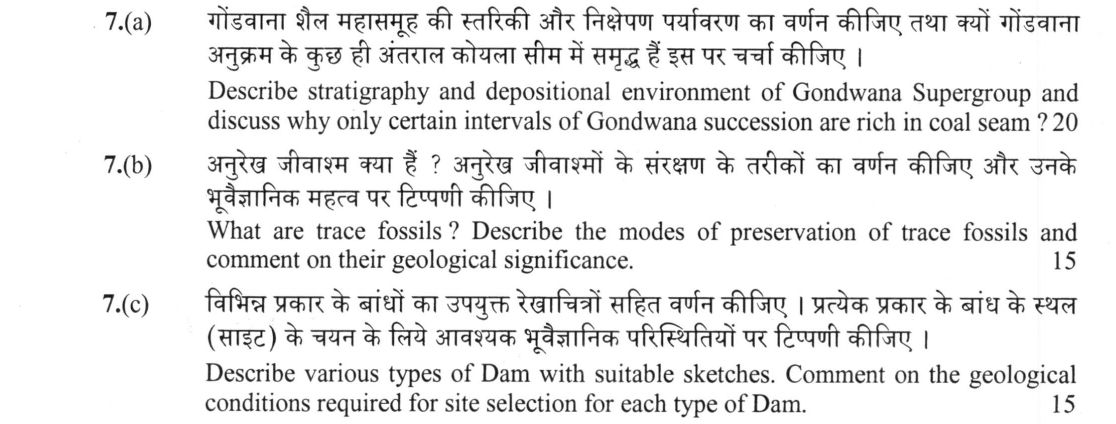
(a) Describe stratigraphy and depositional environment of Gondwana Supergroup and discuss why only certain intervals of Gondwana…
Describe stratigraphy and depositional environment of Gondwana Supergroup and discuss why only certain intervals of Gondwana succession are rich in coal seam? 20 marks
What are trace fossils? Describe the modes of preservation of trace fossils and comment on their geological significance. 15 marks
Describe various types of Dam with suitable sketches. Comment on the geological conditions required for site selection for each type of Dam. 15 marks
हिंदी में प्रश्न पढ़ें
गोंडवाना शैल महासमूह की स्तरिकी और निक्षेपण पर्यावरण का वर्णन कीजिए तथा क्यों गोंडवाना अनुक्रम के कुछ ही अंतराल कोयला सीम में समृद्ध हैं इस पर चर्चा कीजिए । (20 अंक)
अनुरेख जीवाश्म क्या हैं ? अनुरेख जीवाश्मों के संरक्षण के तरीकों का वर्णन कीजिए और उनके भूवैज्ञानिक महत्व पर टिप्पणी कीजिए । (15 अंक)
विभिन्न प्रकार के बांधों का उपयुक्त रेखाचित्रों सहित वर्णन कीजिए । प्रत्येक प्रकार के बांध के स्थल (साइट) के चयन के लिये आवश्यक भूवैज्ञानिक परिस्थितियों पर टिप्पणी कीजिए । (15 अंक)
Model answer
Written by UPSC Answer Check against this question's marking rubric, to the expected length. UPSC does not publish answers for Mains — this is one way to score well, not an official key.
Gondwana Supergroup. The Indian Gondwana Supergroup is a thick clastic sequence resting unconformably on Vindhyan/Precambrian basement. It is conventionally divided into Lower Gondwana (Talchir, Barakar and Panchet), Middle Gondwana (Kamthi, Mahadeva and Maleri) and Upper Gondwana (Panchgani and overlying Jurassic beds); in some basin charts the uppermost clastic succession is labelled Maleri–Panchgani, but Maleri is Late Triassic and conventionally Middle Gondwana. Talchir is continental glaciogenic/glacio-fluvial, with tillites, varved clays and dropstones. Barakar is fluvio-lacustrine, with sandstones, shales, siltstones, coal seams, Glossopteris flora and fish remains. Panchet contains sandstones, shales, conglomerates, minor coal and Glossopteris flora. Kamthi is fluvial-lacustrine, with sandstones, shales, conglomerates, minor coal and Glossopteris/conifer remains. Maleri and Panchgani are fluvial, with sandstones, conglomerates and shales, and internal unconformities mark erosion and non-deposition between these units. The environment was mainly fluvio-lacustrine under a seasonal climate, with deltaic swamps in subsiding rift basins. Coal is richest in Lower Gondwana, especially Barakar and Karharbari intervals, and in some basins Panchet, because post-glacial humid climate, active subsidence, low relief, waterlogged anoxic swamps and luxuriant Glossopteris flora allowed peat accumulation. The Damuda Series and Raniganj coalfield are type examples. In Upper Gondwana, coal is thin or absent because of aridization, reduced subsidence and a changed floral regime, which favoured channelized fluvial sands rather than peat swamps.
Trace fossils. Trace fossils or ichnofossils are sedimentary structures recording organism behaviour—trails, burrows, borings, resting traces and faecal pellets—rather than body parts. They occur as exogenic surface trails, endogenic burrows/borings and composite structures, but these are occurrence/ethologic categories; their preservation modes are distinct. Surface impressions/molds preserve trails or burrow walls as relief on bedding planes. Sediment-filled casts preserve burrows filled with coarser or finer sediment, visible in section. Hard-substrate borings preserve bioerosion in shells, wood, carbonate or chert as voids or cement-filled tubes. Mineralized/concretionary preservation occurs when early diagenetic calcite, phosphate, pyrite or concretionary rims cement the trace. Bioturbation mottling preserves mixed sediment fabrics, disrupted grading and burrow networks. Their significance is high: ichnofacies such as Skolithos indicate high-energy shallow marine settings, while Cruziana indicates low-energy deeper marine conditions; they help reconstruct paleoecology, substrate stability, oxygenation, water depth and biostratigraphy through ichnogenus ranges.
Dams. Dams are classified by material—earthfill, rockfill and concrete—and by structural form—gravity, arch and buttress. A sketch of a gravity dam shows a massive triangular section with load arrows downward and uplift arrow upward; it relies on weight, so it needs continuous, strong, low-permeability bedrock, typically massive igneous or metamorphic rock, to carry load, resist uplift and seepage, with no active faults. Bhakra Nangal is a concrete gravity dam. An arch dam sketch shows a curved upstream face directing load into abutments; it requires a narrow gorge or canyon with strong, stable abutments in the canyon walls, low foundation deformation and watertight rock, as at Idukki. A buttress dam sketch shows slab panels supported by buttress piers; it needs competent bedrock for the piers and a stable, low-seepage foundation, and can use less concrete than a gravity dam. Earthfill and rockfill dams are zoned embankments; a section shows an impervious clay/silt core, shell materials, filters and a cutoff. They need stable foundations and abutments, low-permeability foundation or cutoff, suitable borrow material, and absence of active faults; they can be adapted to weaker foundations with treatment. Composite dams, such as Hirakud, combine gravity and arch behaviour, requiring both massive foundation for the gravity portion and strong abutments for the arch portion. In all cases, site selection demands competent bedrock, a narrow gorge where appropriate, watertight foundation, stable slopes, and absence of active faults. Thus, geological setting controls coal potential, fossil interpretation and dam safety.
What "Describe" is asking you to do
Give a full, ordered account of the thing named — its parts, stages or mechanism — in the sequence in which it actually exists or occurs. Most describe questions come from the science optionals, where the marks sit in correct technical detail and, where the stem says so, a labelled diagram.
Structure that answers it
One-line identification of the subject → the parts or stages in their real order, each with its defining detail → labelled diagram where the subject is structural → closing line on function or significance
Where marks are lost
Loose general prose where the examiner is ticking named parts, correct terminology and their sequence; and in the General Studies papers, turning to evaluation before the description is finished.
How this answer will be evaluated
Approach
Framework: Geology Paper 1: Define > Process > Field/Petrographic Evidence > Indian Example. (a) describe: define > structure or process in order > labelled diagram > significance | (b) describe: define > structure or process in order > labelled diagram > significance | (c) describe: define > structure or process in order > labelled diagram > significance Full marks: Precise stratigraphy, named Indian examples, clear causal links, accurate sketches, specific geological conditions.
Key points expected
- Name Gondwana Supergroup formations (e.g., Mahakoshal, Barakar)
- Identify depositional environments (fluvial, deltaic, marine)
- Explain coal-forming conditions (swamps, anoxic, tectonic stability)
- Link coal seams to specific stratigraphic intervals
- Define trace fossils (ichnofossils)
- Describe preservation modes (molds, casts, fills)
- Explain geological significance (environmental reconstruction)
- Mention specific trace fossil types (e.g., burrows, tracks)
Evaluation rubric
Each sub-part is marked on its own, against the marks and word limit printed on the paper.
- (a) Stratigraphic sequence, depositional environments, and causal analysis of coal formation intervals. 20 marks
describe— define → structure or process in order → labelled diagram → significance
Must cover
- Name Gondwana Supergroup formations (e.g., Mahakoshal, Barakar)
- Identify depositional environments (fluvial, deltaic, marine)
- Explain coal-forming conditions (swamps, anoxic, tectonic stability)
- Link coal seams to specific stratigraphic intervals
Loses marks
- Generic description without Indian examples
- Missing stratigraphic sequence
- No link between environment and coal formation
Earns more
- Mention specific Indian basins (e.g., Jharia, Raniganj)
- Reference specific formations (e.g., Barakar, Raniganj)
- Describe tectonic setting (Gondwana rifting)
- Mention specific coal seams (e.g., Barakar coal)
Extra mark
- Mention specific coal rank (e.g., bituminous)
- Reference specific tectonic event (e.g., Gondwana rifting)
- (b) Definition of trace fossils, preservation modes, and geological significance. 15 marks
describe— define → structure or process in order → labelled diagram → significance
Must cover
- Define trace fossils (ichnofossils)
- Describe preservation modes (molds, casts, fills)
- Explain geological significance (environmental reconstruction)
- Mention specific trace fossil types (e.g., burrows, tracks)
Loses marks
- Confusing trace fossils with body fossils
- No explanation of preservation modes
- Generic significance without specific examples
Earns more
- Name specific trace fossils (e.g., Rhizocorallium, Cruziana)
- Link to specific environments (e.g., tidal flats)
- Mention ichnofacies
- Reference specific Indian occurrences
Extra mark
- Mention specific ichnofacies (e.g., Skolithos)
- Reference specific Indian formation with trace fossils
- (c) Types of dams with sketches and geological conditions for site selection. 15 marks
describe— define → structure or process in order → labelled diagram → significance
Must cover
- Describe various dam types (gravity, arch, earth-fill)
- Provide suitable sketches for each type
- Explain geological conditions for site selection
- Link dam type to specific geological setting
Loses marks
- Missing sketches
- No link between dam type and geological conditions
- Generic description without specific examples
Earns more
- Mention specific dam examples (e.g., Bhakra, Tehri)
- Describe specific geological conditions (e.g., hard rock, fault-free)
- Reference specific dam types (e.g., concrete gravity, earth-fill)
- Mention specific geological hazards (e.g., seismicity, karst)
Extra mark
- Mention specific dam (e.g., Bhakra, Tehri)
- Reference specific geological hazard (e.g., seismicity)
Practice this exact question
Write your answer and it is marked point by point against the model answer above — what you covered, what you missed, what you got wrong.
Evaluate my answer →More from Geology 2021 Paper I
- Q4 (a) What are hanging wall and footwall of a fault? Describe the different classes of faul…
- Q5 Answer the following questions in about 150 words each: (a) What are megafossils? Give na…
- Q6 (a) Discuss the evolutionary trends in the lineage of equidae and give any two examples o…
- Q7 (a) Describe stratigraphy and depositional environment of Gondwana Supergroup and discuss…
- Q8 (a) Give a brief account of sources of groundwater pollution in India and discuss the man…