Paper I — Q4
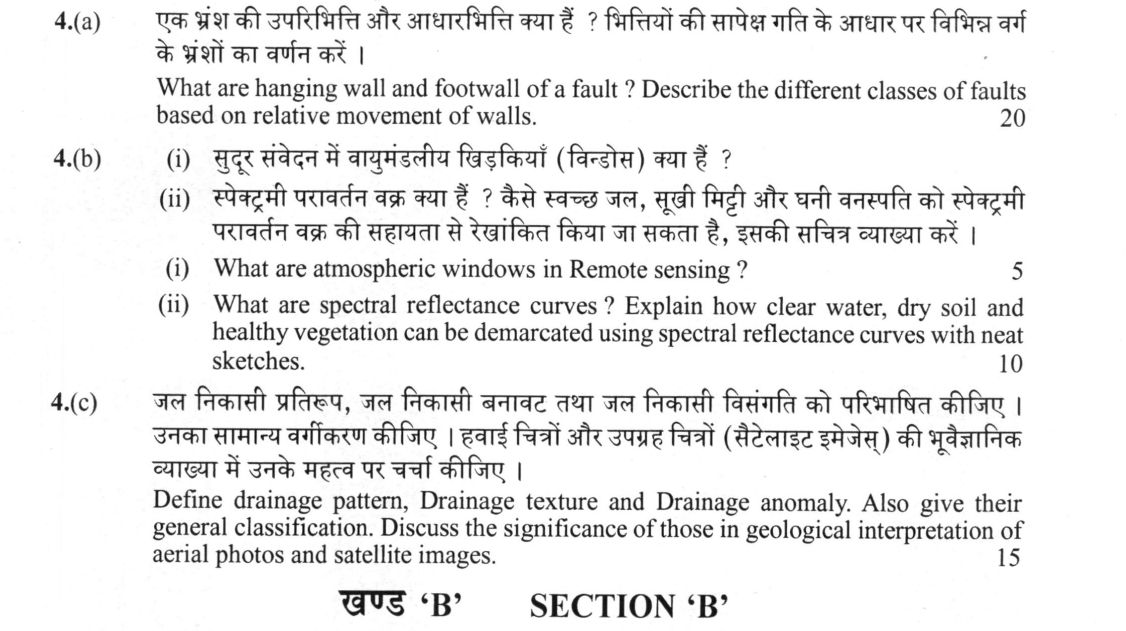
(a) What are hanging wall and footwall of a fault? Describe the different classes of faults based on relative movement of walls…
What are hanging wall and footwall of a fault? Describe the different classes of faults based on relative movement of walls. 20 marks
What are atmospheric windows in Remote sensing? (ii) What are spectral reflectance curves? Explain how clear water, dry soil and healthy vegetation can be demarcated using spectral reflectance curves with neat sketches. 15 marks
Define drainage pattern, Drainage texture and Drainage anomaly. Also give their general classification. Discuss the significance of those in geological interpretation of aerial photos and satellite images. 15 marks
हिंदी में प्रश्न पढ़ें
एक भ्रंश की उपरिभित्त और आधारभित्त क्या है ? भित्तियों की सापेक्ष गति के आधार पर विभिन्न वर्ग के भ्रंशों का वर्णन करें । (20 अंक)
सुदूर संवेदन में वायुमंडलीय खिड़कियाँ (विंडोस) क्या हैं ? (ii) स्पेक्ट्रमी परावर्तन वक्र क्या हैं ? कैसे स्वच्छ जल, सूखी मिट्टी और घनी वनस्पति को स्पेक्ट्रमी परावर्तन वक्र की सहायता से रेखांकित किया जा सकता है, इसकी संचित व्याख्या करें । (15 अंक)
जल निकासी प्रतिरूप, जल निकासी बनावट तथा जल निकासी विसंगति को परिभाषित कीजिए । उनका सामान्य वर्गीकरण कीजिए । हवाई चित्रों और उपग्रह चित्रों (सैटेलाइट इमेजेस) की भूवैज्ञानिक व्याख्या में उनके महत्व पर चर्चा कीजिए । (15 अंक)
Model answer
Written by UPSC Answer Check against this question's marking rubric, to the expected length. UPSC does not publish answers for Mains — this is one way to score well, not an official key.
Faults and wall movement. A fault is a fracture with displacement. The fault plane divides two blocks; the block lying above the inclined fault plane is the hanging wall, the block below is the footwall. If the plane is vertical, the terms are not useful. Faults are classified by the direction of relative slip. In dip-slip faults, slip is parallel to the dip and produces vertical separation. Normal faults form under extension; the hanging wall moves down relative to the footwall. Reverse faults form under compression; the hanging wall moves up. A thrust fault is a low-angle reverse fault, usually dipping less than 30°. In strike-slip faults, slip is parallel to the strike and produces horizontal offset: dextral/right-lateral when the opposite side moves right, sinistral/left-lateral when it moves left. Oblique-slip faults combine dip-slip and strike-slip components. Anderson’s theory of faulting links these to stress: normal faults with vertical maximum compressive stress, reverse/thrust faults with horizontal maximum compressive stress, and strike-slip faults with horizontal principal stresses. Indian examples include the Siwalik frontal thrust and Narmada-Tapti strike-slip lineaments. This classification is fundamental to structural mapping.
Remote sensing. (i) Atmospheric windows are wavelength bands where absorption by atmospheric gases is low, so surface radiation reaches sensors. They are not continuous across the visible–SWIR. Water vapour bands near 1.4 and 1.9 µm split the visible–NIR region; useful short-wave windows are about 0.4–1.3, 1.5–1.8 and 2.0–2.4 µm. Mid-infrared windows are narrower, about 3.5–4.2 and 4.5–5.0 µm, because CO2 and H2O absorb elsewhere. The thermal-infrared window is 8–14 µm. These windows are used by passive optical and thermal sensors. O3, CO2 and H2O cause absorption outside these windows. (ii) A spectral reflectance curve plots reflectance against wavelength. Clear water has very low visible reflectance, a few percent, peaking in blue-green, and near-zero NIR reflectance because water absorbs strongly. Dry soil has low visible reflectance, generally increasing with wavelength but not monotonic, with absorption troughs near 1.4, 1.9 and 2.2 µm due to water/OH and iron-oxide effects in the visible. Healthy vegetation shows low blue and red reflectance due to chlorophyll, a steep rise and high NIR plateau due to leaf internal structure, and a SWIR decline due to water. A sketch would show water as a low flat visible curve falling to near zero in NIR; soil as a gently rising curve with troughs; vegetation as a low visible curve with red absorption, high NIR plateau and SWIR fall.
Drainage interpretation. Drainage pattern is the plan arrangement of streams and tributaries; drainage texture is the relative frequency or density of streams, classified as coarse, medium or fine; drainage anomaly is a local departure from the expected pattern. Patterns are commonly classified as dendritic, trellis, rectangular, radial, parallel and annular. Anomalies can be classified as linear offsets or deflections, compression or straightening of meanders, ponding or impoundment, annular/concentric channels, and abrupt changes in texture or density. In geological interpretation, dendritic patterns indicate homogeneous, unstructured rocks; trellis patterns indicate folded or tilted strata with alternating hard and soft rocks; radial patterns indicate domes or volcanic cones; rectangular patterns indicate faulted or jointed blocks. Texture indicates permeability, runoff and erosion: fine texture suggests low permeability or high runoff, coarse texture suggests high permeability or resistant bedrock. Anomalies mark active tectonics, buried structures, lithological boundaries or fault-controlled flow. On satellite images, these features are mapped by tracing stream networks and comparing local texture with the regional background. In India, offset streams and compressed meanders along Narmada-Tapti lineaments, Siwalik frontal fault drainage, Ganga-Yamuna integration, and lineament-controlled anomalies in Dharwar and Aravalli cratons help map hidden structures from aerial photos and satellite images.
What "Describe" is asking you to do
Give a full, ordered account of the thing named — its parts, stages or mechanism — in the sequence in which it actually exists or occurs. Most describe questions come from the science optionals, where the marks sit in correct technical detail and, where the stem says so, a labelled diagram.
Structure that answers it
One-line identification of the subject → the parts or stages in their real order, each with its defining detail → labelled diagram where the subject is structural → closing line on function or significance
Where marks are lost
Loose general prose where the examiner is ticking named parts, correct terminology and their sequence; and in the General Studies papers, turning to evaluation before the description is finished.
How this answer will be evaluated
Approach
Framework: Geology Paper 1: Define > Process > Field/Petrographic Evidence > Indian Example. (a) describe: define > structure or process in order > labelled diagram > significance | (b(i)) define: precise definition > the distinguishing feature > one example | (b(ii)) explain: definition/context > points in order > small example > short close | (c) define: precise definition > the distinguishing feature > one example Full marks: Comprehensive definitions, accurate classifications, clear diagrams, and specific Indian examples.
Key points expected
- Define hanging wall and footwall
- Classify faults based on relative movement
- Provide labelled diagrams for each class
- Explain the mechanism of movement
- Define atmospheric windows
- Explain their role in remote sensing
- Mention specific wavelength ranges
- Define spectral reflectance curves
Evaluation rubric
Each sub-part is marked on its own, against the marks and word limit printed on the paper.
- (a) Define fault walls and classify faults by relative movement with diagrams. 20 marks
describe— define → structure or process in order → labelled diagram → significance
Must cover
- Define hanging wall and footwall
- Classify faults based on relative movement
- Provide labelled diagrams for each class
- Explain the mechanism of movement
Loses marks
- Missing diagrams or sketches
- Confusing hanging and footwall
- Generic description without specific classes
Earns more
- Mention specific Indian fault examples
- Discuss the geological significance of faults
- Include a section on fault geometry
Extra mark
- Reference a specific Indian fault system
- Mention the economic importance of faulting
- (b(i)) Define atmospheric windows in remote sensing. 5 marks
define— precise definition → the distinguishing feature → one example
Must cover
- Define atmospheric windows
- Explain their role in remote sensing
- Mention specific wavelength ranges
Loses marks
- Vague definition without wavelength ranges
- Confusing atmospheric windows with other concepts
Earns more
- Provide a diagram of the electromagnetic spectrum
- Discuss the impact of atmospheric absorption
Extra mark
- Mention specific sensors that use these windows
- Reference a specific application in Indian remote sensing
- (b(ii)) Explain spectral reflectance curves and demarcate water, soil, vegetation. 10 marks
explain— definition/context → points in order → small example → short close
Must cover
- Define spectral reflectance curves
- Explain how clear water is demarcated
- Explain how dry soil is demarcated
- Explain how healthy vegetation is demarcated
Loses marks
- Missing sketches or diagrams
- Confusing the reflectance of different materials
- Generic explanation without specific wavelength ranges
Earns more
- Provide neat sketches of the curves
- Mention specific wavelength ranges for each
- Discuss the physical basis of reflectance
Extra mark
- Reference a specific Indian application
- Mention specific sensors used for this
- (c) Define drainage terms, classify them, and discuss their significance. 15 marks
define— precise definition → the distinguishing feature → one example
Must cover
- Define drainage pattern, texture, and anomaly
- Provide general classification for each
- Discuss significance in geological interpretation
- Mention use in aerial photos and satellite images
Loses marks
- Missing definitions or classifications
- Generic discussion without specific examples
- Confusing drainage terms
Earns more
- Provide examples of each drainage type
- Discuss the relationship between drainage and geology
- Mention specific Indian examples
Extra mark
- Reference a specific Indian drainage system
- Mention specific satellite images used for this
Practice this exact question
Write your answer and it is marked point by point against the model answer above — what you covered, what you missed, what you got wrong.
Evaluate my answer →More from Geology 2021 Paper I
- Q1 Answer the following questions in about 150 words each: (a) Explain what is ring of fire?…
- Q2 (a) What are lithospheric plates? Discuss the theory of plate tectonics. Which plates wer…
- Q3 (a) What are the fundamental concepts used in Geomorphological studies? Explain the conce…
- Q4 (a) What are hanging wall and footwall of a fault? Describe the different classes of faul…
- Q5 Answer the following questions in about 150 words each: (a) What are megafossils? Give na…
- Q6 (a) Discuss the evolutionary trends in the lineage of equidae and give any two examples o…
- Q7 (a) Describe stratigraphy and depositional environment of Gondwana Supergroup and discuss…