Paper I — Q2
(a) What are lithospheric plates? Discuss the theory of plate tectonics. Which plates were involved when a major earthquake…
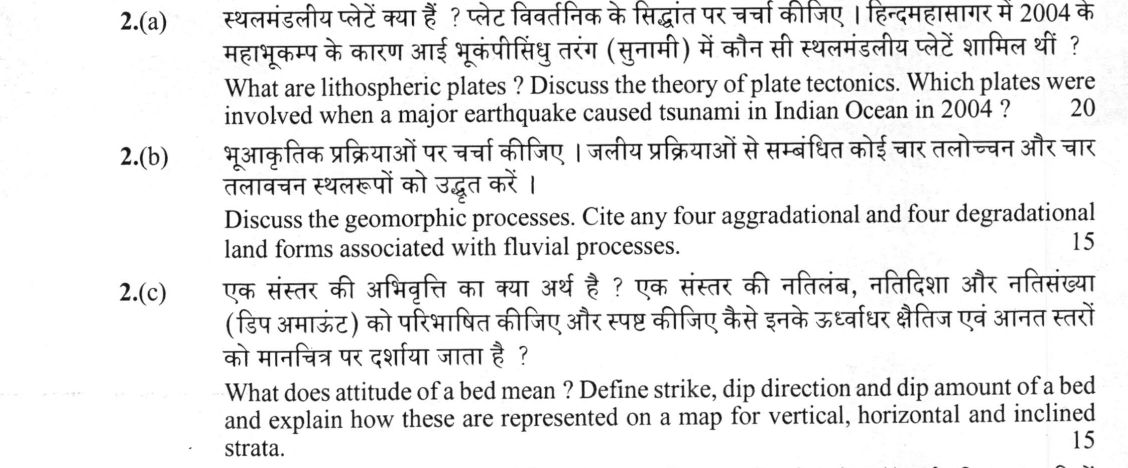
What are lithospheric plates? Discuss the theory of plate tectonics. Which plates were involved when a major earthquake caused tsunami in Indian Ocean in 2004? 20 marks
Discuss the geomorphic processes. Cite any four aggradational and four degradational land forms associated with fluvial processes. 15 marks
What does attitude of a bed mean? Define strike, dip direction and dip amount of a bed and explain how these are represented on a map for vertical, horizontal and inclined strata. 15 marks
हिंदी में प्रश्न पढ़ें
स्थलमंडलीय प्लेटें क्या हैं ? प्लेट विवर्तनिक के सिद्धांत पर चर्चा कीजिए । हिंदमहासागर में 2004 के महाभूकंप के कारण आई भूकंपीसिंधु तरंग (सुनामी) में कौन सी स्थलमंडलीय प्लेटें शामिल थीं ? (20 अंक)
भूआकृतिक प्रक्रियाओं पर चर्चा कीजिए । जलीय प्रक्रियाओं से संबंधित कोई चार तलोच्चन और चार तलावचन स्थलरूपों को उद्धृत करें । (15 अंक)
एक संस्तर की अभिवृत्ति का क्या अर्थ है ? एक संस्तर की नतिलंब, नतिदिशा और नतिसंख्या (डिप अमाउंट) को परिभाषित कीजिए और स्पष्ट कीजिए कैसे इनके ऊर्ध्वाधर क्षैतिज एवं आनत स्तरों को मानचित्र पर दर्शाया जाता है ? (15 अंक)
Model answer
Written by UPSC Answer Check against this question's marking rubric, to the expected length. UPSC does not publish answers for Mains — this is one way to score well, not an official key.
Lithospheric plates and plate tectonics Lithospheric plates are rigid, brittle blocks of crust and uppermost mantle, generally 50–150 km thick, that move over the weaker asthenosphere. Plate tectonics integrates continental drift, seafloor spreading, and subduction into one framework: mantle convection, plate boundaries, and recycling of lithosphere. At divergent boundaries, upwelling mantle creates new oceanic crust; at convergent boundaries, dense oceanic lithosphere subducts beneath continental or oceanic plates, producing trenches, volcanic arcs, and earthquakes; at transform boundaries, plates slide past one another. Triple junctions, where three plates meet, show how spreading, subduction, and transform motion are linked. The theory also explains mountain building, such as the Himalayan orogeny from the ongoing collision of the Indian Plate with Asia, and the Wilson cycle of ocean opening and closing. A cross-section diagram would show a spreading ridge, a subduction zone, and a transform fault. The 2004 Sumatra–Andaman earthquake (Mw 9.1–9.3) occurred at the Sunda Trench, where the Indian/Indo-Australian plate was thrust beneath the Burma/Sunda plate. The plates involved were the Indian Plate, the Indo-Australian Plate, and the Burma microplate; the thrust-fault mechanism generated a megathrust slip that displaced seawater and caused a destructive Indian Ocean tsunami.
Geomorphic processes Geomorphic processes are endogenic and exogenic. Endogenic processes are internal and constructive or destructive: tectonism, volcanism, and diastrophism. Exogenic processes are external and driven by climate, water, wind, and gravity: weathering, erosion, transportation, and deposition. Fluvial processes produce both aggradational and degradational landforms. Aggradation dominates lower courses and floodplains, while degradation is strongest in upper courses and tectonically uplifted regions. Aggradational landforms are built by deposition: alluvial fans, such as the Kosi fan; point bars on the inside of river bends; natural levees along floodplains; and deltas, especially the Ganga–Brahmaputra delta. These show sediment accumulation where river velocity decreases. Degradational landforms are cut by erosion: V-shaped river valleys, gorges, canyons, and waterfalls, such as Jog Falls; the Chambal badlands illustrate intense fluvial degradation, while the Grand Canyon shows long-term downcutting. A profile diagram would show a river cutting a valley and depositing a fan or delta downstream.
Attitude of a bed The attitude of a bed is its three-dimensional orientation in space, expressed by strike, dip direction, and dip amount. Strike is the compass direction of the line formed where a bedding plane intersects a horizontal plane; it is measured in degrees from north. Dip direction is the direction in which the bed slopes downward, always perpendicular to strike. Dip amount is the angle of inclination measured from the horizontal plane, ranging from 0° to 90°. On a geological map, horizontal strata are shown by a strike line marked H or with tick marks indicating no dip, because the bed is parallel to the horizontal plane. Vertical strata are shown by a straight line with V or arrows, indicating 90° dip; the strike is recorded and the symbol shows the vertical plane. Inclined strata are shown by a strike line with a short perpendicular tick or arrow pointing down-dip and the dip angle, for example 30°, written near the symbol. GSI (Geological Survey of India) maps use these symbols to represent bedding planes, faults, and structural-field measurements. A map sketch would show horizontal beds as H, vertical beds as V, and inclined beds as a strike line with a 30° down-dip arrow.
Conclusion Together, plate tectonics and geomorphic processes explain Earth’s dynamic surface: plates create uplift, subsidence, and seismic hazards, while fluvial processes build and erode landforms. Understanding plate boundaries and bed attitudes helps map hazards, reconstruct geological history, and manage natural resources.
What "Discuss" is asking you to do
Lay the issue out from more than one side — how it arose, what is claimed for it, what is held against it, and where it now stands. UPSC attaches discuss to broad topics with several live dimensions, so coverage of the dimensions earns more than the strength of your opinion.
Structure that answers it
Set the issue up → the case as it is made → the case against → the dimension both sides leave out → where the balance now lies
Where marks are lost
Listing facts with no thread between them, or arguing one side throughout and calling it a discussion.
How this answer will be evaluated
Approach
(a) discuss: intro > 3-4 dimensions > example > balanced close | (b) discuss: intro > 3-4 dimensions > example > balanced close | (c) explain: definition/context > points in order > small example > short close Full marks: Precise definitions, clear explanations, accurate identification of plates and landforms, and correct map representations with standard symbols.
Key points expected
- Define lithospheric plates as rigid crustal segments
- Explain plate tectonics: driving forces, boundaries, and movement
- Identify Indo-Australian and Sunda plates for 2004 tsunami
- Describe the subduction mechanism causing the 2004 event
- Define geomorphic processes (erosion, deposition, weathering)
- List four aggradational fluvial landforms (e.g., alluvial fan, delta)
- List four degradational fluvial landforms (e.g., V-shaped valley, gorge)
- Briefly explain the formation of each landform type
Evaluation rubric
Each sub-part is marked on its own, against the marks and word limit printed on the paper.
- (a) Define lithospheric plates, explain plate tectonics, and identify plates involved in the 2004 Indian Ocean tsunami. 20 marks
discuss— intro → 3-4 dimensions → example → balanced close
Must cover
- Define lithospheric plates as rigid crustal segments
- Explain plate tectonics: driving forces, boundaries, and movement
- Identify Indo-Australian and Sunda plates for 2004 tsunami
- Describe the subduction mechanism causing the 2004 event
Loses marks
- Confusing lithosphere with asthenosphere
- Failing to name the specific plates involved in 2004
- Describing plate tectonics without linking to the 2004 event
Earns more
- Mention specific boundary types (convergent, divergent, transform)
- Reference the 2004 Sumatra-Andaman earthquake magnitude
- Explain the role of the Sunda Trench
- Mention the resulting tsunami impact on Indian coast
Extra mark
- Sketch of the subduction zone geometry
- Mention of the 2005 Nias earthquake as a related event
- (b) Discuss geomorphic processes and list four aggradational and four degradational fluvial landforms. 15 marks
discuss— intro → 3-4 dimensions → example → balanced close
Must cover
- Define geomorphic processes (erosion, deposition, weathering)
- List four aggradational fluvial landforms (e.g., alluvial fan, delta)
- List four degradational fluvial landforms (e.g., V-shaped valley, gorge)
- Briefly explain the formation of each landform type
Loses marks
- Listing landforms without explaining their formation
- Confusing aggradational and degradational landforms
- Failing to distinguish between fluvial and other geomorphic processes
Earns more
- Distinguish between aggradation and degradation clearly
- Provide examples of specific fluvial landforms in India
- Explain the role of river gradient in landform development
- Mention the concept of base level
Extra mark
- Sketch of a fluvial landform profile
- Reference to specific Indian river systems (e.g., Ganga, Brahmaputra)
- (c) Define attitude of a bed, strike, dip direction, and dip amount, and explain their map representation for vertical, horizontal, and inclined strata. 15 marks
explain— definition/context → points in order → small example → short close
Must cover
- Define attitude of a bed (orientation in 3D space)
- Define strike, dip direction, and dip amount precisely
- Explain map representation for vertical strata (strike line)
- Explain map representation for horizontal strata (no strike/dip)
Loses marks
- Confusing strike and dip direction
- Failing to explain the map representation for all three strata types
- Using non-standard symbols for strike and dip
Earns more
- Explain map representation for inclined strata (strike and dip symbols)
- Use standard geological map symbols for strike and dip
- Provide a simple sketch of the three strata types
- Mention the relationship between strike and dip (90 degrees)
Extra mark
- Reference to the use of a Brunton compass for measurement
- Mention of the 'right-hand rule' for dip direction
Practice this exact question
Write your answer and it is marked point by point against the model answer above — what you covered, what you missed, what you got wrong.
Evaluate my answer →More from Geology 2021 Paper I
- Q1 Answer the following questions in about 150 words each: (a) Explain what is ring of fire?…
- Q2 (a) What are lithospheric plates? Discuss the theory of plate tectonics. Which plates wer…
- Q3 (a) What are the fundamental concepts used in Geomorphological studies? Explain the conce…
- Q4 (a) What are hanging wall and footwall of a fault? Describe the different classes of faul…
- Q5 Answer the following questions in about 150 words each: (a) What are megafossils? Give na…