Paper I — Q8
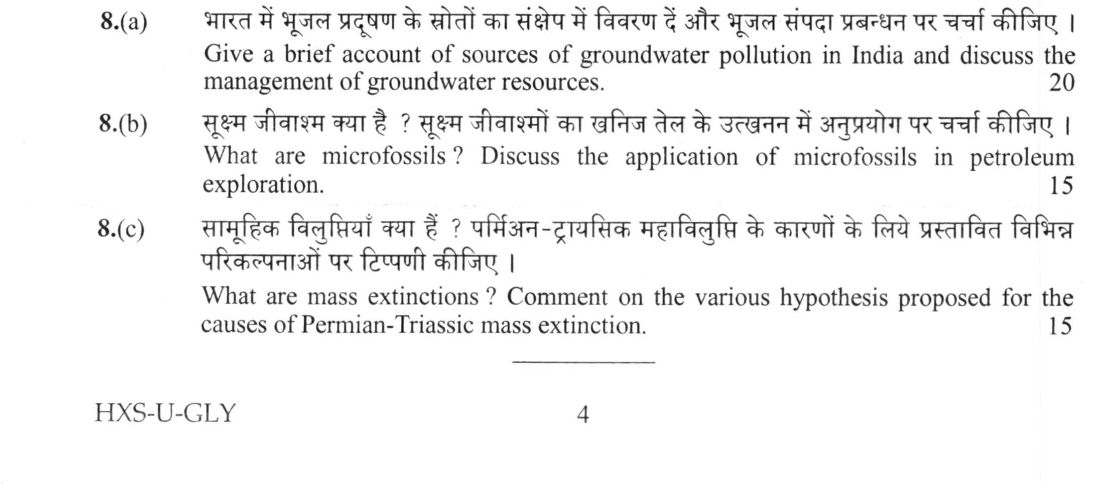
(a) Give a brief account of sources of groundwater pollution in India and discuss the management of groundwater resources. (20…
Give a brief account of sources of groundwater pollution in India and discuss the management of groundwater resources. 20 marks
What are microfossils? Discuss the application of microfossils in petroleum exploration. 15 marks
What are mass extinctions? Comment on the various hypothesis proposed for the causes of Permian-Triassic mass extinction. 15 marks
हिंदी में प्रश्न पढ़ें
भारत में भूजल प्रदूषण के स्रोतों का संक्षेप में विवरण दें और भूजल संपदा प्रबंधन पर चर्चा कीजिए । (20 अंक)
सूक्ष्म जीवाश्म क्या हैं ? सूक्ष्म जीवाश्मों का खनिज तेल के उत्खनन में अनुप्रयोग पर चर्चा कीजिए । (15 अंक)
सामूहिक विलुप्तियाँ क्या हैं ? परमियन-ट्रायसिक महाविलुप्ति के कारणों के लिये प्रस्तावित विभिन्न परिकल्पनाओं पर टिप्पणी कीजिए । (15 अंक)
Model answer
Written by UPSC Answer Check against this question's marking rubric, to the expected length. UPSC does not publish answers for Mains — this is one way to score well, not an official key.
Groundwater Pollution and Management in India
Groundwater degradation in India occurs through both geogenic and anthropogenic pathways. Geogenic contamination is prominent in the Bengal Basin, where reductive dissolution of iron oxyhydroxides mobilizes toxic arsenic, and in the semi-arid hard-rock terranes of Rajasthan, Telangana, and Andhra Pradesh, where leaching of granitic minerals releases excess fluoride. In coastal tracts of Gujarat and Tamil Nadu, intensive over-pumping induces seawater intrusion and aquifer salinization. Anthropogenic contamination arises from agricultural runoff containing leached nitrates and pesticides in the Indo-Gangetic Plains, untreated heavy metal-bearing industrial effluents, untreated urban sewage, and landfill leachate percolating into shallow aquifers.
Groundwater management requires an integrated supply- and demand-side approach. Supply enhancement is achieved via artificial recharge structures, including check dams, percolation tanks, and recharge shafts, guided by the Central Ground Water Board's (CGWB) National Aquifer Mapping and Management Programme (NAQUIM) to delineate dynamic aquifer geometries. Demand-side interventions focus on micro-irrigation (drip and sprinkler systems) under the Pradhan Mantri Krishi Sinchayee Yojana and crop diversification away from water-intensive crops. Regulatory oversight is provided by Central Ground Water Authority (CGWA) guidelines, environmental impact assessments, and the implementation of state-level groundwater legislation aligned with the Model Groundwater Bill.
Microfossils and Petroleum Exploration
Microfossils are microscopic skeletal remains and organic micro-entities, typically smaller than 1 mm, requiring optical or scanning electron microscopy for identification. Major groups include calcareous taxa (foraminifera, ostracods), siliceous forms (radiolarians, diatoms), phosphatic remains (conodonts), and organic-walled palynomorphs (dinoflagellates, spores, and pollen).
In petroleum exploration, microfossils are indispensable tools. First, their high abundance in small-volume drill cuttings and rapid evolutionary turnover enable high-resolution biostratigraphic zonation and regional reservoir correlation. Second, they facilitate paleoenvironmental and paleobathymetric reconstruction; for example, benthic-to-planktic foraminiferal ratios indicate paleodepth, salinity, and depositional energy. Third, palynofacies analysis evaluates source rock potential by identifying kerogen types (Types I through IV). Fourth, organic and phosphatic microfossils serve as thermal maturity indicators; tools such as the Spore Coloration Index (SCI) and the Conodont Alteration Index (CAI) reliably define the oil, condensate, and dry-gas generation windows.
Permian-Triassic Mass Extinction Hypotheses
Mass extinctions are geologically rapid, globally synchronous events marked by catastrophic drops in biodiversity across multiple unrelated clades. The Permian-Triassic extinction (~252 Ma), known as the 'Great Dying', represents Earth's most severe crisis, eliminating over 90% of marine species and roughly 70% of terrestrial vertebrate families.
Several interacting hypotheses have been proposed to explain this biospheric collapse:
Siberian Traps Volcanism: Massive continental flood basalt eruptions extruded millions of cubic kilometers of magma, releasing immense volumes of mantle- and coal-derived CO2, SO2, and halogens, triggering catastrophic global warming and widespread oceanic anoxia and euxinia.
Ocean Acidification: Massive absorption of volcanic and thermogenic carbon dioxide lowered ocean pH, causing extensive dissolution and calcification crises in marine invertebrates.
Methane Clathrate Dissociation: Hyperthermal warming destabilized continental slope gas hydrates, releasing large pulses of isotopically light methane that intensified greenhouse heating.
Bolide Impact: Extraterrestrial impact models suggest shock-induced perturbations, though unequivocal evidence and a confirmed contemporaneous crater remain absent.
Sea-Level Regression and Pangea Configuration: Late Permian marine regression reduced shallow epicontinental seaways, while the coalesced Pangean landmass created extreme continental interiors, severely contracting ecospace.
Moving forward, addressing India's water stress demands transitioning from reactive extraction to science-based aquifer stewardship under NAQUIM, while advancing integrated biostratigraphic and geochemical modeling remains vital for reducing exploration risks in deep-water hydrocarbon basins.
What "Discuss" is asking you to do
Lay the issue out from more than one side — how it arose, what is claimed for it, what is held against it, and where it now stands. UPSC attaches discuss to broad topics with several live dimensions, so coverage of the dimensions earns more than the strength of your opinion.
Structure that answers it
Set the issue up → the case as it is made → the case against → the dimension both sides leave out → where the balance now lies
Where marks are lost
Listing facts with no thread between them, or arguing one side throughout and calling it a discussion.
How this answer will be evaluated
Approach
Framework: Geology Paper 1: Define > Process > Field/Petrographic Evidence > Indian Example. (a) account for: state the phenomenon > the causes in order of weight > conclusion | (b) explain: definition/context > points in order > small example > short close | (c) comment: context > arguments both sides > judgment > close Full marks: Precise definitions, specific Indian examples, clear causal chains, and balanced discussion of hypotheses.
Key points expected
- Identify anthropogenic sources (sewage, industrial effluents, agriculture)
- Identify natural sources (salinity, fluoride, arsenic)
- Discuss management via CGWA guidelines or National Water Policy
- Provide specific Indian examples (e.g., Aravalli fluoride, Punjab salinity)
- Define microfossils (e.g., foraminifera, radiolarians, dinoflagellates)
- Explain biostratigraphic correlation using microfossils
- Explain paleoenvironmental reconstruction (facies analysis)
- Link to petroleum exploration (source rock, reservoir, seal)
Evaluation rubric
Each sub-part is marked on its own, against the marks and word limit printed on the paper.
- (a) State sources of groundwater pollution in India and discuss management strategies. 20 marks
account for— state the phenomenon → the causes in order of weight → conclusion
Must cover
- Identify anthropogenic sources (sewage, industrial effluents, agriculture)
- Identify natural sources (salinity, fluoride, arsenic)
- Discuss management via CGWA guidelines or National Water Policy
- Provide specific Indian examples (e.g., Aravalli fluoride, Punjab salinity)
Loses marks
- Generic description without Indian context
- Confusing surface water pollution with groundwater
- Ignoring natural pollution sources
Earns more
- Mention specific pollutants (nitrates, heavy metals)
- Reference specific management acts (Jal Jeevan Mission)
- Discuss recharge techniques (check dams, percolation tanks)
- Mention monitoring networks (CGWA monitoring wells)
Extra mark
- Cite specific CGWA report data on over-exploited zones
- Mention specific court orders (e.g., NGT orders on groundwater)
- (b) Define microfossils and explain their application in petroleum exploration. 15 marks
explain— definition/context → points in order → small example → short close
Must cover
- Define microfossils (e.g., foraminifera, radiolarians, dinoflagellates)
- Explain biostratigraphic correlation using microfossils
- Explain paleoenvironmental reconstruction (facies analysis)
- Link to petroleum exploration (source rock, reservoir, seal)
Loses marks
- Confusing microfossils with macrofossils
- Failing to link to petroleum exploration
- Generic description without specific examples
Earns more
- Mention specific microfossil groups (calcareous, siliceous)
- Explain organic geochemistry (biomarkers) from microfossils
- Reference specific Indian basins (e.g., Krishna-Godavari, Cambay)
- Mention specific age markers (e.g., Cretaceous foraminifera)
Extra mark
- Cite specific biomarker compounds (e.g., steranes, hopanes)
- Mention specific Indian petroleum fields (e.g., Bombay High)
- (c) Define mass extinctions and comment on hypotheses for Permian-Triassic extinction. 15 marks
comment— context → arguments both sides → judgment → close
Must cover
- Define mass extinctions (e.g., >75% species loss)
- Identify Permian-Triassic as the 'Great Dying' (~252 Ma)
- Discuss volcanic hypothesis (Siberian Traps)
- Discuss other hypotheses (anoxia, methane release, impact)
Loses marks
- Confusing Permian-Triassic with other mass extinctions
- Failing to discuss multiple hypotheses
- Generic description without specific evidence
Earns more
- Mention specific taxa affected (e.g., trilobites, brachiopods)
- Exclude specific mechanisms (e.g., ocean acidification)
- Reference specific geological evidence (e.g., iridium anomaly)
- Mention specific time scale (e.g., Late Permian)
Extra mark
- Cite specific research papers or authors (e.g., Raup, Sepkoski)
- Mention specific isotopic evidence (e.g., carbon isotope excursion)
Practice this exact question
Write your answer and it is marked point by point against the model answer above — what you covered, what you missed, what you got wrong.
Evaluate my answer →More from Geology 2021 Paper I
- Q5 Answer the following questions in about 150 words each: (a) What are megafossils? Give na…
- Q6 (a) Discuss the evolutionary trends in the lineage of equidae and give any two examples o…
- Q7 (a) Describe stratigraphy and depositional environment of Gondwana Supergroup and discuss…
- Q8 (a) Give a brief account of sources of groundwater pollution in India and discuss the man…