Paper I — Q3
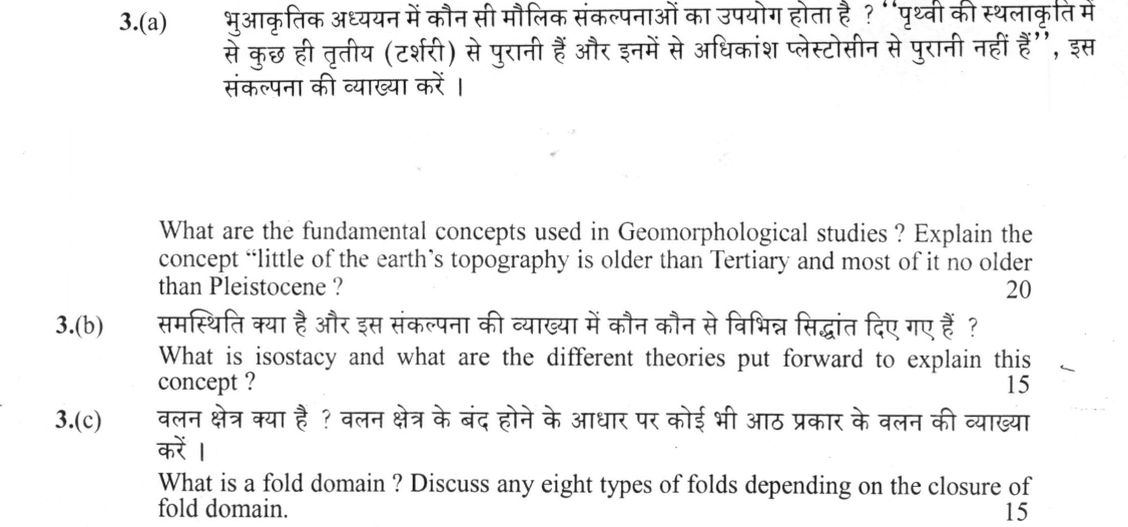
(a) What are the fundamental concepts used in Geomorphological studies? Explain the concept "little of the earth's topography is…
What are the fundamental concepts used in Geomorphological studies? Explain the concept "little of the earth's topography is older than Tertiary and most of it no older than Pleistocene"? 20 marks
What is isostacy and what are the different theories put forward to explain this concept? 15 marks
What is a fold domain? Discuss any eight types of folds depending on the closure of fold domain. 15 marks
हिंदी में प्रश्न पढ़ें
भूआकृतिक अध्ययन में कौन सी मौलिक संकल्पनाओं का उपयोग होता है ? "पृथ्वी की स्थलाकृति में से कुछ ही तृतीय (टर्शरी) से पुरानी हैं और इनमें से अधिकांश प्लेस्टोसीन से पुरानी नहीं हैं", इस संकल्पना की व्याख्या करें । (20 अंक)
समस्थिति क्या है और इस संकल्पना की व्याख्या में कौन कौन से विभिन्न सिद्धांत दिए गए हैं ? (15 अंक)
वलन क्षेत्र क्या है ? वलन क्षेत्र के बंद होने के आधार पर कोई भी आठ प्रकार के वलन की व्याख्या करें । (15 अंक)
Model answer
Written by UPSC Answer Check against this question's marking rubric, to the expected length. UPSC does not publish answers for Mains — this is one way to score well, not an official key.
Geomorphological studies operate on fundamental conceptual frameworks: the Davisian cycle of erosion based on progressive landscape evolution through youth, maturity, and old age driven by base-level lowering; Penck’s model emphasizing the simultaneous, competing interplay between tectonic uplift rates and denudation; climatic geomorphology establishing morphoclimatic zones; and tectonic geomorphology linking active crustal deformation with drainage morphology.
Temporal Scale of Topography W.D. Thornbury’s dictum that "little of the earth's topography is older than Tertiary and most of it no older than Pleistocene" distinguishes rock antiquity from geomorphic antiquity. While underlying cratonic rocks date to the Archean, terrestrial relief is continuously obliterated by denudation occurring at typical rates of 10 to 100 mm/kyr, accelerating during mountain building. Consequently, uplifted paleo-surfaces are rapidly excised, creating a preservation bias toward Cenozoic landforms. For instance, while Appalachian strata are Paleozoic, its present ridge-and-valley topography reflects Tertiary uplift and differential etching; similarly, the Himalayas expose ancient Gondwanan basement within relief generated entirely since the Neogene. Furthermore, Pleistocene glaciations, glacial-interglacial eustatic sea-level fluctuations, and intense periglacial weathering globally reworked continental drainage basins, making the vast majority of extant landforms younger than 2.6 Ma.
Isostasy and Its Models Isostasy denotes the state of hydrostatic equilibrium between Earth’s rigid lithosphere and the asthenosphere, where buoyant crustal blocks float according to Archimedes' principle.
George Airy proposed that the crust has a uniform density (ρ_c) floating on a denser mantle (ρₘ). High topographic loads are compensated by deep crustal roots, where equilibrium dictates that load mass equals displaced mantle mass (h ρ_c = r (ρₘ - ρ_c), where h is topography and r is root thickness). J.H. Pratt proposed a uniform depth of compensation with lateral density variations: elevated blocks have lower densities, satisfying the condition H ρ = constant.
Refining these local models, the Hayford-Bowie system operationalized Pratt’s concept using standardized compensation depths (~113.7 km), while Heiskanen synthesized Airy-Pratt mechanisms. F.A. Vening Meinesz introduced regional isostasy, demonstrating that the lithosphere behaves as an elastic plate with finite flexural rigidity, distributing point loads across a broader deflection basin. Modern seismic tomography and GPS geodetic uplift measurements (e.g., post-glacial rebound in Fennoscandia and Fennoscandian-style uplift in the Canadian Shield) corroborate combined Airy-flexural compensation.
Fold Domains and Fold Closure Types A fold domain is a structurally homogeneous volume of folded rock bounded by inflection points or tangent lines on fold limbs, within which the geometric orientation of hinge lines and axial surfaces remains uniform. The closure defines the geometric convergence of fold limbs towards the hinge zone. Eight distinct fold types categorized by closure include:
- Anticline: A fold closing upward that contains stratigraphically older rocks in its core, formed by compressional shortening.
- Syncline: A fold closing downward that contains stratigraphically younger rocks in its core.
- Antiform: A purely descriptive geometric fold closing convex-upward where the stratigraphic age succession is unknown or inverted.
- Synform: A descriptive geometric fold closing concave-upward without stratigraphic age attribution.
- Dome: A doubly plunging anticlinal structure with limbs dipping radially outward in all directions, exhibiting non-linear closure.
- Basin: A doubly plunging synclinal structure with limbs dipping inward toward a central point.
- Monocline: A step-like, one-limbed fold closing in opposite senses over a single flexure, typically overlying deep-seated reactivated basement faults.
- Chevron Fold: A fold exhibiting angular closure with sharp, planar limbs and acute, V-shaped hinge zones produced by strong competence contrasts during flexural slip.
In the Indian subcontinent, these geometries are prominently preserved: polyphase antiforms and synforms define the Proterozoic Aravalli Fold Belt; tight chevron folds and asymmetric synclines characterize the Krol Belt in the Lesser Himalaya; and classic half-graben monoclinal and basinal fold closures govern sedimentation in the Gondwana coalfields. Thus, continuous dynamic coupling between crustal deformation, isostatic adjustments, and surficial denudation orchestrates the evolution of Earth's structural and geomorphic architecture.
What "Explain" is asking you to do
Make the working of something clear — what sets it off, what follows from what, and what it produces. Explain is the Commission's mechanism word: it dominates the technical papers and the “explain why” stems, where the marks sit in the causal chain and not in the label.
Structure that answers it
State what it is → the initiating condition → the chain of cause, step by step → an instance where it plays out → what the chain produces
Where marks are lost
Describing what something looks like instead of why it works that way. Naming the stages without linking them reads as description too.
How this answer will be evaluated
Approach
Framework: Geology Paper 1: Define > Process > Field/Petrographic Evidence > Indian Example. (a) explain: definition/context > points in order > small example > short close | (b) explain: definition/context > points in order > small example > short close | (c) discuss: intro > 3-4 dimensions > example > balanced close Full marks: Precise definitions, clear causal chains, specific Indian examples, and accurate sketches.
Key points expected
- Define fundamental concepts (e.g., uniformitarianism, denudation, uplift)
- Explain the 'Tertiary/Pleistocene' topography concept
- Link topography age to tectonic cycles
- Provide a specific Indian example (e.g., Himalayas, Deccan)
- Define isostacy (isostatic equilibrium)
- Explain Airy's theory (crustal root)
- Explain Pratt's theory (lateral density variation)
- Mention Heiskanen's theory (flexural isostasy)
Evaluation rubric
Each sub-part is marked on its own, against the marks and word limit printed on the paper.
- (a) List fundamental geomorphological concepts and explain the Tertiary/Pleistocene topography hypothesis. 20 marks
explain— definition/context → points in order → small example → short close
Must cover
- Define fundamental concepts (e.g., uniformitarianism, denudation, uplift)
- Explain the 'Tertiary/Pleistocene' topography concept
- Link topography age to tectonic cycles
- Provide a specific Indian example (e.g., Himalayas, Deccan)
Loses marks
- Generic description without Indian example
- Confusing Tertiary and Pleistocene time scales
- Missing the causal link between tectonics and topography
Earns more
- Mention specific tectonic events (e.g., Alpine orogeny)
- Reference specific Indian formations or cratons
- Discuss the role of erosion vs. uplift
Extra mark
- Sketch of a tectonic cycle
- Specific stratigraphic age data
- (b) Define isostacy and outline the theories explaining it. 15 marks
explain— definition/context → points in order → small example → short close
Must cover
- Define isostacy (isostatic equilibrium)
- Explain Airy's theory (crustal root)
- Explain Pratt's theory (lateral density variation)
- Mention Heiskanen's theory (flexural isostasy)
Loses marks
- Confusing isostacy with isostasy
- Missing the distinction between Airy and Pratt
- No mention of the lithosphere-asthenosphere interface
Earns more
- Sketch of Airy vs. Pratt models
- Reference to specific Indian examples (e.g., Himalayan uplift)
- Mention of geophysical evidence (gravity anomalies)
Extra mark
- Detailed phase diagram of crustal flexure
- Specific gravity data from Indian basins
- (c) Define fold domain and discuss eight types of folds based on closure. 15 marks
discuss— intro → 3-4 dimensions → example → balanced close
Must cover
- Define fold domain
- List 8 types of folds (e.g., open, close, isoclinal, recumbent)
- Describe the closure characteristics of each type
- Provide a specific Indian example (e.g., Aravalli, Vindhyan)
Loses marks
- Listing fewer than 8 types of folds
- Confusing fold types with fault types
- No mention of the closure of the fold domain
Earns more
- Sketches of different fold types
- Reference to specific Indian geological formations
- Mention of the tectonic setting (e.g., compressional, extensional)
Extra mark
- Detailed structural map of an Indian fold domain
- Specific mineralogical evidence of folding
Practice this exact question
Write your answer and it is marked point by point against the model answer above — what you covered, what you missed, what you got wrong.
Evaluate my answer →More from Geology 2021 Paper I
- Q1 Answer the following questions in about 150 words each: (a) Explain what is ring of fire?…
- Q2 (a) What are lithospheric plates? Discuss the theory of plate tectonics. Which plates wer…
- Q3 (a) What are the fundamental concepts used in Geomorphological studies? Explain the conce…
- Q4 (a) What are hanging wall and footwall of a fault? Describe the different classes of faul…
- Q5 Answer the following questions in about 150 words each: (a) What are megafossils? Give na…
- Q6 (a) Discuss the evolutionary trends in the lineage of equidae and give any two examples o…