Paper I — Q5
Answer the following questions in about 150 words each: (a) What are megafossils? Give names of any three age-diagnostic…
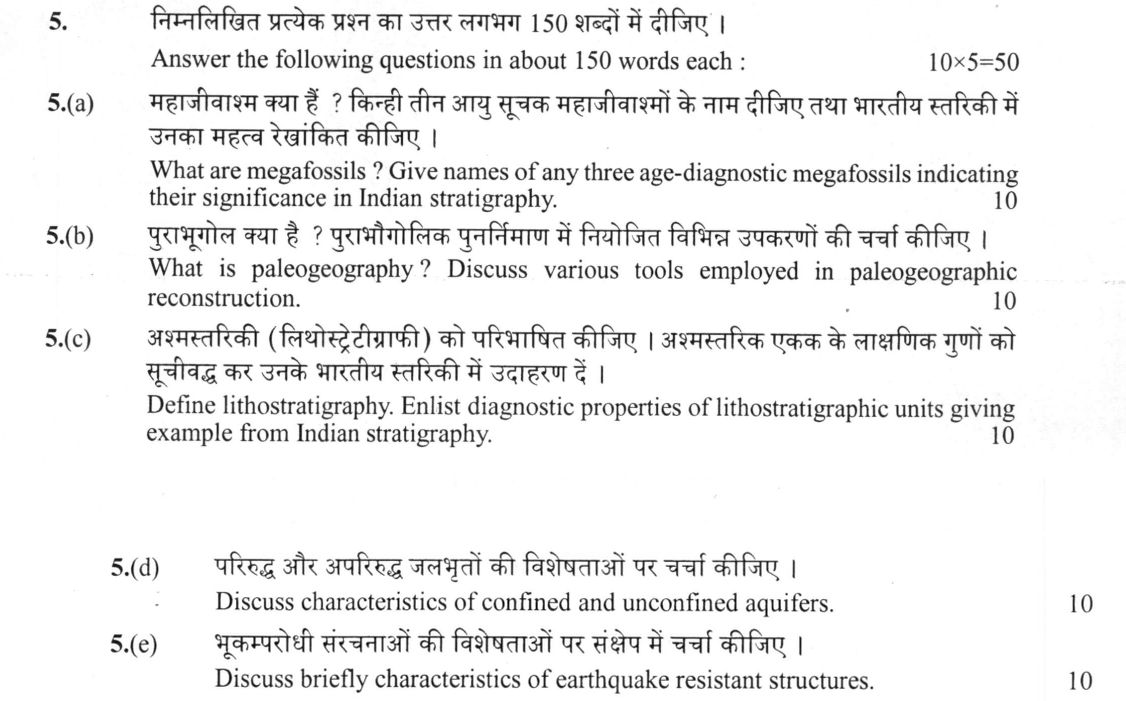
Answer the following questions in about 150 words each: What are megafossils? Give names of any three age-diagnostic megafossils indicating their significance in Indian stratigraphy. 10 marks
What is paleogeography? Discuss various tools employed in paleogeographic reconstruction. 10 marks
Define lithostratigraphy. Enlist diagnostic properties of lithostratigraphic units giving example from Indian stratigraphy. 10 marks
Discuss characteristics of confined and unconfined aquifers. 10 marks
Discuss briefly characteristics of earthquake resistant structures. 10 marks
हिंदी में प्रश्न पढ़ें
निम्नलिखित प्रत्येक प्रश्न का उत्तर लगभग 150 शब्दों में दीजिए । महाजीवाश्म क्या हैं ? किन्हीं तीन आयु सूचक महाजीवाश्मों के नाम दीजिए तथा भारतीय स्तरिकी में उनका महत्व रेखांकित कीजिए । (10 अंक)
पुराभूगोल क्या है ? पुराभौगोलिक पुनर्निर्माण में नियोजित विभिन्न उपकरणों की चर्चा कीजिए । (10 अंक)
अश्मस्तरिकी (लिथोस्ट्रैटिग्राफी) को परिभाषित कीजिए । अश्मस्तरिक एकक के लक्षणिक गुणों को सूचीबद्ध कर उनके भारतीय स्तरिकी में उदाहरण दें । (10 अंक)
परिरुद्ध और अपरिरुद्ध जलभृतों की विशेषताओं पर चर्चा कीजिए । (10 अंक)
भूकंपरोधी संरचनाओं की विशेषताओं पर संक्षेप में चर्चा कीजिए । (10 अंक)
Model answer
Written by UPSC Answer Check against this question's marking rubric, to the 150-word length. UPSC does not publish answers for Mains — this is one way to score well, not an official key.
(a) Megafossils and Indian Stratigraphic Significance
Megafossils are macroscopic fossilized remains of ancient flora and fauna preserved in sedimentary strata, sufficiently large to be evaluated and categorized without optical magnification. In Indian stratigraphy, three age-diagnostic megafossils serve as fundamental chronostratigraphic and paleoenvironmental benchmarks:
Glossopteris: This tongue-shaped gymnospermous leaf flora characterizes the Lower Gondwana Group, specifically defining the Permian period. Its presence across the Talchir, Barakar, and Raniganj formations confirms a terrestrial, fluvio-lacustrine depositional regime and provides crucial fossil evidence for continental drift and Gondwanaland reconstruction.
Inoceramus: This large, concentrically ribbed marine bivalve is an established index fossil for the Late Cretaceous. In India, it is diagnostic of marine strata such as the Bagh Beds of the Narmada Valley and the Ariyalur Group in the Cauvery Basin, marking major Cenomanian-to-Campanian marine transgressive phases.
Stegodon ganesa: This vertebrate proboscidean megafossil is diagnostic of the Neogene-Quaternary transition within the Siwalik Supergroup. Found predominantly in the Upper Siwalik Pinjor and Tatrot stages, it pinpoints Plio-Pleistocene biostratigraphic boundaries and documents the mammalian evolutionary turnover in the Himalayan foreland basin.
(b) Paleogeography and Reconstruction Tools
Paleogeography is the branch of historical geology that reconstructs the spatial configuration of continents, ocean basins, past shorelines, topographic features, and depositional environments across geological epochs.
The primary tools employed in paleogeographic reconstruction encompass multiple disciplines:
Paleomagnetism provides the spatial baseline by measuring remnant magnetization in rocks, enabling geologists to derive apparent polar wander paths and determine the paleolatitude and orientation of drifting tectonic plates over time.
Facies analysis and paleoecology evaluate physical sedimentary structures and biofacies assemblages to demarcate spatial transitions between continental, littoral, shelf, and abyssal realms.
Paleoclimatic indicators provide environmental constraints; for example, tillites and glacial striations reveal polar conditions, evaporites and calcretes indicate arid belts, and thick coal seams signify humid, tropical latitudes.
Sea-level curves and sequence stratigraphy track relative sea-level fluctuations, unconformity-bounded depositional sequences, and marine transgressions or regressions.
Computer-aided kinematic modeling and GIS-based paleogeographic maps integrate structural, geochemical, and paleocurrent data to model dynamic paleogeography.
(c) Lithostratigraphy and Diagnostic Properties
Lithostratigraphy is the branch of stratigraphy concerned with the organization and systematic classification of rock bodies into discrete, mappable units based entirely on their observable lithological characteristics and geometric relations, independent of inferred geological time.
The primary diagnostic properties used to define lithostratigraphic units (Supergroup, Group, Formation, Member, Bed) include lithological composition (rock type), grain texture (sorting, roundness, size), mineralogical assemblage, primary color, sedimentary structures (bedding geometry, laminations, cross-bedding), stratum thickness, lateral continuity, and fossil content when fossils act as rock-forming lithic components.
A premier Indian example is the Mesoproterozoic to Neoproterozoic Vindhyan Supergroup. It is subdivided based on lithological properties into the Semri, Kaimur, Rewa, and Bhander Groups. Within this framework, individual units are mapped on lithic contrasts, such as the Rohtas Limestone (dominated by fine-grained calcareous facies), the Kaimur Sandstone (mature, quartz-arenite beds with prominent cross-bedding), and the Sirbu Shale (distinctive fine, argillaceous laminations), representing shifts in depositional energy and provenance.
(d) Characteristics of Confined and Unconfined Aquifers
Aquifers exhibit distinct hydrogeological properties depending on their confining boundaries and hydraulic regimes:
An unconfined aquifer (water-table or phreatic aquifer) is bounded below by an impermeable stratum, while its upper boundary is the water table open directly to atmospheric pressure. Its hydraulic head coincides with this physical phreatic surface. It undergoes direct vertical recharge via local precipitation, resulting in rapid and pronounced seasonal fluctuations of the water table. The storage behavior of unconfined aquifers is governed primarily by specific yield, and their distribution is localized within near-surface alluvial or weathered zones.
A confined aquifer (artesian aquifer) is trapped between two impermeable bounding layers (aquicludes or aquitards), keeping the groundwater under hydrostatic pressure greater than atmospheric pressure. When penetrated by a borehole, water rises to a potentiometric surface; if this surface lies above the ground level, a flowing artesian well forms. Recharge is restricted to distant intake areas where the permeable bed outcrops. Confined aquifers exhibit regional extent, steady extraction yields buffered from local droughts, and low storativity controlled by the compressibility of the rock matrix and water elasticity.
(e) Characteristics of Earthquake-Resistant Structures
Earthquake-resistant structures are engineered to absorb, disperse, and dissipate dynamic ground motion without sustaining total collapse, ensuring life safety during major seismic events. In India, seismic design is standardized under Bureau of Indian Standards codes IS 1893 (criteria for earthquake design) and IS 13920 (ductile detailing).
Key characteristics include:
Structural Regularity: Symmetry in both plan and elevation prevents catastrophic torsional stresses and uneven lateral load distributions during ground shaking.
Ductility and Lateral Stiffness: Incorporating ductile detailing in reinforced concrete, moment-resisting frames, and reinforced concrete shear walls allows the structure to undergo large inelastic deformations and dissipate seismic energy without brittle fracture.
Base Isolation and Damping: Installing elastomeric bearings or lead-rubber isolators at the foundation decouples the superstructure from ground vibrations. Complementary tuned mass dampers and viscous dampers absorb kinetic vibrations.
Avoidance of Weak Zones: Structural designs eliminate soft storeys (unbraced stilt parking) and short-column configurations that typically fail through shear concentration.
The way forward lies in integrating performance-based design, retrofitting aging infrastructure in high-risk seismic zones (Zones IV and V), and enforcing strict structural auditing during urban construction.
What "Discuss" is asking you to do
Lay the issue out from more than one side — how it arose, what is claimed for it, what is held against it, and where it now stands. UPSC attaches discuss to broad topics with several live dimensions, so coverage of the dimensions earns more than the strength of your opinion.
Structure that answers it
Set the issue up → the case as it is made → the case against → the dimension both sides leave out → where the balance now lies
Where marks are lost
Listing facts with no thread between them, or arguing one side throughout and calling it a discussion.
How this answer will be evaluated
Approach
Framework: Geology Paper 1: Define > Process > Field/Petrographic Evidence > Indian Example. (a) define: precise definition > the distinguishing feature > one example | (b) discuss: intro > 3-4 dimensions > example > balanced close | (c) define: precise definition > the distinguishing feature > one example | (d) discuss: intro > 3-4 dimensions > example > balanced close | (e) discuss: intro > 3-4 dimensions > example > balanced close Full marks: Precise definitions, specific Indian examples, clear causal chains, and relevant sketches/diagrams.
Key points expected
- Precise definition of megafossils (visible to naked eye)
- Name three specific megafossils (e.g., Ammonites, Graptolites, Trilobites)
- Link each fossil to a specific geological age (e.g., Devonian, Carboniferous)
- State significance in Indian stratigraphy (e.g., dating the Vindhyan or Gondwana series)
- Definition of paleogeography (ancient geography)
- Mention at least three tools (e.g., paleomagnetism, paleobotany, paleoclimatology)
- Explain how one tool works (e.g., magnetic polarity for plate movement)
- Link to Indian context (e.g., Gondwana reconstruction)
Evaluation rubric
Each sub-part is marked on its own, against the marks and word limit printed on the paper.
- (a) Define megafossils and identify three age-diagnostic examples with their stratigraphic significance in India. 10 marks · 150 words
define— precise definition → the distinguishing feature → one example
Must cover
- Precise definition of megafossils (visible to naked eye)
- Name three specific megafossils (e.g., Ammonites, Graptolites, Trilobites)
- Link each fossil to a specific geological age (e.g., Devonian, Carboniferous)
- State significance in Indian stratigraphy (e.g., dating the Vindhyan or Gondwana series)
Loses marks
- Listing microfossils (e.g., Foraminifera) as megafossils
- Generic description without specific Indian examples
- Missing the 'age-diagnostic' aspect of the fossils
Earns more
- Mention specific Indian formations (e.g., Rajmahal Traps, Vindhyan Supergroup)
- Distinguish between index fossils and general megafossils
Extra mark
- Sketch of a specific fossil (e.g., Goniatite)
- Reference to specific Indian craton (e.g., Singhbhum)
- (b) Define paleogeography and discuss the various tools used for its reconstruction. 10 marks · 150 words
discuss— intro → 3-4 dimensions → example → balanced close
Must cover
- Definition of paleogeography (ancient geography)
- Mention at least three tools (e.g., paleomagnetism, paleobotany, paleoclimatology)
- Explain how one tool works (e.g., magnetic polarity for plate movement)
- Link to Indian context (e.g., Gondwana reconstruction)
Loses marks
- Confusing paleogeography with paleontology
- Listing tools without explaining their application
- No mention of Indian context or Gondwana
Earns more
- Mention specific isotopic methods (e.g., Oxygen isotopes)
- Reference to specific Indian basins (e.g., Krishna-Godavari)
Extra mark
- Sketch of a paleogeographic map (e.g., Gondwana)
- Mention of specific paleoclimate indicators (e.g., coal swamps)
- (c) Define lithostratigraphy and enlist diagnostic properties of its units with Indian examples. 10 marks · 150 words
define— precise definition → the distinguishing feature → one example
Must cover
- Definition of lithostratigraphy (classification by rock type)
- List diagnostic properties (e.g., lithology, texture, composition)
- Provide a specific Indian example (e.g., Deccan Traps, Vindhyan Supergroup)
- Distinguish from biostratigraphy or chronostratigraphy
Loses marks
- Confusing lithostratigraphy with biostratigraphy
- Generic description without specific Indian examples
- Missing the 'diagnostic properties' aspect
Earns more
- Mention specific rock types (e.g., sandstone, shale, limestone)
- Reference to specific Indian formations (e.g., Rajmahal Basalt)
Extra mark
- Sketch of a lithostratigraphic column
- Mention of specific mineral composition
- (d) Discuss the characteristics of confined and unconfined aquifers. 10 marks · 150 words
discuss— intro → 3-4 dimensions → example → balanced close
Must cover
- Definition of confined aquifer (bounded by aquitards)
- Definition of unconfined aquifer (water table is upper boundary)
- Mention key characteristics (e.g., artesian pressure, water table fluctuation)
- Provide an Indian example (e.g., Ganga alluvial aquifer)
Loses marks
- Confusing confined and unconfined aquifers
- Generic description without specific Indian examples
- Missing the 'characteristics' aspect
Earns more
- Mention specific Indian aquifers (e.g., Deccan Traps aquifer)
- Explain the difference in pumping behavior
Extra mark
- Sketch of a confined vs. unconfined aquifer
- Mention of specific hydrogeological parameters (e.g., transmissivity)
- (e) Briefly discuss the characteristics of earthquake-resistant structures. 10 marks · 150 words
discuss— intro → 3-4 dimensions → example → balanced close
Must cover
- Definition of earthquake-resistant structures
- Mention key characteristics (e.g., ductility, redundancy, base isolation)
- Explain how one characteristic works (e.g., base isolation absorbs energy)
- Provide an Indian example (e.g., Bhuj earthquake resistant building)
Loses marks
- Generic description without specific Indian examples
- Confusing earthquake-resistant with earthquake-proof
- Missing the 'characteristics' aspect
Earns more
- Mention specific Indian codes (e.g., IS 1893)
- Reference to specific Indian earthquakes (e.g., 2001 Bhuj, 2015 Nepal)
Extra mark
- Sketch of a base-isolated building
- Mention of specific structural elements (e.g., shear walls)
Practice this exact question
Write your answer and it is marked point by point against the model answer above — what you covered, what you missed, what you got wrong.
Evaluate my answer →More from Geology 2021 Paper I
- Q2 (a) What are lithospheric plates? Discuss the theory of plate tectonics. Which plates wer…
- Q3 (a) What are the fundamental concepts used in Geomorphological studies? Explain the conce…
- Q4 (a) What are hanging wall and footwall of a fault? Describe the different classes of faul…
- Q5 Answer the following questions in about 150 words each: (a) What are megafossils? Give na…
- Q6 (a) Discuss the evolutionary trends in the lineage of equidae and give any two examples o…
- Q7 (a) Describe stratigraphy and depositional environment of Gondwana Supergroup and discuss…
- Q8 (a) Give a brief account of sources of groundwater pollution in India and discuss the man…