Paper II — Q1
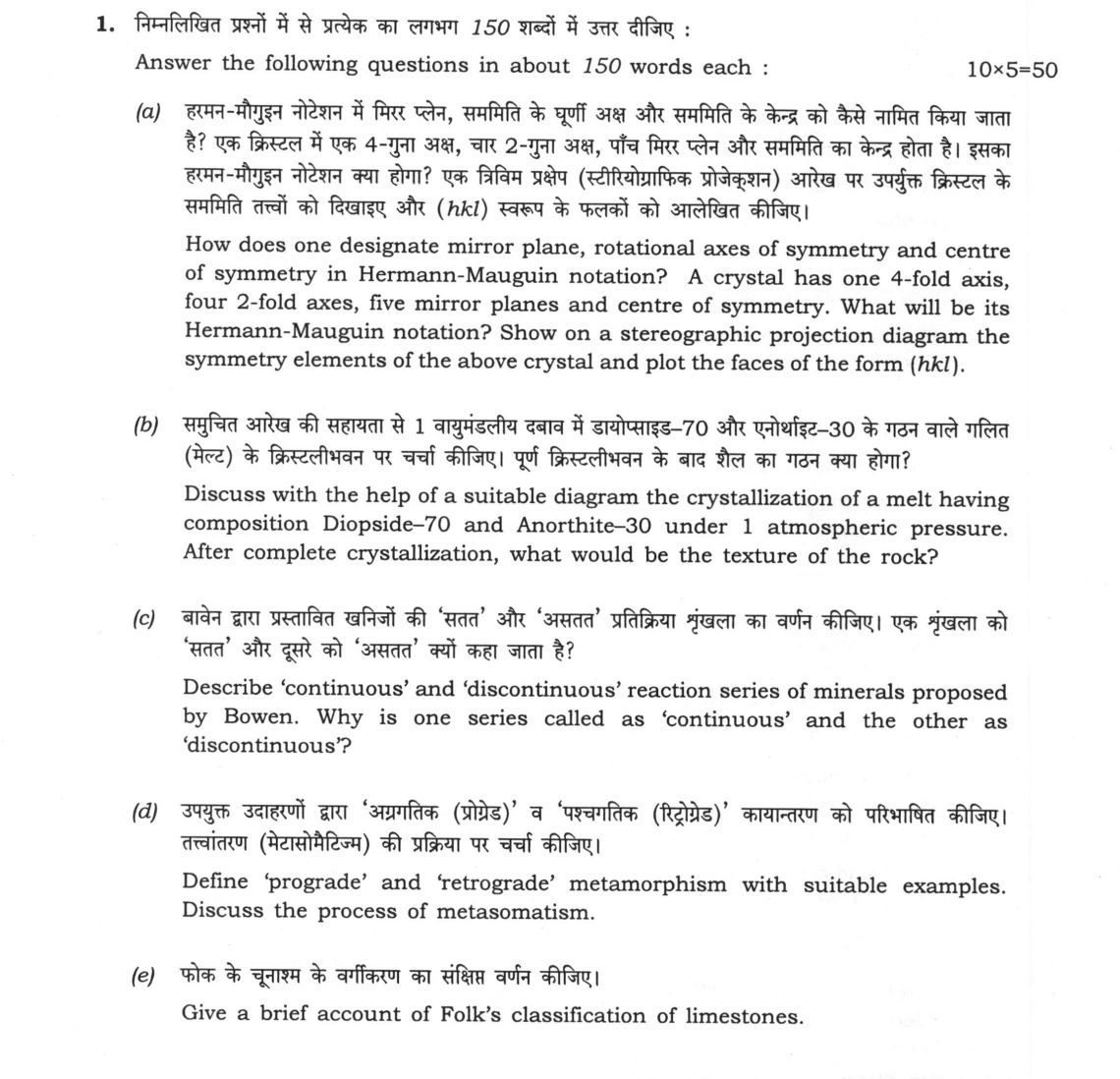
Answer the following questions in about 150 words each: (a) How does one designate mirror plane, rotational axes of symmetry and…
Answer the following questions in about 150 words each:
How does one designate mirror plane, rotational axes of symmetry and centre of symmetry in Hermann-Mauguin notation? A crystal has one 4-fold axis, four 2-fold axes, five mirror planes and centre of symmetry. What will be its Hermann-Mauguin notation? Show on a stereographic projection diagram the symmetry elements of the above crystal and plot the faces of the form (hkl).
Discuss with the help of a suitable diagram the crystallization of a melt having composition Diopside-70 and Anorthite-30 under 1 atmospheric pressure. After complete crystallization, what would be the texture of the rock?
Describe 'continuous' and 'discontinuous' reaction series of minerals proposed by Bowen. Why is one series called as 'continuous' and the other as 'discontinuous'?
Define 'prograde' and 'retrograde' metamorphism with suitable examples. Discuss the process of metasomatism.
Give a brief account of Folk's classification of limestones.
हिंदी में प्रश्न पढ़ें
निम्नलिखित प्रश्नों में से प्रत्येक का लगभग 150 शब्दों में उत्तर दीजिए :
हर्मन-मौगुइन नोटेशन में मिरर प्लेन, सममिति के घूर्णी अक्ष और सममिति के केन्द्र को कैसे नामित किया जाता है? एक क्रिस्टल में एक 4-गुणा अक्ष, चार 2-गुणा अक्ष, पाँच मिरर प्लेन और सममिति का केन्द्र होता है। इसका हर्मन-मौगुइन नोटेशन क्या होगा? एक त्रिविम प्रक्षेप (स्टीरियोग्राफिक प्रोजेक्शन) आरेख पर उपर्युक्त क्रिस्टल के सममिति तत्वों को दिखाइए और (hkl) स्वरूप के फलकों को आलेखित कीजिए।
समुचित आरेख की सहायता से 1 वायुमण्डलीय दबाव में डायोपसाइड-70 और एनोर्थाइट-30 के गठन वाले गलित (मेल्ट) के क्रिस्टलीभवन पर चर्चा कीजिए। पूर्ण क्रिस्टलीभवन के बाद शैल का गठन क्या होगा?
बावेन द्वारा प्रस्तावित खनिजों की 'सतत' और 'असतत' प्रतिक्रिया श्रृंखला का वर्णन कीजिए। एक श्रृंखला को 'सतत' और दूसरे को 'असतत' क्यों कहा जाता है?
उपयुक्त उदाहरणों द्वारा 'अग्रगतिक (प्रोग्रेड)' व 'पश्चगतिक (रिट्रोग्रेड)' कायान्तरण को परिभाषित कीजिए। तत्वान्तरण (मेटासोमेटिज्म) की प्रक्रिया पर चर्चा कीजिए।
फोक के चुनाश्म के वर्गीकरण का संक्षिप्त वर्णन कीजिए।
Model answer
Written by UPSC Answer Check against this question's marking rubric, to the 150-word length. UPSC does not publish answers for Mains — this is one way to score well, not an official key.
(a) Hermann–Mauguin notation. In Hermann–Mauguin notation, rotational axes are written as digits 1, 2, 3, 4 and 6; mirror planes as m; and a centre of symmetry as 1 with a bar, or implied by n/m when a mirror is perpendicular to an axis. The positions denote principal, perpendicular and diagonal axes. The crystal has one 4-fold axis, four 2-fold axes, five mirror planes and a centre. The principal axis is therefore 4/m; the perpendicular 2-fold axes and diagonal 2-fold axes are each 2/m. The symbol is 4/m 2/m 2/m, abbreviated 4/mmm. On a stereographic projection, the 4-fold axis is at the centre; the four 2-fold axes lie horizontally as opposite pairs along crystallographic and diagonal directions; the five mirror planes are great circles, one horizontal and four vertical; the centre is a small circle. The general form {hkl} plots as eight face poles symmetrically related by these elements.
(b) Crystallization of Di70–An30 melt. The Diopside–Anorthite binary system is eutectic. At 1 atm the eutectic is near 1270–1275°C at about 40–42% anorthite. A melt of 70% diopside and 30% anorthite lies on the diopside side of the eutectic. On cooling, its liquidus is about 1300–1310°C, where diopside begins to crystallize. As diopside is removed, the residual liquid becomes richer in anorthite and follows the liquidus toward the eutectic composition. At the eutectic temperature the remaining liquid solidifies simultaneously as diopside and anorthite. The final rock is therefore a mixture of diopside and anorthite. The early diopside crystals grow as large phenocrysts, while anorthite crystallizes later as laths in the interstices and in the eutectic intergrowth. This produces an ophitic or subophitic texture, in which large diopside grains enclose smaller anorthite laths. The diagram shows the liquidus, eutectic horizontal, and path moving rightward to the eutectic.
(c) Bowen's reaction series. Bowen's reaction series describes the order in which minerals crystallize from a cooling basaltic magma. The continuous series is the plagioclase feldspar series. As temperature falls, plagioclase changes composition gradually from calcium-rich anorthite toward sodium-rich albite. Because the same mineral species persists and only its composition changes smoothly, the series is called continuous. The discontinuous series involves separate mineral species that appear in succession: olivine crystallizes first, then reacts with the melt to form pyroxene, followed by amphibole and finally biotite. Each step replaces the earlier mineral by a new, chemically distinct phase, so the series is discontinuous. The continuous series is thus a solid-solution trend, while the discontinuous series records abrupt phase changes as the melt evolves. The two series operate together during fractional crystallization, with continuous plagioclase crystallization accompanying the stepwise changes in the mafic minerals. This explains igneous mineral assemblages and mafic-to-felsic trends.
(d) Prograde and retrograde metamorphism. Prograde metamorphism occurs when rocks are subjected to increasing pressure and temperature, usually during burial, heating or tectonic thickening. Mineral assemblages react progressively toward higher-grade conditions. A classic example is the Barrovian sequence in pelites, where chlorite, biotite, garnet, staurolite and finally sillimanite appear with rising temperature. In India, the high-grade granulite–charnockite terrains of Tamil Nadu record prograde heating to granulite facies, with orthopyroxene and other high-temperature minerals. Retrograde metamorphism occurs during cooling, uplift or fluid ingress, when high-grade minerals break down to lower-grade assemblages. Examples include garnet breaking down to chlorite, quartz and biotite, orthopyroxene changing to amphibole, and retrograde chloritization of pyroxene. Metasomatism is chemical alteration caused by infiltration of fluids that add or remove components. It produces new minerals and compositions, as in skarns, greisen and fenitization around alkaline intrusions, e.g. Sivamalai, Tamil Nadu.
(e) Folk's classification of limestones. Folk's classification of limestones is based on the type of grains, called allochems, and the nature of the fine-grained matrix or cement. Allochems include intraclasts, ooids, fossils and peloids. If the grains are set in micrite, the rock is a micrite; if they are cemented by sparite, it is a sparite. Thus fossil grains in micrite give biomicrite, while the same grains in sparite give biosparite. Ooids give oomicrite or oosparite, intraclasts give intramicrite or intrasparite, and peloids give pelmicrite or pelsparite. A limestone with no significant grains is simply micrite. The classification is useful because grain type and matrix control porosity and permeability. Sparitic limestones with well-cemented grains may have interparticle porosity, while micritic limestones often have lower permeability unless micrite is dissolved or fractured. Folk's scheme therefore links carbonate texture to depositional environment and reservoir quality. It also helps distinguish grain-supported from matrix-supported limestones in reservoir studies.
What "Discuss" is asking you to do
Lay the issue out from more than one side — how it arose, what is claimed for it, what is held against it, and where it now stands. UPSC attaches discuss to broad topics with several live dimensions, so coverage of the dimensions earns more than the strength of your opinion.
Structure that answers it
Set the issue up → the case as it is made → the case against → the dimension both sides leave out → where the balance now lies
Where marks are lost
Listing facts with no thread between them, or arguing one side throughout and calling it a discussion.
How this answer will be evaluated
Approach
Framework: Geology, Paper 2. (a) explain: definition/context > points in order > small example > short close | (b) discuss: intro > 3-4 dimensions > example > balanced close | (c) describe: define > structure or process in order > labelled diagram > significance | (d) define: precise definition > the distinguishing feature > one example | (e) account for: state the phenomenon > the causes in order of weight > conclusion Full marks: Precise definitions, correct diagrams, and specific Indian examples for all parts.
Key points expected
- Define notation for mirror plane, axis, and center
- Derive H-M symbol for 4-fold, 4x2-fold, 5 mirror, center
- Draw stereographic projection of symmetry elements
- Plot faces of form (hkl) on projection
- Draw binary phase diagram for Diopside-Anorthite
- Trace liquidus path for 70-30 composition
- Identify eutectic point and final crystallization
- Describe texture (e.g., interlocking, granular)
Evaluation rubric
Each sub-part is marked on its own, against the marks and word limit printed on the paper.
- (a) Define H-M notation for symmetry elements and derive the symbol for the given crystal. · 150 words
explain— definition/context → points in order → small example → short close
Must cover
- Define notation for mirror plane, axis, and center
- Derive H-M symbol for 4-fold, 4x2-fold, 5 mirror, center
- Draw stereographic projection of symmetry elements
- Plot faces of form (hkl) on projection
Loses marks
- Confusing H-M with Schoenflies notation
- Missing the stereographic projection diagram
Earns more
- Correctly identifies point group (e.g., 4/mmm)
- Accurate placement of poles on stereonet
Extra mark
- Mentions specific crystal class name (e.g., Tetragonal)
- (b) Trace crystallization of Diopside-Anorthite melt and identify final rock texture. · 150 words
discuss— intro → 3-4 dimensions → example → balanced close
Must cover
- Draw binary phase diagram for Diopside-Anorthite
- Trace liquidus path for 70-30 composition
- Identify eutectic point and final crystallization
- Describe texture (e.g., interlocking, granular)
Loses marks
- Incorrect phase diagram shape (e.g., solid solution)
- Failing to identify the eutectic reaction
Earns more
- Labels liquidus and solidus lines correctly
- Mentions specific mineral proportions at eutectic
Extra mark
- Links to specific Indian basaltic or gabbroic occurrence
- (c) Explain Bowen's reaction series and the basis for 'continuous' vs 'discontinuous' terms. · 150 words
describe— define → structure or process in order → labelled diagram → significance
Must cover
- List minerals in the discontinuous series (olivine to garnet)
- List minerals in the continuous series (plagioclase)
- Explain why one is continuous (solid solution)
- Explain why one is discontinuous (distinct compositions)
Loses marks
- Confusing the order of minerals in the series
- Failing to explain the 'why' of the terminology
Earns more
- Mentions the role of temperature and silica activity
- Draws the schematic reaction series diagram
Extra mark
- Links to specific Indian igneous rock (e.g., Deccan Traps)
- (d) Define prograde/retrograde metamorphism and discuss metasomatism. · 150 words
define— precise definition → the distinguishing feature → one example
Must cover
- Define prograde metamorphism with example
- Define retrograde metamorphism with example
- Define metasomatism (chemical change)
- Distinguish metasomatism from simple metamorphism
Loses marks
- Confusing metasomatism with regional metamorphism
- Lack of specific examples for prograde/retrograde
Earns more
- Mentions specific mineral assemblages for P-T conditions
- Gives example of metasomatic rock (e.g., skarn)
Extra mark
- Names an Indian skarn or marble deposit
- (e) Summarize Folk's classification of limestones. · 150 words
account for— state the phenomenon → the causes in order of weight → conclusion
Must cover
- Define the three main components (grains, mud, cement)
- List grain types (ooids, bioclasts, etc.)
- Define terms: grainstone, packstone, wackestone, mudstone
- Mention the role of cement (sparite)
Loses marks
- Confusing Folk's with Dunham's classification
- Missing the definition of 'mud' vs 'matrix'
Earns more
- Draws the Folk classification triangle or diagram
- Distinguishes between allochems and autochems
Extra mark
- Applies classification to an Indian limestone (e.g., Vindhyan)
Practice this exact question
Write your answer and it is marked point by point against the model answer above — what you covered, what you missed, what you got wrong.
Evaluate my answer →More from Geology 2021 Paper II
- Q1 Answer the following questions in about 150 words each: (a) How does one designate mirror…
- Q2 (a) Give the classification scheme of silicate minerals on the basis of atomic structure,…
- Q3 (a) Discuss briefly the processes of magma generation in the Earth's interior. How is gra…
- Q4 (a) What is provenance? How can we use clastic quartz, feldspars and lithic grains in pro…