Paper II — Q3
(a) Discuss briefly the processes of magma generation in the Earth's interior. How is grain size of an igneous rock related to…
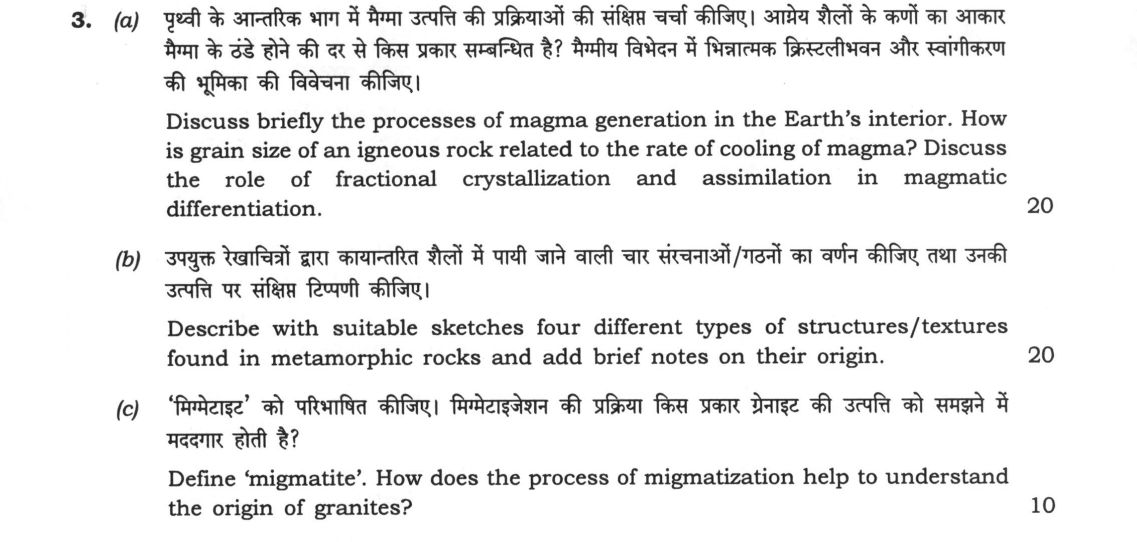
Discuss briefly the processes of magma generation in the Earth's interior. How is grain size of an igneous rock related to the rate of cooling of magma? Discuss the role of fractional crystallization and assimilation in magmatic differentiation. 20 marks
Describe with suitable sketches four different types of structures/textures found in metamorphic rocks and add brief notes on their origin. 20 marks
Define 'migmatite'. How does the process of migmatization help to understand the origin of granites? 10 marks
हिंदी में प्रश्न पढ़ें
पृथ्वी के आन्तरिक भाग में मैग्मा उत्पत्ति की प्रक्रियाओं की संक्षिप्त चर्चा कीजिए। आग्नेय शैलों के कणों का आकार मैग्मा के ठंडे होने की दर से किस प्रकार सम्बन्धित है? मैग्मीय विभेदन में भिन्नात्मक क्रिस्टलीभवन और स्वांगीकरण की भूमिका की विवेचना कीजिए। (20 अंक)
उपयुक्त रेखाचित्रों द्वारा कायान्तरित शैलों में पायी जाने वाली चार संरचनाओं/गठनों का वर्णन कीजिए तथा उनकी उत्पत्ति पर संक्षिप्ट टिप्पणी कीजिए। (20 अंक)
'मिग्मेटाइट' को परिभाषित कीजिए। मिग्मेटाइजेशन की प्रक्रिया किस प्रकार ग्रेनाइट की उत्पत्ति को समझने में मददगार होती है? (10 अंक)
Model answer
Written by UPSC Answer Check against this question's marking rubric, to the expected length. UPSC does not publish answers for Mains — this is one way to score well, not an official key.
Magma generation in the Earth’s interior is governed by temperature, pressure, composition and volatile content. Decompression melting occurs when hot peridotite rises beneath mid-ocean ridges, hotspots and continental rifts; pressure falls faster than temperature, crossing the solidus and producing basaltic magma. Flux melting occurs in subduction zones where H₂O released from the slab lowers the solidus of the mantle wedge, generating hydrous, often calc-alkaline magmas. Heat transfer from hot mantle plumes or magma bodies, aided by heat retention in thickened crust, can raise local temperatures to the solidus, causing contact melting or crustal anatexis; in thickened, hot crust at 650–800 °C, upper amphibolite to granulite-facies conditions, partial melting yields granitic melts.
Grain size records cooling history. Slow cooling in plutons allows large crystals to grow, giving coarse phaneritic textures (granite, gabbro). Rapid cooling at surface produces fine aphanitic crystals (basalt) or vitreous glass (obsidian, rhyolite). Intermediate or two-stage cooling gives porphyritic texture: large phenocrysts formed slowly at depth, then rapid eruption cools the groundmass. Thus texture is a direct kinetic record of residence time and heat loss.
Magmatic differentiation separates minerals and melts. Fractional crystallization, described by Bowen’s reaction series, removes early Fe-Mg silicates and Ca-plagioclase from basaltic magma, enriching residual melt in silica, alkalis and volatiles, producing andesitic to rhyolitic compositions. Assimilation incorporates country rock, modifying melt composition, viscosity and crystallization path; together they explain compositional ranges without requiring separate primary magmas.
Metamorphic structures and textures. Four common types are foliation, lineation, porphyroblastic texture and granoblastic texture. Foliation is planar alignment of platy minerals (mica, chlorite) produced by directed pressure and recrystallization; it ranges from slaty cleavage at low grade to schistosity and gneissic banding at higher grade. Sketch: parallel mica plates oriented perpendicular to maximum compressive stress, with alternating light and dark bands in gneiss. Lineation is linear alignment of minerals or stretched grains, produced by shear or compression; sketch: elongate hornblende or stretched porphyroclasts defining a line in a schist. Porphyroblastic texture consists of large crystals (porphyroblasts) growing in a finer matrix during recrystallization; sketch: rotated porphyroblasts/porphyroclasts such as garnet or staurolite in a foliated matrix, showing growth under directed pressure. Granoblastic texture is equigranular, interlocking grains formed by recrystallization under high temperature and pressure, often in contact or high-grade regional metamorphism; sketch: polygonal quartz-feldspar grains without foliation. Additional textures include augen gneiss (stretched feldspar porphyroclasts in foliated matrix), mylonitic foliation from ductile shear, and hornfelsic fine-grained non-foliated texture from contact metamorphism.
Migmatite and granite origin. Migmatite is a mixed rock containing dark mafic melanosome and light felsic leucosome, with possible leucogranite veins or neosomes. Migmatization records partial melting of metamorphic crust (anatexis) and segregation of melt. It helps solve the granite problem by showing granites can form in situ from high-grade metamorphic rocks rather than only by intrusion of mantle-derived magmas. Where melt remains mixed with restite, the result is metatexis; where melt is fully extracted and crystallizes as granite, it is diatexis. Field evidence from high-grade terranes, such as Himalayan and Aravalli granulite-migmatite belts, links migmatites to granitic plutons and demonstrates the transition from metamorphic to igneous realms. Thus, igneous and metamorphic processes are linked: magma generation and differentiation produce primary rocks, while metamorphism and anatexis can recycle them into granites.
What "Discuss" is asking you to do
Lay the issue out from more than one side — how it arose, what is claimed for it, what is held against it, and where it now stands. UPSC attaches discuss to broad topics with several live dimensions, so coverage of the dimensions earns more than the strength of your opinion.
Structure that answers it
Set the issue up → the case as it is made → the case against → the dimension both sides leave out → where the balance now lies
Where marks are lost
Listing facts with no thread between them, or arguing one side throughout and calling it a discussion.
How this answer will be evaluated
Approach
Framework: Geology Paper 2: Define > Process > Field/Petrographic Evidence > Indian Example. (a) discuss: intro > 3-4 dimensions > example > balanced close | (b) describe: define > structure or process in order > labelled diagram > significance | (c) define: precise definition > the distinguishing feature > one example Full marks: All parts with Indian examples, precise mineral composition, and clear sketches/diagrams.
Key points expected
- Magma generation via partial melting (decompression/fluxing)
- Grain size inversely related to cooling rate (phaneritic vs aphanitic)
- Fractional crystallization mechanism (Bowen's reaction series)
- Assimilation of country rock in differentiation
- Four distinct structures/textures (e.g., foliation, gneissic, schistose, mylonitic)
- Suitable sketches for each structure
- Brief notes on origin (pressure, temperature, deformation)
- Precise mineral composition and texture description
Evaluation rubric
Each sub-part is marked on its own, against the marks and word limit printed on the paper.
- (a) Magma generation, grain size vs cooling rate, and magmatic differentiation mechanisms. 20 marks
discuss— intro → 3-4 dimensions → example → balanced close
Must cover
- Magma generation via partial melting (decompression/fluxing)
- Grain size inversely related to cooling rate (phaneritic vs aphanitic)
- Fractional crystallization mechanism (Bowen's reaction series)
- Assimilation of country rock in differentiation
Loses marks
- Generic description without Indian example
- Missing sections or sketches
- Confusing fractional crystallization with assimilation
Earns more
- Bowen's reaction series diagram
- Indian example (e.g., Deccan Traps, Chotanagpur)
- Precise mineral composition (e.g., olivine, pyroxene)
- Link to economic deposit (e.g., chromite)
Extra mark
- Named Indian craton or basin
- Stratigraphic age of formation
- (b) Four metamorphic structures/textures with sketches and origin notes. 20 marks
describe— define → structure or process in order → labelled diagram → significance
Must cover
- Four distinct structures/textures (e.g., foliation, gneissic, schistose, mylonitic)
- Suitable sketches for each structure
- Brief notes on origin (pressure, temperature, deformation)
- Precise mineral composition and texture description
Loses marks
- Missing sketches or sections
- Generic description without Indian example
- Confusing igneous with metamorphic textures
Earns more
- Indian example (e.g., Aravalli, Eastern Ghats)
- Link to economic deposit (e.g., bauxite, iron ore)
- Stratigraphic age of formation
- Named Indian craton or basin
Extra mark
- 30-second diagram of metamorphic facies
- Specific mineral assemblage (e.g., garnet, staurolite)
- (c) Definition of migmatite and migmatization's role in granite origin. 10 marks
define— precise definition → the distinguishing feature → one example
Must cover
- Precise definition of migmatite (partial melt + solid rock)
- Migmatization process (partial melting, melt segregation)
- Link to granite origin (anatexis, leucogranite formation)
- Indian example (e.g., Aravalli, Eastern Ghats)
Loses marks
- Generic description without Indian example
- Missing sections or sketches
- Confusing migmatite with pure granite
Earns more
- Stratigraphic age of formation
- Named Indian craton or basin
- Precise mineral composition (e.g., leucosome, leucocryst)
- Link to economic deposit (e.g., rare earth elements)
Extra mark
- 30-second diagram of migmatite texture
- Specific mineral assemblage (e.g., quartz, feldspar, mica)
Practice this exact question
Write your answer and it is marked point by point against the model answer above — what you covered, what you missed, what you got wrong.
Evaluate my answer →More from Geology 2021 Paper II
- Q1 Answer the following questions in about 150 words each: (a) How does one designate mirror…
- Q2 (a) Give the classification scheme of silicate minerals on the basis of atomic structure,…
- Q3 (a) Discuss briefly the processes of magma generation in the Earth's interior. How is gra…
- Q4 (a) What is provenance? How can we use clastic quartz, feldspars and lithic grains in pro…
- Q5 Answer the following questions in about 150 words each: (a) Lead (Pb) mineralization zone…
- Q6 (a) Give the modern classification of mineral deposits and explain in brief the residual…