Paper II — Q4
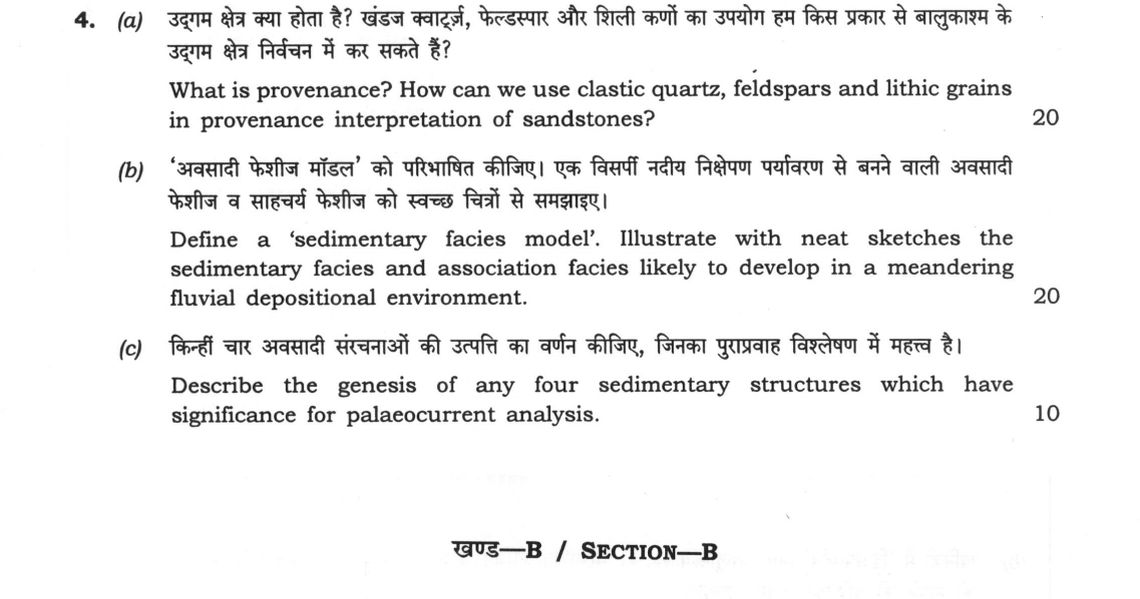
(a) What is provenance? How can we use clastic quartz, feldspars and lithic grains in provenance interpretation of sandstones?…
What is provenance? How can we use clastic quartz, feldspars and lithic grains in provenance interpretation of sandstones? 20 marks
Define a 'sedimentary facies model'. Illustrate with neat sketches the sedimentary facies and association facies likely to develop in a meandering fluvial depositional environment. 20 marks
Describe the genesis of any four sedimentary structures which have significance for palaeocurrent analysis. 10 marks
हिंदी में प्रश्न पढ़ें
उद्गम क्षेत्र क्या होता है? खंडज क्वार्ट्ज, फेल्डस्पार और शैली कणों का उपयोग हम किस प्रकार से बालूकाश्म के उद्गम क्षेत्र निर्वचन में कर सकते हैं? (20 अंक)
'अवसादी फेसीज मॉडल' को परिभाषित कीजिए। एक विसर्पी नदीय निक्षेपण पर्यावरण से बनने वाली अवसादी फेसीज व साहचर्य फेसीज को स्वच्छ चित्रों से समझाइए। (20 अंक)
किन्हीं चार अवसादी संरचनाओं की उत्पत्ति का वर्णन कीजिए, जिनका पुराप्रवाह विश्लेषण में महत्व है। (10 अंक)
Model answer
Written by UPSC Answer Check against this question's marking rubric, to the expected length. UPSC does not publish answers for Mains — this is one way to score well, not an official key.
Provenance Interpretation from Sandstone Petrography
Provenance encompasses the composition, tectonic setting, climate, and relief of the source terrain supplying detritus to a sedimentary basin. Detrital framework grains—quartz, feldspars, and rock fragments (lithics)—provide primary genetic signatures:
Clastic Quartz: Monocrystalline quartz (Qm) with straight/non-undulatory extinction typically indicates stable, plutonic igneous (granitic) sources. Polycrystalline quartz (Qp) with multiple sutured subgrains and undulatory extinction points to high-to-medium-grade metamorphic parentage. Micro-inclusions such as rutile needles, tourmaline, or embayed volcanic margins further differentiate source lithologies.
Feldspars: Potassium feldspar (microcline, orthoclase) reflects acidic plutonic rocks and pegmatites, whereas plagioclase (calcic to intermediate) denotes intermediate-to-basic igneous or volcanic arc sources. Pristine, unaltered feldspars indicate rapid erosion under arid or cold climates with high tectonic relief, while heavily sericitised or saussuritised grains signify intense chemical weathering in humid conditions or prolonged sediment transport.
Lithic Fragments (L): Supracrustal lithics directly mirror the unroofed source. Volcanic lithics (Lv) characterise magmatic arc systems; metamorphic lithics (Lm) like schist and phyllite fragments identify dynamic orogenic belts; sedimentary lithics (Ls) such as chert, shale, and carbonate clasts signify recycled sedimentary fold-and-thrust belts.
Using the QFL and Qm-F-Lt ternary discrimination diagrams of Dickinson et al., sandstones are systematically categorized into distinct tectonic provenances: Continental Block (craton interior and transitional continental crust; quartz-rich), Magmatic Arc (undissected to dissected volcanic-plutonic arcs; rich in plagioclase and Lv), and Recycled Orogen (subduction complexes and collision belts; dominated by Qp and diverse lithics). A prime Indian example is the Siwalik molasse of the Himalayan foreland basin, where the upward increase in metamorphic and sedimentary lithics records the progressive unroofing of the rising Himalayan orogen.
`` Q (Total Quartz) /\ / Continental Block / \ / Recycled\ / Orogen \ /_____________\ F L (Feldspars) (Lithics) ``
Sedimentary Facies Model: Meandering Fluvial System
A sedimentary facies model is an idealized, predictive summary that synthesises the physical, biological, and chemical characteristics of a specific depositional environment. It acts as a norm for comparison, a framework for hydrodynamic interpretation, and a predictive tool via Walther’s Law of Facies.
`` [ Vertical Succession ] Floodplain : Mudstone, caliche paleosols, root traces (Suspension settling) Crevasse Splay: Sheet-like thin sandstones with climbing ripples Levee : Interbedded silt-fine sand with ripple laminations Point Bar : Fine-medium sand; climbing ripples -> tabular/trough cross-beds : Lateral Accretion Surfaces (Epsilon Cross-Stratification) Channel Lag : Coarse gravels, rip-up clasts on basal erosional scour ``
In a meandering fluvial environment, continuous lateral migration and vertical aggradation generate an asymmetrical, fining-upward facies association:
Channel Floor and Lag Facies: Formed at the base of the thalweg by intense scouring; composed of poorly sorted gravels, intraformational mud clasts, and heavy mineral concentrates.
Point Bar Facies: Deposited by helicoidal flow on the inner meander bend, exhibiting characteristic inclined lateral accretion surfaces (epsilon cross-stratification). Hydrodynamic energy wanes upward, generating a vertical transition from basal trough cross-bedded medium sand (3D dunes) to upper planar-laminated and ripple-cross-laminated fine sand.
Levee and Crevasse Splay Facies: Overbank flooding builds wedge-shaped levee ridges (fine sand with climbing ripples) flanking the channel. Breaching yields crevasse splay deposits characterized by thin, graded, lobate sheet sandstones interbedded with mud.
Floodplain / Overbank Facies: Settling of suspended silt and clay in low-energy backswamps. Dominant features include massive mudstones, pedogenic calcretes, root bioturbation, and coal seams, as seen in the Lower Gondwana fluvial coal measures of the Damodar Valley basin.
Sedimentary Structures for Palaeocurrent Analysis
Palaeocurrent analysis reconstructs ancient sediment dispersal pathways and regional palaeoslopes using directional structures:
Trough Cross-Bedding: Generated in the lower flow regime by the downstream migration of three-dimensional, sinuous-crested dunes. The curved foresets produce spoon-shaped scours whose symmetry axes plunge strictly downcurrent, providing a reliable unidirectional vector in fluvial channels.
Tabular Cross-Bedding: Produced by the downstream migration of two-dimensional, straight-crested sand waves and dunes. The maximum dip azimuth of the planar foresets records the local bedform migration direction, exhibiting unimodal trends in rivers and bimodal-herringbone patterns in tidal regimes.
Current Ripple Marks: Formed by low-velocity traction currents under lower flow regime conditions. They display an asymmetric cross-sectional profile with a gentle stoss slope (8^°–10^°) facing upstream and a steep lee slope (angle of repose,∼ 30^°–34^°) facing downstream, reliably defining the current vector.
Flute Casts: Formed on the soles of turbidite beds when high-energy turbulent eddies scour cohesive mud substrates, followed by immediate sand infill. Flutes exhibit a bulbous, deeply excavated upstream nose that tapers, widens, and flattens downcurrent, serving as precise indicators of turbidity flow pathways.
Palaeocurrent measurements across the Bhander Sandstone of the Proterozoic Vindhyan Basin systematically demonstrate sediment transport directed towards the west and north-west into the intracratonic depocentre. Integrating sandstone petrofacies, vertical facies models, and directional sole structures provides an indispensable basis for reconstructing basin evolution, paleogeography, and regional tectonic histories.
What "Describe" is asking you to do
Give a full, ordered account of the thing named — its parts, stages or mechanism — in the sequence in which it actually exists or occurs. Most describe questions come from the science optionals, where the marks sit in correct technical detail and, where the stem says so, a labelled diagram.
Structure that answers it
One-line identification of the subject → the parts or stages in their real order, each with its defining detail → labelled diagram where the subject is structural → closing line on function or significance
Where marks are lost
Loose general prose where the examiner is ticking named parts, correct terminology and their sequence; and in the General Studies papers, turning to evaluation before the description is finished.
How this answer will be evaluated
Approach
Framework: Geology Paper 2: Define > Process > Field/Petrographic Evidence > Indian Example. (a) explain: definition/context > points in order > small example > short close | (b) describe: define > structure or process in order > labelled diagram > significance | (c) describe: define > structure or process in order > labelled diagram > significance Full marks: Precise definitions, clear QFL/facies/structure explanations, labelled sketches, named Indian examples with age.
Key points expected
- Precise definition of provenance (source area)
- Explanation of Quartz (Q) as stable/chemical maturity
- Explanation of Feldspar (F) as tectonic maturity
- Explanation of Lithic (L) as source rock type
- Definition of sedimentary facies model
- Sketch of channel facies (point bar, channel lag)
- Sketch of overbank facies (floodplain, crevasse)
- Identification of association facies (e.g., channel-braid)
Evaluation rubric
Each sub-part is marked on its own, against the marks and word limit printed on the paper.
- (a) Define provenance and explain the use of QFL grains in sandstone interpretation. 20 marks
explain— definition/context → points in order → small example → short close
Must cover
- Precise definition of provenance (source area)
- Explanation of Quartz (Q) as stable/chemical maturity
- Explanation of Feldspar (F) as tectonic maturity
- Explanation of Lithic (L) as source rock type
Loses marks
- Confusing provenance with paleocurrent
- Generic description without QFL ratios
- Missing the link between grain type and source
Earns more
- Reference to Dickinson or Ingersoll QFL diagrams
- Link to specific tectonic settings (e.g., rift vs passive margin)
- Mention of Indian sandstone examples (e.g., Vindhyan)
Extra mark
- Specific Indian formation name (e.g., Rewa Sandstone)
- Stratigraphic age of the example
- (b) Define facies model and illustrate meandering fluvial facies with sketches. 20 marks
describe— define → structure or process in order → labelled diagram → significance
Must cover
- Definition of sedimentary facies model
- Sketch of channel facies (point bar, channel lag)
- Sketch of overbank facies (floodplain, crevasse)
- Identification of association facies (e.g., channel-braid)
Loses marks
- Missing sketches or diagrams
- Confusing meandering with braided river facies
- Generic description without specific facies names
Earns more
- Labelled cross-section of meander
- Mention of specific sedimentary structures (e.g., cross-bedding)
- Reference to Indian fluvial basins (e.g., Ganga-Brahmaputra)
Extra mark
- Specific Indian formation name (e.g., Siwalik)
- Stratigraphic age of the example
- (c) Describe genesis of four sedimentary structures for palaeocurrent analysis. 10 marks
describe— define → structure or process in order → labelled diagram → significance
Must cover
- Description of cross-bedding genesis
- Description of ripple marks genesis
- Description of flute casts genesis
- Description of sole marks (e.g., grooves) genesis
Loses marks
- Missing genesis of structures
- Confusing palaeocurrent with palaeoenvironment
- Generic description without specific structures
Earns more
- Link to flow direction (palaeocurrent)
- Mention of specific sedimentary structures (e.g., trough cross-bedding)
- Reference to Indian examples (e.g., Vindhyan)
Extra mark
- Specific Indian formation name (e.g., Rewa Sandstone)
- Stratigraphic age of the example
Practice this exact question
Write your answer and it is marked point by point against the model answer above — what you covered, what you missed, what you got wrong.
Evaluate my answer →More from Geology 2021 Paper II
- Q1 Answer the following questions in about 150 words each: (a) How does one designate mirror…
- Q2 (a) Give the classification scheme of silicate minerals on the basis of atomic structure,…
- Q3 (a) Discuss briefly the processes of magma generation in the Earth's interior. How is gra…
- Q4 (a) What is provenance? How can we use clastic quartz, feldspars and lithic grains in pro…
- Q5 Answer the following questions in about 150 words each: (a) Lead (Pb) mineralization zone…
- Q6 (a) Give the modern classification of mineral deposits and explain in brief the residual…
- Q7 (a) State the characteristic features of cosmic abundance of elements. What are the bases…