Paper II — Q7
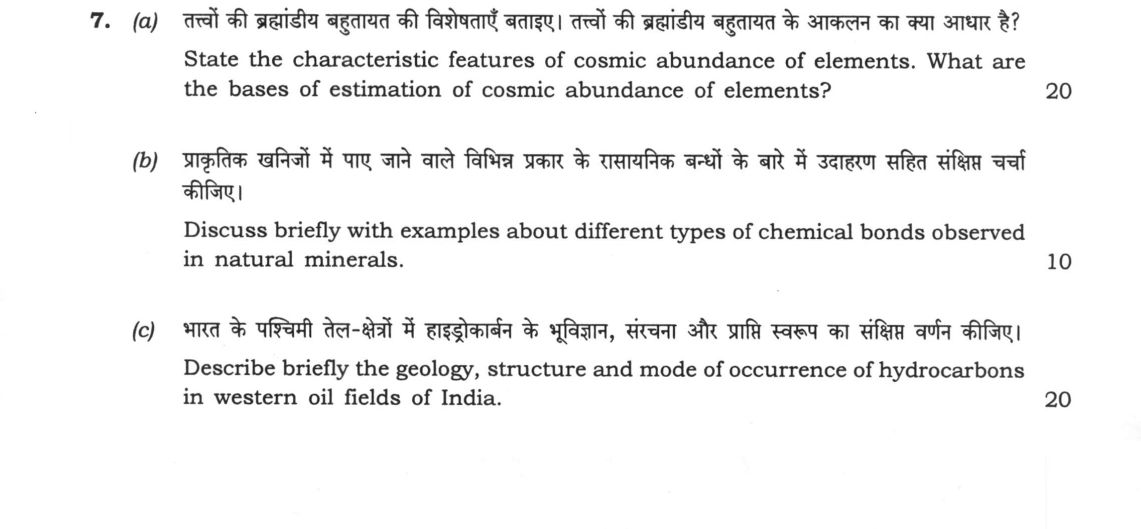
(a) State the characteristic features of cosmic abundance of elements. What are the bases of estimation of cosmic abundance of…
State the characteristic features of cosmic abundance of elements. What are the bases of estimation of cosmic abundance of elements? 20 marks
Discuss briefly with examples about different types of chemical bonds observed in natural minerals. 10 marks
Describe briefly the geology, structure and mode of occurrence of hydrocarbons in western oil fields of India. 20 marks
हिंदी में प्रश्न पढ़ें
तत्वों की ब्रह्मांडीय बहुलायत की विशेषताएं बताइए। तत्वों की ब्रह्मांडीय बहुलायत के आकलन का क्या आधार है? (20 अंक)
प्राकृतिक खनिजों में पाए जाने वाले विभिन्न प्रकार के रासायनिक बंधों के बारे में उदाहरण सहित संक्षिप्त चर्चा कीजिए। (10 अंक)
भारत के पश्चिमी तेल-क्षेत्रों में हाइड्रोकार्बन के भूविज्ञान, संरचना और प्राप्ति स्वरूप का संक्षिप्त वर्णन कीजिए। (20 अंक)
Model answer
Written by UPSC Answer Check against this question's marking rubric, to the expected length. UPSC does not publish answers for Mains — this is one way to score well, not an official key.
Cosmochemistry, mineralogy, and petroleum geology represent an interconnected continuum wherein primary nucleosynthetic abundances dictate the terrestrial mineral matrix, which in turn controls sedimentary basin formation, diagenesis, and hydrocarbon entrapment.
Characteristics and Estimation Bases of Cosmic Abundance
The cosmic abundance of elements exhibits fundamental patterns governed by stellar nucleosynthetic processes:
- Hydrogen and Helium Dominance: Hydrogen and helium constitute approximately 98% of the total mass of the universe, reflecting the initial Big Bang nucleosynthesis.
- Exponential Decline: Abundance decreases exponentially with increasing atomic number (Z) up to Z ≈ 45, after which the curve flattens.
- Oddo-Harkins Rule: Elements with even atomic numbers are systematically more abundant than their odd-Z neighbors due to enhanced nuclear stability from paired nucleons.
- Iron Peak: A pronounced abundance peak occurs around Z = 26 (⁵⁶Fe, Ni, Cr), reflecting the maximum nuclear binding energy per nucleon during stellar silicon-burning stages.
- Depletion of Li, Be, and B: Lithium, beryllium, and boron display anomalously low abundances because they are bypassed in main stellar fusion cycles and readily consumed in thermonuclear reactions.
The estimation of cosmic abundances is based on four primary empirical sources:
- Spectroscopic Analysis: Quantitative evaluation of absorption and emission lines (Fraunhofer lines) in solar and stellar photospheric spectra.
- Meteoritic Analysis: Chemical assays of primitive CI carbonaceous chondrites (e.g., Orgueil meteorite), which preserve the non-volatile solar nebula composition without planetary differentiation.
- Solar Wind Data: Direct capture and isotopic measurement of charged particle fluxes by spaceborne missions like Genesis.
- Cosmic Ray Abundances: High-energy galactic cosmic ray particle flux measurements corrected for spallation reactions.
Chemical Bonds in Natural Minerals
Chemical bonding dictates crystal structures, cleavage, and stability:
- Ionic Bonding: Arises from electrostatic attraction between oppositely charged ions, as seen in halite (NaCl) and fluorite (CaF₂), imparting high symmetry and moderate hardness.
- Covalent Bonding: Formed by the sharing of valence electron pairs, producing high hardness and insolubility, typified by diamond (C) and sphalerite (ZnS).
- Metallic Bonding: Involves closely packed positive ion cores immersed in a delocalized electron cloud, conferring electrical conductivity and malleability in native gold (Au) and native copper (Cu).
- Van der Waals Bonding: Weak, non-directional electrostatic dipolar attractions occurring between neutral layers, explaining the excellent basal cleavage and lubricity of graphite (C) and phyllosilicates like talc.
- Hydrogen Bonding: Weak electrostatic attraction between polarized hydrogen and electronegative atoms (O), governing interlayer bonding in kaolinite and the open structure of ice.
- Mixed Bonding: Most silicates (e.g., quartz and olivine) feature hybrid bonds where Si-O bonds are approximately 50% covalent and 50% ionic.
Geology, Structure, and Hydrocarbons in Western Indian Basins
The Western oil-bearing province comprises petroliferous basins developed along India's passive and rifted western continental margin:
Geology and Basinal Framework:
- Mumbai Offshore Basin: A pericratonic shelf basin containing fractured Precambrian granitic basement overlain by Paleocene-Eocene syn-rift clastics and thick Oligocene-Miocene shelf carbonates. The Miocene L-III limestone member constitutes the principal regional reservoir.
- Cambay Basin: A north-south trending, narrow extensional intracratonic rift basin filled with over 5,000 meters of Tertiary sediments. The prolific Eocene Cambay Shale serves as the primary hydrocarbon source rock, charging overlying deltaic sandstones of the Ankleshwar Formation.
- Kutch-Saurashtra Basin: A pericratonic rift system characterized by thick Mesozoic marine and continental successions unconformably overlain by Tertiary carbonate-clastic sequences.
Structure and Mode of Occurrence:
- Mumbai High Structure: Hydrocarbons occur in a giant, gently dipping NNW-SSE trending doubly plunging anticlinal horst bounded by major listric faults. Entrapment is governed by structural drape, rollover anticlines, fractured basement traps, and stratigraphic pinch-outs sealed by Miocene post-rift shales.
- Cambay Rift Traps: Characterized by asymmetric horst-and-graben geometry with longitudinal bounding faults. Traps occur within tilted fault blocks, roll-over anticlines, fault-propagated closures, and lenticular stratigraphic sand bodies along the basin flanks.
Fundamental cosmic nucleosynthetic abundance dictates the dominant lithophile elements forming Earth's crustal silicates and carbonates, which subsequently provide the structural frameworks and source-reservoir architectures governing hydrocarbon accumulation across tectonic regimes.
What "State" is asking you to do
Give the formulation itself — the theorem, rule, statutory provision or position — worded accurately. Precision of wording is the whole of the mark; no background or justification is being asked for.
Structure that answers it
The statement in full, complete in itself → the conditions under which it holds → an illustration only where the stem asks for one
Where marks are lost
Approximating the wording. A theorem or a provision stated loosely forfeits the mark that exact statement would have carried.
How this answer will be evaluated
Approach
Framework: Geology, Paper 2. (a) explain: definition/context > points in order > small example > short close | (b) discuss: intro > 3-4 dimensions > example > balanced close | (c) describe: define > structure or process in order > labelled diagram > significance Full marks: Precise definitions, correct mineral examples, and specific Indian basin details (Barmer/Jaisalmer) with structural context.
Key points expected
- Define cosmic abundance (mass fraction vs number fraction)
- State features: H/He dominance, odd-even effect, Fe peak
- Explain spectroscopic analysis of stellar atmospheres
- Explain meteorite analysis (chondrites) and solar system data
- Define ionic bonding with mineral example (e.g., Halite, NaCl)
- Define covalent bonding with mineral example (e.g., Diamond, Quartz)
- Define metallic bonding with mineral example (e.g., Native Copper)
- Define van der Waals bonding with mineral example (e.g., Graphite, Mica)
Evaluation rubric
Each sub-part is marked on its own, against the marks and word limit printed on the paper.
- (a) Define cosmic abundance, list its characteristic features, and detail the estimation bases. 20 marks
explain— definition/context → points in order → small example → short close
Must cover
- Define cosmic abundance (mass fraction vs number fraction)
- State features: H/He dominance, odd-even effect, Fe peak
- Explain spectroscopic analysis of stellar atmospheres
- Explain meteorite analysis (chondrites) and solar system data
Loses marks
- Confusing terrestrial abundance with cosmic abundance
- Failing to distinguish between estimation methods (solar vs meteoritic)
Earns more
- Mention nucleosynthesis (Big Bang, stellar, supernova) as origin
- Reference specific isotopes (e.g., 12C, 16O, 56Fe)
Extra mark
- Reference specific abundance values (e.g., H ~75%, He ~23%)
- (b) Briefly discuss different types of chemical bonds in natural minerals with examples. 10 marks
discuss— intro → 3-4 dimensions → example → balanced close
Must cover
- Define ionic bonding with mineral example (e.g., Halite, NaCl)
- Define covalent bonding with mineral example (e.g., Diamond, Quartz)
- Define metallic bonding with mineral example (e.g., Native Copper)
- Define van der Waals bonding with mineral example (e.g., Graphite, Mica)
Loses marks
- Listing bond types without specific mineral examples
- Confusing covalent and ionic character in silicates
Earns more
- Mention mixed bonding (e.g., Si-O in silicates)
- Link bond type to physical properties (hardness, cleavage)
Extra mark
- Sketch of crystal structure showing bond types
- (c) Describe the geology, structure, and mode of occurrence of hydrocarbons in western India. 20 marks
describe— define → structure or process in order → labelled diagram → significance
Must cover
- Identify Western India as a rift basin (Cambrian-Devonian)
- Name source rocks (e.g., Cambrian shales, Barmer basin)
- Describe structural traps (faults, anticlines) and stratigraphic traps
- Name specific fields (e.g., Barmer, Jaisalmer, Ankleshwar)
Loses marks
- Confusing Western India geology with Eastern India (Gondwana) geology
- Failing to mention the rift basin origin
Earns more
- Mention specific formations (e.g., Cambrian shales, Jurassic limestones)
- Describe the role of the Aravalli belt in basin formation
Extra mark
- Sketch of a cross-section showing trap geometry
Practice this exact question
Write your answer and it is marked point by point against the model answer above — what you covered, what you missed, what you got wrong.
Evaluate my answer →More from Geology 2021 Paper II
- Q4 (a) What is provenance? How can we use clastic quartz, feldspars and lithic grains in pro…
- Q5 Answer the following questions in about 150 words each: (a) Lead (Pb) mineralization zone…
- Q6 (a) Give the modern classification of mineral deposits and explain in brief the residual…
- Q7 (a) State the characteristic features of cosmic abundance of elements. What are the bases…
- Q8 (a) How is unscientific development of catchments situated in mountainous regions respons…