Paper II — Q6
(a) Give the modern classification of mineral deposits and explain in brief the residual and mechanical concentration deposits…
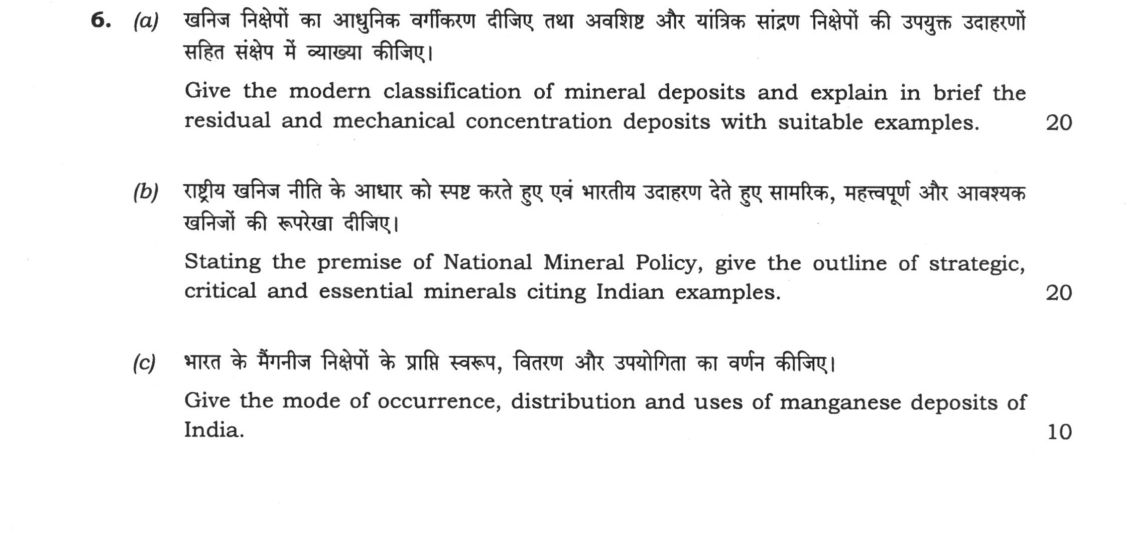
Give the modern classification of mineral deposits and explain in brief the residual and mechanical concentration deposits with suitable examples. 20 marks
Stating the premise of National Mineral Policy, give the outline of strategic, critical and essential minerals citing Indian examples. 20 marks
Give the mode of occurrence, distribution and uses of manganese deposits of India. 10 marks
हिंदी में प्रश्न पढ़ें
खनिज निक्षेपों का आधुनिक वर्गीकरण दीजिए तथा अवशिष्ट और यांत्रिक सांद्रण निक्षेपों की उपयुक्त उदाहरणों सहित संक्षेप में व्याख्या कीजिए। (20 अंक)
राष्ट्रीय खनिज नीति के आधार को स्पष्ट करते हुए एवं भारतीय उदाहरण देते हुए सामरिक, महत्वपूर्ण और आवश्यक खनिजों की रूपरेखा दीजिए। (20 अंक)
भारत के मैंगनीज निक्षेपों के प्राप्ति स्वरूप, वितरण और उपयोगिता का वर्णन कीजिए। (10 अंक)
Model answer
Written by UPSC Answer Check against this question's marking rubric, to the expected length. UPSC does not publish answers for Mains — this is one way to score well, not an official key.
Mineral deposits are the raw material base of industry and energy security; their classification and policy management therefore determine how effectively a country converts geology into development.
Genetic classification and concentration deposits. The modern classification of mineral deposits is genetic and hierarchical: endogenic deposits form within the crust and include magmatic, hydrothermal and metamorphic deposits; exogenic deposits form at or near the surface and include sedimentary, residual and mechanical deposits. Residual concentration deposits form when intense chemical weathering, especially in hot humid tropical climates, decomposes silicate rocks and removes silica, alkali and alkaline earth elements as soluble silica and clays, while less mobile metals such as iron, aluminium and nickel remain behind as oxides, hydroxides and silicates. The process is most effective where relief is low, drainage is slow, and the parent rock is rich in the metal; the result is a cap of ore over laterite. In India, residual deposits include lateritic nickel at Sukinda in Odisha, bauxite at Panchpatmali in Jharkhand, and iron ore in the Singhbhum region, where tropical weathering has concentrated iron oxides in lateritic caps. Mechanical concentration deposits, or placers, form when primary ore is eroded and transported by rivers, glaciers or waves; because heavy minerals have higher specific gravity than common sand and gravel, they settle first and become concentrated in favourable traps such as river bends, paleochannels, beach ridges or tidal flats. The mechanism is density sorting: as flow velocity decreases, heavy minerals drop out first, and repeated erosion and deposition increase grade. Indian examples include the monazite, ilmenite, rutile, zircon and cassiterite placers of the Kerala–Tamil Nadu coast, and alluvial gold in Jharkhand, where dense gold grains have been separated from lighter detritus by fluvial action.
National Mineral Policy and mineral categories. The premise of the National Mineral Policy 2019 is to ensure security of mineral supply for economic growth, defence and energy transition, while promoting sustainable mining, scientific exploration, private sector participation, efficient utilisation and minimal environmental impact. Within this framework, minerals are usefully distinguished as strategic, critical and essential. Strategic minerals are those vital for national security, advanced technology and emerging industries; they include rare earth elements, lithium and cobalt, with rare earth occurrences in the Chhattisgarh REE belts. Rare earth elements are used in magnets, defence electronics and clean-energy devices, while lithium and cobalt are needed for batteries. Critical minerals are indispensable for manufacturing, infrastructure and clean energy but carry higher supply risk; examples are copper at Malanjkhand in Chhattisgarh, tungsten in Kerala, and molybdenum at Degana in Rajasthan. Essential minerals are bulk minerals required for basic industry and everyday life; iron ore, manganese, bauxite and coal are typical, occurring in the Odisha–Jharkhand–Chhattisgarh belt and other major sedimentary and igneous provinces.
Manganese deposits of India. Manganese in India occurs mainly as bedded or stratiform deposits in the Dharwar Supergroup and associated iron formations, indicating a syngenetic sedimentary origin with later supergene enrichment. The deposits are typically banded, with manganese oxides and carbonates interbedded with iron-rich shales and cherts; supergene enrichment increases manganese dioxide in oxidised zones. The largest and highest-grade deposits are in Balaghat, Madhya Pradesh, while other important districts are Nagpur–Bhandara in Maharashtra, Keonjhar and Sundergarh in Odisha, Dharwar in Karnataka and Vizianagaram in Andhra Pradesh. Manganese is used chiefly in ferromanganese for steelmaking, where it acts as a deoxidiser and controls sulphur, and also in dry-cell batteries, chemical industry and aluminium alloying. Although India has the seventh largest global manganese reserves and is a major producer, it still imports battery-grade and high-purity manganese, showing that mineral security depends not only on quantity but on grade, processing and policy support.
What "Explain" is asking you to do
Make the working of something clear — what sets it off, what follows from what, and what it produces. Explain is the Commission's mechanism word: it dominates the technical papers and the “explain why” stems, where the marks sit in the causal chain and not in the label.
Structure that answers it
State what it is → the initiating condition → the chain of cause, step by step → an instance where it plays out → what the chain produces
Where marks are lost
Describing what something looks like instead of why it works that way. Naming the stages without linking them reads as description too.
How this answer will be evaluated
Approach
Framework: UPSC Geology Paper 2. (a) explain: definition/context > points in order > small example > short close | (b) examine: intro > how/why with reasoning > evidence > conclusion | (c) describe: define > structure or process in order > labelled diagram > significance Full marks: Precise definitions, named Indian examples, clear distinctions, and relevant sketches.
Key points expected
- Modern classification of mineral deposits
- Definition of residual concentration deposits
- Definition of mechanical concentration deposits
- Suitable examples for both types
- Premise of National Mineral Policy
- Outline of strategic minerals
- Outline of critical minerals
- Outline of essential minerals
Evaluation rubric
Each sub-part is marked on its own, against the marks and word limit printed on the paper.
- (a) Modern classification of mineral deposits and brief explanation of residual and mechanical concentration types. 20 marks
explain— definition/context → points in order → small example → short close
Must cover
- Modern classification of mineral deposits
- Definition of residual concentration deposits
- Definition of mechanical concentration deposits
- Suitable examples for both types
Loses marks
- Generic description with no Indian example
- Missing sections or sketches
- Confusing residual with mechanical deposits
Earns more
- Sketch of residual deposit formation
- Sketch of mechanical deposit formation
- Mention of specific Indian examples
- Distinction between residual and mechanical
Extra mark
- Named Indian occurrence with stratigraphic age
- Precise mineral composition and texture
- (b) Premise of National Mineral Policy and outline of strategic, critical, and essential minerals with Indian examples. 20 marks
examine— intro → how/why with reasoning → evidence → conclusion
Must cover
- Premise of National Mineral Policy
- Outline of strategic minerals
- Outline of critical minerals
- Outline of essential minerals
Loses marks
- Generic description with no Indian example
- Missing premise of National Mineral Policy
- Confusing strategic, critical, and essential minerals
Earns more
- Indian examples for each category
- Link to economic importance
- Reference to specific policy documents
- Distinction between categories
Extra mark
- Named committee or statutory reference
- Specific Indian mineral occurrence
- (c) Mode of occurrence, distribution, and uses of manganese deposits of India. 10 marks
describe— define → structure or process in order → labelled diagram → significance
Must cover
- Mode of occurrence of manganese deposits
- Distribution of manganese deposits in India
- Uses of manganese deposits
Loses marks
- Generic description with no Indian example
- Missing mode of occurrence
- Missing distribution details
Earns more
- Named Indian craton or basin
- Stratigraphic age of deposits
- Specific mineral composition
- Link to industrial applications
Extra mark
- Named Indian occurrence with stratigraphic age
- Precise mineral composition and texture
Practice this exact question
Write your answer and it is marked point by point against the model answer above — what you covered, what you missed, what you got wrong.
Evaluate my answer →More from Geology 2021 Paper II
- Q3 (a) Discuss briefly the processes of magma generation in the Earth's interior. How is gra…
- Q4 (a) What is provenance? How can we use clastic quartz, feldspars and lithic grains in pro…
- Q5 Answer the following questions in about 150 words each: (a) Lead (Pb) mineralization zone…
- Q6 (a) Give the modern classification of mineral deposits and explain in brief the residual…
- Q7 (a) State the characteristic features of cosmic abundance of elements. What are the bases…
- Q8 (a) How is unscientific development of catchments situated in mountainous regions respons…