Paper II — Q5
Answer the following questions in about 150 words each: (a) Lead (Pb) mineralization zone is drawn in the given diagram with…
Answer the following questions in about 150 words each:
Lead (Pb) mineralization zone is drawn in the given diagram with nomenclature. The related data is also provided in the table. Calculate the average grade of lead (Pb) in percentage.
Scale : 1"=10'
Sample No. | Zone of Influence, L (ft) | Width, W (ft) | W × L (ft²) | % Pb S-1 | 6·0 | 3·5 | 21·00 | 7·1 S-2 | 7·5 | 2·5 | 18·75 | 7·5 S-3 | 10·0 | 3·0 | 30·00 | 6·9 S-4 | 12·5 | 3·5 | 43·75 | 8·9
Describe the geological nature of coal deposits of Jharia (Jharkhand) and comment on their economic potential.
What are geophysical methods of exploration? How is gravity method useful in mapping the metallic ores?
Define 'trace element'. Discuss the possible ways that a trace element can enter into a mineral structure.
State the sea level changes in Late Pleistocene period with possible causes. Add a note on anthropogenic causes occurred in last two centuries.
हिंदी में प्रश्न पढ़ें
निम्नलिखित प्रश्नों में से प्रत्येक का लगभग 150 शब्दों में उत्तर दीजिए :
नामकरण के साथ दिए गए आरेख में सीसा (Pb) खनिजीभवन क्षेत्र दर्शाया गया है। इससे सम्बन्धित आँकड़े भी तालिका में दिए गए हैं। प्रतिशत में सीसे (Pb) के औसत ग्रेड की गणना कीजिए।
पैमाना : 1"=10'
नमूना संख्या | प्रभाव-क्षेत्र, L (ft) | चौड़ाई, W (ft) | W × L (ft²) | सीसा % S-1 | 6·0 | 3·5 | 21·00 | 7·1 S-2 | 7·5 | 2·5 | 18·75 | 7·5 S-3 | 10·0 | 3·0 | 30·00 | 6·9 S-4 | 12·5 | 3·5 | 43·75 | 8·9
झरिया (झारखण्ड) के कोयला निष्क्षेपों की भूवैज्ञानिक प्रकृति का वर्णन कीजिए तथा उनकी आर्थिक क्षमता पर टिप्पणी कीजिए।
अन्वेषण की भूभौतिक विधियाँ क्या हैं? धात्विक अयस्कों के मानचित्रण में गुरुत्वाकर्षण विधि किस प्रकार उपयोगी है?
'सूक्ष्मात्रिक तत्व' को परिभाषित कीजिए। उन सम्भावित तरीकों पर चर्चा कीजिए, जिनसे एक सूक्ष्मात्रिक तत्व खनिज संरचना में प्रवेश कर सकता है।
प्लीस्टोसीन काल के अन्त में समुद्र की सतह में होने वाले परिवर्तनों को सम्भावित कारणों सहित समझाइए। पिछली दो शताब्दियों में मानवजनित कारणों पर टिप्पणी कीजिए।
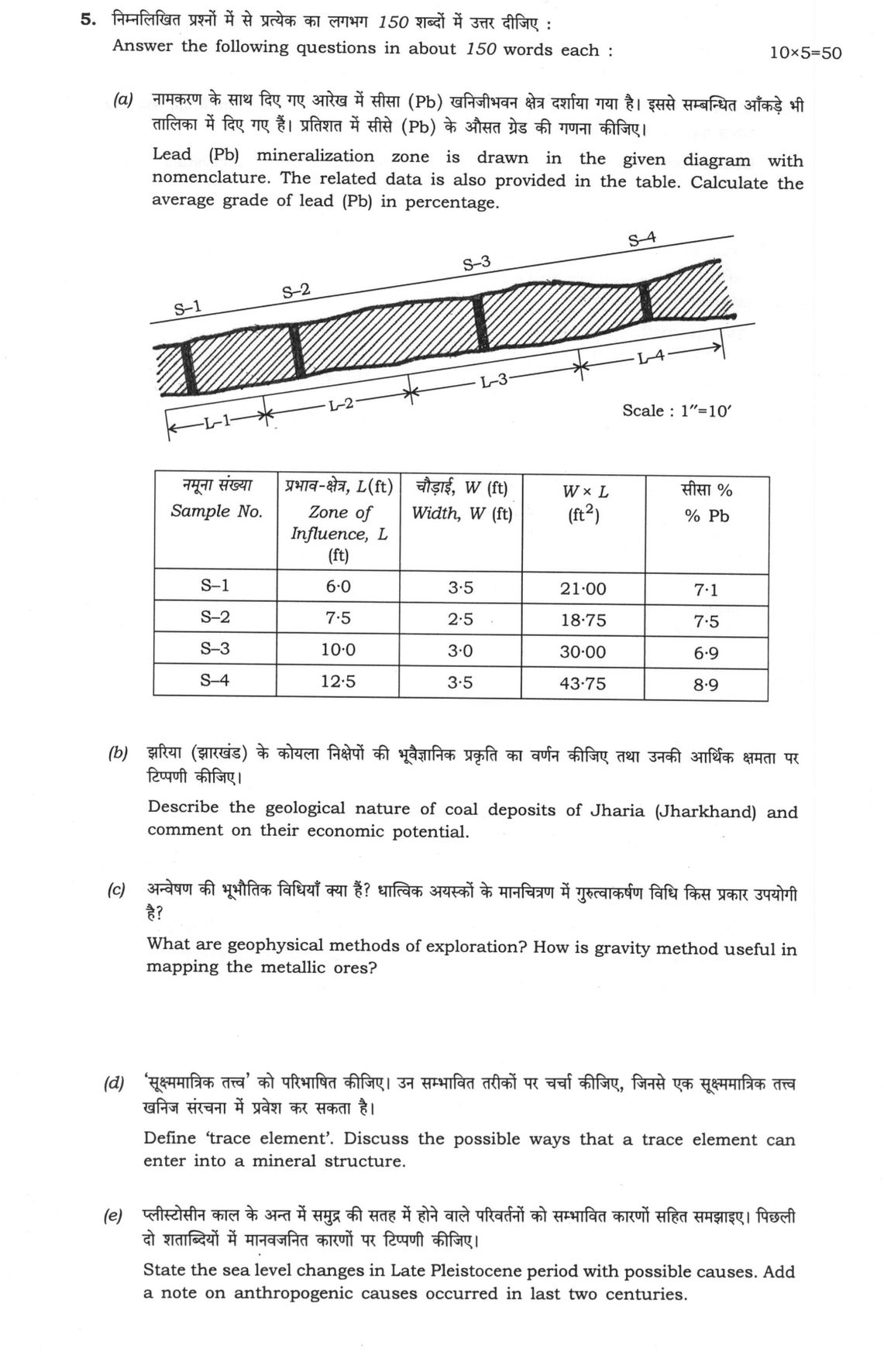
The figure this question refers to, in words
The question paper is a scan and the diagram did not survive as text. This is the figure as read from the original page — every component, value and label — so the question can be worked from the text below.
(a) Sample No. | Zone of Influence, L (ft) | Width, W (ft) | W x L (ft2) | % Pb S-1 | 6.0 | 3.5 | 21.00 | 7.1 S-2 | 7.5 | 2.5 | 18.75 | 7.5 S-3 | 10.0 | 3.0 | 30.00 | 6.9 S-4 | 12.5 | 3.5 | 43.75 | 8.9
What "Calculate" is asking you to do
Apply the standard formula or schedule to data the question has already supplied — a table of readings, cost records, a balance sheet — and produce the number. The method is rarely in doubt; the marks sit in the named intermediate quantities, each of which has to appear as a labelled line.
Structure that answers it
Data as given → formula or standard treatment, named → substitution → each intermediate, labelled → result with units
Where marks are lost
Omitting an intermediate the marking scheme pays for separately, or rounding at an intermediate line so the final figure drifts. In commerce and accountancy, any figure in a statement that no numbered working note supports is treated as unearned.
How this answer will be evaluated
Approach
(a) calculate: given > formula > substitution > result with units > interpretation | (b) describe: define > structure or process in order > labelled diagram > significance | (c) explain: definition/context > points in order > small example > short close | (d) define: precise definition > the distinguishing feature > one example | (e) enumerate: list the items in order > one line each > no commentary Full marks: Precise calculations, specific Indian examples, clear mechanisms, and accurate historical data.
Key points expected
- Sum of W×L areas (113.5 ft²)
- Sum of (Area × %Pb) products
- Final division to get average grade
- Result stated as percentage
- Stratigraphic position (Barakar/Barren Measures)
- Tectonic setting (Raniganj syncline)
- Coal rank (bituminous) and thickness
- Economic potential (reserves/production)
Evaluation rubric
Each sub-part is marked on its own, against the marks and word limit printed on the paper.
- (a) Weighted average grade of Pb using area-weighted method. · 150 words
calculate— given → formula → substitution → result with units → interpretation
Must cover
- Sum of W×L areas (113.5 ft²)
- Sum of (Area × %Pb) products
- Final division to get average grade
- Result stated as percentage
Loses marks
- Using simple arithmetic mean of grades
- Arithmetic errors in multiplication
Earns more
- Explicit formula for weighted average
- Correct arithmetic for each sample
Extra mark
- Mention of area-weighted vs simple average
- (b) Geology of Jharia coal and its economic value. · 150 words
describe— define → structure or process in order → labelled diagram → significance
Must cover
- Stratigraphic position (Barakar/Barren Measures)
- Tectonic setting (Raniganj syncline)
- Coal rank (bituminous) and thickness
- Economic potential (reserves/production)
Loses marks
- Generic coal description without Jharia specifics
- Missing stratigraphic context
Earns more
- Mention of specific seams (e.g., 1, 2, 3)
- Reference to Jharia coalfield area
Extra mark
- Mention of specific mining hazards (fire/flood)
- (c) Geophysical methods and gravity's role in ore mapping. · 150 words
explain— definition/context → points in order → small example → short close
Must cover
- Definition of geophysical methods
- Principle of gravity method (density contrast)
- Application to metallic ores (high density)
- Interpretation of gravity anomalies
Loses marks
- Confusing gravity with magnetic method
- No mention of density contrast
Earns more
- Mention of Bouguer correction
- Example of specific ore (e.g., chromite)
Extra mark
- Comparison with magnetic method
- (d) Definition of trace element and modes of entry. · 150 words
define— precise definition → the distinguishing feature → one example
Must cover
- Definition (<1% by weight)
- Substitution (isomorphous replacement)
- Interstitial inclusion
- Surface adsorption
Loses marks
- Confusing trace with major elements
- Missing mechanism of entry
Earns more
- Example of specific trace element (e.g., REE)
- Mention of ionic radius similarity
Extra mark
- Mention of fluid inclusions
- (e) Late Pleistocene sea level changes and anthropogenic causes. · 150 words
enumerate— list the items in order → one line each → no commentary
Must cover
- Glacial-interglacial cycles (Milankovitch)
- Sea level rise/fall magnitudes
- Anthropogenic causes (CO2, deforestation)
- Recent (20th-21st century) rise
Loses marks
- Ignoring anthropogenic component
- No mention of glacial cycles
Earns more
- Mention of specific glacial periods (e.g., Wisconsin)
- Reference to thermal expansion
Extra mark
- Mention of specific sea level data (e.g., 120m)
Model answer coming soon
Every evaluation on this site is marked against a verified model answer. This question's answer is still being written; evaluation opens the moment it lands.
More from Geology 2021 Paper II
- Q2 (a) Give the classification scheme of silicate minerals on the basis of atomic structure,…
- Q3 (a) Discuss briefly the processes of magma generation in the Earth's interior. How is gra…
- Q4 (a) What is provenance? How can we use clastic quartz, feldspars and lithic grains in pro…
- Q5 Answer the following questions in about 150 words each: (a) Lead (Pb) mineralization zone…
- Q6 (a) Give the modern classification of mineral deposits and explain in brief the residual…
- Q7 (a) State the characteristic features of cosmic abundance of elements. What are the bases…
- Q8 (a) How is unscientific development of catchments situated in mountainous regions respons…