Paper II — Q8
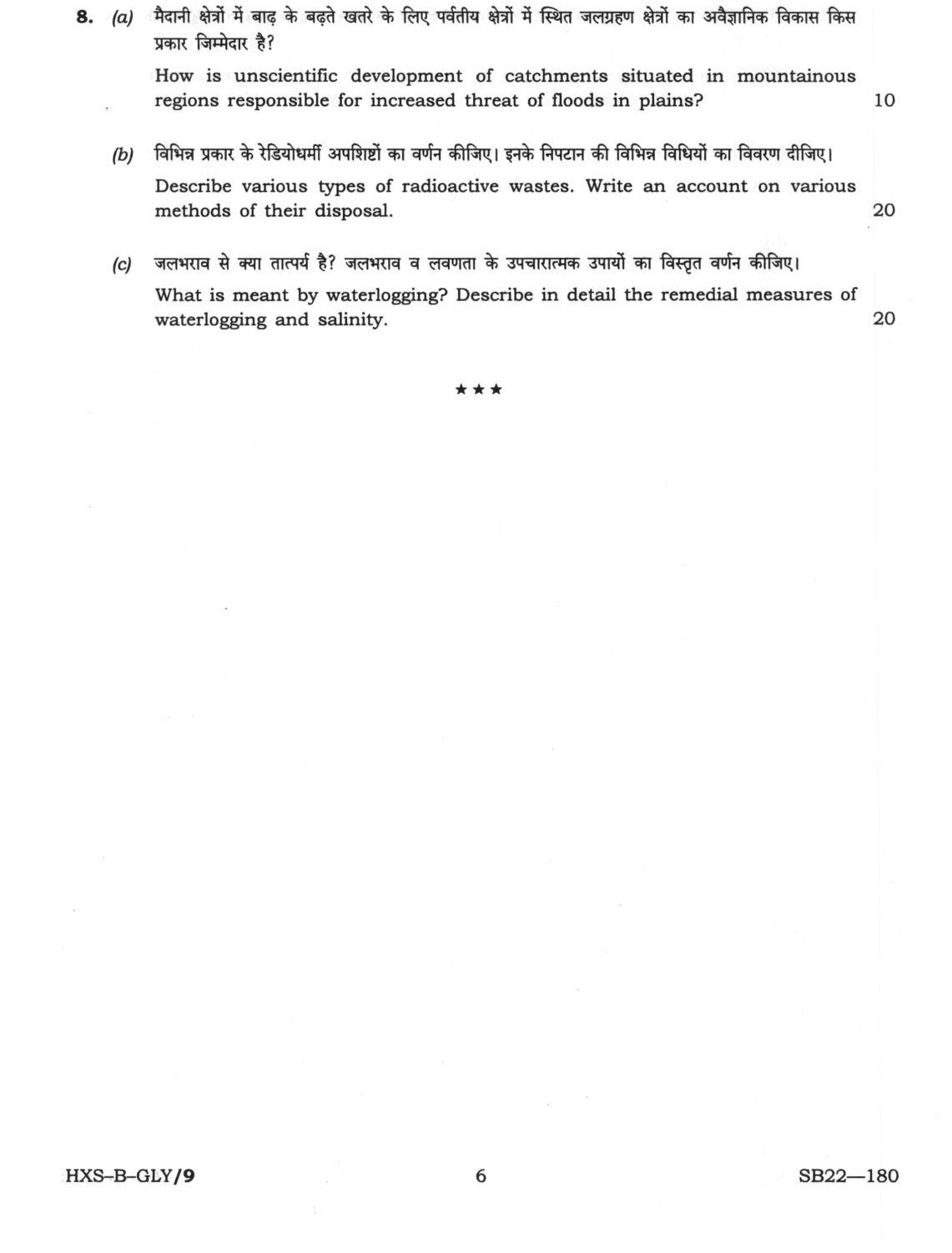
(a) How is unscientific development of catchments situated in mountainous regions responsible for increased threat of floods in…
How is unscientific development of catchments situated in mountainous regions responsible for increased threat of floods in plains? 10 marks
Describe various types of radioactive wastes. Write an account on various methods of their disposal. 20 marks
What is meant by waterlogging? Describe in detail the remedial measures of waterlogging and salinity. 20 marks
हिंदी में प्रश्न पढ़ें
मैदानी क्षेत्रों में बाढ़ के बढ़ते खतरे के लिए पर्वतीय क्षेत्रों में स्थित जलग्रहण क्षेत्रों का अवैज्ञानिक विकास किस प्रकार जिम्मेदार है? (10 अंक)
विभिन्न प्रकार के रेडियोधर्मी अपशिष्टों का वर्णन कीजिए। इनके निपटान की विभिन्न विधियों का विवरण दीजिए। (20 अंक)
जलभराव से क्या तात्पर्य है? जलभराव व लवणता के उपचारात्मक उपायों का विस्तृत वर्णन कीजिए। (20 अंक)
Model answer
Written by UPSC Answer Check against this question's marking rubric, to the expected length. UPSC does not publish answers for Mains — this is one way to score well, not an official key.
Unscientific Development in Mountainous Catchments and Flooding in Plains
Unscientific development in mountainous catchments, particularly in the Himalayas (e.g., Uttarakhand), significantly exacerbates flood hazards in the downstream Indo-Gangetic plains. Deforestation and extensive slope destabilization drastically lower soil infiltration capacity, transforming rainfall into rapid, voluminous surface runoff. Indiscriminate hillside excavation for roads, toe erosion, and poorly engineered agricultural terracing trigger mass wasting and landslides, supplying vast sediment loads to mountain rivers.
As these sediment-laden channels enter the plains, the sudden drop in hydraulic gradient forces rapid deposition. Riverbed aggradation reduces channel cross-sectional area and carrying capacity. Concurrently, encroachment upon floodplains and degradation of natural riparian wetlands strip the basin of its buffering capacity, causing monsoon surges to breach natural levees, trigger river avulsions, and produce severe inundation across the plains.
Radioactive Wastes: Classification and Disposal Methods
Radioactive wastes are categorized according to activity level, heat generation, and radionuclide half-life:
Low-Level Waste (LLW): Contains minimal quantities of short-lived radionuclides originating from hospitals, research laboratories, and industrial cycles (e.g., contaminated protective gear, tools, wiping rags). It emits low radiation and requires no specialized shielding during handling.
Intermediate-Level Waste (ILW): Comprises materials with higher radioactivity, such as chemical sludges, ion-exchange resins, and reactor components. It requires significant radiation shielding (lead or concrete) during handling, though it generates negligible heat.
High-Level Waste (HLW): Characterized by high radioactivity and substantial decay heat, HLW arises from the nuclear fuel cycle. It is distinguished into un-reprocessed spent fuel (containing uranium, plutonium, and actinides) and reprocessed liquid waste containing concentrated fission products.
Disposal Methods: Vitrification: Liquid HLW is chemically immobilized by blending it with molten borosilicate glass matrix at high temperatures, followed by casting into heavy stainless steel canisters for initial cooling. Near-Surface Engineered Facilities: LLW and short-lived ILW are emplaced in concrete-lined vaults, trenches, and rock cavities at shallow depths (e.g., Bhabha Atomic Research Centre facilities), relying on multi-barrier engineering to prevent radionuclide migration. Deep Geological Repositories (DGR): For HLW and spent fuel, disposal involves deep underground excavations (300 to 1,000 meters) within stable, impermeable host formations such as crystalline granite, salt domes, bedded salt, or basalt. The multi-barrier system—incorporating the vitrified matrix, metallic canisters, bentonite clay backfill, and the impermeable host rock—isolates long-lived radioisotopes from the biosphere over geological timescales.
Waterlogging and Salinity: Mechanisms and Remedial Measures
Waterlogging refers to the state where the soil root zone remains saturated above field capacity, creating anaerobic conditions that starve roots of oxygen and curtail crop productivity. It is caused by excessive canal irrigation without adequate conveyance lining, poorly maintained surface drains, high regional water tables, flat topography, and impermeable subsurface claypans. Waterlogging induces secondary salinity: capillary action transports dissolved mineral salts from shallow groundwater to the surface, where intense evaporation leaves crusts of sodium, calcium, and magnesium salts.
Remedial Measures:
Biological Remediation: Biodrainage through the afforestation of high-transpiration, deep-rooted species like Eucalyptus actively lowers the water table. Incorporating salt-tolerant crops (barley, mustard) and green manures (Sesbania) improves soil organic matter, aggregation, and hydraulic conductivity.
Mechanical and Engineering Drainage: Construction of open surface drains rapidly removes storm runoff. Subsurface horizontal drainage, using perforated corrugated PVC or tile pipes wrapped in geotextile envelopes, intercepts and evacuates shallow perched water tables. Vertical drainage via battery tubewell networks pumps excess unconfined groundwater (conjunctive use), lowering the regional water table while supplementing irrigation.
Chemical and Agronomic Remediation: Leaching excess soluble salts by ponding high-quality freshwater flushes them below the active root zone through drainage outlets. For sodic soils, applying chemical amendments such as gypsum (calcium sulphate) or iron pyrites displaces exchangeable sodium cations with calcium, which are subsequently leached out, thereby restoring soil structure and infiltration rates.
Integrated Management
Catchment degradation in upper mountainous watersheds alters regional hydrological cycles and accelerates sedimentation in the plains, which in turn impairs natural surface drainage and raises groundwater tables. Mitigating these connected environmental hazards requires an integrated basin approach, combining upper-catchment slope stabilization with conjunctive water use and subsurface drainage networks across downstream agricultural plains.
What "Describe" is asking you to do
Give a full, ordered account of the thing named — its parts, stages or mechanism — in the sequence in which it actually exists or occurs. Most describe questions come from the science optionals, where the marks sit in correct technical detail and, where the stem says so, a labelled diagram.
Structure that answers it
One-line identification of the subject → the parts or stages in their real order, each with its defining detail → labelled diagram where the subject is structural → closing line on function or significance
Where marks are lost
Loose general prose where the examiner is ticking named parts, correct terminology and their sequence; and in the General Studies papers, turning to evaluation before the description is finished.
How this answer will be evaluated
Approach
(a) explain: definition/context > points in order > small example > short close | (b) describe: define > structure or process in order > labelled diagram > significance | (c) describe: define > structure or process in order > labelled diagram > significance Full marks: Precise causal links, specific technical terms, and Indian examples.
Key points expected
- Deforestation and loss of vegetation cover
- Soil erosion and siltation of river channels
- Increased surface runoff and reduced infiltration
- Sediment transport to plains reducing channel capacity
- Classification: Low, Intermediate, High Level Waste
- Solid vs Liquid waste distinction
- Deep geological disposal for HLW
- Vitrification or solidification for liquid waste
Evaluation rubric
Each sub-part is marked on its own, against the marks and word limit printed on the paper.
- (a) Causal chain linking mountain catchment degradation to plain flooding. 10 marks
explain— definition/context → points in order → small example → short close
Must cover
- Deforestation and loss of vegetation cover
- Soil erosion and siltation of river channels
- Increased surface runoff and reduced infiltration
- Sediment transport to plains reducing channel capacity
Loses marks
- Generic description of floods without catchment link
- Ignoring the 'unscientific development' aspect
Earns more
- Mention of Himalayan catchment instability
- Reference to specific events (e.g., 2013 Uttarakhand)
- Sketch of catchment hydrology
Extra mark
- Specific data on sediment load
- Reference to specific river basins (e.g., Ganga, Brahmaputra)
- (b) Classification of radioactive waste types and detailed disposal methods. 20 marks
describe— define → structure or process in order → labelled diagram → significance
Must cover
- Classification: Low, Intermediate, High Level Waste
- Solid vs Liquid waste distinction
- Deep geological disposal for HLW
- Vitrification or solidification for liquid waste
Loses marks
- Confusing radioactive with chemical waste
- Vague disposal methods (e.g., 'burying it')
Earns more
- Mention of dry cask storage
- Reference to reprocessing (PUREX cycle)
- Discussion of half-life considerations
Extra mark
- Reference to Indian sites (e.g., Trombay, Kalpakkam)
- Mention of specific isotopes (e.g., Cesium-137, Strontium-90)
- (c) Definition of waterlogging and detailed remedial measures for waterlogging and salinity. 20 marks
describe— define → structure or process in order → labelled diagram → significance
Must cover
- Definition: Water table at or above root zone
- Drainage systems (open/closed) for waterlogging
- Leaching for salinity removal
- Subsoil drainage for salinity
Loses marks
- Confusing waterlogging with water scarcity
- Ignoring the salinity component of the question
Earns more
- Mention of tile drainage
- Reference to gypsum application for sodicity
- Discussion of crop selection (salt-tolerant)
Extra mark
- Reference to specific Indian regions (e.g., Indus basin, Deccan)
- Mention of specific drainage structures (e.g., perforated pipes)
Practice this exact question
Write your answer and it is marked point by point against the model answer above — what you covered, what you missed, what you got wrong.
Evaluate my answer →More from Geology 2021 Paper II
- Q5 Answer the following questions in about 150 words each: (a) Lead (Pb) mineralization zone…
- Q6 (a) Give the modern classification of mineral deposits and explain in brief the residual…
- Q7 (a) State the characteristic features of cosmic abundance of elements. What are the bases…
- Q8 (a) How is unscientific development of catchments situated in mountainous regions respons…