Paper II — Q2
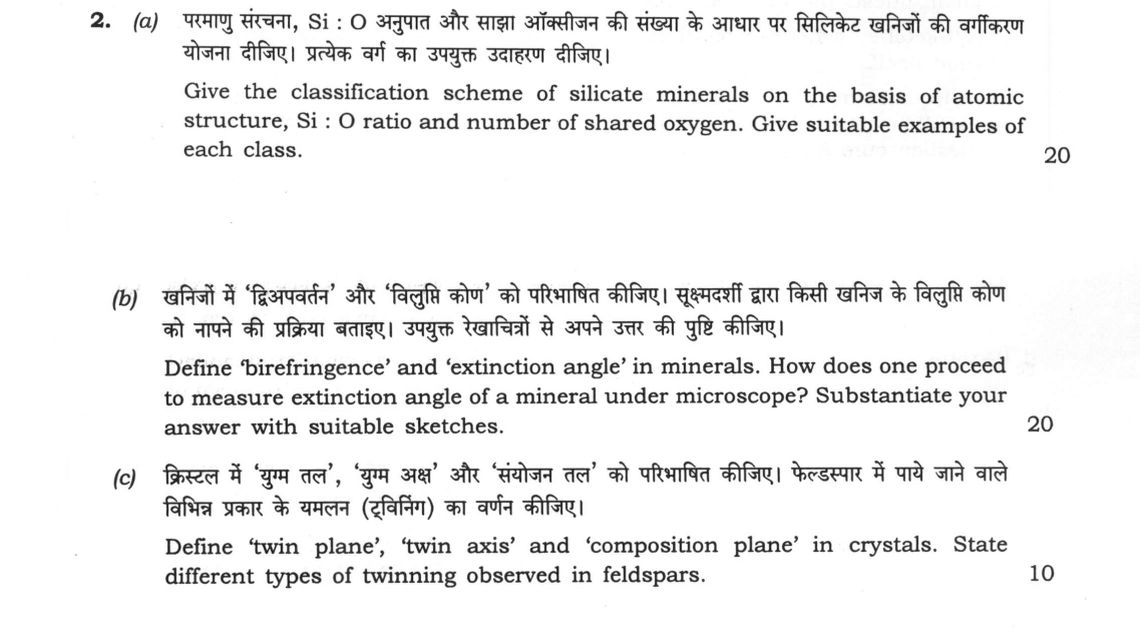
(a) Give the classification scheme of silicate minerals on the basis of atomic structure, Si : O ratio and number of shared…
Give the classification scheme of silicate minerals on the basis of atomic structure, Si : O ratio and number of shared oxygen. Give suitable examples of each class. 20 marks
Define 'birefringence' and 'extinction angle' in minerals. How does one proceed to measure extinction angle of a mineral under microscope? Substantiate your answer with suitable sketches. 20 marks
Define 'twin plane', 'twin axis' and 'composition plane' in crystals. State different types of twinning observed in feldspars. 10 marks
हिंदी में प्रश्न पढ़ें
परमाणु संरचना, Si : O अनुपात और साझा ऑक्सीजन की संख्या के आधार पर सिलिकेट खनिजों की वर्गीकरण योजना दीजिए। प्रत्येक वर्ग का उपयुक्त उदाहरण दीजिए। (20 अंक)
खनिजों में 'द्विवर्तन' और 'विलुप्ति कोण' को परिभाषित कीजिए। सूक्ष्मदर्शी द्वारा किसी खनिज के विलुप्ति कोण को नापने की प्रक्रिया बताइए। उपयुक्त रेखाचित्रों से अपने उत्तर की पुष्टि कीजिए। (20 अंक)
क्रिस्टल में 'युग्म तल', 'युग्म अक्ष' और 'संयोजन तल' को परिभाषित कीजिए। फेल्डस्पार में पाये जाने वाले विभिन्न प्रकार के यमलन (ट्विनिंग) का वर्णन कीजिए। (10 अंक)
Model answer
Written by UPSC Answer Check against this question's marking rubric, to the expected length. UPSC does not publish answers for Mains — this is one way to score well, not an official key.
Part (a) Silicate minerals are classified by the degree of corner-sharing of SiO4 tetrahedra, which fixes the Si:O ratio and the number of shared oxygens. In nesosilicates the tetrahedra are isolated, share no oxygen, have Si:O 1:4 and anion [SiO4]4−; examples are olivine (forsterite–fayalite) and zircon, both common in Indian ultramafics and placers. Sorosilicates consist of pairs sharing one oxygen, Si:O 2:7, [Si2O7]6−; epidote in Indian metamorphic rocks is typical. Cyclosilicates form closed rings in which each tetrahedron shares two oxygens, Si:O 1:3, [Si3O9]6− or [Si6O18]12−; beryl and tourmaline occur in Indian pegmatites. Inosilicates are chains: single-chain pyroxenes share two oxygens, Si:O 1:3, [SiO3]2− (augite, enstatite, diopside); double-chain amphiboles share two to three oxygens, Si:O 4:11, [Si4O11]6− (hornblende, actinolite), common in Deccan and Himalayan ultramafics. Phyllosilicates form sheets in which each tetrahedron shares three basal oxygens, Si:O 2:5, [Si2O5]2− or [Si4O10]4−; micas (muscovite, biotite), talc and chlorite are examples, with major Indian mica belts in Jharkhand, Rajasthan and Odisha. Tectosilicates are three-dimensional frameworks in which all four oxygens are shared, Si:O 1:2, neutral [SiO2]; quartz and feldspars are the principal Indian examples.
Part (b) Birefringence is the difference between the highest and lowest refractive indices: δ = nγ − nα for biaxial minerals, δ = |nε − nω| for uniaxial minerals. Extinction angle is the angle between the vibration direction of the slower ray and a crystal edge or cleavage trace. To measure it, a thin section is examined under crossed polars. A grain with a straight cleavage trace or edge is selected and oriented with the trace parallel to the polarizer (0°). The stage is rotated to extinction; θ1 is recorded. Rotation to the next extinction, about 90° later, gives θ2. The extinction angle is the acute angle between the trace and the slower-ray vibration direction, taken as the smaller of θ1 and 90° − θ1, with readings on both sides averaged. If necessary, a first-order red plate identifies the slower ray at extinction. Sketches: first, a grain with trace parallel to polarizer; second, after rotation by θ, the trace makes θ with the polarizer while the slower-ray vibration direction is parallel to the polarizer and the grain is dark; a third shows the 90° separation of extinction positions and the acute angle.
Part (c) A twin plane is the mirror plane across which one twin individual is the mirror image of the other. A twin axis is the axis about which one individual must be rotated, usually 180°, to coincide with the other. A composition plane is the actual common boundary or contact plane between the two individuals; it may coincide with the twin plane but is conceptually distinct. In feldspars it is often parallel to the twin plane, e.g. (010) in albite twins and (001) in Carlsbad twins. Feldspars show several twin laws. Albite twinning has twin plane (010), twin axis [001] and an angle of about 56°; it is common in plagioclase and microcline. Carlsbad twinning, a pericline law, has twin plane (001), twin axis [010] and an angle of about 90°; it is typical of orthoclase and microcline. Baveno twinning is a microcline variant with twin plane (010), twin axis [001] and about 56°, while Manebach twinning is a microcline pericline variant with twin plane (001), twin axis [010] and about 90°. These laws are recognised in Indian feldspars from Deccan basalts, Himalayan granites and pegmatites by their characteristic lamellae and extinction angles. Thus, the structural, optical and crystallographic features described above provide the standard basis for identifying and classifying silicate minerals.
What "Describe" is asking you to do
Give a full, ordered account of the thing named — its parts, stages or mechanism — in the sequence in which it actually exists or occurs. Most describe questions come from the science optionals, where the marks sit in correct technical detail and, where the stem says so, a labelled diagram.
Structure that answers it
One-line identification of the subject → the parts or stages in their real order, each with its defining detail → labelled diagram where the subject is structural → closing line on function or significance
Where marks are lost
Loose general prose where the examiner is ticking named parts, correct terminology and their sequence; and in the General Studies papers, turning to evaluation before the description is finished.
How this answer will be evaluated
Approach
(a) describe: define > structure or process in order > labelled diagram > significance | (b) define: precise definition > the distinguishing feature > one example | (c) define: precise definition > the distinguishing feature > one example Full marks: Precise definitions, correct Si:O ratios, clear sketches, and named Indian examples.
Key points expected
- Nesosilicates (Island) with Si:O 1:4 and 0 shared O
- Inosilicates (Chain) with Si:O 1:3 and 2 shared O
- Phyllosilicates (Sheet) with Si:O 1:2 and 3 shared O
- Tectosilicates (Framework) with Si:O 1:2 and 4 shared O
- Definition of birefringence (double refraction)
- Definition of extinction angle (angle between extinction and cleavage)
- Procedure: Rotate stage to extinction, measure angle
- Sketches showing polarizer, analyzer, and mineral section
Evaluation rubric
Each sub-part is marked on its own, against the marks and word limit printed on the paper.
- (a) Classification of silicates by structure, Si:O ratio, and shared oxygen with examples. 20 marks
describe— define → structure or process in order → labelled diagram → significance
Must cover
- Nesosilicates (Island) with Si:O 1:4 and 0 shared O
- Inosilicates (Chain) with Si:O 1:3 and 2 shared O
- Phyllosilicates (Sheet) with Si:O 1:2 and 3 shared O
- Tectosilicates (Framework) with Si:O 1:2 and 4 shared O
Loses marks
- Confusing Si:O ratios for chains and sheets
- Missing the 'number of shared oxygen' criterion
- No examples provided for the classes
Earns more
- Cyclosilicates (Ring) with Si:O 1:3 and 2 shared O
- Precise examples: Olivine, Pyroxene, Mica, Quartz
- Sketches of tetrahedral linkage for each class
- Mention of Aluminosilicates (Feldspars) as tectosilicates
Extra mark
- Mention of Indian occurrence (e.g., Mica in Jharkhand)
- Mention of economic importance of specific silicates
- (b) Definitions of birefringence and extinction angle, plus measurement procedure with sketches. 20 marks
define— precise definition → the distinguishing feature → one example
Must cover
- Definition of birefringence (double refraction)
- Definition of extinction angle (angle between extinction and cleavage)
- Procedure: Rotate stage to extinction, measure angle
- Sketches showing polarizer, analyzer, and mineral section
Loses marks
- Missing the measurement procedure
- No sketches provided
- Confusing extinction angle with extinction position
Earns more
- Mention of uniaxial vs biaxial extinction
- Explanation of interference colors
- Use of a goniometer stage for measurement
- Distinction between parallel and oblique extinction
Extra mark
- Mention of specific mineral (e.g., Plagioclase) for example
- Mention of Indian occurrence (e.g., Feldspar in Deccan)
- (c) Definitions of twin plane, twin axis, composition plane, and feldspar twinning types. 10 marks
define— precise definition → the distinguishing feature → one example
Must cover
- Definition of twin plane (composition plane)
- Definition of twin axis (rotation axis)
- Definition of composition plane (interface)
- Types: Carlsbad (Albite) and Baveno (Pericline) twinning
Loses marks
- Confusing twin plane with composition plane
- Missing the types of twinning in feldspars
- No definitions provided
Earns more
- Mention of Polysynthetic twinning (Albite)
- Mention of Man-in-the-moon effect
- Sketch of Carlsbad twin (cross-hatched)
- Mention of Indian occurrence (e.g., Feldspar in Deccan)
Extra mark
- Mention of specific Indian feldspar locality
- Mention of economic importance of feldspar
Practice this exact question
Write your answer and it is marked point by point against the model answer above — what you covered, what you missed, what you got wrong.
Evaluate my answer →More from Geology 2021 Paper II
- Q1 Answer the following questions in about 150 words each: (a) How does one designate mirror…
- Q2 (a) Give the classification scheme of silicate minerals on the basis of atomic structure,…
- Q3 (a) Discuss briefly the processes of magma generation in the Earth's interior. How is gra…
- Q4 (a) What is provenance? How can we use clastic quartz, feldspars and lithic grains in pro…
- Q5 Answer the following questions in about 150 words each: (a) Lead (Pb) mineralization zone…