Paper I — Q1
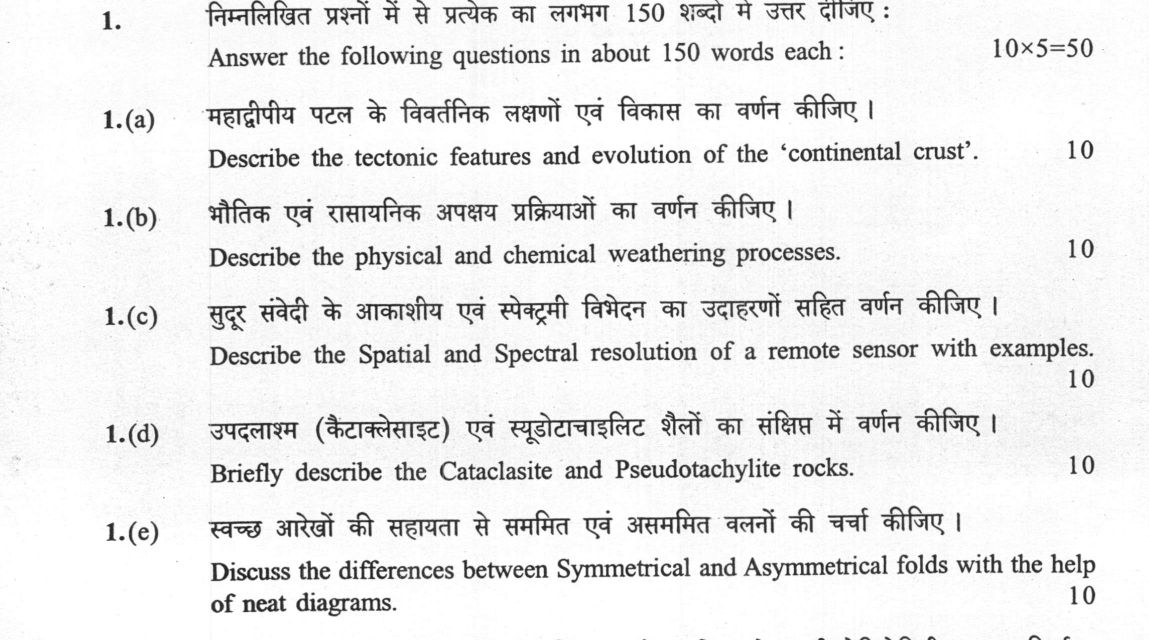
Answer the following questions in about 150 words each: (a) Describe the tectonic features and evolution of the 'continental…
Answer the following questions in about 150 words each: Describe the tectonic features and evolution of the 'continental crust'. 10 marks
Describe the physical and chemical weathering processes. 10 marks
Describe the Spatial and Spectral resolution of a remote sensor with examples. 10 marks
Briefly describe the Cataclasite and Pseudotachylite rocks. 10 marks
Discuss the differences between Symmetrical and Asymmetrical folds with the help of neat diagrams. 10 marks
हिंदी में प्रश्न पढ़ें
निम्नलिखित प्रश्नों में से प्रत्येक का लगभग 150 शब्दों में उत्तर दीजिए : महाद्वीपीय पटल के विवर्तनिक लक्षणों एवं विकास का वर्णन कीजिए । (10 अंक)
भौतिक एवं रासायनिक अपक्षय प्रक्रियाओं का वर्णन कीजिए । (10 अंक)
सुदूर संवेदी के आकाशीय एवं स्पेक्ट्रमी विभेदन का उदाहरणों सहित वर्णन कीजिए । (10 अंक)
उपदलाश्म (कैटाक्लेसाइट) एवं स्यूडोटाचाइलाइट शैलों का संक्षिप्त में वर्णन कीजिए । (10 अंक)
स्वच्छ आरेखों की सहायता से सममित एवं असममित वलनों की चर्चा कीजिए । (10 अंक)
Model answer
Written by UPSC Answer Check against this question's marking rubric, to the 150-word length. UPSC does not publish answers for Mains — this is one way to score well, not an official key.
Continental crust. The continental crust is a thick, buoyant, chemically evolved silicic to intermediate plate that forms the stable foundation of continents. Its tectonic features include cratonic basement, layered upper and lower crust, passive margins, rifts, orogenic belts, and large igneous provinces. Compositionally, it is dominated by granitic and intermediate rocks, with early Archean tonalite–trondhjemite–granodiorite (TTG) suites recording the first major crustal differentiation. This differentiation occurred by partial melting of mafic proto-crust, fractional crystallisation, and underplating, producing a silica-rich upper crust enriched in K, U and Th. Tectonically, its evolution follows Wilson-cycle stages: rifting of a craton, opening of an ocean basin, subduction and arc accretion, continental collision, and final cratonisation. Compared with oceanic crust, continental crust is thicker (30–70 km versus 5–10 km) and less dense (about 2.7 g cm⁻³ versus 3.0 g cm⁻³), which explains its long-term preservation and its resistance to subduction through supercontinent cycles and cratonic stability.
Weathering. Weathering is the in-situ disintegration and decomposition of rocks at or near the Earth’s surface. Physical weathering breaks rock without major chemical change. Exfoliation occurs when outer shells peel from granite inselbergs due to pressure release; frost wedging occurs in Himalayan valleys where water freezes in joints and expands; salt crystallisation occurs in semi-arid and coastal rocks where evaporating brines grow crystals in pores. Chemical weathering alters mineral composition. Hydrolysis converts feldspar in granites or basalts into clay minerals; oxidation changes pyrite to iron oxides, producing red staining; carbonation dissolves limestone in the Satpura and Aravalli regions; hydration adds water to anhydrite, forming gypsum. In India, Deccan basalt weathers to red laterite under humid tropical conditions, while Himalayan slopes show frost wedging and chemical breakdown of quartzite and schist. Together, physical and chemical weathering produce regolith, control soil formation, and supply sediment to rivers, oceans, aquifers and groundwater over time.
Remote-sensor resolution. Spatial resolution is the smallest ground area represented by one pixel, usually expressed in metres. A sensor with 30 m resolution, such as Landsat-8 OLI, records each pixel as a 30 m × 30 m square; Sentinel-2 MSI has 10 m bands, while Cartosat-1 panchromatic imagery reaches about 2.5 m, allowing mapping of individual buildings. Spectral resolution is the ability to distinguish wavelength intervals, measured by the number and width of bands. Multispectral sensors such as Landsat-8 OLI and Sentinel-2 have a limited set of broad bands in visible, red-edge, near-infrared and shortwave-infrared regions, useful for vegetation, water and soil mapping. Hyperspectral sensors, such as AVIRIS or PRISMA, record hundreds of narrow contiguous bands, enabling identification of minerals, crop stress, pollution and urban change. In India, Resourcesat-1 LISS-3 provides multispectral data for agriculture, while hyperspectral missions support mineral exploration. Thus, spatial resolution controls detail, and spectral resolution controls material discrimination.
Cataclasite and pseudotachylite. Cataclasite is a brittle fault rock formed by cataclasis, the progressive fracturing, crushing and comminution of host rock under high differential stress. It consists of angular to sub-angular fragments, clasts and a fine-grained matrix, with little or no melting. Formation is essentially low-temperature relative to melting, and the rock records brittle deformation, grain-size reduction and strain localisation along fault zones. Pseudotachylite, often discussed with pseudotachylyte, is a friction-melt rock generated during rapid seismic slip. Frictional heating raises the fault zone above the melting point of minerals, producing a glassy or fine-grained quenched melt matrix that may contain relict crystals and brecciated clasts. Its seismogenic origin makes it important evidence for earthquake faulting. In India, fault rocks of the Himalayan front and peninsular shear zones show cataclastic and frictional products. Cataclasite records brittle strain, while pseudotachylite records high-temperature frictional melting and rapid cooling in the field during faulting.
Symmetrical and asymmetrical folds. A fold is a bend in rock layers. In neat diagrams, draw folded strata with a hinge line at the crest or trough and an axial plane as a dashed line. A symmetrical fold has limbs dipping at approximately equal angles on either side of a vertical axial plane; the axial plane bisects the interlimb angle, and the hinge line is horizontal. It forms in balanced compressional settings, such as some foreland folds of the Himalaya. An asymmetrical fold has limbs dipping at unequal angles, with one steep limb and one gentle limb; its axial plane is inclined, yet it still bisects the interlimb angle. The hinge line may be inclined or curved. Asymmetrical folds occur in thrust belts, nappe margins and shear zones, for example in the Lesser Himalaya where thrusting produces steep backlimbs. The key difference is the orientation of the axial plane and the relative limb dips and hinge curvature.
What "Describe" is asking you to do
Give a full, ordered account of the thing named — its parts, stages or mechanism — in the sequence in which it actually exists or occurs. Most describe questions come from the science optionals, where the marks sit in correct technical detail and, where the stem says so, a labelled diagram.
Structure that answers it
One-line identification of the subject → the parts or stages in their real order, each with its defining detail → labelled diagram where the subject is structural → closing line on function or significance
Where marks are lost
Loose general prose where the examiner is ticking named parts, correct terminology and their sequence; and in the General Studies papers, turning to evaluation before the description is finished.
How this answer will be evaluated
Approach
Framework: Geology Paper 1: Define > Process > Field/Petrographic Evidence > Indian Example. (a) describe: define > structure or process in order > labelled diagram > significance | (b) describe: define > structure or process in order > labelled diagram > significance | (c) describe: define > structure or process in order > labelled diagram > significance | (d) describe: define > structure or process in order > labelled diagram > significance | (e) discuss: intro > 3-4 dimensions > example > balanced close Full marks: All parts: precise definitions, clear processes, Indian examples, neat diagrams, and economic/stratigraphic links.
Key points expected
- Define continental crust (granitic, 30-70km thick)
- Describe tectonic features (cratons, orogens, rifts)
- Explain evolution (accretion, subduction, isostasy)
- Provide Indian example (Deccan, Himalaya, or Craton)
- Define physical weathering (mechanical breakdown)
- Define chemical weathering (mineral alteration)
- List key processes (e.g., hydration, oxidation)
- Provide Indian example (e.g., laterite formation)
Evaluation rubric
Each sub-part is marked on its own, against the marks and word limit printed on the paper.
- (a) Tectonic features and evolution of continental crust. 10 marks · 150 words
describe— define → structure or process in order → labelled diagram → significance
Must cover
- Define continental crust (granitic, 30-70km thick)
- Describe tectonic features (cratons, orogens, rifts)
- Explain evolution (accretion, subduction, isostasy)
- Provide Indian example (Deccan, Himalaya, or Craton)
Loses marks
- Generic description without Indian example
- Missing tectonic features or evolution stages
Earns more
- Mention specific craton (e.g., Dharwar, Aravalli)
- Reference stratigraphic age (Archean/Proterozoic)
- Link to economic deposits (e.g., gold in cratons)
Extra mark
- Draw a cross-section of crustal layers
- Name a specific Indian formation
- (b) Physical and chemical weathering processes. 10 marks · 150 words
describe— define → structure or process in order → labelled diagram → significance
Must cover
- Define physical weathering (mechanical breakdown)
- Define chemical weathering (mineral alteration)
- List key processes (e.g., hydration, oxidation)
- Provide Indian example (e.g., laterite formation)
Loses marks
- Confusing physical and chemical processes
- Missing Indian example or specific minerals
Earns more
- Mention specific minerals (e.g., feldspar to clay)
- Reference climate zones (tropical vs. arid)
- Link to soil formation (e.g., red soils)
Extra mark
- Draw a diagram of weathering stages
- Name a specific Indian soil type
- (c) Spatial and Spectral resolution of remote sensors. 10 marks · 150 words
describe— define → structure or process in order → labelled diagram → significance
Must cover
- Define spatial resolution (pixel size)
- Define spectral resolution (band width)
- Provide examples (e.g., Landsat, IRS)
- Explain significance in geological mapping
Loses marks
- Confusing spatial and spectral resolution
- Missing examples or geological applications
Earns more
- Mention specific sensors (e.g., LISS, OLI)
- Reference specific bands (e.g., SWIR, NIR)
- Link to geological applications (e.g., mineral mapping)
Extra mark
- Draw a diagram of spectral bands
- Name a specific Indian remote sensing mission
- (d) Cataclasite and Pseudotachylite rocks. 10 marks · 150 words
describe— define → structure or process in order → labelled diagram → significance
Must cover
- Define cataclasite (fractured, non-melted)
- Define pseudotachylite (melted, frictional)
- Describe formation (faulting, frictional heating)
- Provide Indian example (e.g., Himalayan faults)
Loses marks
- Confusing cataclasite and pseudotachylite
- Missing Indian example or formation mechanism
Earns more
- Mention specific textures (e.g., glassy, brecciated)
- Reference specific faults (e.g., Main Central Thrust)
- Link to seismic activity (e.g., earthquake studies)
Extra mark
- Draw a diagram of fault zone with both rocks
- Name a specific Indian fault occurrence
- (e) Differences between Symmetrical and Asymmetrical folds. 10 marks · 150 words
discuss— intro → 3-4 dimensions → example → balanced close
Must cover
- Define symmetrical folds (equal limbs)
- Define asymmetrical folds (unequal limbs)
- Provide neat diagrams of both types
- Explain tectonic causes (e.g., compression, shear)
Loses marks
- Missing diagrams or tectonic causes
- Confusing symmetrical and asymmetrical folds
Earns more
- Mention specific fold types (e.g., chevron, recumbent)
- Reference specific regions (e.g., Himalaya, Aravalli)
- Link to structural geology (e.g., stress analysis)
Extra mark
- Draw a detailed cross-section of both folds
- Name a specific Indian fold occurrence
Practice this exact question
Write your answer and it is marked point by point against the model answer above — what you covered, what you missed, what you got wrong.
Evaluate my answer →More from Geology 2023 Paper I
- Q1 Answer the following questions in about 150 words each: (a) Describe the tectonic feature…
- Q2 (a) Describe the types of radiometric dating techniques used to establish the age of the…
- Q3 (a) Elucidate the types of glacier and illustrate the erosional and depositional features…
- Q4 (a) What is a Shear Zone ? Describe the different Shear Sense indicators. (20 marks) (b)…