Paper I — Q5
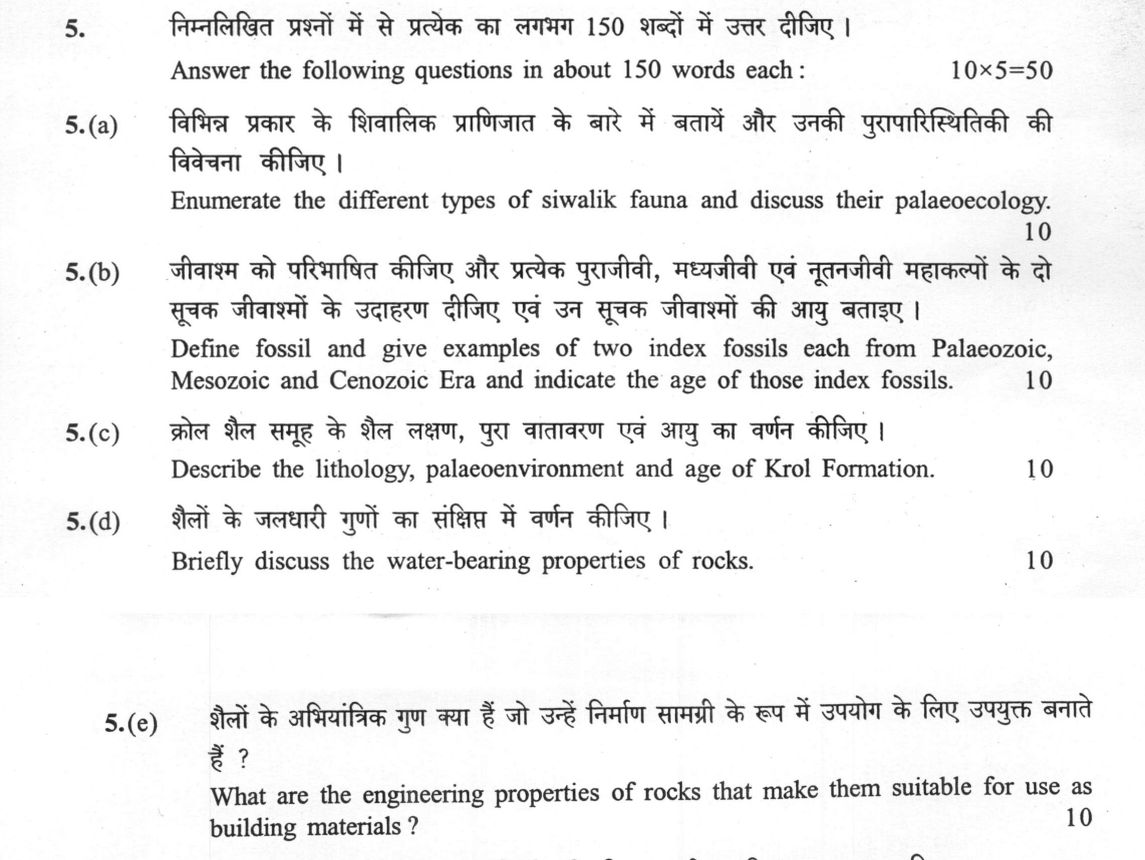
Answer the following questions in about 150 words each: (a) Enumerate the different types of siwalik fauna and discuss their…
Answer the following questions in about 150 words each: Enumerate the different types of siwalik fauna and discuss their palaeoecology. 10 marks
Define fossil and give examples of two index fossils each from Palaeozoic, Mesozoic and Cenozoic Era and indicate the age of those index fossils. 10 marks
Describe the lithology, palaeoenvironment and age of Krol Formation. 10 marks
Briefly discuss the water-bearing properties of rocks. 10 marks
What are the engineering properties of rocks that make them suitable for use as building materials? 10 marks
हिंदी में प्रश्न पढ़ें
निम्नलिखित प्रश्नों में से प्रत्येक का लगभग 150 शब्दों में उत्तर दीजिए । विभिन्न प्रकार के शिवालिक प्राणिजात के बारे में बतायें और उनकी पुरापारिस्थितिकी की विवेचना कीजिए । (10 अंक)
जीवाश्म को परिभाषित कीजिए और प्रत्येक पुराजीवी, मध्यजीवी एवं नूतनजीवी महाकल्पों के दो सूचक जीवाश्मों के उदाहरण दीजिए एवं उन सूचक जीवाश्मों की आयु बताइए । (10 अंक)
क्रोल शैल समूह के शैल लक्षण, पुरा वातावरण एवं आयु का वर्णन कीजिए । (10 अंक)
शैलों के जलधारी गुणों का संक्षिप्त में वर्णन कीजिए । (10 अंक)
शैलों के अभियांत्रिक गुण क्या हैं जो उन्हें निर्माण सामग्री के रूप में उपयोग के लिए उपयुक्त बनाते हैं ? (10 अंक)
Model answer
Written by UPSC Answer Check against this question's marking rubric, to the 150-word length. UPSC does not publish answers for Mains — this is one way to score well, not an official key.
(a) The Siwalik fauna is conventionally divided into Lower, Middle and Upper assemblages, each recording a different stage of Himalayan uplift and climate change. Lower Siwalik fauna, dominated by Giraffidae and Anthracotheriidae, indicates warm, humid, riverine and moist deciduous woodland conditions in the early Miocene foothills, with abundant water sources and dense vegetation. Middle Siwalik fauna, represented by Elephantidae, Suidae and Bovidae, points to drier open woodland and savanna environments in the middle Miocene, as uplift of the Himalaya began to divert monsoon moisture and create piedmont plains. Upper Siwalik fauna, characterised by Equidae and advanced Bovidae, reflects late Miocene to Pliocene grassland-savanna conditions, more seasonal climate, and open landscapes where grazing mammals became dominant. Together these faunal types show a progressive shift from forested river valleys to open grasslands, closely linked to tectonic uplift, drainage reorganisation and aridification of the Indian subcontinent.
(b) A fossil is the preserved remains, impression or trace of a prehistoric organism in rock, formed by natural processes. Index fossils are geographically widespread, short-ranging, abundant and easily identified, so they help correlate strata. In the Palaeozoic Era, Olenellus is an index trilobite of the Cambrian, and Fusulina is a characteristic fusulinid foraminifer of the Permian. In the Mesozoic Era, Phylloceras is an index ammonite of the Jurassic, while Baculites is a typical ammonite of the Cretaceous. In the Cenozoic Era, Nummulites is a large foraminifer diagnostic of the Eocene, and Globorotalia species are useful Pliocene foraminiferal index fossils, with late Pliocene forms such as G. conica used for precise correlation. The Cambrian, Permian, Jurassic, Cretaceous, Eocene and Pliocene ages thus provide a chronostratigraphic framework for the sedimentary record. These examples span the major eras and illustrate how microfossils and macrofossils together underpin biostratigraphy in regional geological mapping.
(c) The Krol Formation is a Precambrian-Cambrian boundary sequence in the Lesser Himalaya. Its lithology includes purple and green shales, flaggy sandstones, stromatolitic dolomites and pink limestones, with distinctive Pipe Rock structures. These rocks indicate a shallow marine shelf to lagoonal environment, where low-energy conditions allowed algal mat growth, carbonate precipitation and periodic sedimentation of fine clastics. The stromatolitic dolomites and pink limestones suggest algal-dominated carbonate production in restricted shallow waters. The age is Terminal Proterozoic or Ediacaran, close to the Precambrian-Cambrian boundary; it does not extend into the basal Early Cambrian, which is represented by the overlying Tal Formation. Thus the Krol Formation is important for recording the transition from Proterozoic to Cambrian time and for preserving stromatolites and other evidence of early algal communities in a shallow marine setting. It also helps constrain the timing of the Precambrian-Cambrian transition in the Lesser Himalaya.
(d) The water-bearing properties of rocks depend on porosity, permeability, saturation and confinement. Porosity is the void space in a rock; primary porosity occurs between grains in sandstones and limestones, while secondary porosity develops in vugs, fractures and weathered zones. Permeability is the ability of a rock to transmit water; intrinsic permeability is a property of the pore network, whereas hydraulic conductivity also depends on the fluid. Specific yield is the proportion of water that drains from a saturated rock under gravity, while specific retention is the water held by capillary forces. Rocks with high porosity and high permeability, such as well-sorted sandstones or fractured limestones, are good aquifers. In India, weathered and fractured Deccan Trap basalts commonly form unconfined aquifers, whereas Ganga basin sandstones, overlain by low-permeability clays, can form confined aquifers. Thus the availability of groundwater is controlled not only by void space but also by connectivity, confinement and recharge conditions.
(e) Rocks are suitable as building materials when their engineering properties match the structural and environmental demands. The main properties are unconfined compressive strength, which must be adequate for the intended load; specific gravity, which indicates density and stability; water absorption, which should be low, often less than 1% for exposed or wet conditions; durability, assessed by tests such as the SLA or Standard Langle weathering test; and hardness, which controls resistance to abrasion and wear. Other useful properties include low cleavage, uniform texture, workability and resistance to chemical weathering. In India, Makrana marble is valued for high durability, low absorption and good finish; Kota stone is used for flooring because of its fine grain and polishability; Chunar sandstone and Agra red sandstone are used where moderate strength, workability and aesthetic qualities are sufficient. Thus suitability depends on a balance of strength, durability, low absorption and workability rather than on a single high-strength value.
What "Enumerate" is asking you to do
Produce the complete set of items asked for, countable and correctly named. The examiner marks against a checklist, so a missing item costs and an elaborated one gains nothing — where discussion is wanted the stem asks for it as a separate sub-part.
Structure that answers it
One line naming the basis on which the set is drawn → items numbered, each in a phrase or a single line → the discussion sub-part taken up separately, after the list is complete
Where marks are lost
Treating it as an essay. Six items named in six lines score better than three items explained at length.
How this answer will be evaluated
Approach
Framework: Geology Paper 1: Define > Process > Field/Petrographic Evidence > Indian Example. (a) enumerate: list the items in order > one line each > no commentary | (b) define: precise definition > the distinguishing feature > one example | (c) describe: define > structure or process in order > labelled diagram > significance | (d) discuss: intro > 3-4 dimensions > example > balanced close | (e) explain: definition/context > points in order > small example > short close Full marks: Precise definitions, specific Indian examples, clear stratigraphic context, and accurate technical terminology.
Key points expected
- List distinct Siwalik fauna types (e.g., mammals, birds)
- Discuss palaeoecology of each type
- Link fauna to specific Siwalik formations (e.g., Baragwanth)
- Mention stratigraphic age (Miocene-Pliocene)
- Precise definition of fossil
- Two index fossils for Palaeozoic Era
- Two index fossils for Mesozoic Era
- Two index fossils for Cenozoic Era
Evaluation rubric
Each sub-part is marked on its own, against the marks and word limit printed on the paper.
- (a) List Siwalik fauna types and discuss their palaeoecology. 10 marks · 150 words
enumerate— list the items in order → one line each → no commentary
Must cover
- List distinct Siwalik fauna types (e.g., mammals, birds)
- Discuss palaeoecology of each type
- Link fauna to specific Siwalik formations (e.g., Baragwanth)
- Mention stratigraphic age (Miocene-Pliocene)
Loses marks
- Generic description without specific Siwalik context
- Missing palaeoecological discussion
Earns more
- Name specific genera (e.g., *Dinofelis*, *Bos*)
- Describe climatic shifts (humid to arid)
- Mention specific Indian localities (e.g., Jammu, Haryana)
Extra mark
- Sketch of a representative Siwalik fossil
- (b) Define fossil and give two index fossils each from Palaeozoic, Mesozoic, Cenozoic with ages. 10 marks · 150 words
define— precise definition → the distinguishing feature → one example
Must cover
- Precise definition of fossil
- Two index fossils for Palaeozoic Era
- Two index fossils for Mesozoic Era
- Two index fossils for Cenozoic Era
Loses marks
- Missing fossils for any era
- No age indication for fossils
Earns more
- Indicate specific age for each fossil
- Mention why they are index fossils (wide distribution, short range)
Extra mark
- Mention specific Indian occurrences of these fossils
- (c) Describe lithology, palaeoenvironment, and age of Krol Formation. 10 marks · 150 words
describe— define → structure or process in order → labelled diagram → significance
Must cover
- Describe lithology of Krol Formation
- Describe palaeoenvironment of Krol Formation
- State age of Krol Formation
- Mention specific rock types (e.g., quartzite, shale)
Loses marks
- Generic description without specific Krol Formation details
- Missing age or palaeoenvironment
Earns more
- Link lithology to depositional environment
- Mention specific Indian localities (e.g., Jammu, Kashmir)
Extra mark
- Sketch of Krol Formation stratigraphy
- (d) Briefly discuss water-bearing properties of rocks. 10 marks · 150 words
discuss— intro → 3-4 dimensions → example → balanced close
Must cover
- Define water-bearing properties (porosity, permeability)
- Discuss factors affecting water-bearing capacity
- Mention specific rock types (e.g., sandstone, limestone)
- Link properties to groundwater occurrence
Loses marks
- Generic description without specific rock examples
- Missing link to groundwater
Earns more
- Mention specific Indian aquifers (e.g., Deccan Traps)
- Discuss impact of fractures and joints
Extra mark
- Diagram showing porosity and permeability
- (e) Explain engineering properties of rocks suitable for building materials. 10 marks · 150 words
explain— definition/context → points in order → small example → short close
Must cover
- List key engineering properties (e.g., strength, durability)
- Explain why these properties are important for building
- Mention specific rock types (e.g., granite, basalt)
- Link properties to specific building applications
Loses marks
- Generic description without specific rock examples
- Missing link to building applications
Earns more
- Mention specific Indian building stones (e.g., Chunar sandstone)
- Discuss weathering resistance
Extra mark
- Table comparing engineering properties of different rocks
Practice this exact question
Write your answer and it is marked point by point against the model answer above — what you covered, what you missed, what you got wrong.
Evaluate my answer →More from Geology 2023 Paper I
- Q2 (a) Describe the types of radiometric dating techniques used to establish the age of the…
- Q3 (a) Elucidate the types of glacier and illustrate the erosional and depositional features…
- Q4 (a) What is a Shear Zone ? Describe the different Shear Sense indicators. (20 marks) (b)…
- Q5 Answer the following questions in about 150 words each: (a) Enumerate the different types…
- Q6 (a) Elucidate an evolutionary trend of Equidae with Indian occurrence. (20 marks) (b) Dis…
- Q7 (a) Describe the stratigraphic sequence of Dharwar Supergroup and add a note on its econo…
- Q8 (a) Discuss briefly how do chemical, physical and bacteriological properties determine th…