Paper I — Q7
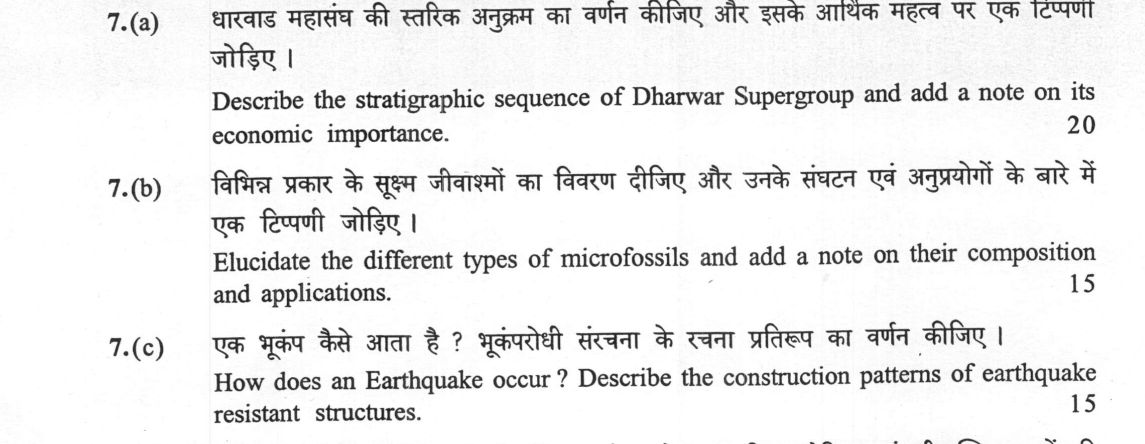
(a) Describe the stratigraphic sequence of Dharwar Supergroup and add a note on its economic importance. (20 marks) (b) Elucidate…
Describe the stratigraphic sequence of Dharwar Supergroup and add a note on its economic importance. 20 marks
Elucidate the different types of microfossils and add a note on their composition and applications. 15 marks
How does an Earthquake occur? Describe the construction patterns of earthquake resistant structures. 15 marks
हिंदी में प्रश्न पढ़ें
धारवाड़ महासंघ की स्तरिक अनुक्रम का वर्णन कीजिए और इसके आर्थिक महत्व पर एक टिप्पणी जोड़िए । (20 अंक)
विभिन्न प्रकार के सूक्ष्म जीवाश्मों का विवरण दीजिए और उनके संघटन एवं अनुप्रयोगों के बारे में एक टिप्पणी जोड़िए । (15 अंक)
एक भूकंप कैसे आता है ? भूकंपरोधी संरचना के रचना प्रतिरूप का वर्णन कीजिए । (15 अंक)
Model answer
Written by UPSC Answer Check against this question's marking rubric, to the expected length. UPSC does not publish answers for Mains — this is one way to score well, not an official key.
Stratigraphic Sequence and Economic Importance of Dharwar Supergroup
The Dharwar Supergroup of the southern Indian Shield represents a classic Archaean-Proterozoic granite-greenstone terrain resting unconformably on the older Peninsular Gneissic Complex (PGC).
Stratigraphically, the sequence is divided into an older, high-grade basement complex and the Dharwar Supergroup proper. The lowermost unit, the Sargur Group (ca. 3.3–3.0 Ga), consists of narrow belts and enclaves of high-grade schists, amphibolites, kyanite-sillimanite pelitic schists, banded iron formations, and ultramafic complexes metamorphosed to upper amphibolite-to-granulite facies.
Unconformably overlying the PGC and Sargur enclaves is the Dharwar Supergroup (ca. 2.9–2.6 Ga), which is subdivided into two successive groups. The lower Bababudan Group is characterized by basal oligomictic quartz-pebble conglomerates, thick successions of amygdaloidal metabasalts and cross-bedded quartzites, culminating in extensive Banded Iron Formations (BIFs), metamorphosed under greenschist-to-amphibolite facies. The conformably-to-unconformably overlying Chitradurga Group comprises polymictic conglomerates (such as the Talya conglomerate), greywackes, phyllites, dolomitic limestones, banded manganese and iron formations, and felsic-to-mafic volcanics developed under greenschist facies conditions.
Economically, the Dharwar Supergroup serves as the primary metallogenic cratonic nucleus of peninsular India. It hosts epigenetic, shear-zone-controlled auriferous quartz lodes at Kolar and Hutti. The massive BIF units of the Bababudan, Kudremukh, and Sandur belts supply superior-grade haematite and magnetite iron ores. Additionally, the Chitradurga and Shimoga belts contain economic bedded manganese ores and stratiform copper deposits (Ingaldhal), along with premium granitic and charnockitic dimension stones.
Microfossils: Types, Composition, and Applications
Microfossils are microscopic skeletal remains and organic organic-walled entities classified broadly by their wall and test mineralogy.
Calcareous microfossils possess shells of calcite or aragonite, dominated by Foraminifera (planktic and benthic protists) and Coccolithophores (calcareous nannofossils). Siliceous microfossils secrete tests of amorphous opaline silica, principally represented by planktic Radiolaria and Diatoms. Phosphatic microfossils consist of calcium phosphate (carbonate-apatite), exemplified by conodont elements. Organic-walled microfossils (Palynomorphs) comprise chemically resistant sporopollenin and dinosporin structures, including Precambrian-Phanerozoic Acritarchs, dinoflagellate cysts, and terrestrial spores and pollen grains.
Microfossils serve as fundamental tools in geosciences. They provide refined biostratigraphic zonation and high-resolution inter-basinal correlation across the Phanerozoic. In hydrocarbon exploration, the Thermal Alteration Index (TAI) of palynomorphs and the Conodont Alteration Index (CAI) evaluate source rock thermal maturity and kerogen quality. Furthermore, stable carbon and oxygen isotopic ratios in foraminiferal tests act as quantitative paleoclimatic proxies and paleoceanographic markers for ocean temperature, paleosalinity, upwelling, and ice-volume shifts, while also enabling the precise demarcation of Phanerozoic systemic boundaries.
Earthquake Genesis and Resistant Structural Patterns
Earthquakes originate primarily through Harry Fielding Reid’s Elastic Rebound Theory. Tectonic stresses accumulate along locked fault planes until the shear stress exceeds the frictional strength of the rock mass, triggering brittle rupture. The stored elastic strain energy is released abruptly as seismic waves propagating outward from the subsurface focus (hypocentre), with maximum initial surface disturbance occurring at the epicentre directly above. Geologically, these events manifest along active plate boundaries, such as the Indo-Eurasian convergent zone driving Himalayan seismicity, as well as along reactivated paleosutures and rift basins causing peninsular intraplate events (e.g., Koyna, Bhuj).
Earthquake-resistant construction incorporates specialized structural engineering measures alongside traditional architectural designs to absorb and dissipate seismic energy.
Modern engineering systems implement base isolation using elastomeric rubber bearings to decouple the superstructure from horizontal ground vibrations. Reinforced concrete shear walls provide lateral stiffness, ductile moment-resisting frames prevent brittle failure, and tuned mass dampers mitigate resonant oscillations in tall edifices. In India, design compliance is governed by Bureau of Indian Standards codes, notably IS 1893 (earthquake-resistant design criteria) and IS 4326 (construction guidelines). Vernacular traditions also embody effective seismic resistance, as seen in the flexible, timber-laced masonry of Kashmiri Dhajji Dewari and Taq systems, as well as the circular, lateral-shear-resistant Bhunga dwellings with conical, hipped roofs in Kutch, Gujarat.
What "Describe" is asking you to do
Give a full, ordered account of the thing named — its parts, stages or mechanism — in the sequence in which it actually exists or occurs. Most describe questions come from the science optionals, where the marks sit in correct technical detail and, where the stem says so, a labelled diagram.
Structure that answers it
One-line identification of the subject → the parts or stages in their real order, each with its defining detail → labelled diagram where the subject is structural → closing line on function or significance
Where marks are lost
Loose general prose where the examiner is ticking named parts, correct terminology and their sequence; and in the General Studies papers, turning to evaluation before the description is finished.
How this answer will be evaluated
Approach
(a) describe: define > structure or process in order > labelled diagram > significance | (b) explain: definition/context > points in order > small example > short close | (c) explain: definition/context > points in order > small example > short close Full marks: Comprehensive, specific, and well-structured answers with diagrams and Indian examples.
Key points expected
- Define Dharwar Supergroup and its age (Archean/Proterozoic).
- List formations in order (e.g., Bhima, Kolar, Chitrapur).
- Describe lithology of each formation (e.g., BIF, schists).
- Note economic importance (e.g., iron, gold, manganese).
- Define microfossils and their size range.
- List different types (e.g., foraminifera, diatoms, radiolarians).
- Describe composition (e.g., calcite, silica, chitin).
- Note applications (e.g., biostratigraphy, paleo-environment).
Evaluation rubric
Each sub-part is marked on its own, against the marks and word limit printed on the paper.
- (a) Stratigraphic sequence of Dharwar Supergroup and its economic importance. 20 marks
describe— define → structure or process in order → labelled diagram → significance
Must cover
- Define Dharwar Supergroup and its age (Archean/Proterozoic).
- List formations in order (e.g., Bhima, Kolar, Chitrapur).
- Describe lithology of each formation (e.g., BIF, schists).
- Note economic importance (e.g., iron, gold, manganese).
Loses marks
- Generic description without specific formation names.
- Missing stratigraphic order (e.g., listing formations randomly).
- No mention of economic importance.
Earns more
- Mention specific Indian craton (e.g., Eastern Dharwar Craton).
- Draw a stratigraphic column or section.
- Link specific minerals to specific formations.
- Mention tectonic setting (e.g., greenstone belts).
Extra mark
- Name specific mines (e.g., Bellary-Hospet for iron).
- Mention specific economic minerals (e.g., chromite, nickel).
- (b) Types of microfossils, their composition, and applications. 15 marks
explain— definition/context → points in order → small example → short close
Must cover
- Define microfossils and their size range.
- List different types (e.g., foraminifera, diatoms, radiolarians).
- Describe composition (e.g., calcite, silica, chitin).
- Note applications (e.g., biostratigraphy, paleo-environment).
Loses marks
- Generic description without specific types.
- Missing composition details.
- No mention of applications.
Earns more
- Draw sketches of different microfossil types.
- Mention specific applications (e.g., oil exploration).
- Link composition to preservation potential.
- Mention specific Indian occurrences (e.g., diatoms in Deccan).
Extra mark
- Name specific microfossil species (e.g., Globigerina).
- Mention specific paleo-environmental indicators (e.g., salinity).
- (c) Mechanism of earthquake occurrence and construction patterns of resistant structures. 15 marks
explain— definition/context → points in order → small example → short close
Must cover
- Define earthquake and its cause (e.g., elastic rebound).
- Describe the process of earthquake occurrence (e.g., faulting).
- List construction patterns for earthquake resistance (e.g., base isolation).
- Explain how these patterns work (e.g., energy dissipation).
Loses marks
- Generic description without specific mechanisms.
- Missing construction patterns.
- No link between mechanism and resistance.
Earns more
- Draw a diagram of faulting or seismic waves.
- Mention specific construction techniques (e.g., shear walls).
- Link construction to specific seismic zones (e.g., India).
- Mention specific building codes (e.g., IS 1893).
Extra mark
- Name specific earthquake-resistant buildings (e.g., in India).
- Mention specific seismic parameters (e.g., Richter scale).
Practice this exact question
Write your answer and it is marked point by point against the model answer above — what you covered, what you missed, what you got wrong.
Evaluate my answer →More from Geology 2023 Paper I
- Q4 (a) What is a Shear Zone ? Describe the different Shear Sense indicators. (20 marks) (b)…
- Q5 Answer the following questions in about 150 words each: (a) Enumerate the different types…
- Q6 (a) Elucidate an evolutionary trend of Equidae with Indian occurrence. (20 marks) (b) Dis…
- Q7 (a) Describe the stratigraphic sequence of Dharwar Supergroup and add a note on its econo…
- Q8 (a) Discuss briefly how do chemical, physical and bacteriological properties determine th…