Paper I — Q6
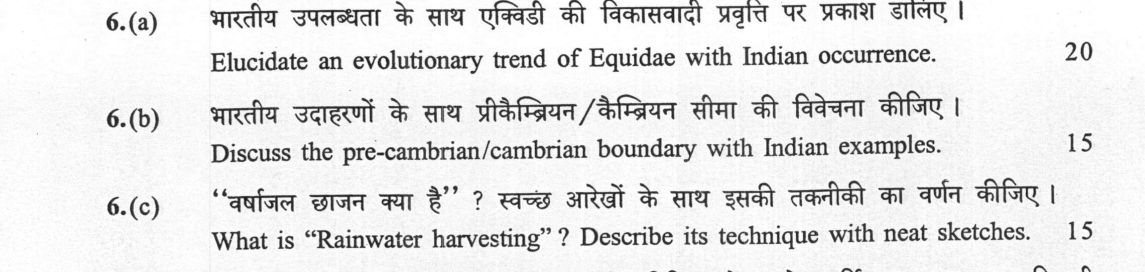
(a) Elucidate an evolutionary trend of Equidae with Indian occurrence. (20 marks) (b) Discuss the pre-cambrian/cambrian boundary…
Elucidate an evolutionary trend of Equidae with Indian occurrence. 20 marks
Discuss the pre-cambrian/cambrian boundary with Indian examples. 15 marks
What is "Rainwater harvesting"? Describe its technique with neat sketches. 15 marks
हिंदी में प्रश्न पढ़ें
भारतीय उपलब्धता के साथ एक्विडी की विकासवादी प्रवृति पर प्रकाश डालिए । (20 अंक)
भारतीय उदाहरणों के साथ प्रीकैम्ब्रियन/कैम्ब्रियन सीमा की विवेचना कीजिए । (15 अंक)
"वर्षाजल छाजन क्या है" ? स्वच्छ आरेखों के साथ इसकी तकनीकी का वर्णन कीजिए । (15 अंक)
Model answer
Written by UPSC Answer Check against this question's marking rubric, to the expected length. UPSC does not publish answers for Mains — this is one way to score well, not an official key.
Equidae evolution and Indian record. Equidae provide a clear evolutionary trend from small, multi-toed, low-crowned browsers to large, single-toed, high-crowned grazers. In the Eocene, Eohippus/Hyracotherium had four toes on the forefeet, three on the hindfeet, short limbs, and brachydont teeth. Through the Oligocene and Miocene, forms such as Mesohippus, Merychippus, Hipparion and later Equus show reduction of lateral digits from four to one, elongation of limb bones, increased body size, and development of hypsodont teeth with enamel folding and cementum deposition, adapted to abrasive grasses. In India, the equid record is essentially Siwalik, spanning the Middle Miocene to Early Pleistocene in the Himalayan Foreland Basin. The basin received coarse sediments from the rising Himalaya, preserving equid teeth, jaws and limb bones in sandstones and conglomerates. Within the broader Murree–Dharmapuri–Siwalik succession, equids are not known from the Murree Group but occur in Siwalik formations. Indian Siwalik occurrences include intermediate, hypsodont Hipparion and Sivalhippus; Equus sivalensis from Haritalyangar and upper Siwalik deposits, with Nagri and Dhok Pathan formations as reference sections, shows the later single-toed, larger, more hypsodont stage. This sequence reflects Miocene–Pleistocene grassland expansion, aridification, and increasing selective pressure for efficient grazing and locomotion.
Pre-Cambrian/Cambrian boundary. The Pre-Cambrian/Cambrian boundary marks the end of the Ediacaran and base of the Cambrian, defined by the first appearance of Treptichnus pedum at Fortune Head, Newfoundland, the GSSP. Meishan, China, is the Permian–Triassic GSSP and is not used for this boundary. It is a global chronostratigraphic line, not a single lithology, and in India it is identified by biostratigraphy and chemostratigraphy. The transition is supported by small shelly fossils, early trilobites, and trace fossils; phosphatized Ediacaran embryos from the Doushantuo Formation, Weng'an, Guizhou, illustrate late Ediacaran complex life but are not a boundary criterion. In India, the Krol–Tal transition in the Lesser Himalaya records the Ediacaran–Cambrian boundary with trace fossils and small shelly faunas. The Bhander Group of the Vindhyan and the Cuddapah Supergroup provide Proterozoic to Cambrian reference successions, where trace-fossil assemblages and carbon-isotope excursions help bracket, correlate, and constrain the sedimentary environments of the transition. Carbon-isotope excursions are particularly useful where faunas are sparse.
Rainwater harvesting. Rainwater harvesting is the interception, collection, and storage of rainwater on the surface or in the subsurface to augment groundwater recharge and reduce runoff. Hydrogeologically, it increases infiltration, raises the water table, and reduces soil erosion. Techniques include rooftop harvesting with recharge pits, check dams or gabions in ephemeral streams, percolation tanks, and subsurface dykes. Rooftop harvesting is especially useful in urban areas, check dams in arid and semi-arid regions, percolation tanks in permeable terrains, and subsurface dykes in shallow aquifers. A neat sketch of rooftop harvesting would show the roof surface, gutter, pipe, filter, and a recharge pit filled with gravel and sand, with arrows for runoff, percolation into the aquifer, and overflow. A check-dam sketch would show an ephemeral stream, a gabion or check dam across the slope, ponded water, infiltration, and downstream sediment trapping. A percolation-tank sketch would show a tank on permeable ground with inlet, filter, spillway, and seepage into the underlying strata. Indian implementation includes mandatory rooftop rainwater harvesting under the Tamil Nadu Buildings (Construction and Maintenance) Act, 1995, traditional kunds and tankas in Rajasthan, and check dams in Gujarat. These structures must be sited after soil, slope and aquifer studies.
Geologically, these themes are linked: fossil successions reveal past environments, boundary stratigraphy anchors time, and aquifer geology guides water conservation. A way forward is to integrate Siwalik-type palaeontological data, Cambrian boundary correlations, and local hydrogeology in resource management, so that groundwater recharge and conservation are planned with scientific certainty. Such integration supports sustainable groundwater use, palaeoclimate reconstruction, and evidence-based conservation policy.
What "Elucidate" is asking you to do
Make a stated proposition plain and then prove it with instances. Elucidate stems almost always carry a claim or a named concept, and very often the words “with examples” or “with suitable diagrams” — the illustration is part of the directive, not decoration.
Structure that answers it
Plain-language statement of what the proposition means → the part that is obscure, resolved → first illustration → second illustration → why the proposition holds
Where marks are lost
Adding terminology; elucidate rewards removing it. The commoner loss is a clean explanation with no example, when the stem asked for examples.
How this answer will be evaluated
Approach
Framework: Geology Paper 1: Define > Process > Field/Petrographic Evidence > Indian Example. (a) explain: definition/context > points in order > small example > short close | (b) discuss: intro > 3-4 dimensions > example > balanced close | (c) describe: define > structure or process in order > labelled diagram > significance Full marks: Comprehensive, specific, and well-structured with all required elements and Indian examples.
Key points expected
- Define Equidae and evolutionary trend
- Describe morphological changes (e.g., limb, teeth)
- Name specific Indian Equidae species
- State stratigraphic age of Indian occurrence
- Define Pre-Cambrian/Cambrian boundary
- Describe key geological changes at boundary
- Name specific Indian examples of boundary
- State stratigraphic age of Indian examples
Evaluation rubric
Each sub-part is marked on its own, against the marks and word limit printed on the paper.
- (a) Evolutionary trend of Equidae with specific Indian occurrences. 20 marks
explain— definition/context → points in order → small example → short close
Must cover
- Define Equidae and evolutionary trend
- Describe morphological changes (e.g., limb, teeth)
- Name specific Indian Equidae species
- State stratigraphic age of Indian occurrence
Loses marks
- Generic description without Indian example
- Missing stratigraphic age
- No mention of specific morphological changes
Earns more
- Mention specific Indian formation (e.g., Narmada)
- Link evolution to environmental changes
- Include a labelled sketch of limb/teeth
Extra mark
- Name specific researcher or discovery site
- Detailed comparison of specific species
- (b) Pre-Cambrian/Cambrian boundary with Indian examples. 15 marks
discuss— intro → 3-4 dimensions → example → balanced close
Must cover
- Define Pre-Cambrian/Cambrian boundary
- Describe key geological changes at boundary
- Name specific Indian examples of boundary
- State stratigraphic age of Indian examples
Loses marks
- Generic description without Indian example
- Missing stratigraphic age
- No mention of specific geological changes
Earns more
- Mention specific Indian craton or basin
- Describe mineral composition or texture
- Include a section or sketch
Extra mark
- Name specific committee or classification
- Detailed comparison of specific formations
- (c) Rainwater harvesting technique with neat sketches. 15 marks
describe— define → structure or process in order → labelled diagram → significance
Must cover
- Define rainwater harvesting
- Describe the technique in order
- Include neat sketches of the technique
- State significance of rainwater harvesting
Loses marks
- Generic description without sketches
- Missing significance
- No mention of specific types or materials
Earns more
- Mention specific types of harvesting
- Describe materials used
- Include a labelled diagram
Extra mark
- Name specific project or implementation
- Detailed comparison of different techniques
Practice this exact question
Write your answer and it is marked point by point against the model answer above — what you covered, what you missed, what you got wrong.
Evaluate my answer →More from Geology 2023 Paper I
- Q3 (a) Elucidate the types of glacier and illustrate the erosional and depositional features…
- Q4 (a) What is a Shear Zone ? Describe the different Shear Sense indicators. (20 marks) (b)…
- Q5 Answer the following questions in about 150 words each: (a) Enumerate the different types…
- Q6 (a) Elucidate an evolutionary trend of Equidae with Indian occurrence. (20 marks) (b) Dis…
- Q7 (a) Describe the stratigraphic sequence of Dharwar Supergroup and add a note on its econo…
- Q8 (a) Discuss briefly how do chemical, physical and bacteriological properties determine th…