Paper I — Q2
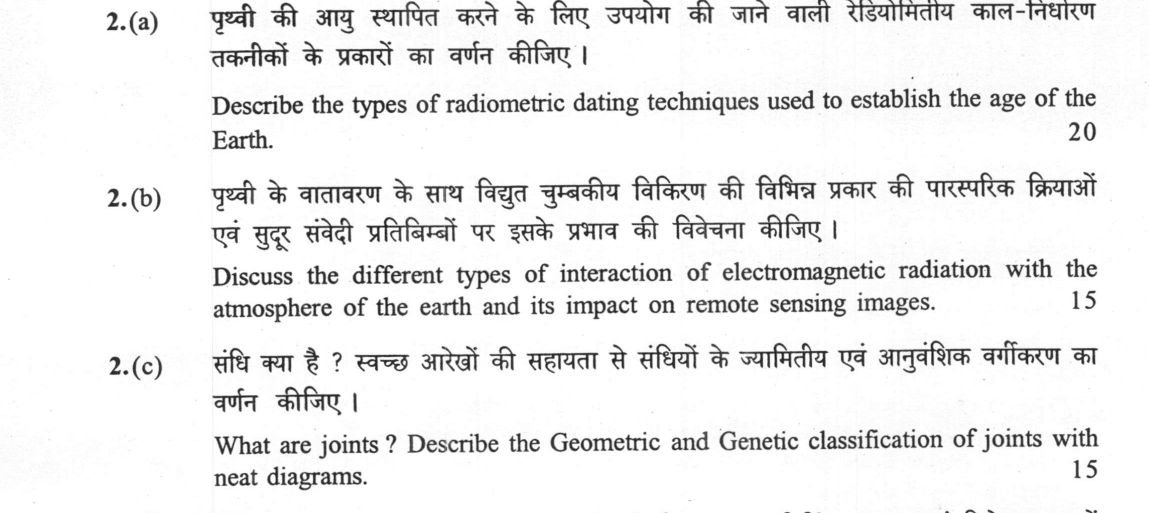
(a) Describe the types of radiometric dating techniques used to establish the age of the Earth. (20 marks) (b) Discuss the…
Describe the types of radiometric dating techniques used to establish the age of the Earth. 20 marks
Discuss the different types of interaction of electromagnetic radiation with the atmosphere of the earth and its impact on remote sensing images. 15 marks
What are joints ? Describe the Geometric and Genetic classification of joints with neat diagrams. 15 marks
हिंदी में प्रश्न पढ़ें
पृथ्वी की आयु स्थापित करने के लिए उपयोग की जाने वाली रेडियोमितीय काल-निर्धारण तकनीकों के प्रकारों का वर्णन कीजिए । (20 अंक)
पृथ्वी के वातावरण के साथ विद्युत चुंबकीय विकिरण की विभिन्न प्रकार की पारस्परिक क्रियाओं एवं सुदूर संवेदी प्रतिबिंबों पर इसके प्रभाव की विवेचना कीजिए । (15 अंक)
संधि क्या है ? स्वच्छ आरेखों की सहायता से संधियों के ज्यामितीय एवं आनुवंशिक वर्गीकरण का वर्णन कीजिए । (15 अंक)
Model answer
Written by UPSC Answer Check against this question's marking rubric, to the expected length. UPSC does not publish answers for Mains — this is one way to score well, not an official key.
(a) Radiometric dating of the Earth Radiometric dating establishes the Earth’s age by measuring parent–daughter isotope ratios in minerals that have remained closed systems. The best-constrained age is ~4.54 Ga, obtained mainly from U–Pb dating of meteorites such as Canyon Diablo and from terrestrial zircons. U–Pb is the most precise method because 238U decays to 206Pb (t1/2 = 4.468 Ga) and 235U to 207Pb (t1/2 = 0.704 Ga); concordia–discordia diagrams separate crystallization ages from later Pb loss. Zircon has a high closure temperature (>900°C) and retains radiogenic Pb and the U–Pb system, giving Jack Hills zircons ~4.404 Ga and Acasta gneiss ~4.03 Ga. Rb–Sr dating uses 87Rb → 87Sr (t1/2 = 48.8 Ga) in whole-rock and mineral isochrons; it is useful for metamorphic and igneous systems but can be reset at lower temperatures. Sm–Nd dating uses 147Sm → 143Nd (t1/2 = 106 Ga) and is important for model ages of mantle differentiation. K–Ar and 40Ar/39Ar methods date volcanic rocks, such as the Deccan traps near 66 Ma, by 40K → 40Ar; the total 40K half-life is 1.25 Ga, while the partial half-life for electron capture to 40Ar is ~11–12 Ga (branching ~10.7%). Their lower closure temperatures make them sensitive to Ar loss and metamorphic resetting. Limitations include open-system behaviour, daughter-product loss, and isotopic inheritance.
(b) Electromagnetic interaction with the atmosphere Remote sensing images are modified by scattering, absorption and refraction. Rayleigh scattering occurs when particles are much smaller than the wavelength (d ≪ λ) and varies as λ−4; it makes the sky blue and adds blue haze to Landsat/IRS optical images. Mie scattering occurs when particles are comparable to the wavelength (d ~ λ), is less wavelength selective, and produces forward-scattered haze from aerosols and dust, reducing contrast. Selective absorption by H2O, CO2 and O3 removes energy in specific bands, defining atmospheric windows such as 0.4–2.5 µm and 8–14 µm; the thermal window is especially useful for thermal infrared sensors. Atmospheric windows are the spectral intervals where transmission is high, so sensors are designed to use them. Refraction bends rays as they pass through layers of different density, causing geometric distortion that must be corrected by geometric/orthorectification, not radiometric calibration. Scattering and absorption require atmospheric correction to remove path radiance and restore surface reflectance. In Indian remote sensing practice, IRS and Landsat imagery over hazy or monsoon-affected regions often shows reduced contrast, blue bias, and degraded thermal band utility unless corrected.
(c) Joints: geometric and genetic classification Joints are fractures in rock with little or no displacement, unlike faults. Geometrically, joints are classified by strike and dip orientation. A neat block diagram would show systematic joint sets: parallel, regularly spaced planes with defined strike and dip, and non-systematic joints that are irregular and localized. Where two or more sets intersect, they form a joint system; conjugate pairs are common. Genetically, joints are classified by stress. Tension joints open perpendicular to the minimum principal stress (σ3); in granites they form sheet joints parallel to the surface, and in folded rocks they propagate as extensional fractures in the hinge or outer arc. Shear joints form by shear failure, usually as conjugate sets inclined at ~30° to σ1; a labelled diagram would show the two sets forming a V opening in the direction of extension. Release or hybrid joints form by a combination of tension and shear. Field criteria include plumose structure, hackles, striations, and joint-surface features that record fracture propagation. Joint spacing and orientation also control weathering, groundwater flow, and engineering site suitability. Applications include dating tectonic and igneous events, correcting satellite data for land-cover and hazard mapping, and using joint data in tunnels, dams, groundwater studies, and structural interpretation.
What "Describe" is asking you to do
Give a full, ordered account of the thing named — its parts, stages or mechanism — in the sequence in which it actually exists or occurs. Most describe questions come from the science optionals, where the marks sit in correct technical detail and, where the stem says so, a labelled diagram.
Structure that answers it
One-line identification of the subject → the parts or stages in their real order, each with its defining detail → labelled diagram where the subject is structural → closing line on function or significance
Where marks are lost
Loose general prose where the examiner is ticking named parts, correct terminology and their sequence; and in the General Studies papers, turning to evaluation before the description is finished.
How this answer will be evaluated
Approach
(a) describe: define > structure or process in order > labelled diagram > significance | (b) discuss: intro > 3-4 dimensions > example > balanced close | (c) describe: define > structure or process in order > labelled diagram > significance Full marks: Comprehensive, accurate, and well-structured answers with specific examples and diagrams.
Key points expected
- Definition of radiometric dating and half-life
- U-Pb dating of zircon (oldest minerals)
- Rb-Sr dating of meteorites (oldest solar system material)
- Mention of the 4.54 billion year age
- Definition of electromagnetic radiation (EMR)
- Explanation of scattering (Rayleigh/Mie)
- Explanation of absorption (by H2O, CO2, O3)
- Identification of atmospheric windows
Evaluation rubric
Each sub-part is marked on its own, against the marks and word limit printed on the paper.
- (a) Define radiometric dating and detail the specific isotopic systems used to date the Earth. 20 marks
describe— define → structure or process in order → labelled diagram → significance
Must cover
- Definition of radiometric dating and half-life
- U-Pb dating of zircon (oldest minerals)
- Rb-Sr dating of meteorites (oldest solar system material)
- Mention of the 4.54 billion year age
Loses marks
- Confusing relative dating with absolute dating
- Failing to mention the specific age of the Earth
- Generic description without naming specific isotopes
Earns more
- Explanation of parent-daughter isotope decay
- Reference to specific meteorites (e.g., Canyon Diablo)
- Mention of K-Ar or Ar-Ar dating
Extra mark
- Reference to specific Indian geological formations for dating
- Mention of specific laboratory techniques (e.g., mass spectrometry)
- (b) Explain how electromagnetic radiation interacts with the atmosphere and the resulting effects on remote sensing. 15 marks
discuss— intro → 3-4 dimensions → example → balanced close
Must cover
- Definition of electromagnetic radiation (EMR)
- Explanation of scattering (Rayleigh/Mie)
- Explanation of absorption (by H2O, CO2, O3)
- Identification of atmospheric windows
Loses marks
- Confusing scattering with absorption
- Failing to mention atmospheric windows
- Generic description without specific atmospheric gases
Earns more
- Diagram of EMR interaction with atmosphere
- Mention of specific wavelengths affected
- Link to specific remote sensing bands (e.g., SWIR, TIR)
Extra mark
- Mention of specific atmospheric correction algorithms
- Reference to specific Indian remote sensing missions (e.g., Cartosat)
- (c) Define joints and provide their geometric and genetic classification with diagrams. 15 marks
describe— define → structure or process in order → labelled diagram → significance
Must cover
- Definition of joints (fractures with no displacement)
- Geometric classification (Joints of bedding, cleavage, etc.)
- Genetic classification (Diastrophic, Unloading, etc.)
- Neat diagrams of joint types
Loses marks
- Confusing joints with faults
- Missing diagrams
- Failing to distinguish between geometric and genetic classification
Earns more
- Mention of specific joint sets (e.g., J1, J2)
- Explanation of joint spacing and orientation
- Link to specific geological structures (e.g., folds, faults)
Extra mark
- Reference to specific Indian geological formations with prominent joints
- Mention of specific joint-related economic deposits
Practice this exact question
Write your answer and it is marked point by point against the model answer above — what you covered, what you missed, what you got wrong.
Evaluate my answer →More from Geology 2023 Paper I
- Q1 Answer the following questions in about 150 words each: (a) Describe the tectonic feature…
- Q2 (a) Describe the types of radiometric dating techniques used to establish the age of the…
- Q3 (a) Elucidate the types of glacier and illustrate the erosional and depositional features…
- Q4 (a) What is a Shear Zone ? Describe the different Shear Sense indicators. (20 marks) (b)…
- Q5 Answer the following questions in about 150 words each: (a) Enumerate the different types…