Paper I — Q8
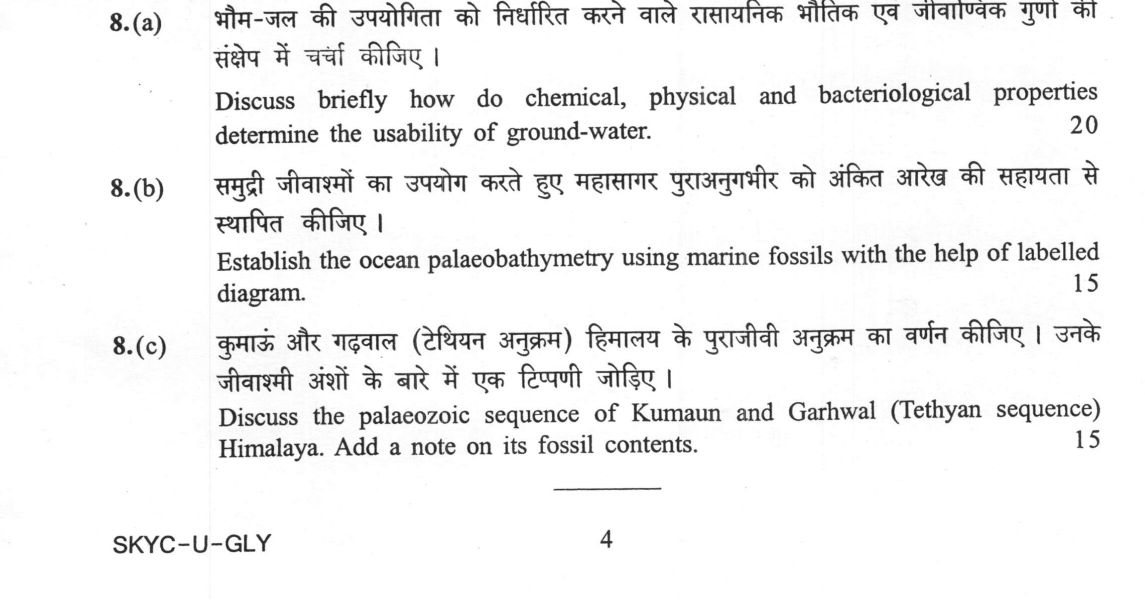
(a) Discuss briefly how do chemical, physical and bacteriological properties determine the usability of ground-water. (20…
Discuss briefly how do chemical, physical and bacteriological properties determine the usability of ground-water. 20 marks
Establish the ocean palaeobathymetry using marine fossils with the help of labelled diagram. 15 marks
Discuss the palaeozoic sequence of Kumaun and Garhwal (Tethyan sequence) Himalaya. Add a note on its fossil contents. 15 marks
हिंदी में प्रश्न पढ़ें
भौम-जल की उपयोगिता को निर्धारित करने वाले रासायनिक भौतिक एवं जीवाण्विक गुणों की संक्षेप में चर्चा कीजिए । (20 अंक)
समुद्री जीवाश्मों का उपयोग करते हुए महासागर पुराअनुगभीर को अंकित आरेख की सहायता से स्थापित कीजिए । (15 अंक)
कुमाऊं और गढ़वाल (टेथियन अनुक्रम) हिमालय के पुराजीवी अनुक्रम का वर्णन कीजिए । उनके जीवाश्मी अंशों के बारे में एक टिप्पणी जोड़िए । (15 अंक)
Model answer
Written by UPSC Answer Check against this question's marking rubric, to the expected length. UPSC does not publish answers for Mains — this is one way to score well, not an official key.
Ground-water usability Ground-water usability is controlled by chemical, physical and bacteriological properties. Chemically, TDS, hardness, fluoride, arsenic and nitrate determine potability. WHO/BIS permissible limits: TDS 500 mg/L desirable and 1000 mg/L permissible; hardness 200 mg/L as CaCO3 desirable and 300 mg/L permissible; fluoride 1.0 mg/L desirable and 1.5 mg/L permissible; arsenic 10 µg/L; nitrate 45 mg/L as NO3 in BIS and 50 mg/L in WHO. High TDS gives saline taste and irrigation restriction; high hardness causes scale; fluoride causes dental/skeletal fluorosis; arsenic causes dermatosis and cancer; nitrate causes methaemoglobinemia. Physically, turbidity, colour, temperature and electrical conductivity affect acceptability and chemical reactivity. Turbidity above 5 NTU is undesirable and can shield pathogens; colour from organics, iron or manganese indicates contamination; temperature influences microbial growth and taste; EC estimates salinity and, with sodium/chloride, controls irrigation suitability. Bacteriological safety is judged by total coliforms, faecal coliforms and E. coli; their presence indicates faecal pollution and risks of cholera, typhoid, dysentery and hepatitis A. In India, arsenic in the Bengal basin, fluoride in Rajasthan and salinity in coastal aquifers are major usability constraints. These parameters are interlinked: chemical contamination can compromise bacteriological safety, while temperature, turbidity and EC influence chemical reactivity; redox and pH control arsenic and fluoride mobility, and salinity may limit irrigation even when microbial tests pass. Usability is therefore classified by integrated assessment: drinking water must meet all potability limits; irrigation water is judged by EC, sodium, chloride and boron; industrial water requires low TDS, hardness, silica and iron.
Palaeobathymetry Ocean palaeobathymetry is established by comparing fossil assemblages with modern depth-zoned communities. A labelled diagram would show four modern-analogue seafloor bands: littoral (0–20 m), neritic (20–200 m), bathyal (200–2000 m) and abyssal (>2000 m), with the carbonate compensation depth marked at about 4000 m. The littoral band is labelled with algae, bivalves, crabs and shallow corals; the neritic band with corals, bivalves, gastropods, echinoids, ostracods and benthic foraminifera; the bathyal band with deep-water corals, bivalves, gastropods, echinoids, ostracods and benthic foraminifera; the abyssal band above the CCD with calcareous benthic foraminifera and below it with agglutinated foraminifera, radiolarians and siliceous sponges. Depth-sensitive fossils are key: benthic foraminifera and ostracods indicate shallow to deep marine settings, depth-zoned molluscs reflect oxygenation and substrate, and radiolarians indicate open-ocean or deep-water conditions. The absence of calcareous tests below the CCD is a critical constraint, because dissolution removes many shallow-marine indicators.
Kumaun–Garhwal Tethyan sequence The Kumaun–Garhwal Tethyan sequence is a Palaeozoic–Mesozoic foreland-basin succession lying north of the South Tethyan Detachment System (STDS), which separates it from the Higher Himalayan Crystallines; the Main Central Thrust (MCT) lies farther south between the Higher and Lesser Himalaya. Its Lower Palaeozoic part includes the Tal Formation quartz arenites, the Cambrian–Ordovician Garbyang Formation carbonates, and the Silurian–Devonian Batal Formation. The Garbyang contains Cambrian archaeocyathid bioherms, trilobites and early brachiopods, while the Batal records brachiopods, cephalopods and conodonts. The Upper Palaeozoic succession is represented by the Carboniferous Lipak Formation, followed by the Permian Fenestella Shale and Po Formation, which contain fusulinid foraminifera, brachiopods and other marine fossils. Permian–Triassic marine shales and limestones overlie these units. The fossil assemblages show predominantly Tethyan affinity, with some Gondwanan elements, indicating that the Kumaun–Garhwal block lay on the northern margin of Gondwana facing the Tethyan Ocean. The disappearance of Permian fusulinids at the P–T boundary records the end-Permian extinction, and the overlying Triassic marine succession marks post-extinction recovery.
The way forward is to treat ground-water quality, palaeodepth reconstruction and Himalayan stratigraphy as integrated Earth-system problems: modern water usability depends on aquifer geochemistry and contamination, palaeobathymetry depends on depth-sensitive fossils, and the Tethyan Himalaya records how oceanic and continental margins evolved under changing climate, tectonics and extinction.
What "Discuss" is asking you to do
Lay the issue out from more than one side — how it arose, what is claimed for it, what is held against it, and where it now stands. UPSC attaches discuss to broad topics with several live dimensions, so coverage of the dimensions earns more than the strength of your opinion.
Structure that answers it
Set the issue up → the case as it is made → the case against → the dimension both sides leave out → where the balance now lies
Where marks are lost
Listing facts with no thread between them, or arguing one side throughout and calling it a discussion.
How this answer will be evaluated
Approach
Framework: Geology Paper 1: Define > Process > Field/Petrographic Evidence > Indian Example. (a) discuss: intro > 3-4 dimensions > example > balanced close | (b) explain: definition/context > points in order > small example > short close | (c) discuss: intro > 3-4 dimensions > example > balanced close Full marks: Precise, specific, and well-linked to Indian examples with clear diagrams.
Key points expected
- Chemical: pH, hardness, nitrates, heavy metals
- Physical: turbidity, TDS, temperature, colour
- Bacteriological: coliforms, E. coli, pathogens
- Linkage to drinking/irrigation suitability
- Concept of depth zonation (bathymetry)
- Specific index fossils for depth (e.g., foraminifera, corals)
- Labelled diagram showing depth vs. fossil assemblage
- Link between fossil type and water depth
Evaluation rubric
Each sub-part is marked on its own, against the marks and word limit printed on the paper.
- (a) Link chemical, physical, and bacteriological parameters to groundwater usability. 20 marks
discuss— intro → 3-4 dimensions → example → balanced close
Must cover
- Chemical: pH, hardness, nitrates, heavy metals
- Physical: turbidity, TDS, temperature, colour
- Bacteriological: coliforms, E. coli, pathogens
- Linkage to drinking/irrigation suitability
Loses marks
- Generic list without linking to usability
- Missing one of the three property categories
Earns more
- Mention of IS 10500 or WHO standards
- Specific Indian example (e.g., Arsenic in West Bengal)
Extra mark
- Reference to specific Indian groundwater survey data
- (b) Establish ocean palaeobathymetry using marine fossils with a labelled diagram. 15 marks
explain— definition/context → points in order → small example → short close
Must cover
- Concept of depth zonation (bathymetry)
- Specific index fossils for depth (e.g., foraminifera, corals)
- Labelled diagram showing depth vs. fossil assemblage
- Link between fossil type and water depth
Loses marks
- No diagram or unlabelled diagram
- Generic description without specific fossil names
Earns more
- Mention of specific facies (e.g., neritic, bathyal)
- Reference to Indian shelf or basin examples
Extra mark
- Specific Indian basin example (e.g., Krishna-Godavari)
- (c) Discuss Palaeozoic sequence of Kumaun and Garhwal Himalaya and its fossil contents. 15 marks
discuss— intro → 3-4 dimensions → example → balanced close
Must cover
- Stratigraphic sequence of Kumaun and Garhwal
- Tethyan sequence context
- Specific fossil contents (e.g., trilobites, brachiopods)
- Link to Indian Himalayan geology
Loses marks
- Generic description without specific formations
- Missing fossil contents or Tethyan context
Earns more
- Mention of specific formations (e.g., Kumaun Group)
- Reference to specific fossil assemblages
Extra mark
- Specific Indian locality or type section
Practice this exact question
Write your answer and it is marked point by point against the model answer above — what you covered, what you missed, what you got wrong.
Evaluate my answer →More from Geology 2023 Paper I
- Q5 Answer the following questions in about 150 words each: (a) Enumerate the different types…
- Q6 (a) Elucidate an evolutionary trend of Equidae with Indian occurrence. (20 marks) (b) Dis…
- Q7 (a) Describe the stratigraphic sequence of Dharwar Supergroup and add a note on its econo…
- Q8 (a) Discuss briefly how do chemical, physical and bacteriological properties determine th…