Paper I — Q3
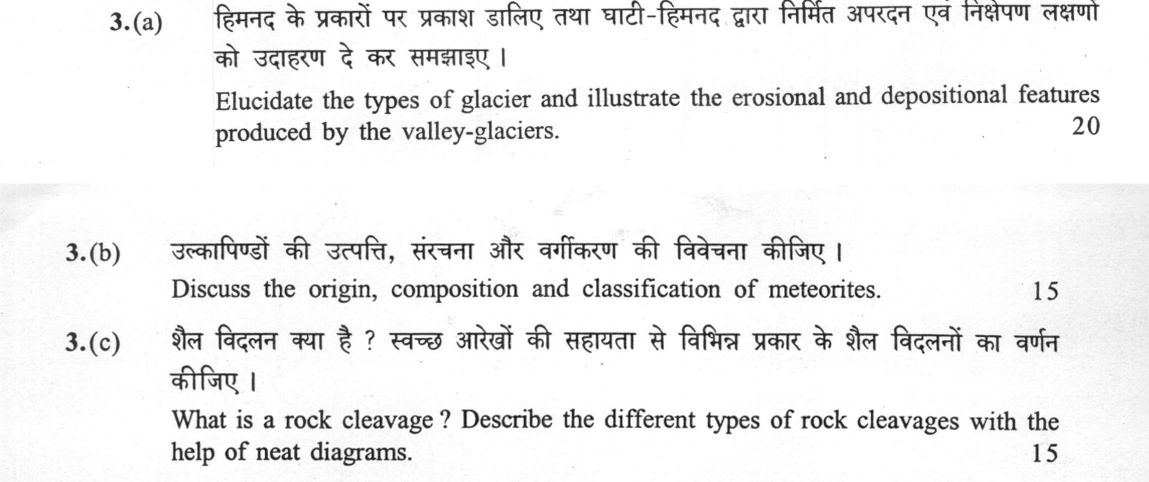
(a) Elucidate the types of glacier and illustrate the erosional and depositional features produced by the valley-glaciers. (20…
Elucidate the types of glacier and illustrate the erosional and depositional features produced by the valley-glaciers. 20 marks
Discuss the origin, composition and classification of meteorites. 15 marks
What is a rock cleavage ? Describe the different types of rock cleavages with the help of neat diagrams. 15 marks
हिंदी में प्रश्न पढ़ें
हिमनद के प्रकारों पर प्रकाश डालिए तथा घाटी-हिमनद द्वारा निर्मित अपरदन एवं निक्षेपण लक्षणों को उदाहरण दे कर समझाइए । (20 अंक)
उल्कापिंडों की उत्पत्ति, संरचना और वर्गीकरण की विवेचना कीजिए । (15 अंक)
शैल विदलन क्या है ? स्पष्ट आरेखों की सहायता से विभिन्न प्रकार के शैल विदलनों का वर्णन कीजिए । (15 अंक)
Model answer
Written by UPSC Answer Check against this question's marking rubric, to the expected length. UPSC does not publish answers for Mains — this is one way to score well, not an official key.
(a) Glaciers and their landforms Glaciers are perennial ice masses that flow under gravity. Valley or alpine glaciers are confined by valley walls and move down a valley; continental ice sheets cover vast areas and flow radially from accumulation centres, controlled more by ice thickness than topography; piedmont glaciers spread out at a valley mouth like a tongue; cirque glaciers occupy bowl-shaped headwalls. In a valley glacier, ice thickens, basal pressure rises, and it deforms internally and slides over bedrock. In an ice sheet, great thickness produces radial flow and subglacial meltwater lubrication, while valley glaciers are channelled and more responsive to local slope. This distinction matters because valley glaciers concentrate erosion in a channel, whereas ice sheets distribute it over a wide area. In India, Gangotri and Siachen illustrate valley glaciers, with cirques, arêtes and U-valleys in the Himalaya.
Erosion is by abrasion, where rock fragments frozen in the ice scratch the bed, and plucking, where meltwater in joints freezes and lifts blocks. Valley-glacier erosional features include cirques, arêtes, horns, U-shaped valleys, roche moutonnée, and striations. A cross-section diagram would show a cirque at the headwall, an arête between cirques, a horn at their intersection, a broad U-valley, a smoothed roche moutonnée, and striated bedrock. Depositional features are moraines, drumlins, eskers, and outwash plains. Terminal moraine marks the snout; lateral moraines lie on the sides; medial moraines form where tributary glaciers meet; ground moraine is buried under the ice. Drumlins are streamlined hills, eskers are sinuous meltwater-channel ridges, and outwash plains are sand and gravel deposited by meltwater beyond the glacier.
(b) Meteorites Meteorites are solid fragments that reach Earth’s surface from space. Most originate from asteroid-belt bodies disrupted by collisions; lunar and Martian meteorites are ejected by impacts. Cometary material can supply meteoroids, but it rarely survives to become meteorites. They are not simply space dust; they are fragments of primitive or differentiated bodies. Compositionally, meteorites are metallic, stony, or stony-iron. Metallic meteorites are mainly Fe-Ni alloys; stony meteorites are silicate-rich; stony-iron meteorites contain significant metal and silicates.
The main classes are chondrites, achondrites, irons, and stony-irons. Chondrites are primitive stony meteorites containing chondrules and often CAIs; they include carbonaceous and ordinary types and preserve early solar-nebula material. Achondrites are igneous, lack chondrules, and come from differentiated parent bodies, including lunar and Martian rocks. Iron meteorites are metallic and show Widmanstätten patterns, likely representing cores of differentiated asteroids. Stony-irons include pallasites, with olivine crystals in a metal matrix, and mesosiderites, which are impact breccias. Diagnosis uses mineralogy, texture, chemistry, and isotopes.
(c) Rock cleavage Rock cleavage is a planar fabric, often produced by aligned minerals or repeated fractures, that allows a rock to split along parallel surfaces. It is different from bedding: bedding records deposition, whereas cleavage records deformation and may cut across bedding. Cleavage is a structural fabric, not merely the cleavage of a single mineral, though mineral alignment controls it. It generally develops perpendicular to the direction of maximum shortening and parallel to the plane of intermediate and minimum stress.
Genetically, cleavage may be fracture or joint cleavage, formed by brittle opening and closing of parallel fractures, or slippage/flow cleavage, formed by ductile slip and mineral reorientation. Slaty cleavage is a low-grade slippage cleavage, fine and perfect. Phyllitic cleavage is intermediate, with a silky sheen and less perfect splitting. Schistose cleavage is higher grade, developed by platy minerals, and splits less readily. Gneissic banding is high-grade compositional layering, not a true cleavage. Diagrams should show: (i) joint cleavage as parallel fractures; (ii) slippage cleavage as aligned mica or chlorite layers; and (iii) a stress ellipse with cleavage perpendicular to maximum shortening.
Together, glaciers, meteorites, and cleavage reveal Earth’s surface processes, solar-system history, and deep deformation.
What "Elucidate" is asking you to do
Make a stated proposition plain and then prove it with instances. Elucidate stems almost always carry a claim or a named concept, and very often the words “with examples” or “with suitable diagrams” — the illustration is part of the directive, not decoration.
Structure that answers it
Plain-language statement of what the proposition means → the part that is obscure, resolved → first illustration → second illustration → why the proposition holds
Where marks are lost
Adding terminology; elucidate rewards removing it. The commoner loss is a clean explanation with no example, when the stem asked for examples.
How this answer will be evaluated
Approach
Framework: Geology, Paper 1. (a) explain: definition/context > points in order > small example > short close | (b) discuss: intro > 3-4 dimensions > example > balanced close | (c) describe: define > structure or process in order > labelled diagram > significance Full marks: Precise definitions, detailed mechanisms, named Indian examples, and clear diagrams.
Key points expected
- Types of glaciers (e.g., Alpine, Continental, Piedmont)
- Erosional features: U-shaped valley, Cirque, Arête, Horn
- Depositional features: Moraines, Drumlins, Erratics
- Neat diagrams illustrating erosional/depositional landforms
- Origin: Solar system formation, parent bodies
- Composition: Stony, Iron, Stony-iron
- Classification: Chondrites, Achondrites, Meteorites
- Balanced close on significance
Evaluation rubric
Each sub-part is marked on its own, against the marks and word limit printed on the paper.
- (a) Classify glaciers and detail valley-glacier landforms with diagrams. 20 marks
explain— definition/context → points in order → small example → short close
Must cover
- Types of glaciers (e.g., Alpine, Continental, Piedmont)
- Erosional features: U-shaped valley, Cirque, Arête, Horn
- Depositional features: Moraines, Drumlins, Erratics
- Neat diagrams illustrating erosional/depositional landforms
Loses marks
- Generic description with no Indian example
- Missing sections or diagrams
Earns more
- Mechanism of glacial erosion (plucking, abrasion)
- Mechanism of deposition (melting, subglacial flow)
- Distinction between terminal and lateral moraines
Extra mark
- Named Indian occurrence (e.g., Zanskar, Siachen, Gangotri)
- Stratigraphic age of glacial deposits
- (b) Explain meteorite origin, composition, and classification. 15 marks
discuss— intro → 3-4 dimensions → example → balanced close
Must cover
- Origin: Solar system formation, parent bodies
- Composition: Stony, Iron, Stony-iron
- Classification: Chondrites, Achondrites, Meteorites
- Balanced close on significance
Loses marks
- Generic description with no Indian example
- Missing sections or diagrams
Earns more
- Spectral analysis of meteorites
- Isotopic dating of meteorites
- Link to planetary differentiation
Extra mark
- Named Indian occurrence (e.g., Nakhla meteorite)
- Specific mineral composition (e.g., olivine, pyroxene)
- (c) Define rock cleavage and describe types with diagrams. 15 marks
describe— define → structure or process in order → labelled diagram → significance
Must cover
- Definition of rock cleavage
- Types: Foliation, Schistosity, Gneissic banding
- Labelled diagrams of each type
- Significance in structural geology
Loses marks
- Generic description with no Indian example
- Missing sections or diagrams
Earns more
- Mechanism of cleavage development
- Relationship to metamorphic grade
- Distinction between cleavage and bedding
Extra mark
- Named Indian occurrence (e.g., Aravalli schists)
- Stratigraphic age of cleaved rocks
Practice this exact question
Write your answer and it is marked point by point against the model answer above — what you covered, what you missed, what you got wrong.
Evaluate my answer →More from Geology 2023 Paper I
- Q1 Answer the following questions in about 150 words each: (a) Describe the tectonic feature…
- Q2 (a) Describe the types of radiometric dating techniques used to establish the age of the…
- Q3 (a) Elucidate the types of glacier and illustrate the erosional and depositional features…
- Q4 (a) What is a Shear Zone ? Describe the different Shear Sense indicators. (20 marks) (b)…
- Q5 Answer the following questions in about 150 words each: (a) Enumerate the different types…
- Q6 (a) Elucidate an evolutionary trend of Equidae with Indian occurrence. (20 marks) (b) Dis…