Paper I — Q4
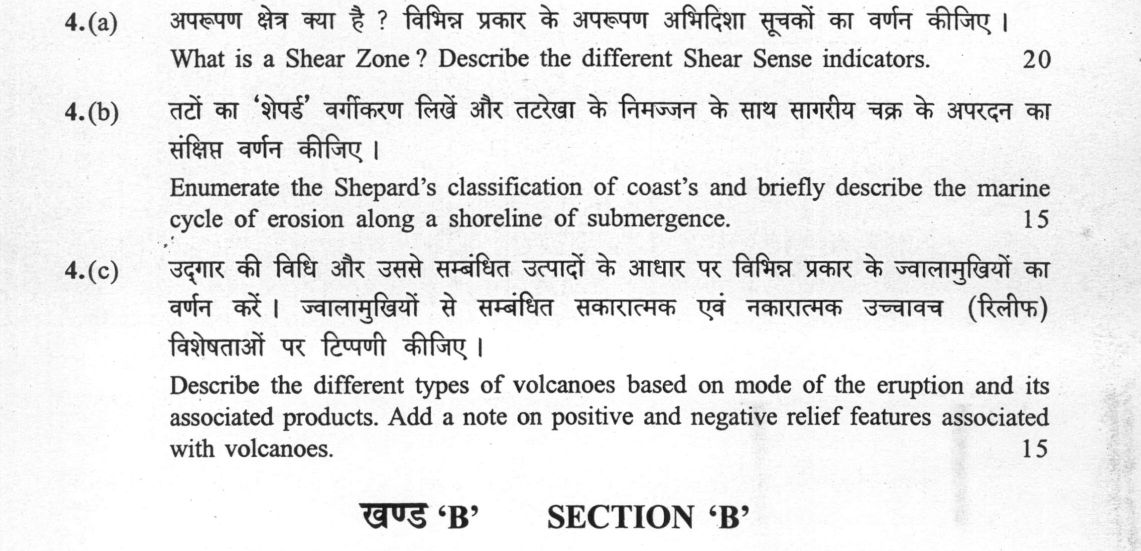
(a) What is a Shear Zone ? Describe the different Shear Sense indicators. (20 marks) (b) Enumerate the Shepard's classification…
What is a Shear Zone ? Describe the different Shear Sense indicators. 20 marks
Enumerate the Shepard's classification of coast's and briefly describe the marine cycle of erosion along a shoreline of submergence. 15 marks
Describe the different types of volcanoes based on mode of the eruption and its associated products. Add a note on positive and negative relief features associated with volcanoes. 15 marks
हिंदी में प्रश्न पढ़ें
अपरूपण क्षेत्र क्या है ? विभिन्न प्रकार के अपरूपण अभिदिशा सूचकों का वर्णन कीजिए । (20 अंक)
तटों का 'शेपर्ड' वर्गीकरण लिखें और तटरेखा के निमज्जन के साथ सागरीय चक्र के अपरदन का संक्षिप्त वर्णन कीजिए । (15 अंक)
उद्गार की विधि और उससे सम्बन्धित उत्पादों के आधार पर विभिन्न प्रकार के ज्वालामुखियों का वर्णन करें । ज्वालामुखियों से सम्बन्धित सकारात्मक एवं नकारात्मक उच्चावच (रिलीफ) विशेषताओं पर टिप्पणी कीजिए । (15 अंक)
Model answer
Written by UPSC Answer Check against this question's marking rubric, to the expected length. UPSC does not publish answers for Mains — this is one way to score well, not an official key.
(a) Shear zones and shear-sense indicators A shear zone is a tabular zone of concentrated strain, usually ductile to brittle-ductile, separating blocks that have moved past one another. It records non-coaxial flow, in which finite-strain axes rotate, and is described by kinematic vorticity, the ratio of rotational to irrotational components of flow. In simple shear, the shear plane, S-foliation and C-plane define the kinematic frame. Shear-sense indicators are asymmetric structures showing relative block motion. S-C fabric is key: S-foliation is oblique to the C-plane, and the acute angle opens toward the shear sense. C′ shear bands cut the S-C fabric at an acute angle and open in the same direction. Asymmetric porphyroclasts are important: δ-type porphyroclasts have tails crossing the median plane; they form when matrix recrystallization is high relative to clast rotation, so tails wrap and cross. σ-type porphyroclasts have tails that do not cross the median plane, reflecting faster rotation than recrystallization. Mica fish, rotated clasts and pressure shadows show asymmetric drag and tailing. Bookshelf gliding occurs when resistant clasts in foliated rock rotate and translate, giving asymmetric spacing and drag. Together these indicators reveal shear sense, strain magnitude and vorticity.
(b) Shepard’s coastal classification and marine erosion on a submergence shore Shepard’s classification is based on dominant formative control. Primary coasts are mainly inherited from terrestrial or tectonic processes—faulted, drowned river-valley, drowned lake or uplifted shoreline forms—and are further modified by lithology and tectonic setting. Secondary coasts are mainly produced by marine processes, especially wave erosion and deposition, giving wave-cut platforms, headlands, bays, beaches, spits, barrier islands and deltas. This primary–secondary scheme is often discussed with Johnson’s shoreline-position classes—submergence, emergence, neutral and compound—but those are not Shepard’s classes. A shoreline of submergence is one where sea level has risen relative to land, or land has subsided, drowning the old coast. The marine erosion cycle begins in youth, when wave attack on a low drowned surface produces cliffs, notches and wave-cut platforms. Erosion concentrates in weaker lithologies, forming headlands and bays; caves in cliffs may be breached to arches and collapse to stacks and stumps. In maturity the platform widens, bays deepen, and the irregular coast is simplified. In old age relief is reduced, the platform becomes a broad marine planation surface, and erosion is slow unless uplift or sea-level change renews the cycle. Indian examples include drowned river-valley coasts on the western and eastern margins and wave-cut platforms along the Konkan coast.
(c) Volcanoes by eruption mode and relief features Volcanoes are classified by eruption mode and products. Hawaiian eruptions are effusive, with low-viscosity basaltic lava, lava fountains, thin pāhoehoe and ʻaʻā flows, and cinder cones, building broad shields. Strombolian eruptions are moderately explosive, with gas-rich basaltic to andesitic magma producing scoria, cinders and short lava flows. Vulcanian eruptions involve more viscous, often andesitic magma, with ash-laden explosions, pumice, lapilli and blocky ejecta. Plinian eruptions are highly explosive, with viscous silicic magma, pumice, ash, pyroclastic flows and tall columns, producing stratovolcanoes and ash sheets. Pelean eruptions are characterised by dome growth, collapse and nuées ardentes/pyroclastic flows, with viscous domes, blocks and hot ash clouds. Positive relief features include volcanic cones, shield volcanoes, stratovolcanoes, lava domes and volcanic necks formed by erosion of surrounding rock. Negative relief features include craters, calderas formed by collapse, maars formed by phreatomagmatic explosion, volcanic depressions and fissure eruption zones that may leave linear vents or rift valleys. In India, Deccan Trap fissure volcanism and Barren Island’s stratovolcanic cone illustrate these forms. Thus, shear zones, coasts and volcanoes are ordered records of strain, shoreline evolution and magmatic style, expressed through diagnostic structures and landforms.
What "Describe" is asking you to do
Give a full, ordered account of the thing named — its parts, stages or mechanism — in the sequence in which it actually exists or occurs. Most describe questions come from the science optionals, where the marks sit in correct technical detail and, where the stem says so, a labelled diagram.
Structure that answers it
One-line identification of the subject → the parts or stages in their real order, each with its defining detail → labelled diagram where the subject is structural → closing line on function or significance
Where marks are lost
Loose general prose where the examiner is ticking named parts, correct terminology and their sequence; and in the General Studies papers, turning to evaluation before the description is finished.
How this answer will be evaluated
Approach
Framework: Geology, Paper 1. (a) describe: define > structure or process in order > labelled diagram > significance | (b) enumerate: list the items in order > one line each > no commentary | (c) describe: define > structure or process in order > labelled diagram > significance Full marks: Precise definitions, labeled diagrams, specific Indian examples, clear causal chains.
Key points expected
- Definition of shear zone as a ductile deformation structure
- Description of asymmetric indicators (S-C fabric, sigma clasts)
- Description of symmetric indicators (porphyroclasts, boudins)
- Labeled sketches of at least two indicators
- List of Shepard's classification (emergent, submergent, etc.)
- Description of marine cycle of erosion stages
- Specific features of submergent shoreline (drowned valleys)
- Mention of rias or fjords as examples
Evaluation rubric
Each sub-part is marked on its own, against the marks and word limit printed on the paper.
- (a) Define shear zone and detail shear sense indicators with diagrams. 20 marks
describe— define → structure or process in order → labelled diagram → significance
Must cover
- Definition of shear zone as a ductile deformation structure
- Description of asymmetric indicators (S-C fabric, sigma clasts)
- Description of symmetric indicators (porphyroclasts, boudins)
- Labeled sketches of at least two indicators
Loses marks
- Confusing shear zones with brittle faults
- Missing diagrams for shear sense indicators
- Generic description without specific structural terms
Earns more
- Mention of kinematic vorticity number
- Reference to specific Indian shear zones (e.g., Narmada-Son)
- Distinction between simple and pure shear
- Discussion of strain partitioning
Extra mark
- Reference to specific mineral assemblages in shear zones
- Mention of specific Indian craton examples
- (b) List Shepard's coastal classification and describe marine erosion cycle on submergent coasts. 15 marks
enumerate— list the items in order → one line each → no commentary
Must cover
- List of Shepard's classification (emergent, submergent, etc.)
- Description of marine cycle of erosion stages
- Specific features of submergent shoreline (drowned valleys)
- Mention of rias or fjords as examples
Loses marks
- Confusing emergent and submergent coast features
- Missing the specific cycle of erosion stages
- Generic description without named coastal types
Earns more
- Distinction between wave-cut and wave-built features
- Reference to specific Indian submergent coasts (e.g., Konkan)
- Mention of transgression and regression
- Description of marine terraces
Extra mark
- Reference to specific Indian coastal formations
- Mention of specific geological ages of coastal features
- (c) Describe volcano types by eruption mode and products; note relief features. 15 marks
describe— define → structure or process in order → labelled diagram → significance
Must cover
- Classification of volcanoes by eruption mode (Hawaiian, Strombolian, etc.)
- Description of associated volcanic products (lava, pyroclasts)
- Identification of positive relief features (cones, domes)
- Identification of negative relief features (calderas, craters)
Loses marks
- Confusing different eruption modes
- Missing the distinction between positive and negative relief
- Generic description without specific volcanic products
Earns more
- Reference to specific Indian volcanoes (e.g., Deccan Traps)
- Mention of specific lava types (basaltic, andesitic)
- Description of specific eruption styles (effusive vs explosive)
- Reference to specific volcanic landforms
Extra mark
- Reference to specific Indian volcanic provinces
- Mention of specific geological ages of volcanic activity
Practice this exact question
Write your answer and it is marked point by point against the model answer above — what you covered, what you missed, what you got wrong.
Evaluate my answer →More from Geology 2023 Paper I
- Q1 Answer the following questions in about 150 words each: (a) Describe the tectonic feature…
- Q2 (a) Describe the types of radiometric dating techniques used to establish the age of the…
- Q3 (a) Elucidate the types of glacier and illustrate the erosional and depositional features…
- Q4 (a) What is a Shear Zone ? Describe the different Shear Sense indicators. (20 marks) (b)…
- Q5 Answer the following questions in about 150 words each: (a) Enumerate the different types…
- Q6 (a) Elucidate an evolutionary trend of Equidae with Indian occurrence. (20 marks) (b) Dis…
- Q7 (a) Describe the stratigraphic sequence of Dharwar Supergroup and add a note on its econo…